
An inbound call center is the team and phone system that answer calls customers start, for questions, orders and support. Calls pass a greeting or IVR, wait in a queue and reach an agent through routing. Dograh, the open-source AI voice agent platform, answers the routine calls and transfers the rest to your team.
Key Takeaways
- Your phone system keeps the queue, and routing decides who answers each call.
- Let AI answer routine questions and bookings, and keep a path to a person.
- Add a Transfer Call tool to the Dograh agent so callers can reach staff.
Every inbound call takes the same short trip, from the dialed number to the person or system that answers it. We follow that trip through queues and routing, cover the measures a manager reads and which calls AI should answer, then show how Dograh answers and transfers them.
The path of an inbound call
An inbound call passes through a handful of stops, and each one is a place where callers wait or get lost. The carrier delivers the call to the number the customer dialed. A greeting or an interactive voice response (IVR) menu asks what the call is about, either by keypad or by speech. Then the call goes to a queue.
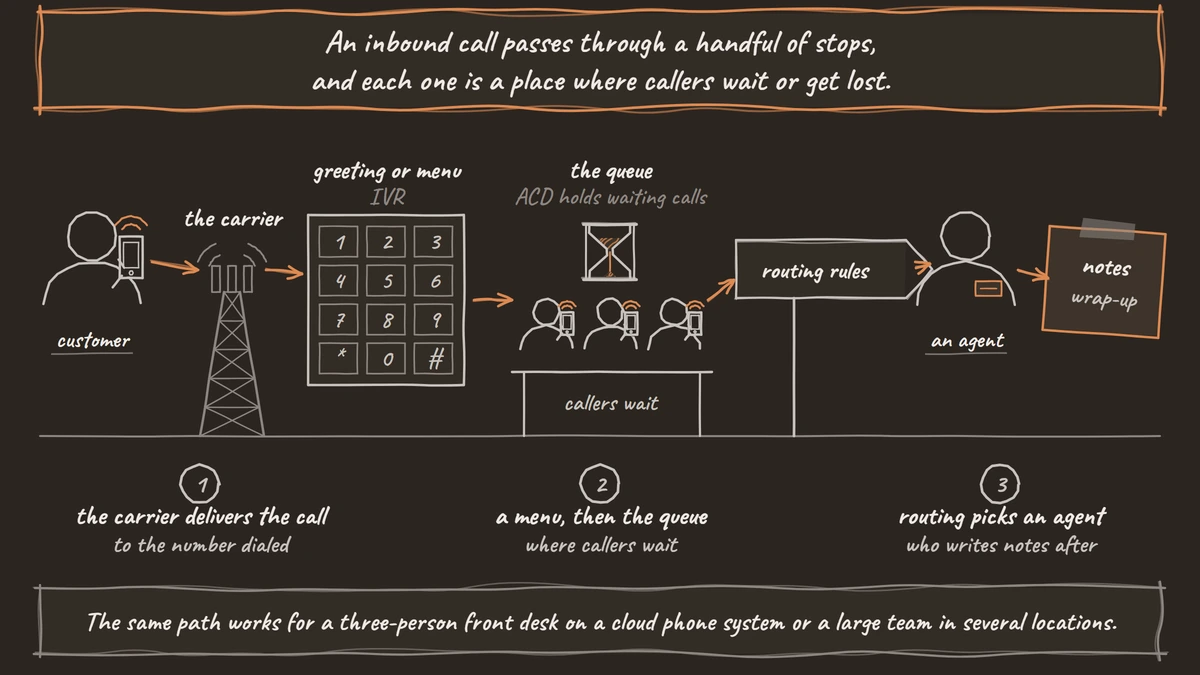
The queue belongs to the automatic call distributor (ACD), the part of the phone system that holds waiting calls and hands each one to an agent. Routing rules decide which agent or team gets it. The agent takes the call, solves what they can, and spends a minute or two afterwards writing notes and setting any follow-up, which is called wrap-up or after-call work.
The same path works for a three-person front desk on a cloud phone system or a large team in several locations. An outbound team runs the other way, choosing when to call from a list, as our guide to the outbound call center explains. Many businesses run both, and the inbound side is usually the one customers judge them on.
Queues, service level and speed of answer
A queue is where demand meets the team, so its numbers tell you whether you have enough people at the right hours. Good queues tell callers roughly how long they will wait, and many offer a callback so the caller can end the call and keep their place.
Service level is the share of calls answered within a set number of seconds. The long-standing convention, as SQM Group's definition puts it, is 80% of calls answered within 20 seconds. It is a target a business picks, not a law, and a clinic or a utility may choose different seconds for different lines.
Average speed of answer (ASA) is the mean wait before a person picks up, and abandonment is the share of callers who give up before that. In MaxContact's 2025-26 UK survey of 300 contact center leaders, reported by IT Brief, speed of answer averaged 17.4 seconds and abandonment 4.1%, down from 4.4% the year before. MaxContact sells contact center software, and these are UK figures, so treat them as one reference point.
How routing decides who answers
Routing matches each call to the person or system best placed to finish it. The simplest rule sends every call to the next free agent. Most teams add more than that.
Skills-based routing sends a call to agents with the right skill, such as a language, a product or a license, based on the menu choice or what the caller said. Priority routing moves some callers up the queue, such as a customer with an open outage or a high-value account. Data-directed routing looks up the caller's number first and sends a known customer to their usual team. Time-of-day rules send calls after hours to an answering service, voicemail or an AI agent.
Routing by speech is replacing long keypad menus. The caller says what they need in their own words, and the system picks the queue from that, which saves the caller from guessing which number matches "billing questions about a recent order". It only works when the words map cleanly to a team, so the categories still need to be few and clear.
Overflow rules decide what happens when a queue gets too long, such as moving calls to a second team or a voice agent. Our post on AI call routing shows how to build these rules inside a voice agent, step by step.

Open Source Alternative to Vapi / Retell
Self-hosted voice agent platform — no per-minute fees
dograh-hq/dograh
Star on GitHub
The measures an inbound manager reads
An inbound manager reads speed first, then whether the caller's problem was solved. In CMP Research's 2026-2027 report, 80% of customer contact leaders rated customer satisfaction important or highly important, 71% said the same of first contact resolution, and 68% of self-service resolution rate. Our guide to first call resolution covers how to count it.
Average handle time, occupancy and cost per call fill out the picture. They are useful for staffing, and misleading when they become goals on their own, because a team can shorten calls by solving less.
Staffing comes straight from these numbers. Calls expected in each half hour, multiplied by the average minutes each one takes, give the workload, and the service level target decides how many people must be free to meet it. A team that misses its target every Monday morning usually needs a different schedule before it needs more people, and that is also the hour where an AI agent taking routine calls helps most.
Wait time can also improve faster than the experience behind it. Social Security reported that its National 800 Number answered 65% more calls in fiscal 2025 than in 2024, and the average wait fell from 30 minutes in January 2025 to 7 minutes in September 2025. That is a real gain on a very large line. It still says nothing on its own about whether each caller's problem got solved, which is why speed and resolution belong on the same report.
Which calls AI answers and which go to people
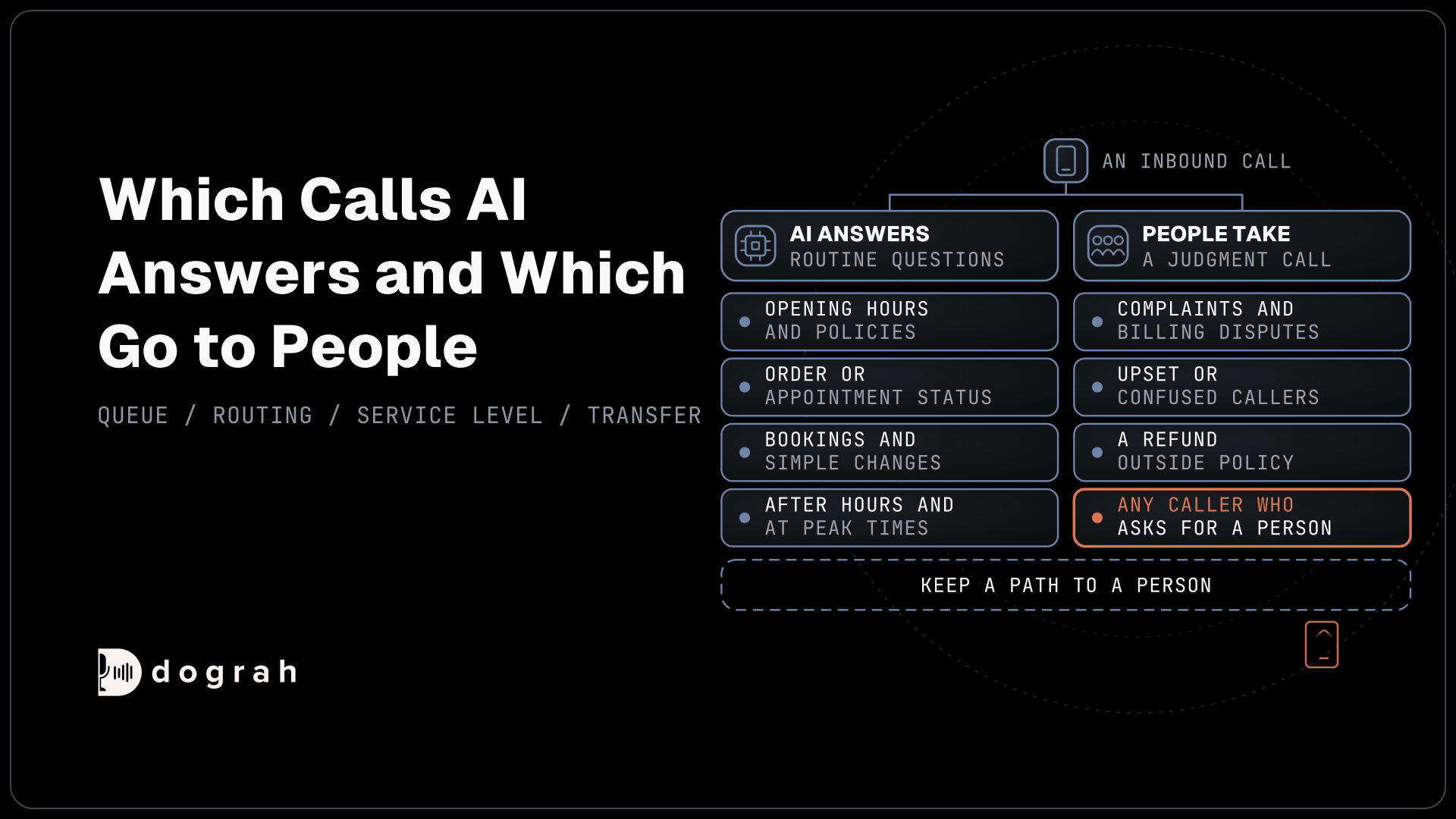
AI should answer the calls where the answer lives in a document or a system and the caller wants it quickly. Opening hours, policies, order or appointment status, bookings and simple changes fit well. So do calls after hours and at peak times, when the alternative is a long wait or voicemail. Many teams start there, because an after-hours caller who gets an answer is better off than one who leaves a message nobody reads until morning.
People should take complaints, billing disputes, upset or confused callers, and anything with a judgment call, such as a refund outside policy. They should also take any caller who asks for a person. Callers say so plainly. Gartner found that 87% of customers say companies using generative AI for service must give them access to a human agent, as reported by destinationCRM.
The split is rarely clean on day one. A safe start is an AI agent that answers a short list of call types, checks who the caller is before reading any account details, and hands everything else to the team with notes. Our post on AI voice agents for inbound customer support covers answer sources, caller checks and recording consent for that build.
Join the Dograh Community
Dograh is an OSS alternative to Vapi. Join our Slack community for queries, releases, best practices & community interactions.
Answering, transferring and hosting with Dograh
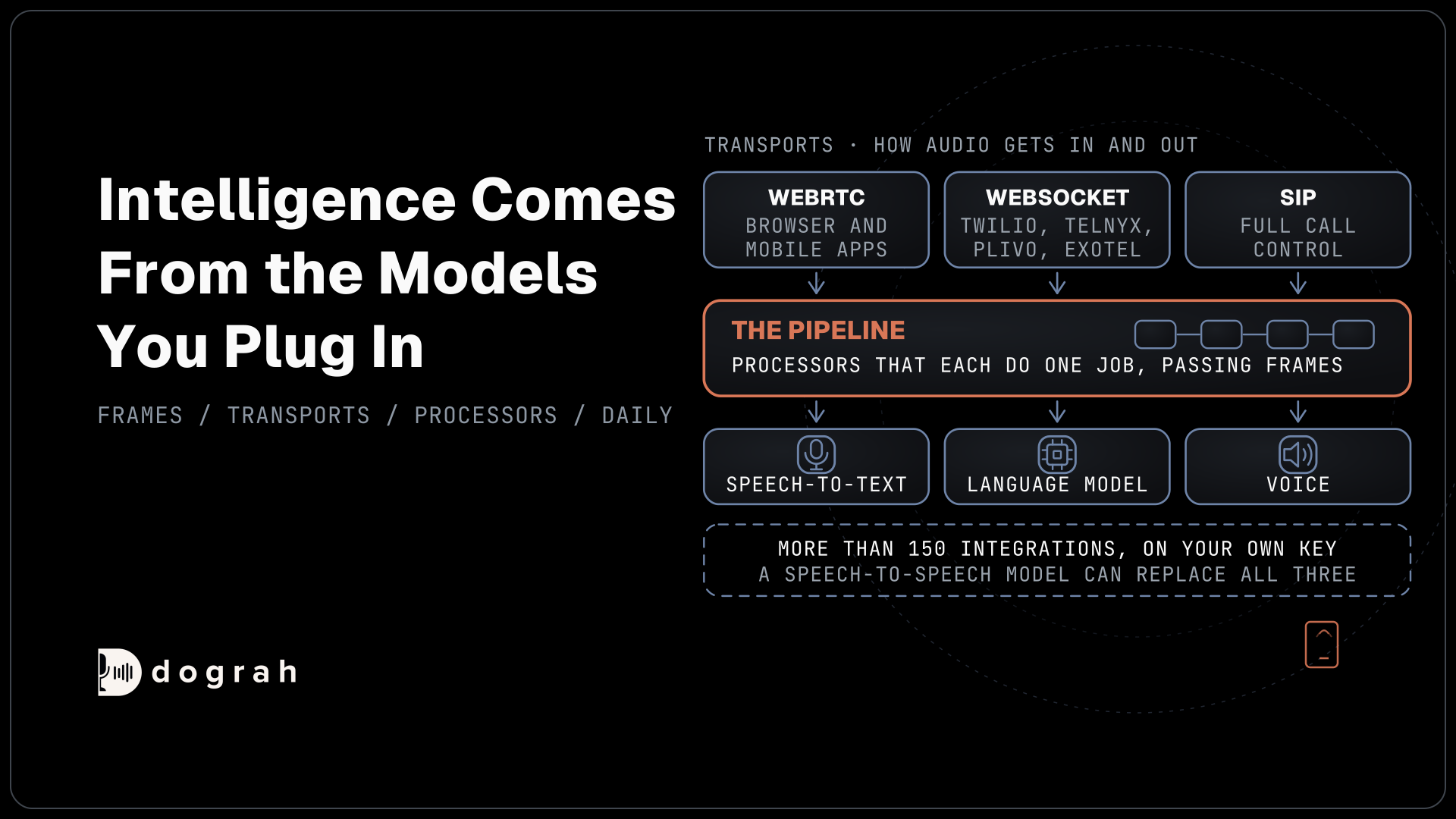
In Dograh, each phone number has an Inbound workflow setting that points its calls at an agent, and several numbers can point at the same one. You bring the carrier and the numbers. Connecting a number means adding the provider under Telephony, then adding the number and picking its inbound workflow. Pre-Call Data Fetch can look up the caller by number before the greeting plays, and the agent answers from Knowledge Base files and from your own systems through HTTP API tools. Inside the agent, routing runs on pathways between its steps, and Transfer To Agent hands a call to another agent, such as one built for billing.
When a call needs a person, Transfer Call works on Twilio, Telnyx, Plivo, Cloudonix and Asterisk ARI. Dograh calls the destination first and connects the caller only when someone answers. If nobody picks up within the timeout, 30 seconds by default, the agent hears that and the call goes on with the agent. A voicemail that picks up counts as answered, so turn voicemail off on the transfer number or set it to pick up later than the Transfer Timeout. No summary goes across by default, so have an HTTP API tool write the caller's details to your system before the transfer. Test every transfer over a real phone call before callers depend on it.
Your phone system keeps the queue. Dograh answers as many calls at once as its concurrency limit allows, 10 by default on a self-hosted install and on Dograh Cloud pay as you go, and every inbound and outbound call in the organization shares that limit. A call that arrives over the limit is turned away at once with a short spoken message that the service is unavailable, so set the carrier's or PBX's overflow rule to send extra calls elsewhere before they reach the agent, as our post on overflow call handling covers.
Dograh is open source under the BSD 2-Clause license, and you can self-host it with Docker Compose. Running it yourself means no per-minute platform fee. Servers, model keys and phone minutes still cost money, and your team looks after the database and upgrades, with support from the open-source community and custom SLAs on Enterprise. If you would rather not run it, Dograh Cloud hosts it for a 1¢-a-minute platform fee, with models and phone minutes on top.
Glossary
- Automatic call distributor (ACD)
- The part of a phone system that holds waiting calls in a queue and hands each one to an available agent according to routing rules.
- Service level
- The share of calls answered within a set number of seconds. The long-standing convention is 80% within 20 seconds, but each business picks its own.
- Skills-based routing
- Routing that sends a call to agents with the skill it needs, such as a language or a product, based on the menu choice or what the caller said.
- Inbound workflow
- The setting on a Dograh phone number that decides which agent answers its calls. Several numbers can point at the same agent.