
AI call center QA software reads every call transcript against a scorecard and flags calls a person should review, while a human team can only listen to a small share. It can misread tone, so people check the grader. Dograh, the open-source AI voice agent platform, scores its own agents' calls with a QA node.
Key Takeaways
- Let AI score rule checks on every call, and send tone and judgment to people.
- Check the AI grader against a person's scores before you trust it.
- Add Dograh's QA node, and it scores every eligible call by default.
A QA analyst can listen to a few calls per agent, and AI can read every one. We cover what to score, where AI grading goes wrong and how people keep it honest, then show Dograh's QA step, which scores its own agent calls and not human agents' calls.
Why a small human sample misses things
Human QA listens to a small slice of calls, so most problems never reach a reviewer. Vendors that sell AI QA put manual review at a few percent of calls. The exact share varies, but the shape does not change. One analyst can score a handful of calls per agent each month, and everything else goes unheard.
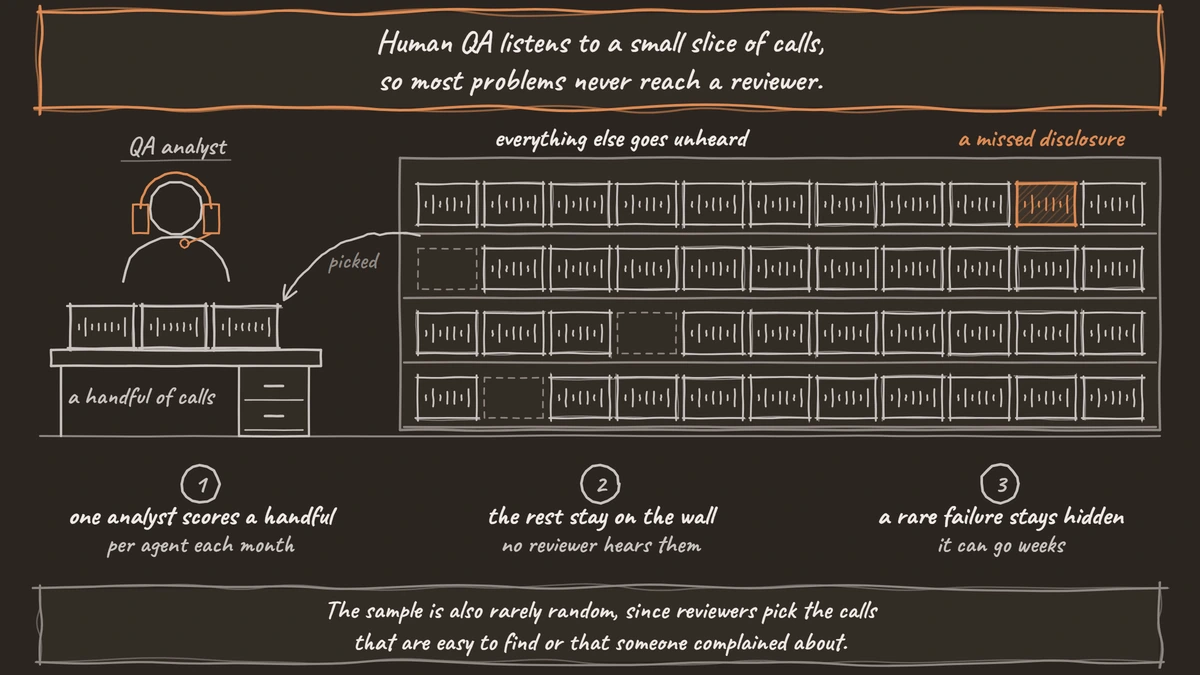
A small sample is fine for coaching style, because a person's habits show up on most calls. It is poor at catching rare failures. A missed disclosure on one call in a hundred can go weeks without landing in the sample, and by then it has happened to hundreds of customers. The sample is also rarely random, since reviewers pick the calls that are easy to find or that someone complained about.
Quality work is getting more attention for a reason. In CMP Research's 2026-2027 report, upgrading quality assurance moved up two places in contact leaders' priorities, which the report links to harder front-line work as simpler contacts are automated. Automated calls need the same review. The COPC CX Standard, Release 8.0, tells operations to "apply the same performance standards to every interaction, whether handled by a person or a bot".
What an AI scorecard should check
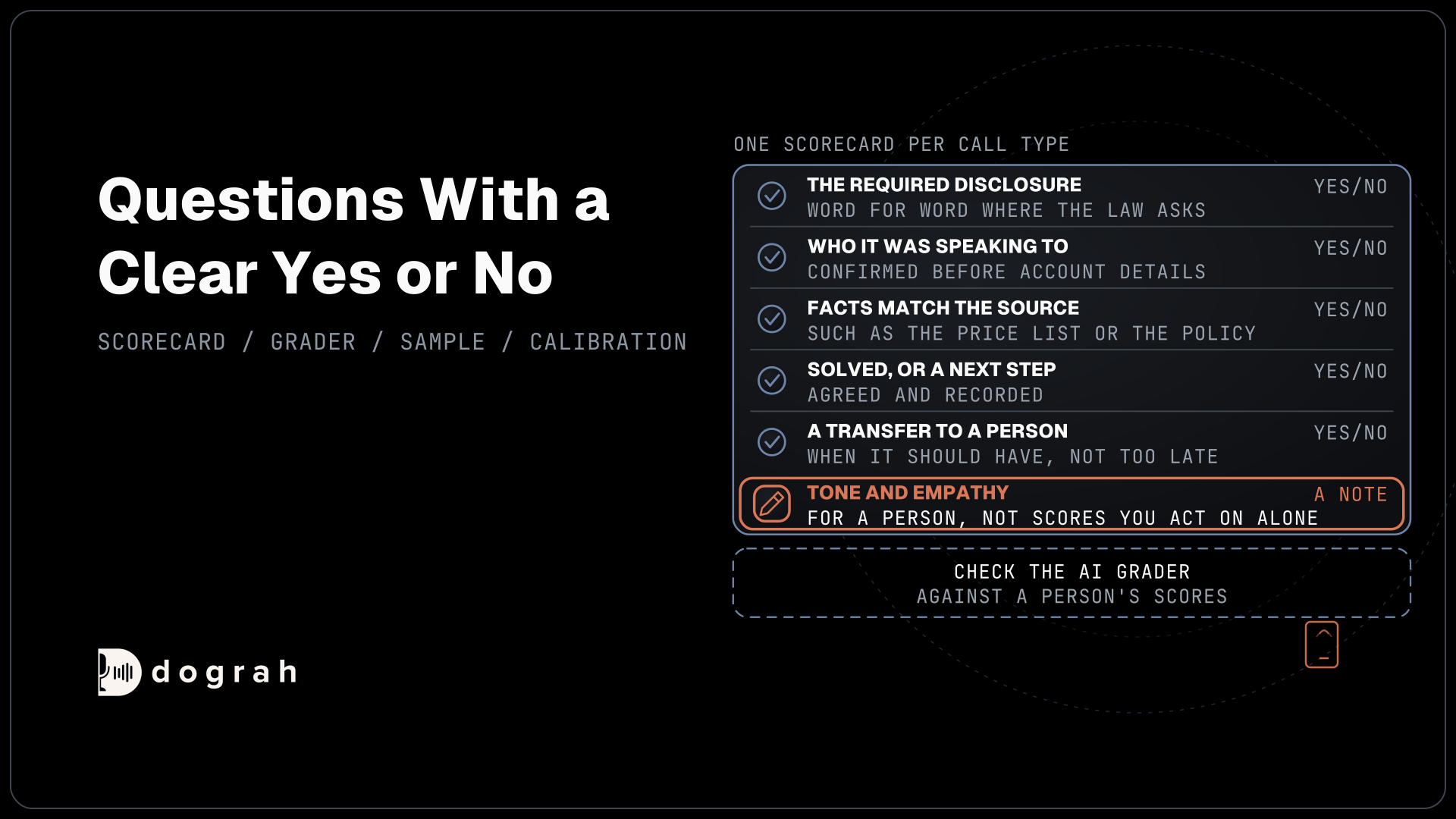
A good AI scorecard asks questions with a clear yes or no in the transcript. It checks that the agent gave the required disclosure, word for word where the law asks for it, and confirmed who it was speaking to before reading account details. It checks that the facts the agent stated match the source, such as the price list or the policy, and that the issue was solved or a next step was agreed and recorded.
Transfers deserve their own line. Check whether the call went to a person when it should have, such as when the caller asked, and whether it went too late, after several rounds of the agent failing. A count of transfers alone tells you little. Resolution is the other line worth scoring on every call, and our guide to first call resolution shows how to define it so the score means something.
Tone and empathy belong on the scorecard as notes for a person, not as scores you act on alone. Aircall, which sells AI QA, describes AI scoring as reliable on binary, rule-based questions and weak on subjective ones such as empathy. Vendors such as Level AI say they score 100% of calls, chats and bot conversations, open-ended items included. The coverage is real, but a high empathy score from a model is an opinion, and it should be treated as one.
Write one scorecard per call type. A billing line and a booking line fail in different ways, and our post on call QA and scoring per client program shows how a contact center keeps a separate scorecard for each program it runs.
Where AI scoring goes wrong
An AI grader is a language model reading text, so it carries the model's habits into every score. A February 2026 study tested 18 models on 3,000 real contact center transcripts. Judgments flipped in 5.4% to 13.0% of cases, a measure the authors call the counterfactual flip rate, when details that should not matter, such as the agent's identity, the call context or speaking style, were changed. Telling the grader about past performance pushed it up to 16.4%, and fairness instructions in the prompt helped only a little. The authors work for a company that sells contact center QA.
Vague criteria cause most of the noise in practice. "Was the agent helpful?" gets a different answer each time. "Did the agent offer both appointment times before ending the call?" gets the same answer every time.
The transcript is a second source of error. Most phone calls reach the system as narrowband audio, so names, numbers and accents are transcribed less accurately than on a clean recording, and the grader then scores words the caller never said. Long calls can also look thorough to a model when they were really slow. Each of these is a reason to keep a person reading a share of the graded calls.
Scorecards can also be gamed. When a team learns that the grader looks for a phrase, such as "is there anything else I can help with", the phrase appears on every call whether or not the issue was solved. Score the outcome the phrase was meant to protect, and rotate a few spot checks onto calls that passed.

Open Source Alternative to Vapi / Retell
Self-hosted voice agent platform — no per-minute fees
dograh-hq/dograh
Star on GitHub
Keeping people in the review loop
The review loop is what turns an AI score into something a team can act on. Start with calibration. Aircall suggests that an experienced analyst score the same 20 to 30 calls by hand before the team trusts the AI's results, then rewrites every question where the two disagree.
Keep calibrating after launch. Each week, a person double-scores a small random set of calls the AI already graded, including some it scored highly, since a missed failure hides among the passes. Give agents, or the team that owns an AI agent, a way to appeal a score, and track how often appeals win.
Treat the scoring prompt like code. Write down every change and the date, and re-run the calibration set after each one, because a reworded question can move scores across the board. When scores jump, check the prompt history before you blame the agents.
Close the loop with changes. Group the flagged calls by tag or failed question each week, pick the largest group, and fix the cause, such as a script line or a missing answer in the knowledge base. Then watch the same question's score the following week. A QA program that produces scores and no changes costs model time and teaches nobody anything.
Every call or a sample
Reading every call is the case against a human sample, and it is where most teams should start. Score 100% of calls in the first weeks after launch, for a week after any change to the flow, and for as long as a script carries a disclosure the law requires.
Once a flow is stable, many teams lower the share. The reviews themselves cost model time, and the real limit is people reading the flagged calls. Our post on automated QA for voice agents works through why a random 5-10% sample catches most problems within a week at steady volume, so we will not repeat the math here.
Join the Dograh Community
Dograh is an OSS alternative to Vapi. Join our Slack community for queries, releases, best practices & community interactions.
QA for Dograh agent calls, and where results live
Dograh's QA node reviews each call its own agents handle after the call ends, with a System Prompt you write. The default prompt returns tags such as DEAD_AIR and USER_FRUSTRATED, a 1 to 10 score, a sentiment and a short summary, and you can replace it with your own scorecard and the JSON fields you want back. The node reviews the transcript node by node, so each step of the call gets its own result, often called per-step scoring, and the output shows in the QA Results card on the run's detail page.
The defaults match the approach of scoring everything. Sample Rate (%) starts at 100, and a lower value picks calls at random. Minimum Call Duration (seconds) skips calls under 15 seconds, and Include Voicemail Calls is off, so the node reviews every eligible call. Use Workflow's LLM is on by default, so the review runs on the agent's own model unless you pick another. QA also runs on test calls from the editor, before you publish. Calibrate the prompt on 20 to 30 calls you have read yourself before you rely on its scores.
The scope is your own agents' calls. The node reads the events of calls a Dograh agent handled, so it does not score human agents' calls or recordings from another phone system. Teams that grade a human floor keep a QA suite for that part, as our comparison of Dograh vs Observe.AI sets out. A Webhook node can send each call's QA fields to your own dashboard or review queue.
Where the results live depends on where Dograh runs. When you host it yourself, the transcripts and QA results are stored on your servers, while a hosted grading model still receives each transcript it scores. The QA step's own provider list covers OpenAI, Azure OpenAI, OpenRouter, Google Gemini and Anthropic, so to grade with a self-hosted or other OpenAI-compatible model, keep Use Workflow's LLM on and run the agent on that model. Running it yourself means no per-minute platform fee, though servers, model keys and phone minutes still cost money, and your team looks after the database and upgrades. Dograh Cloud runs the platform for you at a 1¢-a-minute platform fee, with model and phone usage on top.
Glossary
- Calibration
- Scoring the same calls by hand and by AI, then rewriting the questions where they disagree, so the AI grader matches what the team means.
- Counterfactual flip rate
- How often a grader's judgment changes when a detail that should not matter, such as the agent's name or speaking style, is changed in the transcript.
- Sample rate
- The share of calls the QA step reviews. At 100 every eligible call is scored, and lower values pick calls at random.
- Per-step scoring
- Grading each step of a voice agent's call separately, so a team can see which part of the flow went wrong instead of one score for the whole call.