
Choosing Dograh vs Observe.AI comes down to which calls you need covered. Observe.AI is a closed contact center suite that grades and coaches human agents and also sells Voice AI agents. For teams that want to own their automated calls, Dograh is the open-source option, self-hosted or on Dograh Cloud, and it can run beside Observe.AI.
Key Takeaways
- Observe.AI says it evaluates every conversation, AI and human, in one suite.
- Dograh covers automated calls only, in open code, with Transfer Call and step-by-step QA.
- Observe.AI stores call data in the US, Canada, the EU or Australia.
Observe.AI is a contact center AI suite that grades and coaches human agents and also sells automated voice agents. Dograh is an open-source AI voice agent platform for the automated calls alone. This post compares building, handoffs, QA, data and cost, then we talk about when each one fits.
Dograh vs Observe.AI at a glance
The two products overlap on automated calls and part ways on everything around human agents. Each row asks both the same question.
| Row | Observe.AI | Dograh |
|---|---|---|
| What it is | A contact center AI suite for AI and human conversations | An open-source AI voice agent platform for automated calls |
| Code | Closed and hosted | Open source under BSD 2-Clause |
| Automated calls | Voice AI, inbound and outbound, with 12+ action types and voicemail detection | Agents built in the Agent Builder or on the canvas, with HTTP API and MCP tools, Campaigns and voicemail handling |
| Human agents | Companion Agent live assist, Performance coaching and QA | Out of scope. Transfer Call hands callers to your people |
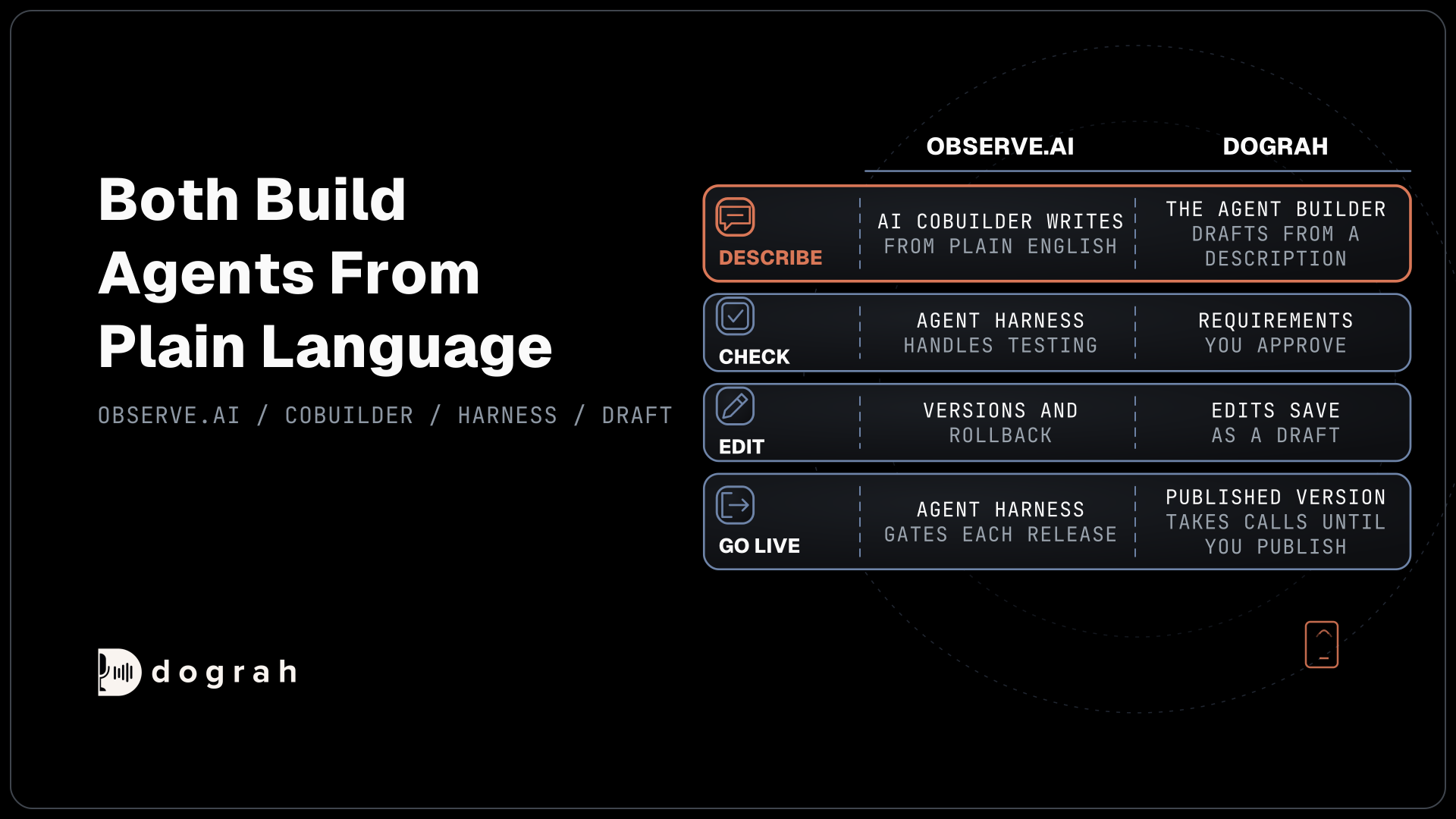
| Building agents | AI CoBuilder writes agents from plain English, and Agent Harness versions, gates and rolls back | The Agent Builder drafts from a description, edits save as drafts, and the published version stays live until you publish |
| Handoff | Context passed to live agents during transfer | Dograh calls the destination first and connects the caller only when someone answers |
| QA | One evaluation across AI and human calls | A QA node that scores each step of Dograh's own calls |
| Caller input and texts | Keypad digit capture | Callers reply by speaking, and an HTTP API tool sends texts through your own SMS provider |
| Where data sits | Observe.AI's cloud in the US, Canada, the EU or Australia | Your own database and storage when self-hosted. Dograh Cloud names no region |
| Price shape | By quote | Self-hosted, no per-minute platform fee. Dograh Cloud, 1¢/min platform fee |
| Phone | CRM, telephony, APIs and MCP through its Integration Fabric | Twilio, Telnyx, Plivo, Vonage, Exotel, Vobiz, Cloudonix and Asterisk ARI |
Two products with different scopes
Observe.AI sells to the whole contact center, and Dograh sells to the part that runs on its own. Observe.AI says "Every conversation, AI and human, is evaluated". Voice AI and Chat AI handle conversations without a person, Companion Agent helps live agents during calls, Performance ties coaching to outcomes, and Insight works as an analyst across all of it.
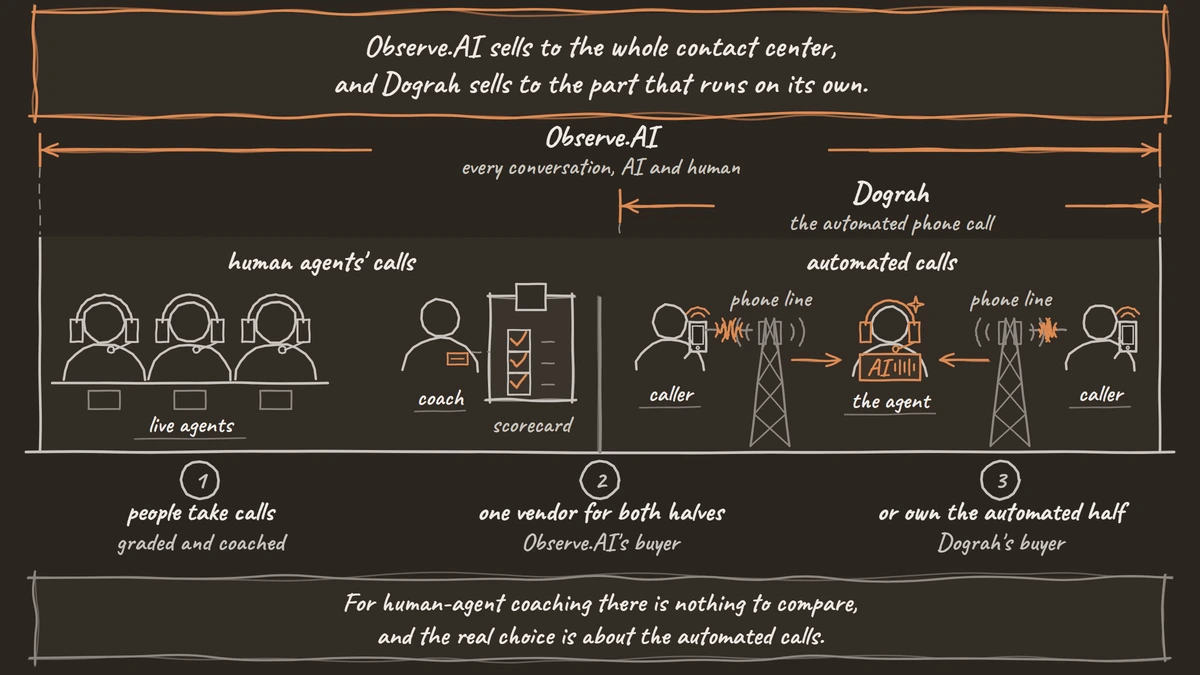
Dograh does one of those jobs, the automated phone call, and does it in code you can run yourself. Grading and coaching a human agent's call sits outside its scope. A team that wants both halves from one vendor is Observe.AI's buyer. A team that wants to own the automated half, and already handles human QA some other way, is Dograh's.
That makes the comparison narrower than it looks. For human-agent coaching there is nothing to compare, and the real choice is about the automated calls. Our Observe.AI review walks through the whole suite product by product.
Building and running the automated calls
Both products build agents from plain language, and they differ in who runs them. Observe.AI's Voice AI answers inbound and outbound calls and takes more than 12 kinds of action, such as authenticating a caller, looking up and updating records, refunds and scheduling. AI CoBuilder writes agents from plain English, Agent Harness handles versions, testing and rollback, and Observe.AI quotes its own figure of responses under 300 ms.
In Dograh you describe the agent to the Agent Builder, which may ask a few questions and then lists the agent's requirements for you to approve before it builds. Later edits save as a draft, and the published version keeps taking calls until you publish the new one. HTTP API and MCP tools reach your systems during the call, and Pre-Call Data Fetch pulls fresh records before the greeting.
Outbound work runs through Campaigns, with retries from 0 to 10 and calling hours set by weekday in one time zone. Voicemail handling is off by default, and once you switch it on in the agent's Settings, the agent can disconnect or leave a message. Each agent takes its own speech-to-text, language model and voice, so you can change one without touching the others.

Open Source Alternative to Vapi / Retell
Self-hosted voice agent platform — no per-minute fees
dograh-hq/dograh
Star on GitHub
Handoffs and phone lines
The handoff is where an automated call meets the human side. Observe.AI says Voice AI passes context to live agents during transfer, and its Integration Fabric connects to CRM, telephony and other systems through APIs and MCP.
Dograh connects to Twilio, Telnyx, Plivo, Vonage, Exotel, Vobiz, Cloudonix and Asterisk ARI. On Twilio, Telnyx, Plivo, Cloudonix and Asterisk ARI, Transfer Call calls the destination first and connects the caller only when someone answers. If nobody picks up within 30 seconds by default, the agent hears that the line was busy or not answered and keeps the caller.
Notes for the person who answers reach them through your own system. An HTTP API tool writes the case details into your CRM or helpdesk before the transfer, so they are waiting when the call connects. On Exotel, Vobiz and Vonage, the agent books a callback request through an HTTP API tool when the caller needs a person.
QA for AI calls and human calls
Observe.AI's QA is built for a mixed floor, where one evaluation covers AI and human calls alike. Buyers on Software Finder's reviews praise its Section Score Card, auto-suggested QA ratings and searchable transcripts. The same reviewers report missed words, mixed-up speakers and false positives in moment detection, so transcription accuracy is worth testing on your own calls.
Dograh's QA node reviews Dograh's own calls after they end, from editor test calls to live calls of the published agent. Each step of the call gets its own tags, a score from 1 to 10, a sentiment and a summary, and a Sample Rate setting picks a share of calls at random. View Trace adds the speech-to-text, AI and voice time for every turn.
The two cover different ground. Observe.AI grades the people and the bots on one scale. Dograh grades the automated agent step by step, which helps you find the exact turn that went wrong.
Join the Dograh Community
Dograh is an OSS alternative to Vapi. Join our Slack community for queries, releases, best practices & community interactions.
Where call data sits and what it costs
Observe.AI keeps call data in its own cloud, with choices inside it. Observe.AI lists storage in the US, Canada, the EU or Australia, retention with export and delete you configure, customer-managed keys and private VPC peering. Pricing is by quote, and our guide to Observe.AI pricing covers the units and the questions to ask.
An open platform you run yourself keeps recordings and transcripts in your own database and storage. Hosting Dograh yourself with Docker Compose means no per-minute platform fee, though servers, model keys and phone minutes still land on your bill. The database and every upgrade are also your team's to run. Support comes through the open-source community, Enterprise adds custom SLAs, and Dograh Cloud hosts it for you at a 1¢-a-minute platform fee with 10 calls at once included.
Where Observe.AI wins
Observe.AI is the stronger pick for a contact center that wants one vendor for its people and its bots. It grades human agents' calls, coaches them through Performance and helps them live through Companion Agent, and it puts AI and human calls on one evaluation. That side of the floor sits outside Dograh's scope.
Its Voice AI also brings things a regulated contact center asks for out of the box. Callers can enter digits on the keypad, transcripts and actions are redacted for card, personal and health details in real time, and Agent Harness gates each release. Regional storage and customer-managed keys come inside one hosted contract, with no servers for your team to run. If that is your shape, Observe.AI fits better.
When Dograh fits
Dograh fits when you want to own the automated calls. That means open code you can read and change, the platform on your own servers or on-prem on Enterprise, and your choice of model and carrier for each agent.
It also fits beside Observe.AI. Automated calls run on Dograh, Transfer Call hands callers to your human team, and Observe.AI keeps grading and coaching those people. Our post on the open-source alternative to Observe.AI covers running the two side by side.
To test the fit, start on Dograh Cloud or self-host with Docker Compose, build one automated call you handle today, and place it over a real phone line, since a browser test call cannot run a transfer. Then run the QA node on those calls and compare the step scores with your current results.
Glossary
- Human-agent QA
- Scoring the calls your people handle against a scorecard, to find coaching needs. Observe.AI is built around it, while Dograh's QA node covers automated calls.
- Live assist
- Real-time help shown to a human agent during a call, such as prompts and answers. Observe.AI sells it as Companion Agent.
- QA node
- The Dograh step that reviews a finished call. It gives each step of the call its own tags, score, sentiment and summary.
- Customer-managed keys
- Encryption keys the customer controls inside a vendor's cloud. Observe.AI offers them, and a self-hosted platform keeps keys in your own systems.