
Observe.AI suits contact centers that need QA, coaching and live assist for human agents, with automated calls scored on the same scorecard. It is closed, hosted and priced by quote on a yearly contract. For teams that want to own the platform for automated calls, Dograh, the open-source AI voice agent platform, runs self-hosted or on Dograh Cloud.
Key Takeaways
- Observe.AI is a QA and coaching suite first, with voice agents added on top.
- Its AWS Marketplace listing sells VoiceAI on a 12-month contract with no mid-term refunds.
- Reviewers praise its QA coverage but report transcription and sentiment errors.
Observe.AI grew up grading human agents, and its voice agent now runs on the same platform. We cover what the suite does that an agent platform does not, the voice agent on its own, what reviewers say, pricing, data, demo questions, fit and how open-source Dograh handles the automated calls.
What Observe.AI sells today
Observe.AI sells software for two kinds of conversation, the ones a person handles and the ones an AI agent handles alone. Voice AI and Chat AI resolve conversations on their own, and a newer Headless Agent puts the same intelligence into frontline tools. For people, Companion Agent gives live agents real-time assist, Insight acts as an AI analyst for customer data, and Performance ties coaching to outcomes. Observe.AI sums it up as "Every conversation, AI and human, is evaluated."
Under the agents sit AI CoBuilder, which configures agents from plain instructions, Agent Harness for versioning, testing and release, and an integration layer that reaches CRMs, contact center platforms, APIs and MCP servers. Named customers include DoorDash, Uber and SoFi, and its BPO partners include Concentrix and Alorica. Observe.AI says most teams go from setup to production in one to two months.
What a suite does that an agent platform does not
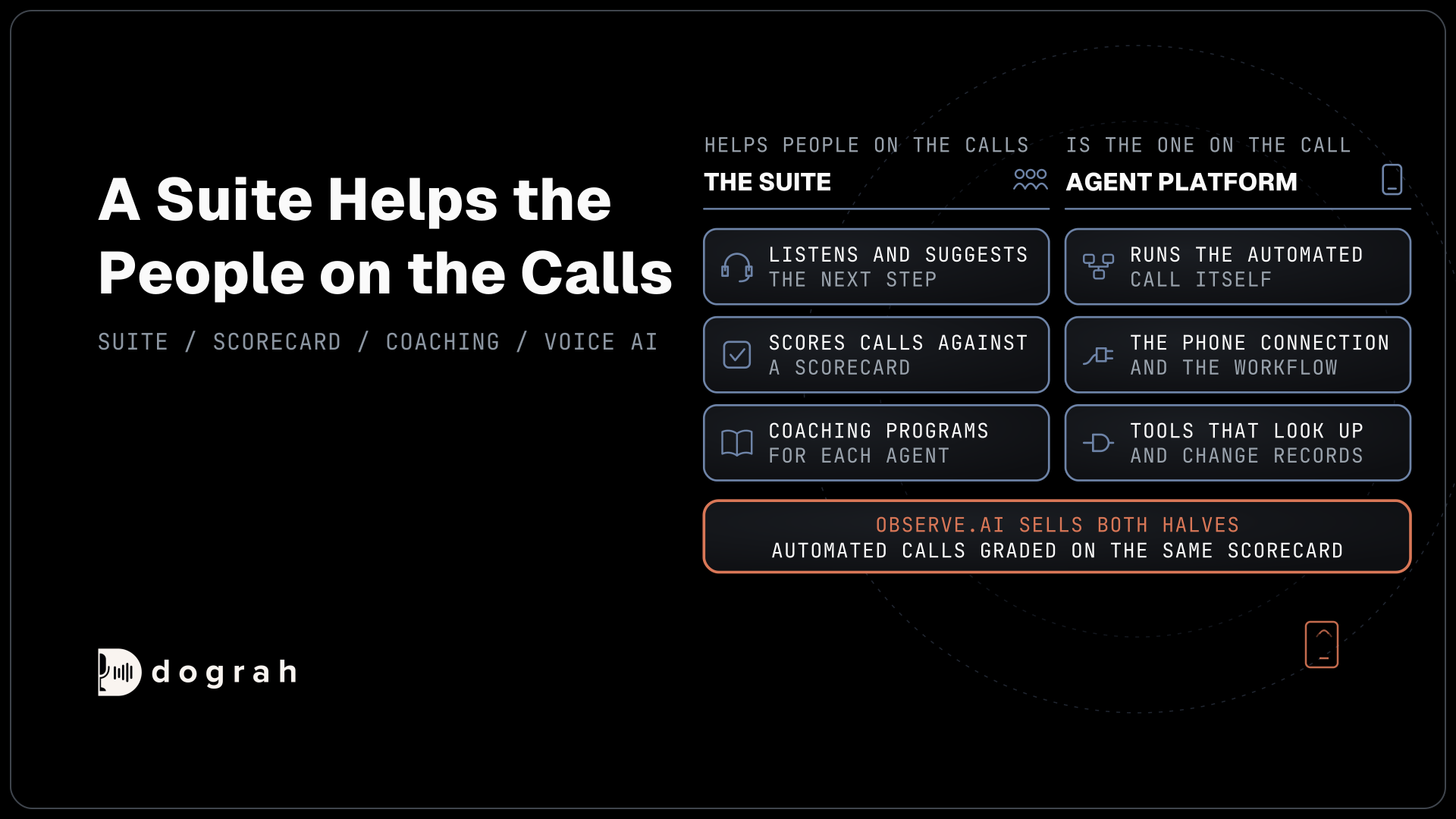
A suite helps the people on the calls, and an agent platform is the one on the call. Observe.AI's suite listens while a human agent talks and suggests the next step, scores that agent's calls against a scorecard, runs coaching programs for each agent, and reports trends across every human and AI conversation in one place. For a contact center of hundreds of agents, or a BPO running many client programs, that layer is the main product.
An agent platform does a narrower job well. It runs the automated call itself, the workflow, the phone connection, the tools that look up and change records, and the speech and language models. It scores the calls it handles, and your staff's calls stay with the suite. Our post on the open-source alternative to Observe.AI splits Observe.AI's products along that line, product by product.
The voice agent, judged on its own
Observe.AI's voice agent is a full product in its own right. Observe.AI's Voice AI page covers inbound and outbound calls with "12+ action types", such as authenticating callers, looking up and updating records, refunds and scheduling. It collects sensitive digits by keypad, detects voicemail on outbound calls, and applies real-time redaction to personal, card and health details in transcripts and actions.
Hand-offs go to a person with full context, under the rules you set. Observe.AI claims responses under 300 milliseconds with streaming speech recognition and voices, which is its own figure to test on your lines. CoBuilder configures the agent, and Agent Harness versions, gates and rolls back changes. The integrations are described by type, CRM, telephony, APIs and MCP, so confirm the exact systems for your stack in the demo.

Open Source Alternative to Vapi / Retell
Self-hosted voice agent platform — no per-minute fees
dograh-hq/dograh
Star on GitHub
What reviewers praise and criticize
Most user reviews of Observe.AI are about the QA suite, not the voice agent. In 16 reviews on Software Finder, users praise searchable transcripts, auto-suggested QA scores, coaching dashboards and responsive account managers. QA teams in particular like reviewing far more calls than manual sampling allows.
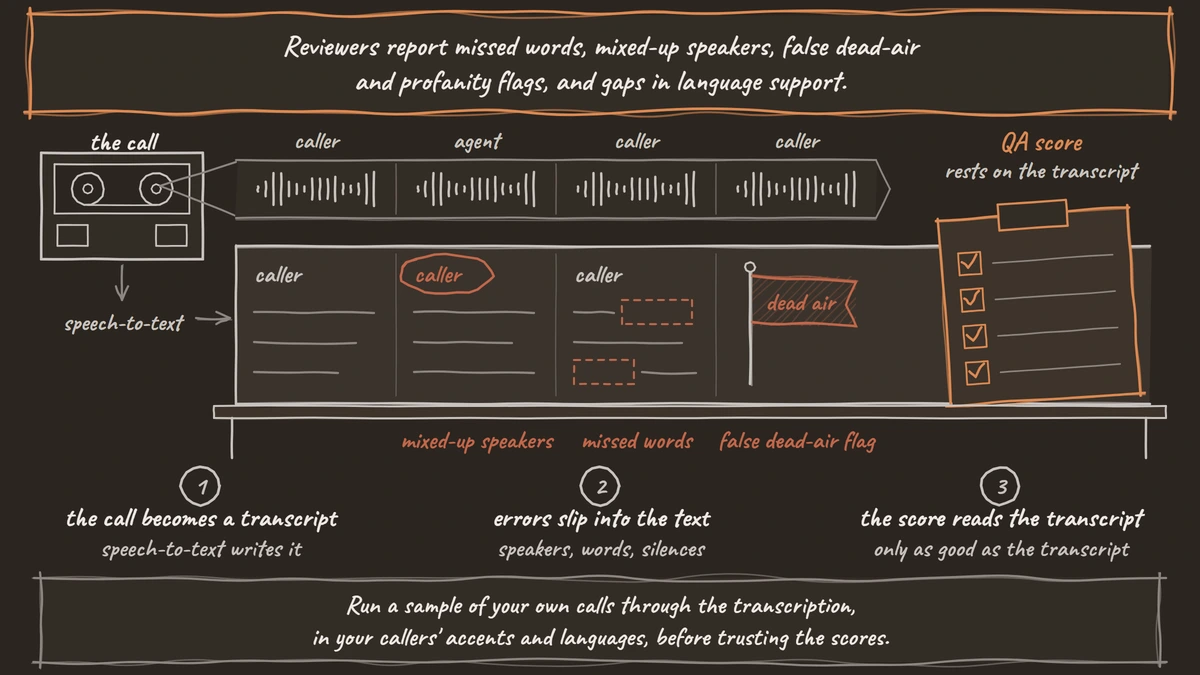
The complaints are about accuracy and effort. Reviewers report missed words, mixed-up speakers, false dead-air and profanity flags, and gaps in language support. Some found setup steep, with features that need a dedicated administrator. Only one review covers building VoiceAI agents, and it is positive about prototyping speed. Read "every conversation is evaluated" with that in mind, since a score is only as good as the transcript under it.
Pricing by quote and one public listing
Observe.AI is priced by quote through a demo, with one public contract listing. Its AWS Marketplace listing for VoiceAI Agents sells a 12-month contract on two contract dimensions, "Minutes per Month" at $4.80 and "Number of Interactions" at $12.00, each per unit for 12 months. A 24-month term is listed too, no refunds are given during an active subscription, and the software runs as SaaS outside AWS. Those units are contract terms, not a per-minute call rate, so ask what one unit buys. Our roundup of Observe.AI alternatives compares that contract with per-minute platforms.
Where call data sits
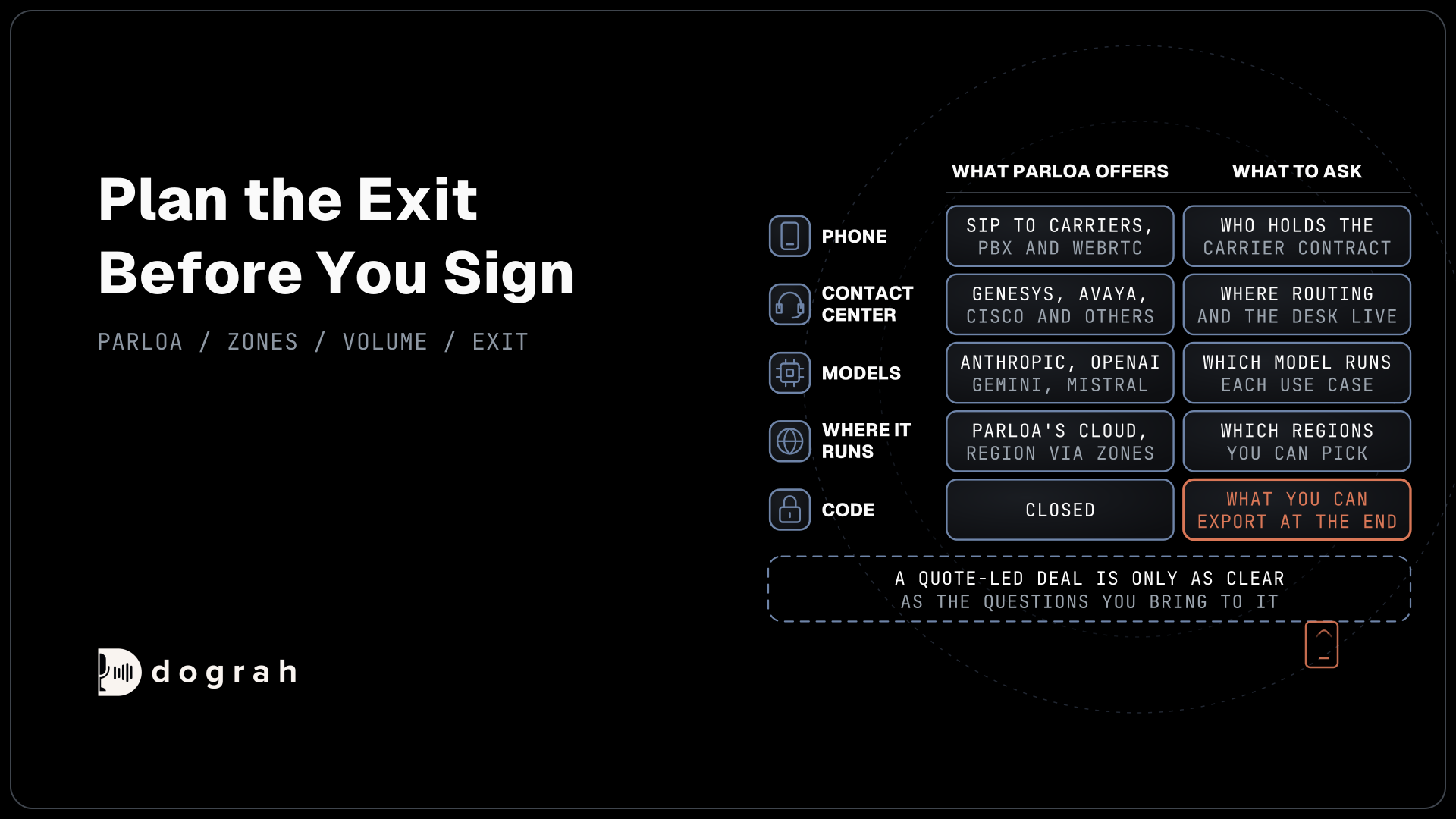
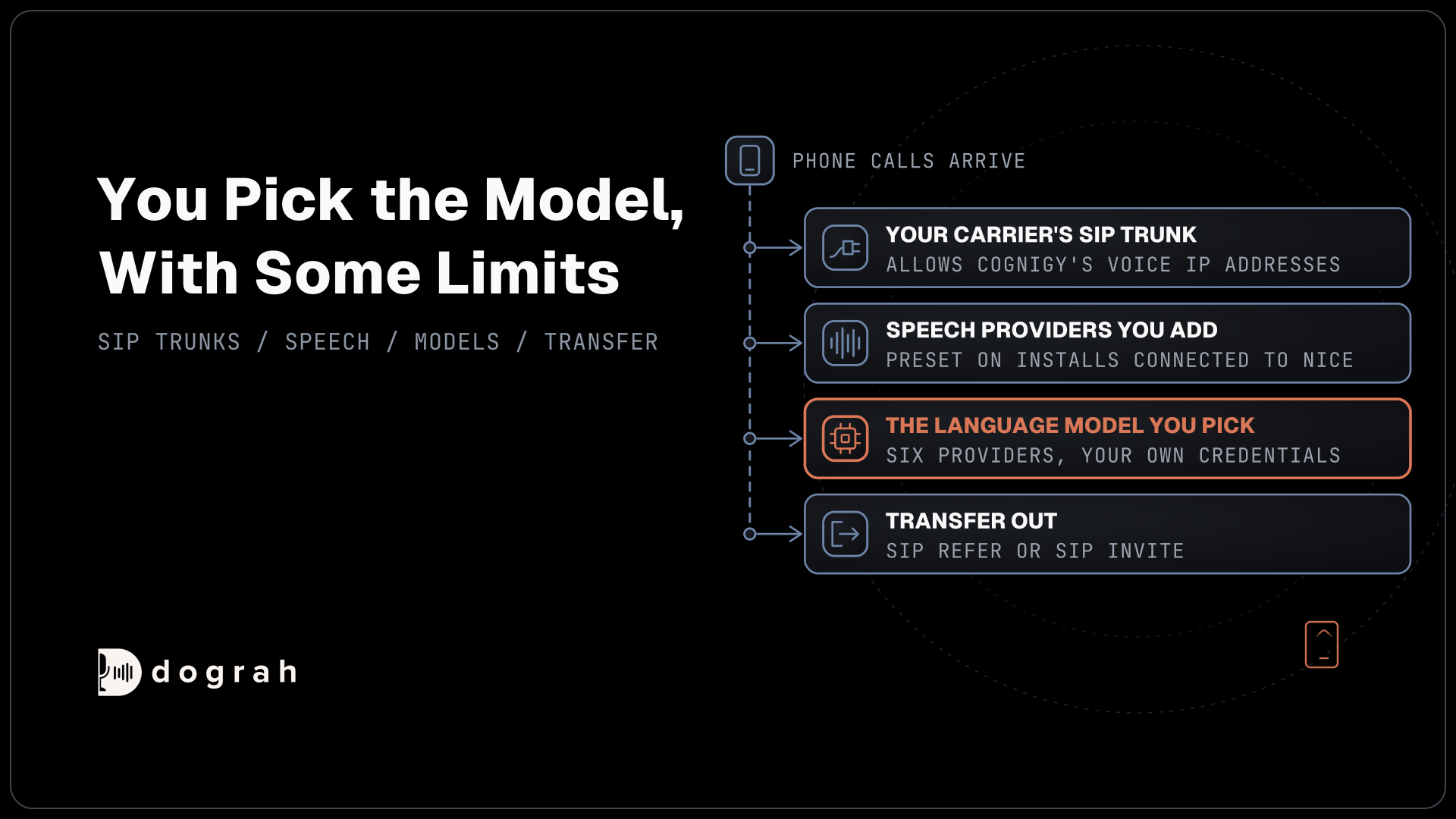
Observe.AI's data controls are real, and they all sit inside its cloud. Observe.AI's trust and security page lists data storage in the US, Canada, the EU or Australia, configurable retention with export and delete, and models used for inference only, never trained on your data. You can bring your own model keys and customer-managed encryption keys, connect over a VPN or private VPC peering, and keep data in isolated storage per tenant.
What you cannot do is run it yourself. The platform is closed and hosted, so recordings, transcripts and scores live in Observe.AI's cloud in the region you pick, and no one outside Observe.AI can read the code that handles them. For many contact centers that is fine. For a team whose rules say call audio stays on its own servers, it settles the question.
Join the Dograh Community
Dograh is an OSS alternative to Vapi. Join our Slack community for queries, releases, best practices & community interactions.
Questions to ask in an Observe.AI demo
Bring questions that test both halves. Ask what one minute and one interaction mean on your contract, and whether the voice agent can be bought without the QA suite. Ask which contact center platform and CRM connect for your setup, and which models hear your calls in which region. Run a sample of your own calls through the transcription, in your callers' accents and languages, before trusting the scores. Then ask what the default retention period is and who on your team can change it.
Who Observe.AI fits
Observe.AI fits a contact center or BPO whose first need is QA, coaching and live assist for human agents, and that wants automated calls graded on the same scorecard. A team that already uses it for people gets a voice agent that shares the same evaluation, redaction and controls.
It fits less well a team that only needs automated calls, wants to read the code or run it on-prem, or wants per-minute pricing without a 12-month contract. It also fits poorly where transcription accuracy in a less common language is critical and untested.
Where Dograh fits
Dograh, the open-source AI voice agent platform, covers the automated-call half of Observe.AI's job. The code is open under the BSD 2-Clause license, and you can self-host it with Docker Compose, run it on Dograh Cloud, or deploy on-prem on the Enterprise plan. A new agent starts in the Agent Builder, where you describe the call and approve the requirements it lists before it builds.
During a call, the agent works in your systems through an HTTP API tool for any endpoint you own, or an MCP tool for a Model Context Protocol server, which covers lookups, updates and bookings. Campaigns dial outbound lists within the calling hours you set and retry busy or unanswered numbers. Callers give details by voice, and when they need a person, Transfer Call on Twilio, Telnyx, Plivo, Cloudonix or Asterisk ARI rings that person first and puts the caller through only once the call is answered. If the call goes unanswered, is busy or fails, the caller stays with the agent.
Quality checks cover the agent's own calls. The QA step scores every step of test and live calls after they end, with a sample rate you set, and View Trace shows the speech-to-text, AI and voice time for each turn. Scorecards and coaching for human agents stay with the suite that grades them today, and our post on call QA and scoring in contact centers covers how per-client QA works.
Self-hosted, recordings and transcripts land in storage and a database on your own servers, and the speech and language models are a separate layer you choose, from Dograh's own models to your keys or open-weight models you host. Self-hosted, there is no per-minute platform fee, but servers, model keys and phone minutes still cost money. Dograh Cloud charges a 1¢-a-minute platform fee. Your team runs the server, the database and the upgrades, supported by the community on the open-source version or by custom SLAs on Enterprise.
Glossary
- Real-time assist
- Software that listens to a human agent's live call and suggests answers or next steps on screen. Observe.AI sells it as Companion Agent.
- Contract dimension
- A unit a marketplace contract is priced on, such as minutes per month or interactions. On Observe.AI's AWS listing these are contract terms, not per-minute call rates.
- Real-time redaction
- Removing personal, card or health details from a transcript as the call happens, so they never reach stored logs. Observe.AI's voice agent does this.
- VPC peering
- A private network link between a customer's cloud network and a vendor's, so traffic does not cross the public internet. Observe.AI offers it, and the data still sits in its cloud.