
Observe.AI prices through a demo and a quote. Its public figures are AWS Marketplace contracts, with VoiceAI Agents billed on minutes and on interactions, one per call, and its assist and QA products priced per agent. Teams that want to own their automated calls can run them on Dograh, an open-source AI voice agent platform.
Key Takeaways
- VoiceAI counts each call as one interaction, however long the call runs.
- Time with human agents after a handover stays outside the VoiceAI meters.
- Assist and QA products bill per agent, on 12, 24 or 36-month terms.
An Observe.AI quote is easier to judge once you know the units behind it. We read the three AWS listings, how VoiceAI counts minutes and interactions, a month counted in units and what drives the total. Then we talk about questions to ask and where Dograh fits on automated calls.
How Observe.AI sells, and what is public
Observe.AI sells through its sales team, and every deal starts with a demo. Its homepage leads with "Get a Demo" across the voice agent, assist and QA products, and Observe.AI says most teams go from setup to production in a month or two. Our Observe.AI review covers what the products do, so this post stays on how they are billed.
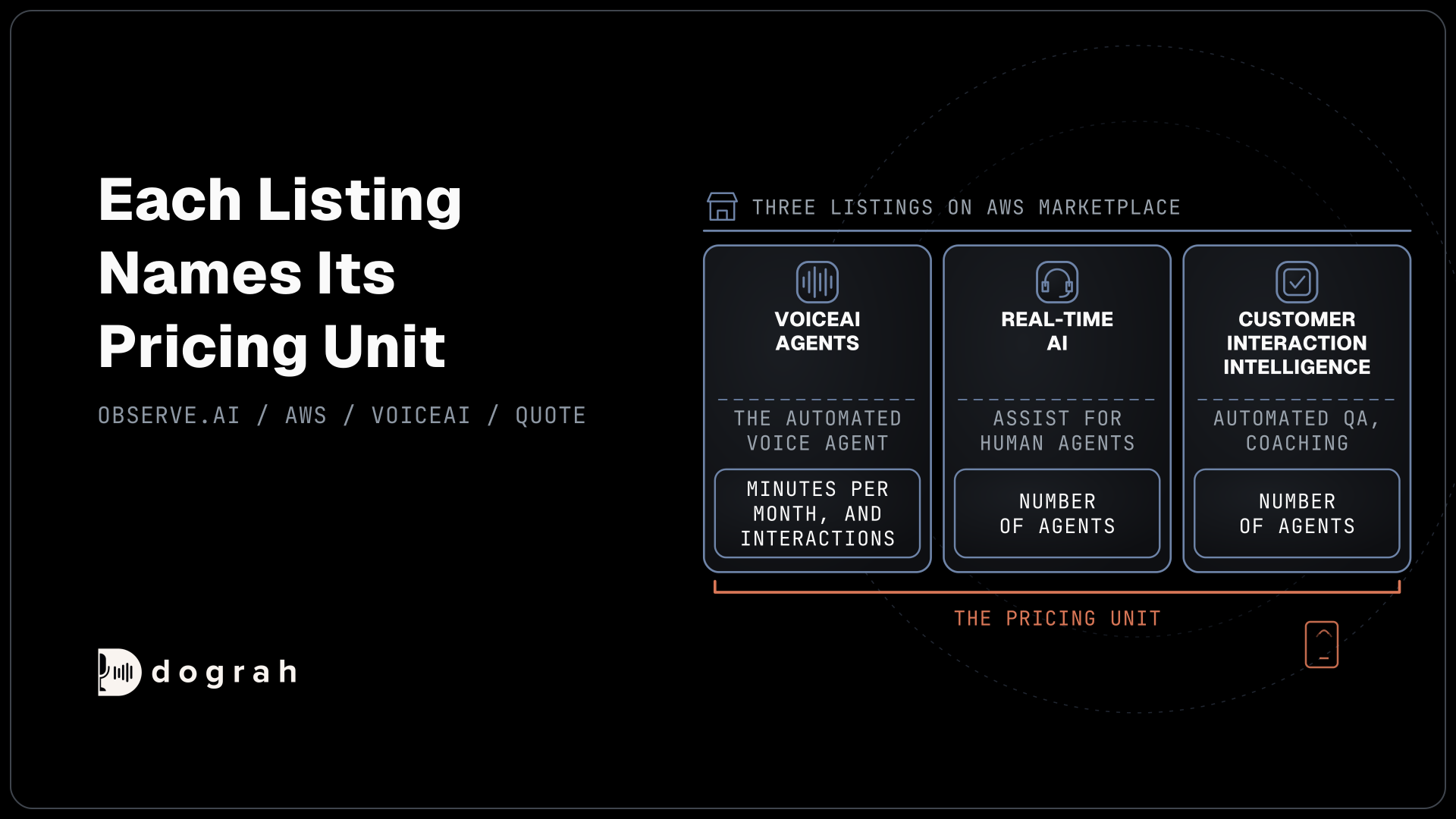
The figures you can read today sit on AWS Marketplace, where Observe.AI lists three products as software contracts. Each listing names its pricing unit and a 12-month price, and each says no refunds are given during an active subscription. They are contract terms, and none of them is a per-minute call rate.
| Listing | What it covers | Pricing dimension | 12-month price | Contract terms |
|---|---|---|---|---|
| VoiceAI Agents for Customer Support | The automated voice agent | Minutes per Month, and Number of Interactions | $4.80 and $12.00 | 12 or 24 months |
| Real-Time AI | Agent Assist, Knowledge AI, Summarization AI and Supervisor Assist for human agents | Number of Agents | $828.00 | 12, 24 or 36 months |
| Customer Interaction Intelligence | Automated QA, coaching and insights across conversations | Number of Agents | $828.00 | 12, 24 or 36 months |
Only the 12-month prices appear on the listings, so the 24 and 36-month prices come with the quote.
How VoiceAI counts minutes and interactions
The VoiceAI listing bills two meters, and both land on the same invoice. Observe.AI's VoiceAI Agents listing prices "Minutes per Month" at $4.80 and "Number of Interactions" at $12.00, each shown as a cost per 12 months, and calls them separate usage meters, not tiers. You commit to a contract term and pay for the units you use across both.
An interaction is one customer conversation the agent handles. Each call the agent takes counts as a single interaction, regardless of its length, while Minutes per Month measures call time. A 40-second call and a 12-minute call therefore add the same one interaction and very different minutes.
The handover is where both meters stop. The agent passes calls to a live agent with the context transferred, and only the AI-handled portion counts toward metered usage. Time your human agents spend after the handover falls outside the VoiceAI meters, though those people may sit on the per-agent products below.
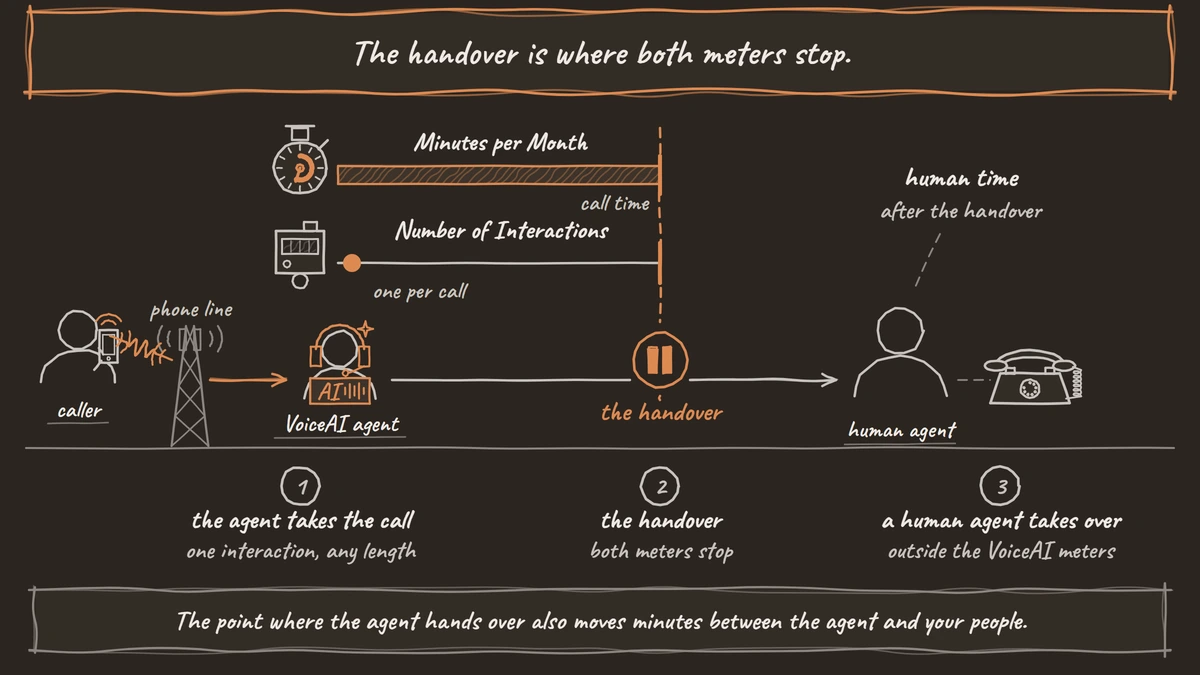
What one unit buys is the question to settle first. The listing says the price entitles you to a specified quantity of use for the contract duration, and it sends buyers to a private offer for a custom quote. Ask how many minutes or interactions one unit covers before you multiply anything.
Per-agent pricing for the human-agent products
Observe.AI's assist and QA products are priced on people rather than calls. Real-Time AI covers Agent Assist, Knowledge AI, Summarization AI, Supervisor Assist and reporting, while Customer Interaction Intelligence covers automated QA across conversations, coaching and insights. Both list $828.00 for a 12-month contract on a "Number of Agents" dimension, with 12, 24 and 36-month terms, and the Real-Time AI listing says plainly "You pay per agent".
That charge follows the agents covered by the contract rather than the calls they handle. Directory sites repeat the $828 as a yearly per-agent price and report a minimum of more than 100 seats. Treat both as secondary, and get the seat count, any minimum and the multi-year rates written into the quote.
This split is why one listing price is never the whole bill. A contact center that buys the voice agent with assist and QA pays two kinds of unit at once, call usage for the agent and seats for its people, and each product is its own line.

Open Source Alternative to Vapi / Retell
Self-hosted voice agent platform — no per-minute fees
dograh-hq/dograh
Star on GitHub
Counting a month of VoiceAI usage
A worked example in units shows how the two meters move without guessing a dollar total. Take a month where the VoiceAI agent answers 5,000 calls. Of those, 4,000 stay with the agent for an average of 4 minutes, and 1,000 are handed to a person after 2 minutes.
| Meter | How it counts | This month |
|---|---|---|
| Number of Interactions | One per call the agent takes, whatever its length | 5,000 |
| Minutes per Month | AI-handled minutes only | 4,000 x 4 + 1,000 x 2 = 18,000 |
| Human time after handover | Outside the VoiceAI meters | Not counted by VoiceAI |
Both meters add together on the same invoice. The 1,000 handed-off calls still count as full interactions, while their minutes stop at the handover, so moving the handover earlier trims minutes and leaves interactions unchanged. To turn 5,000 interactions and 18,000 minutes into money, you need the unit size and the committed quantity from your quote.
What drives an Observe.AI bill
The products you buy set the shape of the bill first. A VoiceAI-only contract bills calls through minutes and interactions, and adding Real-Time AI or Customer Interaction Intelligence adds a seat-based line for every human agent those products cover.
Then come the commitment and the term. You commit to a contract and pay on usage within it, so the quantity you commit decides how much capacity you buy up front. Terms run 12 or 24 months for VoiceAI and up to 36 months for the per-agent products, with no refunds while a subscription is active.
Call patterns matter more than the average call length. Many short calls push interactions up, while long calls push minutes up. The point where the agent hands over also moves minutes between the agent and your people. The VoiceAI listing also notes that additional AWS infrastructure costs may apply, so ask whether any of that reaches you.
Questions to ask in an Observe.AI quote
Start with the units, since every other number rests on them. Ask what one Minutes per Month unit and one Number of Interactions unit buy, how many your contract commits, and what happens above that quantity. Ask whether VoiceAI can be bought without Real-Time AI or Customer Interaction Intelligence, and whether a seat minimum applies to those two.
Then ask about the contract. Ask for the 24 and 36-month prices, and whether a private offer through AWS Marketplace lets you count the spend against an existing AWS commitment. Ask too who pays any AWS infrastructure costs the listing mentions.
Finish with the data and the exit. Ask which models handle your calls and in which region, what the default retention is and who can change it, whether customer managed keys come with your plan, and how you export recordings and transcripts when the term ends. Our roundup of Observe.AI alternatives sets those answers beside other options.
Join the Dograh Community
Dograh is an OSS alternative to Vapi. Join our Slack community for queries, releases, best practices & community interactions.
Where call data sits on Observe.AI
Observe.AI is closed software that runs in its own cloud. Its trust and security page lists data storage in the US, Canada, the EU or Australia, retention you configure with export and delete, and models used for inference only, not trained on customer data. It also offers customer managed keys and private VPC peering.
You can bring your own LLM keys, which moves the model contract to you while call audio still passes through Observe.AI's platform. A team whose rules need recordings and transcripts on its own servers needs software it can run itself, and that is a different purchase from any of these contracts.
Where Dograh fits for automated calls
Dograh covers the automated-call half of this picture, the job the VoiceAI listing meters. It answers and places calls, uses your tools during the call and scores its own calls with a QA node, while assist, coaching and QA for human agents stay with Observe.AI or another suite. Our post on the open-source alternative to Observe.AI covers running the two side by side.
The handover works the way the VoiceAI meters assume. Transfer Call works on Twilio, Telnyx, Plivo, Cloudonix and Asterisk ARI, and Dograh calls the destination first and connects the caller only when someone answers. A no-answer, busy or failed attempt comes back to the agent and the call continues. A Webhook node then sends each call's results to your own reporting, so the agent's scores sit next to your team's.
The platform side has one meter, call minutes, and only on Cloud. Running Dograh yourself means no per-minute platform fee. You still pay for servers, model keys and phone minutes, and your team looks after the database and upgrades. A self-hosted install runs 10 calls at once by default, a limit you can raise. Support comes from the open-source community, and Enterprise adds custom SLAs. If you would rather not host it, Dograh Cloud runs it for a 1 cent a minute platform fee, and Pay as you go includes 10 concurrent calls, with more on request.
Glossary
- Pricing dimension
- The unit an AWS Marketplace listing is priced on, such as Minutes per Month or Number of Agents. Observe.AI's listings show a 12-month price for each dimension.
- Interaction
- One customer conversation Observe.AI's VoiceAI agent handles. Each call counts as a single interaction regardless of its length, and minutes are metered separately.
- Private offer
- A custom quote a seller makes to one buyer through AWS Marketplace. Observe.AI's VoiceAI listing sends buyers to a private offer for their price.
- Committed quantity
- The amount of use a contract entitles you to for its term. Observe.AI's VoiceAI listing bills against it, so the committed amount sets what you pay up front.