
Inworld AI alternatives are divided into voice APIs that replace TTS-2 and agent layers that replace the Realtime API. ElevenLabs, Cartesia and Rime are voice APIs, while OpenAI Realtime, Gemini Live and full platforms are agent layers. For teams that want to own the platform, Dograh is the open-source option, self-hosted or on Dograh Cloud, with Inworld voices.
Key Takeaways
- Inworld now sells voices, speech-to-text and a Realtime API, and owns Ultravox.
- Dograh is the open-source agent layer and runs Inworld TTS-2 on your key.
- Inworld's Realtime API follows OpenAI's protocol, so client code moves with few changes.
Inworld began as a game-character company and now sells voice models and a speech-to-speech API, so the question is which part to replace. We sort the options in one table, then we talk about how open-source Dograh runs the call around any voice, when staying wins and what leaving takes.
Inworld AI alternatives in one table
Inworld today sells two layers, and each one has its own set of alternatives. The voice layer is TTS-2, TTS-2 Flash and STT-1 speech-to-text. The agent layer is Inworld's Realtime API, which connects speech-to-text, the language model you choose and TTS-2 in one spoken conversation, plus Ultravox, which Inworld now owns. Inworld has retired its older Character Studio, so game-character tools are left out.
| Option | What it replaces | Open code | Where it runs | Price unit | Runs inside Dograh |
|---|---|---|---|---|---|
| Inworld (baseline) | Voice (TTS-2, TTS-2 Flash, STT-1) and the Realtime API | Closed | Inworld's cloud, with EU and India data residency on Enterprise | Per 1M characters, speech-to-text per hour | TTS-2 yes. STT-1 and the Realtime API no |
| Dograh | The agent layer around any voice | Yes, BSD 2-Clause | Your servers with Docker Compose, Dograh Cloud, or on-prem on Enterprise | Self-hosted, no per-minute platform fee. Dograh Cloud, 1¢/min platform fee | It is the platform |
| ElevenLabs | Voice, plus a speech engine for agents | Closed | ElevenLabs' cloud | $0.04 to $0.08 per 1,000 characters | Voice yes |
| Cartesia | Voice, Ink speech-to-text and Managed Agents | Closed | Cartesia's cloud, with on-prem or private cloud through sales | Credits for models, $0.03 a minute for agents | Sonic and Ink yes |
| Rime, Deepgram Aura, Gemini TTS, MiniMax, Murf | Voice | Closed | Each vendor's cloud | Each vendor's own rate | Yes |
| OpenAI Realtime and Gemini Live | Agent layer, as speech-to-speech | Closed | The provider's cloud | Per audio token | Yes, as Realtime providers |
| Ultravox, now owned by Inworld | Agent layer, as speech-to-speech | Open model weights, hosted service closed | Ultravox's cloud | $0.05 a minute | Yes, as a Realtime provider |
| Vapi and Retell AI | Agent layer, as hosted platforms | Closed | The vendor's cloud | A platform rate per minute, plus models | No, they are platforms too |
Dograh: open code around any voice
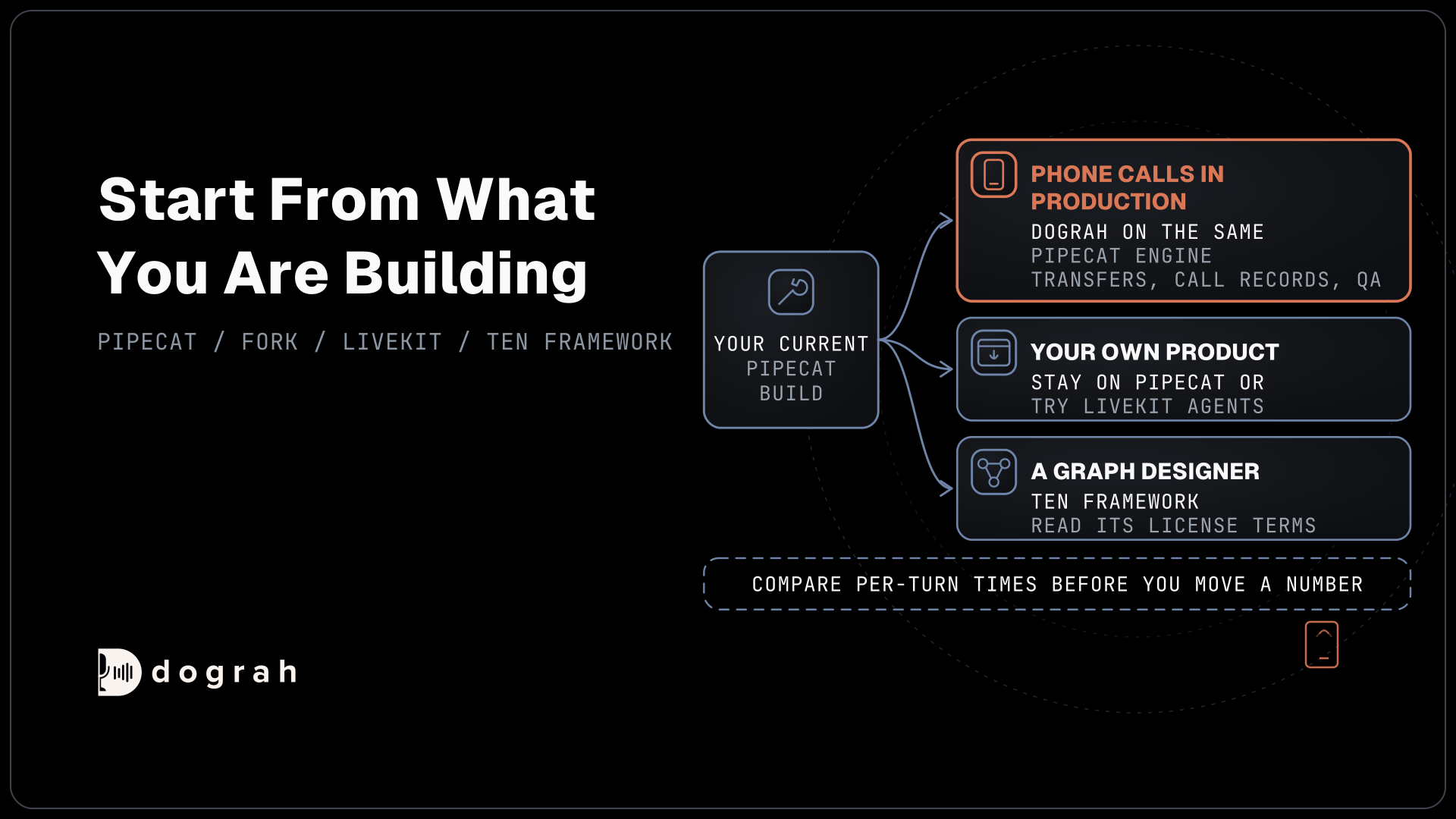
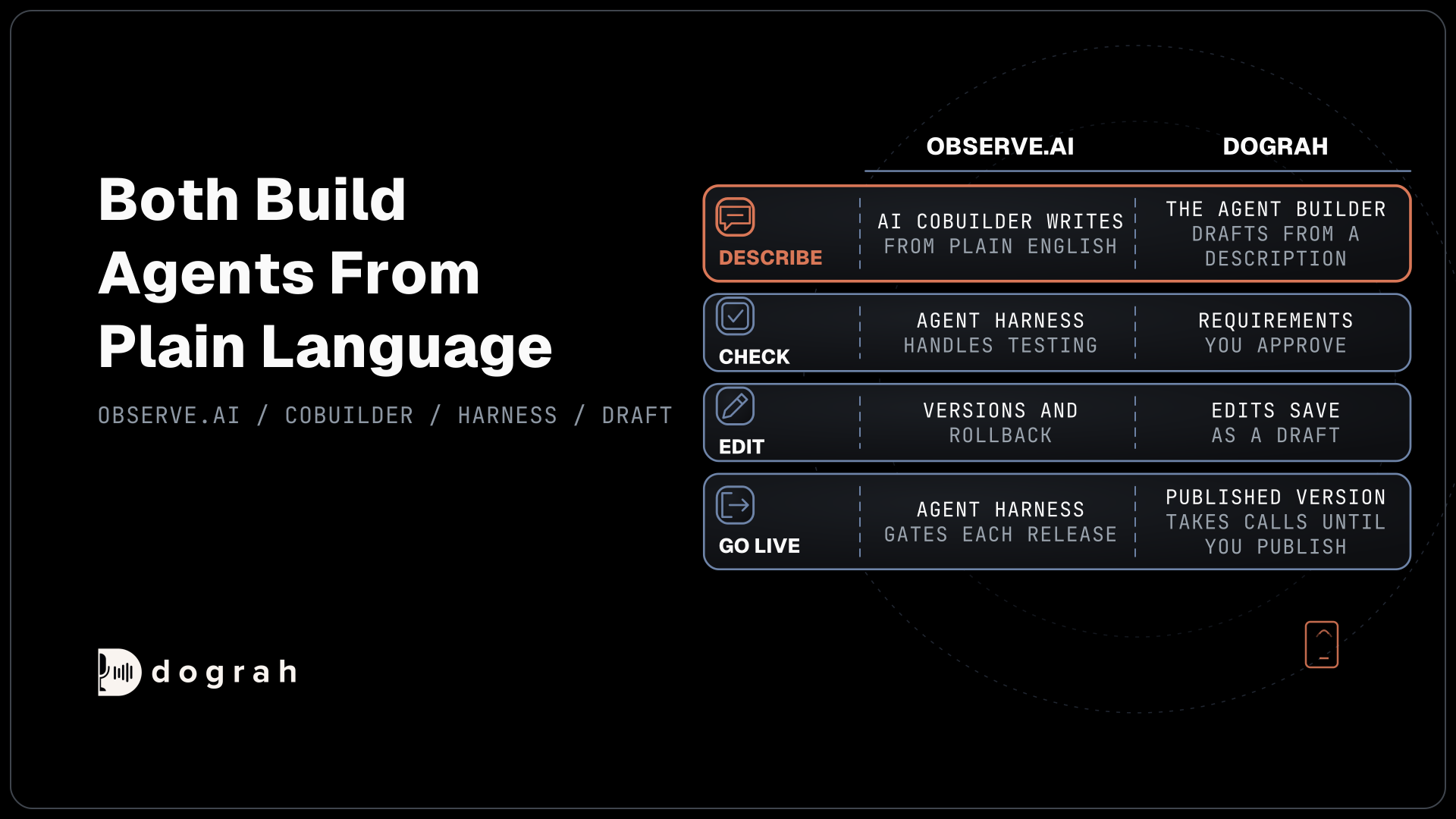
Dograh replaces the layer around the voice and lets you keep the voice you like. The whole platform sits on GitHub under the BSD 2-Clause license, so your team can read and change every line that touches a call. New agents start in the Agent Builder, where you describe the agent, approve the "Your agent requirements" card and let it build, with a canvas for hand edits and a QA node that scores each step of test and live calls.
Inworld TTS-2 is a built-in voice provider in Dograh, on your own Inworld key. The model field defaults to inworld-tts-2 and accepts inworld-tts-2-flash if you type it, the voice can be the default Ashley or a workspace voice ID for a cloned voice, and a delivery mode sets Stable, Balanced or Creative. STT-1 and the Realtime API are not offered as providers, so the agent takes speech-to-text from another provider, or runs a speech-to-speech model such as Ultravox in a Realtime configuration. Our page on how to use Inworld voices in Dograh walks through the setup.
The rest of the call comes with the platform. Calls reach Dograh over Twilio, Telnyx, Plivo, Vonage, Exotel, Vobiz, Cloudonix and Asterisk ARI. On Twilio, Telnyx, Plivo, Cloudonix and Asterisk ARI, Transfer Call dials the destination first and connects the caller only when someone answers. Campaigns run outbound lists with retries, and View Trace shows the speech-to-text, AI and voice time for each turn of a call.
With bring your own key (BYOK), the Inworld voice contract moves to you, while the reply text still reaches Inworld. On the platform side, running Dograh yourself with Docker Compose carries no per-minute platform fee. The bill that remains is servers, model keys and phone minutes, and your team takes care of the database and each upgrade. Help comes from the open-source community, with custom SLAs on Enterprise, and Dograh Cloud hosts the whole thing for a 1¢-a-minute platform fee with 10 calls at once included.

Open Source Alternative to Vapi / Retell
Self-hosted voice agent platform — no per-minute fees
dograh-hq/dograh
Star on GitHub
Voice APIs that replace TTS-2
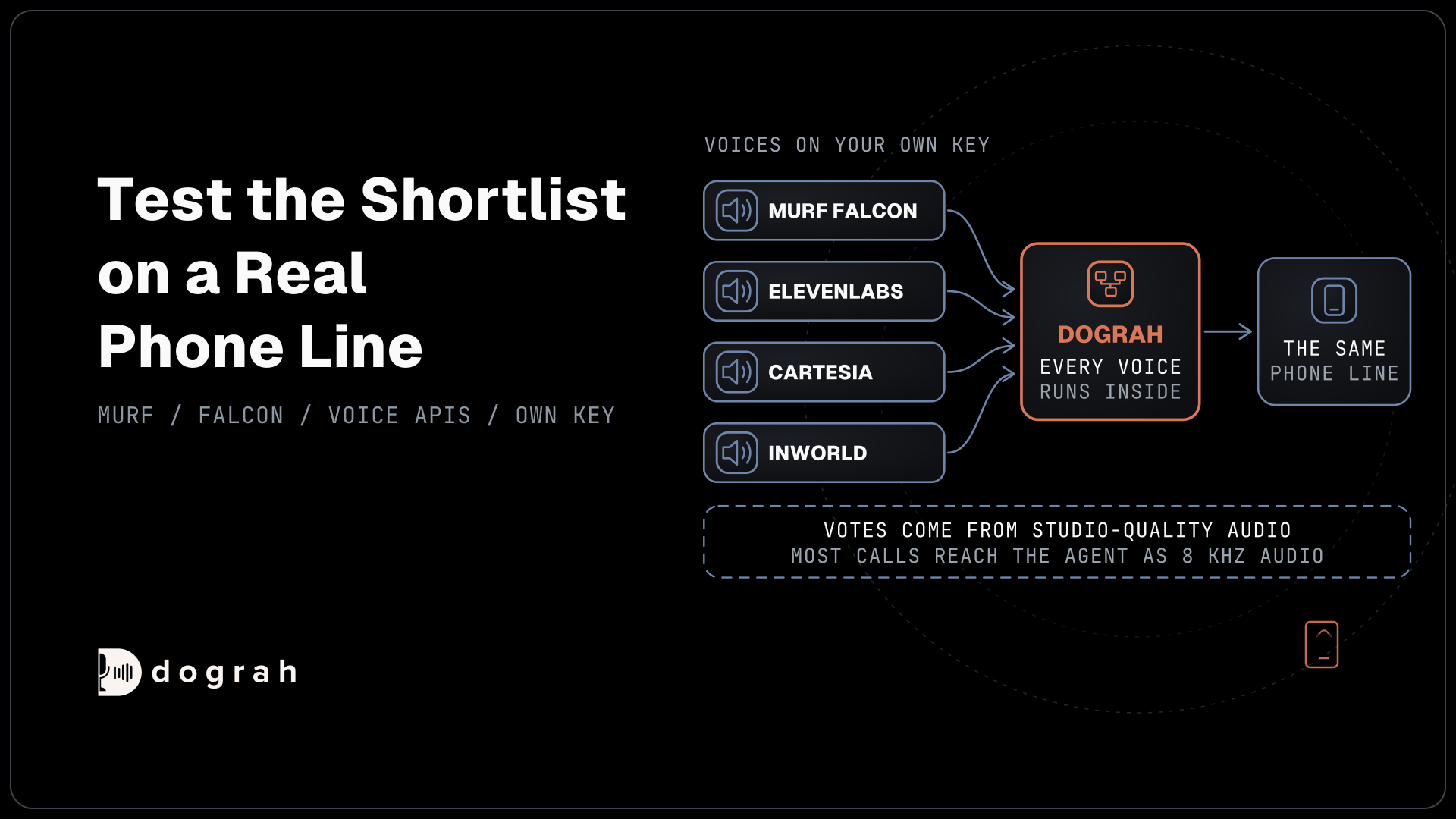
If your own code or platform runs the call and only the voice needs to change, the swap is one provider for another. ElevenLabs bills v4 Turbo and Flash at $0.04 per 1,000 characters, and v4 and Multilingual v2 at $0.08. Cartesia sells Sonic 3.6 in 44 languages, billed in credits at about one credit per character. Rime, Deepgram Aura, Google's Gemini TTS, MiniMax and Murf fill out the field, each with its own voices and languages.
Quality is easier to compare on blind votes than on vendor claims. On Artificial Analysis's Speech Arena, as measured on 19 November 2026, Eleven v4 ranked 1st, Cartesia's Sonic 3.6 4th, Gemini 3.8 Flash TTS 6th, Inworld Realtime TTS-2 9th and Realtime TTS-2 Flash 18th. Those votes come from studio-quality audio, and most phone calls still reach the agent as 8 kHz audio, so play the shortlist over a real phone line before you decide.
Every voice in this group also runs inside Dograh on your own key, so a test can keep the same agent and change only the voice setting. Our roundup of the best text-to-speech APIs for voice agents compares the price per character across ten of them.
Agent layers that replace the Realtime API
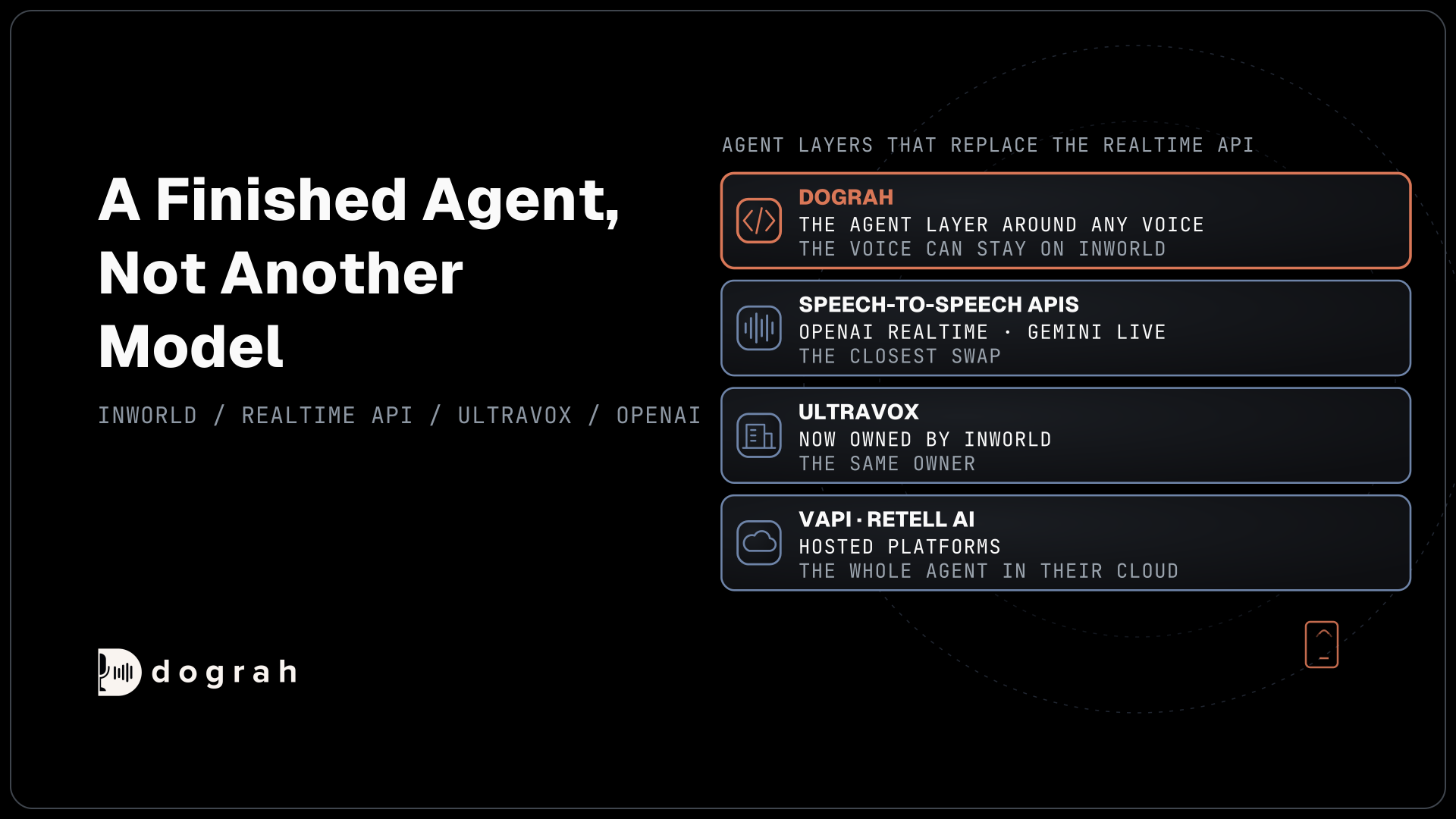
A team that wants a finished agent, not another model, needs an agent layer. Speech-to-speech APIs are the closest swap for Inworld's Realtime API. OpenAI Realtime and Gemini Live take the caller's audio and answer in audio, and Inworld's API follows the OpenAI Realtime protocol, so moving there is the shortest code change.
Ultravox is the odd case. Inworld bought Ultravox on 30 September 2026 and says existing customers need no migration or code change. Ultravox still sells at $0.05 a minute after 30 free minutes, with open model weights and a closed hosted service. Our Ultravox review covers it in full. Leaving Inworld for Ultravox now keeps you with the same owner.
Full platforms sit one step further out. Vapi and Retell AI run the whole agent in their cloud at a published rate per minute plus models, and Dograh does the same job in code you can run yourself. A speech-to-speech model inside a platform is also a normal setup, since Dograh offers seven Realtime providers, from OpenAI and Gemini to Ultravox and AWS Nova Sonic.
Join the Dograh Community
Dograh is an OSS alternative to Vapi. Join our Slack community for queries, releases, best practices & community interactions.
When staying on Inworld makes sense
Inworld is still a strong pick for a team happy with TTS-2. Its price falls with each plan, from $25 per 1M characters on demand to $12.50 on the $1,500 Growth plan. Inworld lists HIPAA and a BAA as add-ons on Growth, with EU and India data residency on Enterprise. TTS-2 Flash answers at a lower rate when speed matters more than steering.
Teams already built on the Realtime API also have little reason to rush. It speaks OpenAI's protocol, so the client code stays portable, and Ultravox customers keep running unchanged under the new owner. Our Inworld AI review covers who it fits in more depth. If the voice is right and only the agent layer is the problem, keep TTS-2 and run it inside a platform you own.
What moving off Inworld takes
Plan the move layer by layer, because each one carries over differently. Cloned voices live in your Inworld workspace, so a new voice provider means cloning the voice again from your source recordings and testing it on real calls. Inworld's own voice migration tool moves clones into Inworld, not out of it, so keep the original recordings.
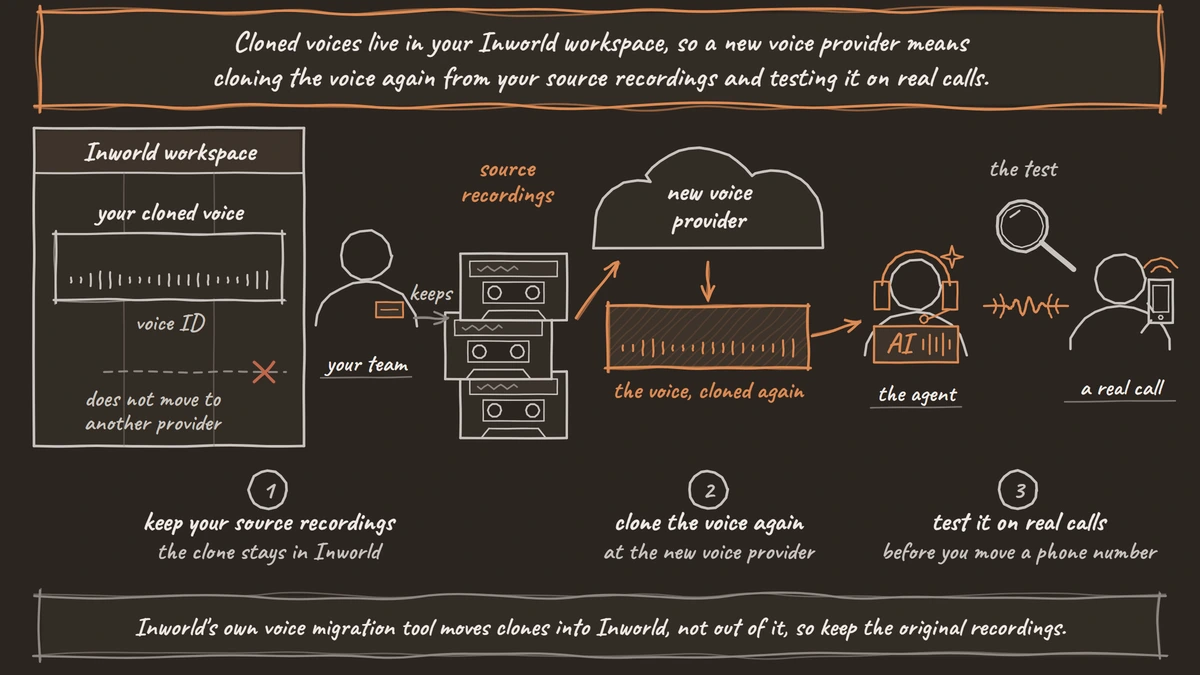
The Realtime API is the easier part to move. Client code written against Inworld's OpenAI-compatible protocol needs few changes to run on OpenAI Realtime. A move to a full platform is a rebuild, where the prompts and tools become the written spec for the new agent. In Dograh that agent is described to the Agent Builder, and the voice can stay on Inworld while everything else changes.
Credits need a look before you cancel. Our guide to Inworld AI pricing covers how unused subscription credits roll over and what happens when you leave a plan. Then move one queue or one number first, compare the voice time per turn on both setups, and switch the rest only when the new one holds up.
Picking your Inworld alternative
Start from the part that is not working. If the voice is the problem, try ElevenLabs, Cartesia or Rime against TTS-2 on the same phone line, and compare price per character at your volume. If the Realtime API is the problem and you want to stay with an API, OpenAI Realtime and Gemini Live are the nearest swaps.
If what you want is control, meaning open code, your own servers or on-prem inside your network, start with Dograh and keep any voice you like, Inworld's included. If you would rather not run anything, a hosted platform such as Vapi or Retell AI takes the servers off your hands. Whichever way you lean, run one real call on the new setup before you move a phone number.
Glossary
- Agent layer
- The software that runs the conversation around the models, from the phone line and turn-taking to tools and transfers. Inworld's Realtime API and Dograh both sit here.
- Delivery mode
- Dograh's setting for Inworld TTS-2 that trades steadiness for expression, with Stable, Balanced or Creative. It starts on Balanced.
- Workspace voice
- A cloned or custom voice stored in a team's Inworld workspace and used by its voice ID. It does not move to another provider.
- Bring your own key (BYOK)
- Plugging your own model provider account into a platform. The contract and bill are yours, while the text or audio still reaches that provider.