
Inworld AI suits developers who want a fast, steerable voice API, and it has owned Ultravox since September 2026. TTS-2 costs $25 per million characters on demand. For teams that want to own the platform, Dograh is the open-source AI voice agent platform, self-hosted or on Dograh Cloud, and runs Inworld voices on your key.
Key Takeaways
- Inworld sells text-to-speech, speech-to-text, a Realtime API and model routing as separate APIs.
- TTS-2 ranks 9th of 105 voices on the Artificial Analysis Speech Arena.
- Zero data retention starts on Developer, and EU data residency needs Enterprise.
Inworld sells the voice, the listening and the routing behind many voice agents, and in September 2026 it bought Ultravox. We review its products, voice quality and speed, prices, data terms and fit for phone agents, then show how Dograh runs Inworld voices and Ultravox on your own keys.
Inworld AI in one table
Inworld is strongest as a voice and simplest as a set of APIs, and its limits sit in hosting and in who can use it. Each row is covered, with its source, in the sections below.
| Area | Strength | Limit |
|---|---|---|
| Voice | TTS-2 ranks 9th of 105 on the Speech Arena, with plain-language steering | ElevenLabs v4 models sit above it |
| Speed | Inworld lists 100 ms P90 time to first audio for TTS-2 and 20 ms for Flash | Inworld's own figures, measured on its servers |
| Languages | TTS-2 accepts codes for 470 languages | 94 are fully supported, and 15 most closely evaluated |
| Phone audio | Returns mu-law and A-law, the phone codecs | A phone agent still needs a platform around it |
| Price | TTS-2 from $25 per million characters on demand down to $12.50 on Growth | Every character sent counts, tags and unplayed audio included |
| Data terms | GDPR and SOC 2 Type II on every plan | Zero retention from Developer, EU residency on Enterprise |
| Open code | TTS-1 training code under MIT | TTS-2 weights are not published, and the service is hosted |
| Building | APIs, SDKs and a Twilio guide | Suits teams that work in code |
What Inworld sells now
Inworld's product is a set of voice APIs, and the voice is the center of it. TTS-2 is the flagship and production default, and TTS-2 Flash is the faster version without steering. The older 1.5 models are deprecated, so reviews built on them describe a product Inworld is retiring.
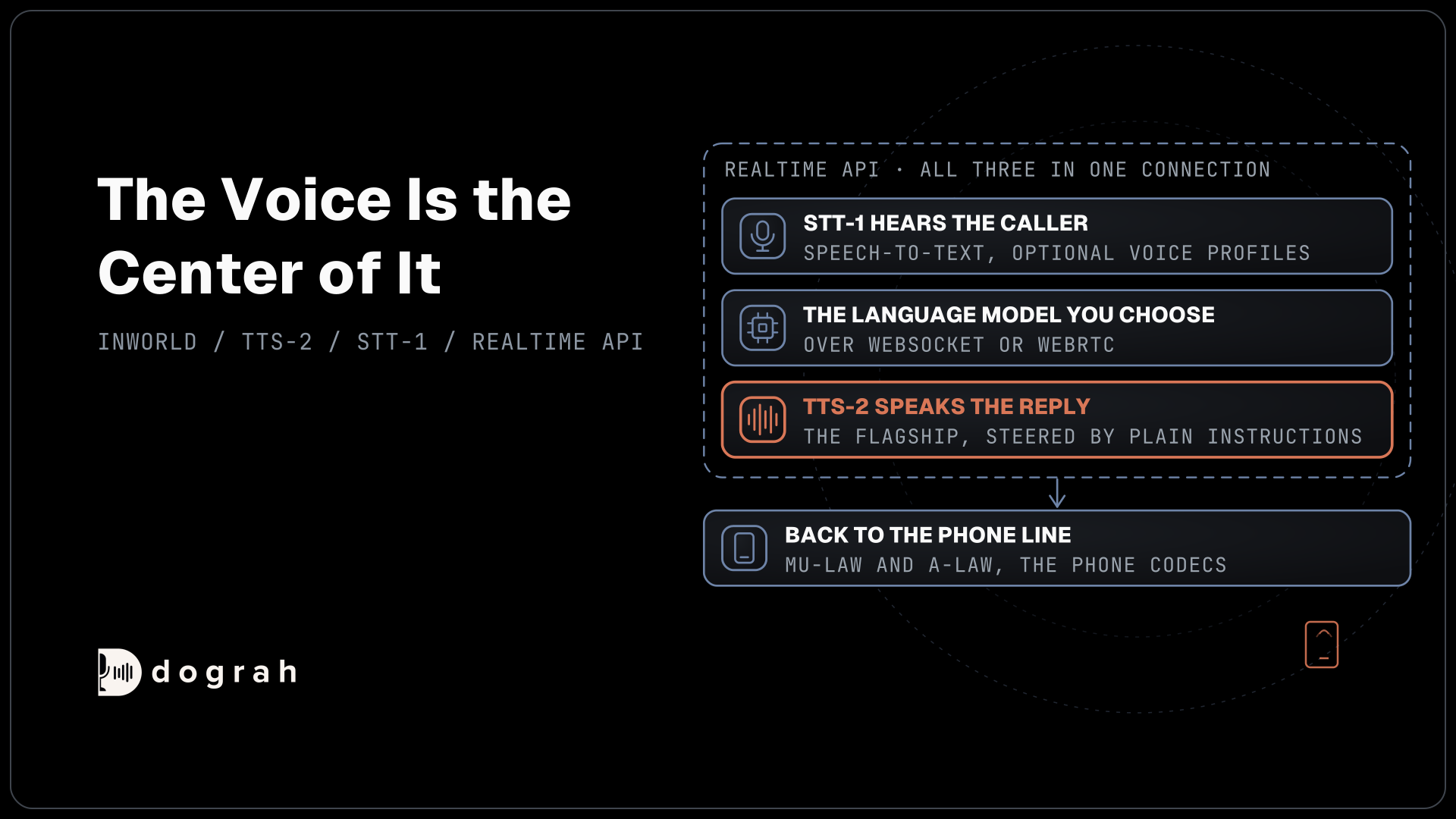
Around the voice sit three more APIs. STT-1 is Inworld's speech-to-text, in 30 languages, with optional Voice Profiles that report a speaker's age, gender, emotion, vocal style and accent beside the transcript. The Realtime API joins speech-to-text, the language model you choose and a TTS voice in one connection over WebSocket or WebRTC, following OpenAI's Realtime protocol. Inworld Inference routes requests to hosted open models or third-party ones behind one API key.
Ultravox is the newest part. Inworld's announcement, dated 30 September 2026, says Ultravox customers need no migration or code change, and built-in Inworld voices on Ultravox moved to TTS-2 at no extra cost. Ultravox is still sold under its own name and prices, and our Ultravox review covers it in full.
How TTS-2 sounds and how fast it is
On quality, TTS-2 is among the strongest voices a phone agent can use. On the Artificial Analysis Speech Arena, a live leaderboard where listeners vote blind between clips, TTS-2 currently ranks 9th of 105 and TTS-2 Flash 18th. Eleven v4 Turbo and Eleven v4 share first place, so TTS-2 sits close behind ElevenLabs' two newest models.
Speed claims need care. Inworld lists 100 ms P90 time to first audio for TTS-2 and 20 ms for Flash, measured on its own servers before the network. On a call, the caller's wait also includes turn detection, the language model and the phone path, so test the whole turn on a real line.
What sets TTS-2 apart is control. You steer it with plain instructions in square brackets, such as an emotion, a pace or a laugh, and you can clone a voice from as little as 3 seconds of audio or design one from a description. TTS-2 accepts codes for 470 languages in three tiers, with 15 most closely evaluated, 79 more fully supported and 376 best effort. Check your language's tier before you build around it, and listen on 8 kHz phone audio, not only in a browser.
Inworld on a phone line
Inworld covers the voice side of a phone call well, and leaves the call itself to a platform. It returns audio in mu-law and A-law, the codecs phone networks use, so speech can go to a carrier without conversion, and its docs include a guide for phone calls through Twilio ConversationRelay. Turn-taking, tools, transfers and call records still come from Inworld's Realtime API or from a platform you choose.
Concurrency is the number to check before a busy line goes live. Inworld lists concurrent TTS requests by plan, 5 on On-Demand, 10 on Creator, 50 on Builder, 150 on Developer and 500 on Growth, and estimates at least four user sessions for each request slot, a figure it says will differ by use case. By that estimate, a line with 100 calls at once points at Builder or above, whatever the character count says.
Interruptions matter as well. Audio already generated for a sentence the caller talks over still counts as used, so an agent that gets cut off often pays for words nobody heard, unless the integration cancels the unfinished text. Test with real callers who interrupt, not only with clean demo turns.
Prices in brief
Inworld prices by plan, and every plan's fee comes back as credits. Inworld's plans run from On-Demand at $0, then Creator at $25, Builder at $100, Developer at $300 and Growth at $1,500 a month, with Enterprise custom. TTS-2 runs from $25 per million characters on demand down to $12.50 on Growth, Flash from $15 down to $7, and STT-1 costs $0.15 an hour on demand and $0.10 on paid plans.
The Realtime API has no per-minute price and bills each part at your plan's rates. Our post on Inworld AI pricing works through a month of calls and the billing rules that move it. For how Inworld's rates sit beside other voices, see our ranking of the best TTS APIs for voice agents.

Open Source Alternative to Vapi / Retell
Self-hosted voice agent platform — no per-minute fees
dograh-hq/dograh
Star on GitHub
Data terms and the closed-source gap
Inworld's data terms step up with the plan, so what you get depends on what you pay. GDPR and SOC 2 Type II apply on every plan. Zero data retention, which Inworld describes as never storing your requests or audio when turned on, starts on Developer at $300 a month. HIPAA and a business associate agreement (BAA) are an add-on on Growth, and a data processing agreement (DPA), an SLA and EU or India data residency sit on Enterprise.
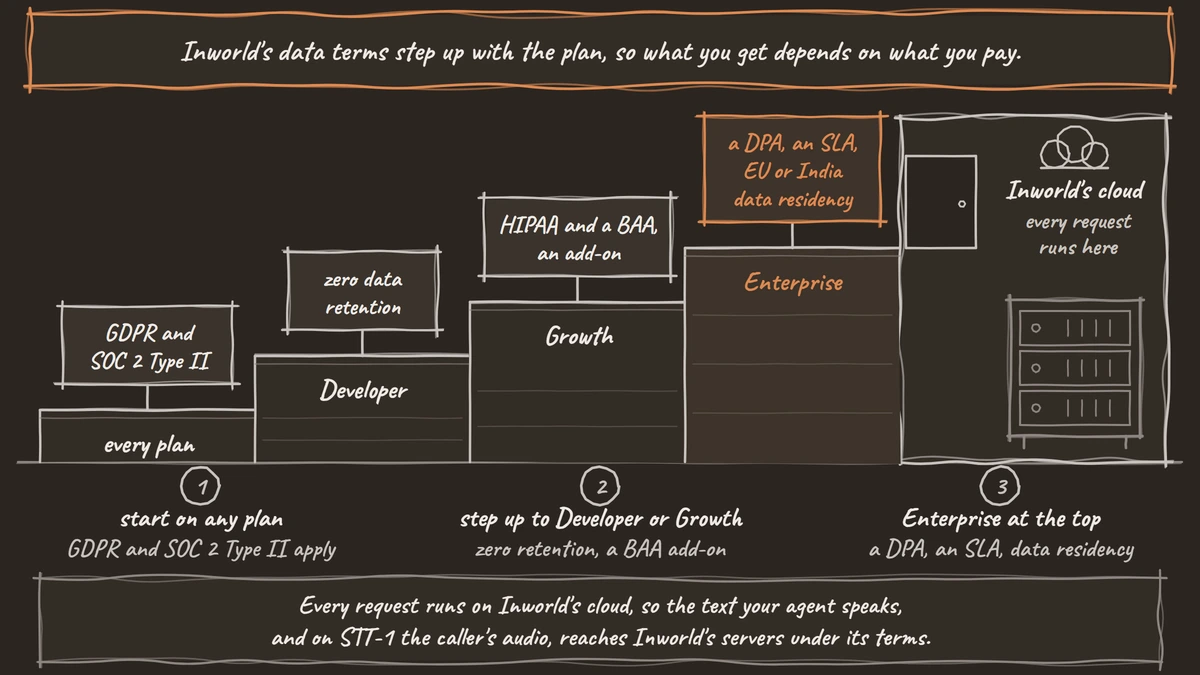
The models themselves are closed and hosted. Inworld's TTS repository holds the MIT-licensed training and modeling code for the older TTS-1 models, while TTS-2's weights are not published. Every request runs on Inworld's cloud, so the text your agent speaks, and on STT-1 the caller's audio, reaches Inworld's servers under its terms. For a regulated team, that means the plan you buy is also your data policy, and a privacy review looks at Inworld as a vendor.
Who Inworld fits
Inworld fits developers who want a top-ten voice with steering and cloning, priced per character, from a company that also sells the other parts of an agent. A team already on Ultravox gets one owner for the model and the voice, and our guide to Ultravox alternatives covers the other routes. A team that wants the Realtime API's single connection, on an OpenAI-compatible protocol, gets a cascade without building the plumbing.
It fits less well a team without developers, since every product is an API. It also fits less well a team that needs zero data retention, a DPA or EU residency on a small budget, since those sit on the higher plans, or a team that must keep every voice on its own servers.
Join the Dograh Community
Dograh is an OSS alternative to Vapi. Join our Slack community for queries, releases, best practices & community interactions.
Where Dograh fits
Dograh fits teams that want Inworld's voice inside an agent platform they own. Inworld TTS is a built-in voice provider that runs on your own Inworld key, billed by Inworld, with inworld-tts-2 and the Ashley voice as defaults. You can type inworld-tts-2-flash as a custom model, paste a cloned voice ID, set the language, the speed and a delivery mode of Stable, Balanced or Creative. Ultravox, Inworld's other product, is a built-in Realtime provider on your Ultravox key, so one agent can speak with an Inworld voice in a cascade while another runs on Ultravox. Our page on using Inworld voices in Dograh shows that setup on your own key, cloned voice IDs included.
In Dograh, the orchestration layer runs the call flow, tools and telephony, and you pick the speech and language models separately. Bring your own key (BYOK) moves the contract to you, while the text still reaches Inworld. Lines the agent says on every call can play as pre-recorded clips instead, so those sentences never reach Inworld at all. Transfer Call can hand a caller who needs a person to your staff on Twilio, Telnyx, Plivo, Cloudonix and Asterisk ARI. Dograh dials the destination before connecting the caller, who is joined only when someone answers, and a busy line or no answer returns the call to the agent.
Where the voices run decides both cost and data. Voice audio stays inside your network only when open models run on your own servers, which run through Local Models (Speaches). Self-hosted Dograh has no per-minute platform fee, but servers, model keys and phone minutes still cost money. Dograh Cloud charges a 1¢-a-minute platform fee. The trade for self-hosting is upkeep, since your team runs the server, the database and every upgrade, with help from the community on Slack and GitHub for the open-source version and custom SLAs on Enterprise.
Glossary
- Steering
- Plain-language instructions in square brackets inside the text, such as an emotion or a pace, that change how TTS-2 reads a line. The tag counts as billed characters.
- P90 time to first audio
- The time within which 90 percent of requests return their first audio. Inworld lists 100 ms for TTS-2, measured on its own servers before the network.
- Zero data retention
- A setting where the provider keeps no copy of your requests or audio. Inworld offers it from the Developer plan up.
- Bring your own key (BYOK)
- Using a model provider account of your own inside a platform. You hold the contract and the bill, while your text or audio still goes to that provider.