
Inworld AI pricing runs on monthly plans from $0 to $1,500, and each paid plan's fee comes back as credits. TTS-2 costs $25 per million characters on demand and $12.50 on Growth. For teams that want to own the platform, Dograh is the open-source AI voice agent platform, self-hosted or on Dograh Cloud, and plays Inworld voices on your key.
Key Takeaways
- Every paid plan's fee comes back as credits that roll over for three months.
- Inworld bills every character sent, including steering tags and audio nobody hears.
- Under Inworld, Ultravox still charges $0.05 a minute with the voice included.
Inworld's rates look simple per million characters, but what you send decides the bill. We lay out the plan ladder and credit rules, how characters and audio are counted, a 4,000-minute month, Ultravox's prices under Inworld, and how Dograh runs Inworld voices on your own key.
How Inworld prices, in one table
Inworld sells monthly plans, and the plan sets your rate for every product. Inworld sells six tiers, with yearly billing giving two months free.
| Plan | Monthly fee | TTS-2 per 1M characters | TTS-2 Flash per 1M characters | STT-1 per hour | Concurrent TTS requests |
|---|---|---|---|---|---|
| On-Demand | $0 | $25 | $15 | $0.15 | 5 |
| Creator | $25 | $20 | $10 | $0.10 | 10 |
| Builder | $100 | $17.50 | $9 | $0.10 | 50 |
| Developer | $300 | $15 | $8 | $0.10 | 150 |
| Growth | $1,500 | $12.50 | $7 | $0.10 | 500 |
| Enterprise | Custom | Custom | Custom | Custom | Custom |
The language model is billed from the same credits, from $0.07 per million input tokens on open models, with third-party models passed through at the provider's cost. The plan also decides your data terms. Zero data retention starts on Developer, HIPAA and a business associate agreement (BAA) are a Growth add-on, and a data processing agreement and EU or India data residency sit on Enterprise.
Credits, rollover and what happens when you leave
A paid plan is a prepayment more than a fee. Each month's fee comes back as credits equal to the plan price, and your usage is taken from them at that plan's rates. Unused subscription credits roll over for up to 3 months while the subscription stays active, each month's grant on its own clock.
Extra credits start at $10, bill at your tier's rates and expire a year after purchase. The rules turn strict when you step down. Downgrades and cancellations take effect at the end of the billing period, and any remaining credits are forfeited, so time a downgrade for when the balance is low.
The practical test is simple. If your monthly usage at a tier's rates is above that tier's fee, the plan pays for itself. If it is far below, a smaller plan or On-Demand costs less, even with its higher rates.
What counts as a character
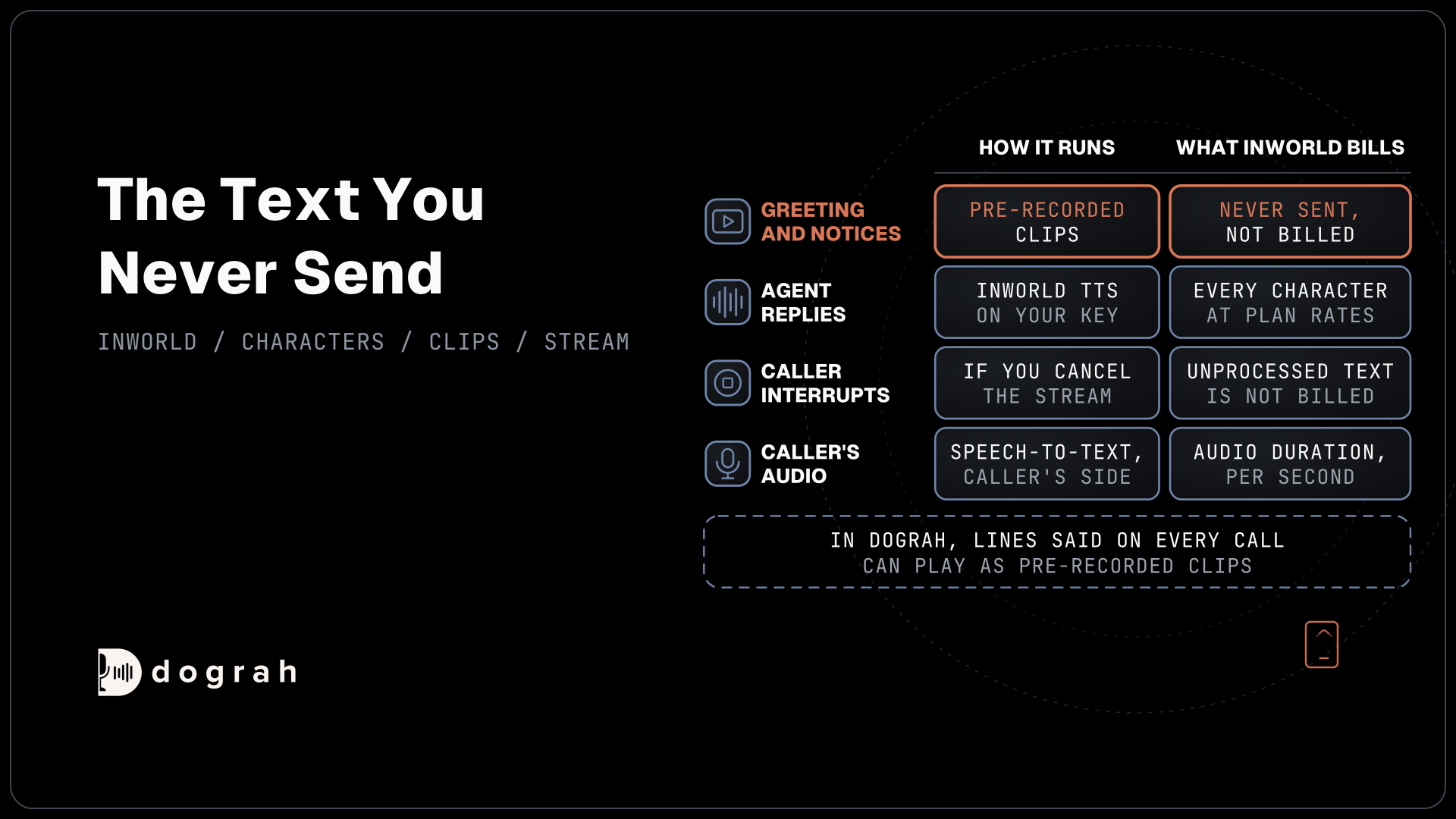
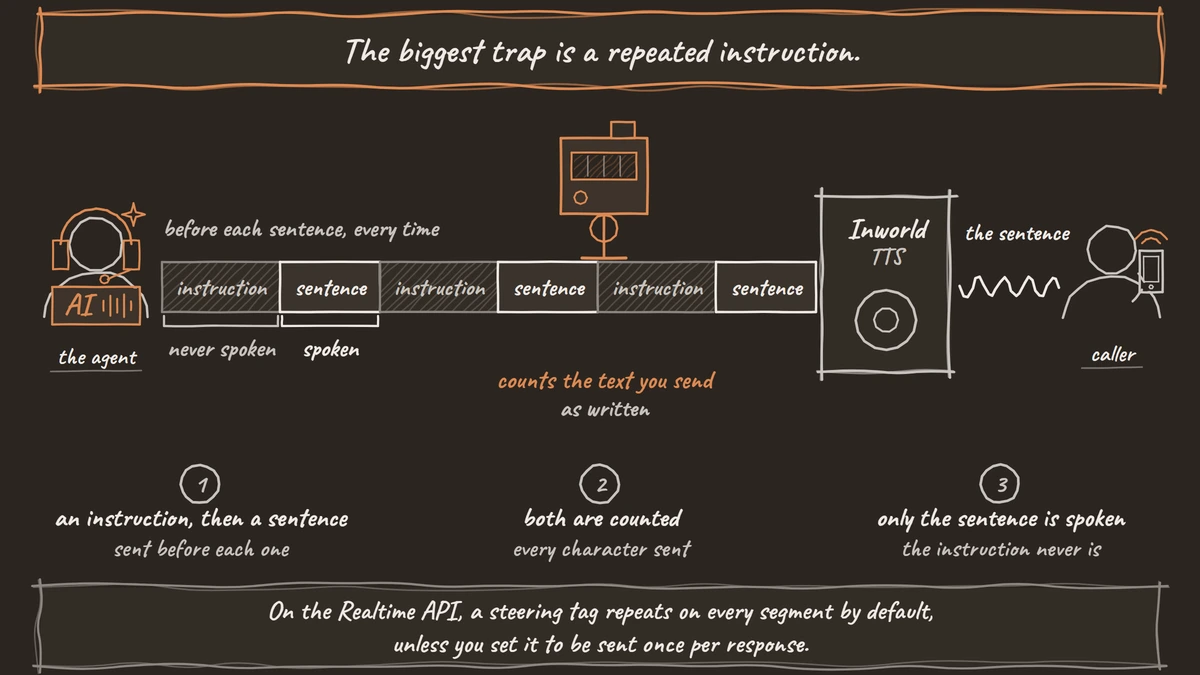
Inworld counts the text you send, as written, and that is where most surprises come from. Inworld's billing counts spaces, punctuation and steering tags, so a tag like [whisper] costs characters though it is never spoken. Audio you do not play is still counted too, which matters on calls where callers interrupt.
The biggest trap is a repeated instruction. Inworld's own example is an agent that sends a 130-character instruction before each 120-character sentence and pays for 250 characters every time, so the instruction is more than half of its usage. On the Realtime API, a steering tag repeats on every segment by default, unless you set it to be sent once per response.
Two settings work in your favor. Canceling a stream when the caller interrupts discards text that has not been processed yet, so it is not billed. And the Batch API costs 20% less per character, which suits audio you can generate ahead of time, such as greetings and notices.
Speech-to-text and the Realtime API
STT-1 bills by audio duration with per-second rounding, so each stream is rounded up to the next whole second. It counts the audio you send, not the speech it detects, so a stream left open on a silent line keeps billing for as long as audio keeps arriving. Close the stream when the call ends, and send only the caller's side.
The Realtime API has no per-minute or per-session price. It uses component billing, charging the speech-to-text, language model and TTS parts at your plan's rates, and the language model part grows during a call, because the system prompt, tool definitions and conversation history are sent again as input on every turn. Segments already sent before an interruption are still counted. A long call with a big prompt therefore costs more per minute at its end than at its start.
What 4,000 minutes a month costs
A worked example makes the rules concrete. Take 4,000 call minutes in a month and assume the agent speaks 1.6 million characters, about 1,600 minutes of agent speech at Inworld's own estimate of 1,000 characters a minute, while speech-to-text streams the caller's side for all 4,000 minutes, or 66.7 hours. On-Demand's small included allowance is left out of the sums.
| Plan and model | Voice | Speech-to-text | What you pay |
|---|---|---|---|
| On-Demand, TTS-2 | 1.6 x $25 = $40 | 66.7 x $0.15 = $10 | $50 |
| Creator, TTS-2 | 1.6 x $20 = $32 | 66.7 x $0.10 = $6.67 | $25 fee plus $13.67 of extra credits, so $38.67 |
| Creator, TTS-2 Flash | 1.6 x $10 = $16 | 66.7 x $0.10 = $6.67 | $25 fee, with $2.33 of credits rolling over |
| Builder, TTS-2 | 1.6 x $17.50 = $28 | 66.7 x $0.10 = $6.67 | $100 fee, with $65.33 of credits rolling over |
| Ultravox, Pay as you go | Included | Included | (4,000 - 30 free) x $0.05 = $198.50 |
Creator fits this volume best, and Builder only makes sense if your usage will grow into its credits. Every Inworld row still needs a language model on top, and its cost grows with each turn as history is resent. The Ultravox row bundles the model and the voice in one minute rate, so the two are different kinds of bill. Add phone minutes to every row.

Open Source Alternative to Vapi / Retell
Self-hosted voice agent platform — no per-minute fees
dograh-hq/dograh
Star on GitHub
How Ultravox is priced under Inworld
Inworld bought Ultravox on 30 September 2026, and Ultravox still sells on its own terms. Ultravox gives 30 free minutes, then $0.05 a minute with the voice included, up to 5 calls at once on Pay as you go. Pro costs $100 a month, billed yearly, with no hard cap on calls at once, and SIP adds half a cent a minute on Pay as you go.
Three things changed with the new owner. The Scale plan is no longer offered, and Ultravox's concurrency guide points Scale customers to Inworld's Growth tier. Built-in Inworld voices on Ultravox moved to TTS-2 at no extra cost. And Threads, side conversations that run alongside a call, bill by token at $2.00 per million input tokens and $15.00 per million output tokens, with Threads on Inworld models charged to your own Inworld key when you add one. Our Ultravox review covers the plans and the model in full.
Questions to ask before you pick a plan
A few answers decide which plan fits, so get them before you commit. Start with concurrency. Count your busiest hour, since the plan caps concurrent TTS requests, and Inworld estimates at least four user sessions per request slot, a figure it says varies by use case.
Then check your data terms. If you need zero data retention, a BAA, a data processing agreement or EU residency, the plan is set by those needs before any price. Ask how your integration handles interruptions and whether it cancels unfinished text. Ask what happens to credits if you move down a tier mid-year, and get Enterprise rates in writing, since they are custom. Our Inworld AI review covers the products and fit behind these prices.
Join the Dograh Community
Dograh is an OSS alternative to Vapi. Join our Slack community for queries, releases, best practices & community interactions.
Inworld voices in Dograh and where the bill runs
Inworld TTS is a built-in voice provider in Dograh, the open-source AI voice agent platform, and it runs on your own Inworld key. Your Inworld bill stays exactly as this post describes, billed by Inworld at your plan's rates, with inworld-tts-2 and the Ashley voice as defaults and inworld-tts-2-flash available as a custom model. Ultravox runs as a built-in Realtime provider on your Ultravox key too.
The biggest saving is the text you never send. Lines the agent says on every call, such as the greeting or a policy notice, can play as pre-recorded clips, and every clip that plays is a sentence Inworld does not bill. Our post on cutting voice AI costs with pre-recorded audio works through how much that saves.
The platform is its own line next to the Inworld bill, and where it runs decides that line. Self-hosted Dograh has no per-minute platform fee, but servers, model keys and phone minutes still cost money. Dograh Cloud charges a 1¢-a-minute platform fee. On the 4,000 minutes above that adds 4,000 x $0.01 = $40, with 10 calls at once included on pay as you go. Self-hosting also hands your team the server, the database and every upgrade, backed by community support on Slack and GitHub for the open-source version and custom SLAs on Enterprise.
Glossary
- Subscription credits
- The credits each paid Inworld plan grants every month, equal to its fee. Usage is taken from them at that plan's rates, and unused credits roll over for up to 3 months.
- Steering tag
- A plain-language instruction in square brackets, such as [whisper], that changes how TTS-2 reads a line. Inworld counts it as billed characters though it is not spoken.
- Per-second rounding
- STT-1 counts each audio stream to the next whole second. It counts audio sent, not speech detected, so an open stream on a silent line keeps billing.
- Component billing
- Pricing that charges each part of a voice session, speech-to-text, the language model and the voice, at its own rate. Inworld's Realtime API bills this way, with no per-minute price.