
Ultravox alternatives are divided into other speech-to-speech models, hosted cascade platforms and open-source options you run yourself. For teams that want to own the platform, Dograh is the open-source AI voice agent platform, self-hosted or on Dograh Cloud, and it runs Ultravox on your key. GPT-Live and Gemini Live are models, and Vapi and Retell AI hosted platforms.
Key Takeaways
- Ultravox's $0.05 minute includes the model and voice, unlike most rows here.
- Speech-to-speech models bill per minute or token, and you still wire phones and tools.
- Dograh is open source and self-hostable, and runs Ultravox as a provider on your key.
Inworld now owns Ultravox, and some teams want a second option before their next contract. We put every option in one table, show how open-source Dograh runs Ultravox or another speech model, then cover speech models, hosted platforms, frameworks, a priced month, staying and leaving.
Ultravox alternatives in one table
Ultravox is the baseline row, and every other option answers the same questions about what it is, where it runs and how it bills. Ultravox gives 30 free minutes, then $0.05 a minute with the voice included, and Pay as you go stops at 5 calls at once.
| Option | What it is | Open code and where it runs | How it bills | Calls at once |
|---|---|---|---|---|
| Ultravox (baseline) | Speech-native model on a hosted platform, now owned by Inworld | MIT model weights, closed hosted platform on Ultravox's servers | $0.05/min with the voice. Pro $100/mo billed yearly. SIP 0.5¢/min | 5 on Pay as you go, no hard cap on Pro |
| Dograh | Open-source AI voice agent platform that runs Ultravox, other speech-to-speech models or a cascade | BSD 2-Clause. Your servers, on-prem on Enterprise, or Dograh Cloud | Self-hosted, no per-minute platform fee. Dograh Cloud, 1¢/min platform fee. Models and phone extra | 10 by default self-hosted, adjustable. 10 on Cloud pay as you go |
| OpenAI GPT-Live and gpt-realtime | Speech-to-speech models | Closed, OpenAI's cloud | GPT-Live $0.05/min plus the backend model and tools. gpt-realtime-2.1 by audio token | Set by your OpenAI account |
| Gemini Live | Speech-to-speech models | Closed, Google's cloud | $0.005/min audio in, $0.018/min audio out | Set by your Google account |
| Vapi | Hosted cascade platform | Closed, Vapi's cloud | $0.05/min hosting plus models and phone | 4 with no package, 10 on Core ($29/mo) |
| Retell AI | Hosted cascade platform | Closed, Retell's cloud, on-prem through Enterprise sales | $0.055/min voice infrastructure plus the model, $0.015/min telephony | 20 included, $8/mo each extra |
| ElevenLabs Agents | Hosted cascade platform | Closed, ElevenLabs' cloud | Plan minutes, then $0.08/min, language model on top | 4 to 40 by plan |
| Inworld Realtime API | Speech-to-text, a language model and a voice in one connection | Closed, Inworld's cloud | Billed by each part used, no per-minute price | By plan |
| LiveKit Agents and Pipecat | Open-source frameworks | Apache-2.0 and BSD-2-Clause, your servers | Free to self-host | Your servers |
Ultravox's single rate already holds the language model and the voice, while most other rows add models on top. Every closed row runs on its vendor's servers, so the call audio and transcripts sit with that vendor. Only Dograh and the two frameworks let you run the whole stack yourself, and of those only Dograh arrives as a working phone platform.
Dograh: open code, your servers and Ultravox inside
All of Dograh is in its GitHub repository under the BSD 2-Clause license, so your team can read any line of code that touches a call. You can self-host it with Docker Compose on a server with at least 8 GB of RAM and 4 vCPUs, run it on Dograh Cloud, or take on-prem deployment on the Enterprise plan. It comes as a complete platform, with the Agent Builder, a visual call-flow canvas, Campaigns, call transfer, QA and call traces.
Ultravox is built in as a Realtime speech-to-speech provider and runs on your own Ultravox key, billed by Ultravox. You add it under Models in the sidebar by choosing Realtime mode in a model configuration, with ultravox-v0.7 and the Mark voice as defaults, plus a separate language model for variable extraction and QA. Dograh acts as the orchestration layer for the call flow, tools and telephony, and the speech and language models sit in their own layer that you choose. So one agent can stay on Ultravox while another moves to GPT-Live, Gemini Live, Grok or Amazon Nova Sonic, or to a cascade of separate speech-to-text, language and voice models. On a speech-to-speech model, fixed transition lines play from a recording, and agent handoffs and the spoken transfer introduction run on a cascade agent.
Bring your own key (BYOK) moves the contract to you, but the call audio still reaches Ultravox or whichever provider you pick. Audio stays inside your network only when open-weight models run on your own servers too. A caller who asks for a person can be passed on with Transfer Call, which works on Twilio, Telnyx, Plivo, Cloudonix and Asterisk ARI. Dograh calls the destination first and connects the caller only when someone answers, and a busy line, no answer or a failed call comes back to the agent, which carries on with the caller.
Where the platform runs decides its fee. Self-hosted Dograh has no per-minute platform fee, but servers, model keys and phone minutes still cost money. Dograh Cloud charges a 1¢-a-minute platform fee, and its pay as you go plan includes 10 calls at once, with more on request. A self-hosted install runs 10 calls at once by default, a setting you can raise. The server, the database and every upgrade are then your team's to run, with community support on Slack and GitHub for the open-source version and custom SLAs on Enterprise.

Open Source Alternative to Vapi / Retell
Self-hosted voice agent platform — no per-minute fees
dograh-hq/dograh
Star on GitHub
Other speech-to-speech models
These are models, so they replace Ultravox's model and leave the phone line, tools and call records for you to wire. OpenAI prices GPT-Live at $0.05 a minute, billed per second, with the backend model and tool use charged separately. gpt-realtime-2.1 bills by audio token instead, at $32 per million tokens in and $64 out, and its mini version at $10 and $20.
Gemini 3.8 Live, its Extended Thinking version and Gemini 3.1 Flash Live share one rate, $0.005 a minute of audio in and $0.018 a minute out. Grok Voice and Amazon Nova Sonic fill out the group, and our guide to speech-to-speech voice AI maps the phone path and tool support for each one.
Every model here is closed and hosted, like Ultravox's platform. Where they differ from a cascade is reasoning. In our experience a cascade of separate models is better at reasoning, tool calling and voice cloning, and speech-to-speech models can fail in calls that chain several tool calls. Our post on cascade vs speech-to-speech walks through each trade-off.
Hosted cascade platforms
A hosted cascade platform runs separate speech-to-text, language and voice models for you on one bill, so you can pick each model and swap it later. Vapi charges $0.05 a minute for hosting, with every model and the phone line billed on top. With no package the limit is 4 calls at once, Core raises it to 10 for $29 a month, and HIPAA handling is a $2,000-a-month add-on.
Retell AI lists $0.055 a minute for voice infrastructure and $0.015 for telephony, with the language model priced separately and an all-in range of $0.07 to $0.31 a minute. It includes 20 calls at once and sells speech-to-speech models too, GPT-Live 1 among them at $0.05 a minute plus the backend model. ElevenLabs Agents bundles minutes into plans, from 15 free minutes up to Business at $990 for 12,375, then charges $0.08 a minute with the language model on top.
Inworld, Ultravox's new owner, sells its own Realtime API, which joins speech-to-text, the language model you choose and a voice in one connection, following OpenAI's Realtime protocol. It bills each part at your plan's rates with no per-minute price, and our Inworld AI review covers it in full. All four are closed source, so your calls run, and are stored, on the vendor's servers under its terms.
Open-source frameworks: LiveKit Agents and Pipecat
LiveKit Agents and Pipecat are strong building blocks for developers, though the product is left for them to make. LiveKit Agents carries the Apache-2.0 license, and Pipecat, the BSD-2-Clause Python framework, is what Dograh itself is built on. With either one, your team writes the phone wiring, call history, transfers and QA before the first caller gets an answer. Our comparison of open-source voice AI frameworks shows what each gives you on a phone line.
Ultravox's own model weights are open too, under MIT. The v0.7 release sits on GLM-4.6, a model of about 357 billion parameters, so self-hosting the model means serious GPUs and a platform you still build around it. Our Ultravox review covers that route.
What 3,000 minutes a month costs
A worked example makes the published rates concrete. Take 3,000 call minutes in one month and price only the line each option bills for them.
| Option | Line for 3,000 minutes | Still to add |
|---|---|---|
| Ultravox, Pay as you go | (3,000 - 30 free) x $0.05 = $148.50 | Carrier minutes, or 3,000 x $0.005 = $15 on SIP |
| OpenAI GPT-Live | 3,000 x $0.05 = $150 | Backend model, tools and a phone path |
| Vapi | 3,000 x $0.05 = $150 | Speech-to-text, language model, voice and phone |
| Retell AI | 3,000 x $0.055 = $165, plus 3,000 x $0.015 = $45 telephony, so $210 | The language model |
| ElevenLabs Agents, Scale | $299 plan with 3,738 minutes included | The language model and carrier minutes |
| Dograh Cloud | 3,000 x $0.01 = $30 | Your models on your keys, such as Ultravox's own minutes, and phone |
| Dograh self-hosted | No platform fee | Servers, model keys and phone minutes |
The rows count different things. Ultravox's minute already pays for the model and the voice, while the Vapi, Retell AI and Dograh rows still need models added at each provider's price. Ultravox's concurrency cap on Pay as you go is 5 calls at once, so a busier line means Pro at $100 a month on a yearly plan.
Join the Dograh Community
Dograh is an OSS alternative to Vapi. Join our Slack community for queries, releases, best practices & community interactions.
When staying on Ultravox makes sense
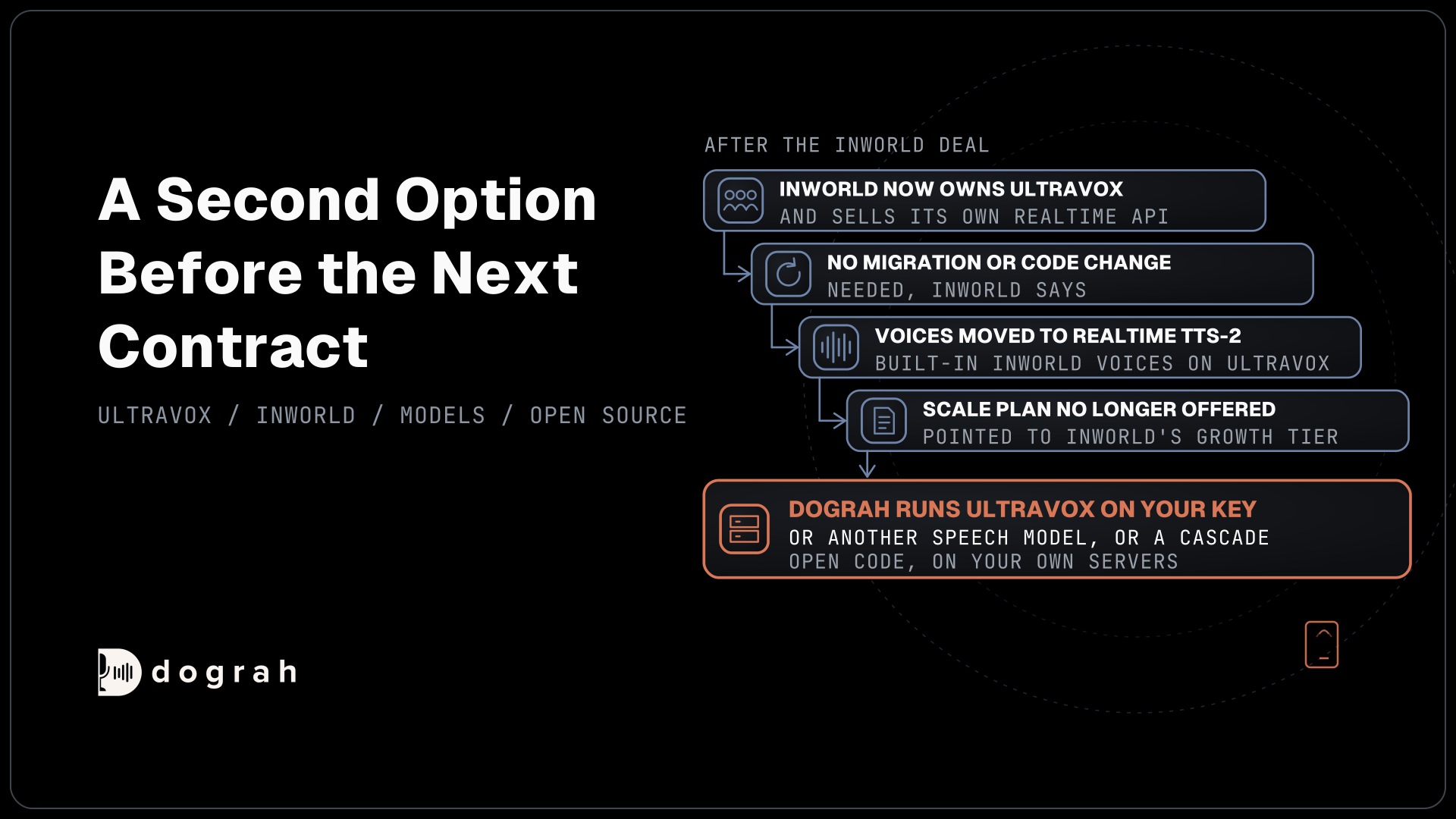
Ultravox is a sound choice for conversational calls with light tool use, where one rate covering the model and the voice keeps the bill easy to forecast. It connects natively to Twilio, Telnyx, Plivo and Exotel, plus SIP, and Inworld's announcement says no migration or code change is needed after the deal. Built-in Inworld voices on Ultravox moved to Realtime TTS-2 at no extra cost.
New features keep arriving as well. Threads run parallel side conversations alongside the main call, billed by token at $2.00 per million input tokens and $15.00 per million output tokens, and Threads on Inworld models bill to your own Inworld key if you add one. The case for looking around starts with the plan changes. Ultravox's concurrency guide says the Scale plan is no longer offered, with Scale customers pointed to Inworld's Growth tier, and paid plans can still return an HTTP 429 error under extreme load.
What moving off Ultravox takes
A move is mostly a rebuild of the agent around a new model, so start by pulling out what you have. Ultravox's API returns each agent's details through Get Agent, every call an agent made through List Agent Calls, each call's messages through List Call Messages and a link to its recording through Get Call Recording. Save those before you delete anything, because deleting a call removes its messages, recordings and stages, and Ultravox keeps only basic metadata.
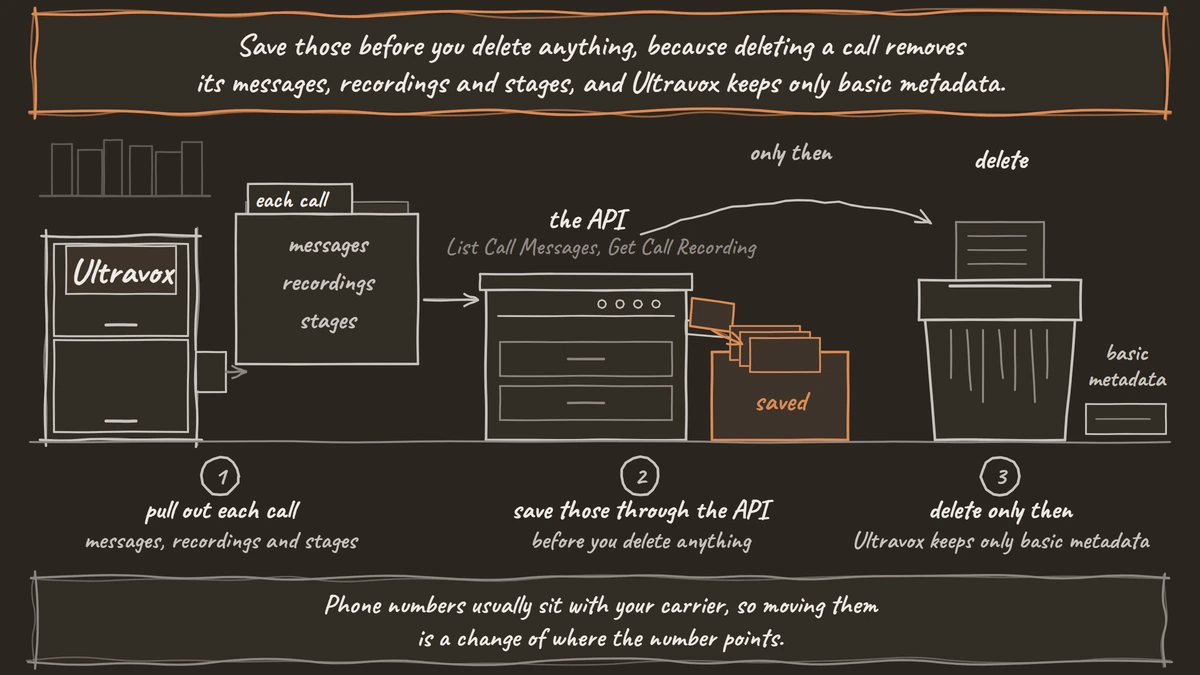
Phone numbers usually sit with your carrier, so moving them is a change of where the number points. On Dograh you can keep Ultravox as the model while the new platform takes over the calls, then test a cascade on the same script and compare the two in each call's trace. Rebuild each tool as an HTTP API tool, and test every transfer over a real phone call, because a browser test call cannot run one.
Then run both for a while. Send one number or one campaign to the new agent, keep Ultravox on the rest, and listen on real phone lines. On most phone calls the agent still gets 8 kHz audio, while a browser demo runs at 16 kHz.
Picking your Ultravox alternative
Start from where your calls must run and who will run the platform. If you want open source, your own servers or on-prem inside your network, start with Dograh, keeping Ultravox as a model on your key if you like how it sounds. Teams that want to build the product themselves can start from LiveKit Agents or Pipecat. If you only want a different model, GPT-Live and Gemini Live are the closest swaps. And if a hosted bill suits you, price Vapi, Retell AI and ElevenLabs Agents at your own minutes with models and phone added.
Whichever way you lean, run one real call flow on the new option before you move a phone number.
Glossary
- Speech-native model
- A model that takes the caller's audio directly, with no separate speech-to-text step. Ultravox hears audio this way, then writes its reply as text for a voice to speak.
- Cascade
- A voice agent built from separate speech-to-text, language and voice models. Each part can be swapped on its own, and cascades handle chains of tool calls better.
- Concurrency cap
- The most calls a plan lets run at the same time. Ultravox's Pay as you go plan stops at 5, and its Pro plan has no hard cap.
- Bring your own key (BYOK)
- Using your own account with a model provider inside a platform. Contract and billing become yours, but the provider still receives the call audio.