
Yes. An AI voice agent can dial a list or call one person when your system asks, and talk on its own. In the US it needs the person's prior consent first, written consent for sales calls. Dograh, the open-source AI voice agent platform we build, does both, and you can self-host it or run it on Dograh Cloud.
Key Takeaways
- Get consent before the first dial. A bought list carries none.
- Campaigns dial a CSV list. The API Trigger starts single calls from your system.
- Open with the business name and an easy way to stop the calls.
An outbound AI call is a normal phone call placed by software, so the robocall rules apply to it in full. Below, we cover the consent you need and the two ways to start calls, then what the agent says when someone picks up, set up in Dograh.
What an outbound AI call actually does
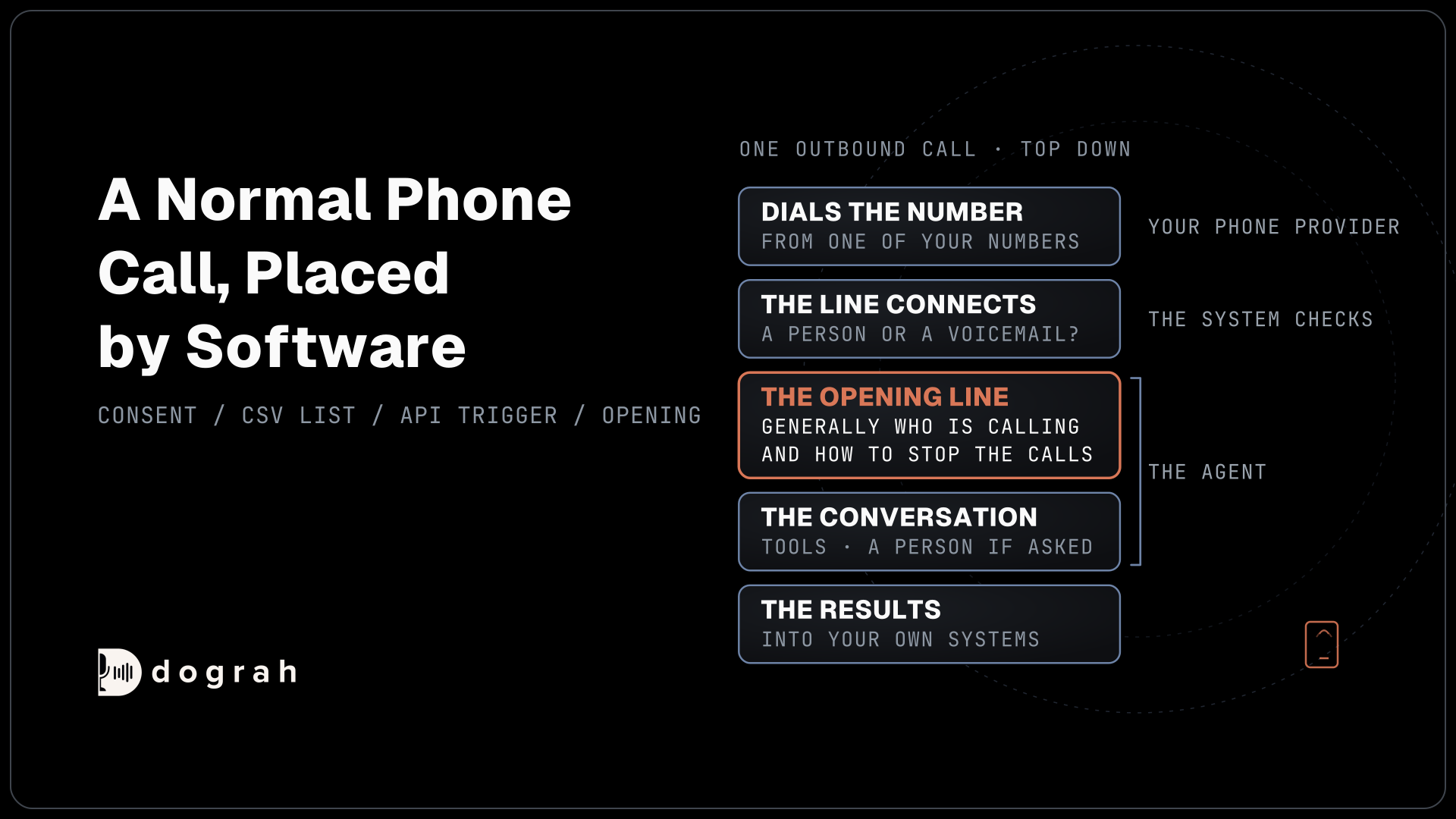
An outbound AI call starts like any other call, with a carrier dialling a number, and the agent only takes over once the line connects. Your phone provider places the call from one of your numbers. When the other end picks up, the system decides whether a person or a voicemail greeting answered, then the agent speaks its opening line and listens.
From there the agent runs the conversation you designed. It can look up an order or write an answer back to your system through a tool, and it can hand the call to a person when the caller asks. When the call ends, the results go to your own systems, so the next step happens without anyone typing notes.
So the honest answer is yes, and the work sits around the call more than inside it. First you need the right to call the person. Then the call has to start at the right moment, and its opening has to say who is calling and how to stop the calls. The rest of this post takes those parts in order.
Consent comes before the first dial
In the US, an AI voice counts as an artificial voice under the Telephone Consumer Protection Act (TCPA), so the consent rules for robocalls apply. The Federal Communications Commission (FCC) ruled in 2024 that the restriction on "artificial or prerecorded voice" covers AI technologies that generate human voices. An AI-voice call to a mobile number needs the person's prior express consent, unless it is an emergency or falls under an exemption.
Sales calls need more. Under the FCC's calling rules, artificial-voice telemarketing calls to mobile or residential numbers need prior express written consent, and a bought list carries no consent from anyone on it. Sales calls may only go out between 8 a.m. and 9 p.m. in the called person's local time, and the list has to be checked against the National Do Not Call Registry and your own do-not-call list. These rules are summarised here in plain words, so confirm with counsel how they apply to your calls and your list before the first campaign.
People do complain when the rules are ignored. The FTC's Do Not Call data book counted over 258 million active registrations and over 2.6 million complaints in its 2025 fiscal year. Complaints also feed the call-labelling systems that decide whether your next call shows up as spam.
Calls to people in the EU follow other rules. National ePrivacy law sets consent for marketing calls, and the AI Act now asks for a spoken AI notice at the start of the call, as our guide to the EU AI Act for voice agents explains.
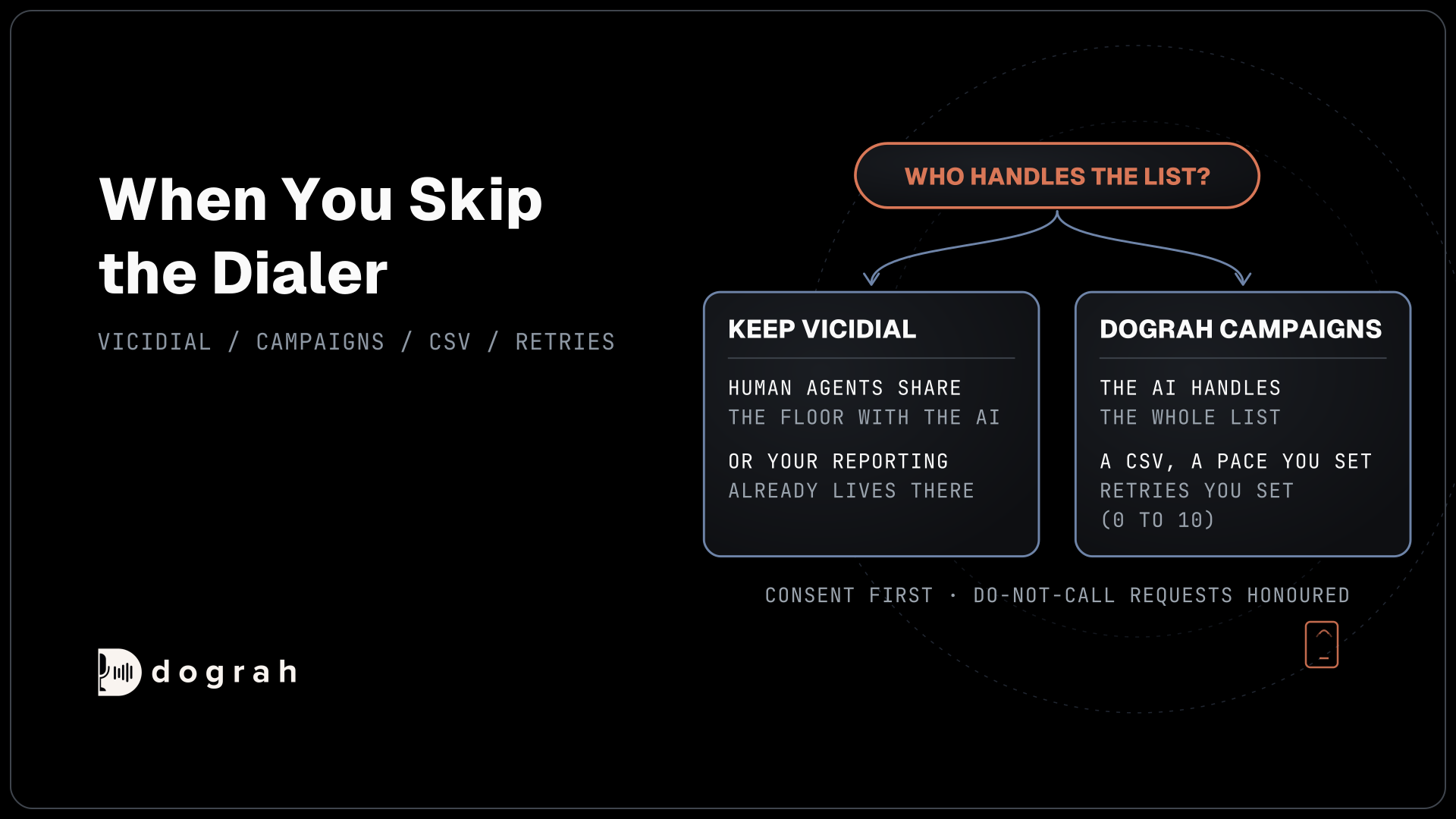
Way one: a campaign from a CSV list
A campaign dials a list for you, and it is the right tool when you have many people to call about the same thing. In Dograh, you create a campaign under Campaigns and upload a CSV file with a phone_number column. Every other column becomes a variable the agent can use on that call, such as a first name or an appointment date, and the upload rejects a list with the same number twice.
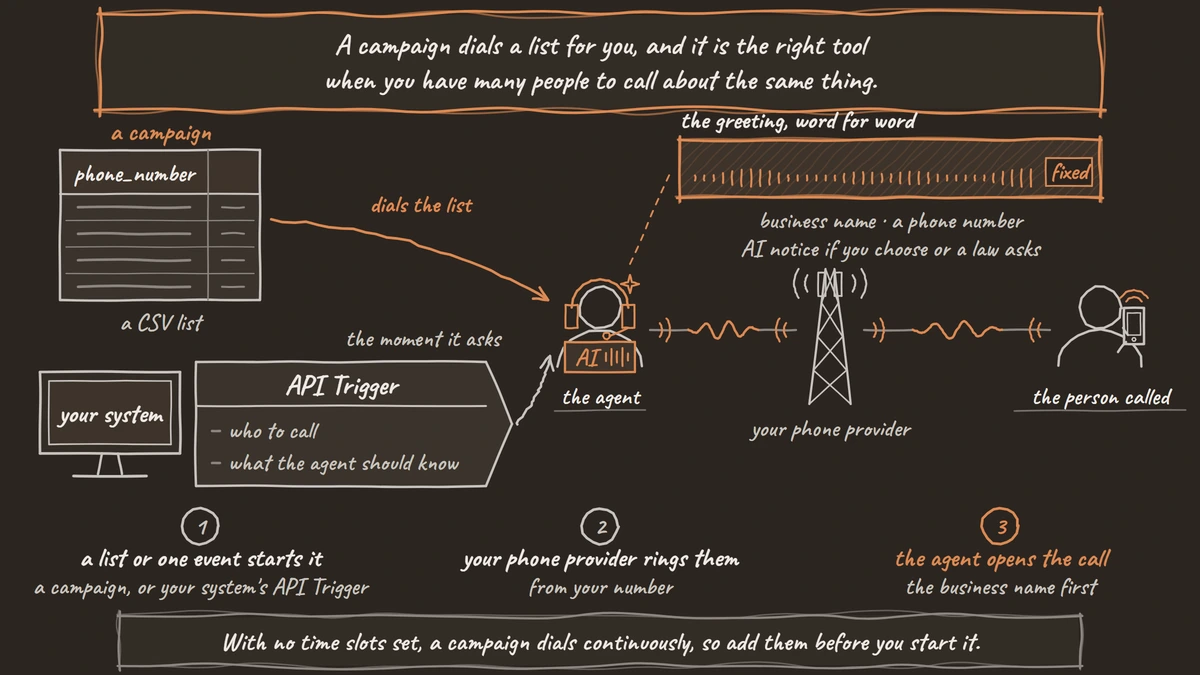
The campaign settings control how the list is worked. Calling hours run in one time zone per campaign, so a list that spans the country is split into one campaign per time zone, which keeps every call inside the 8 a.m. to 9 p.m. window. With no time slots set, a campaign dials continuously, so add them before you start it.
Retries are your call. You set the retries (0 to 10), how long Dograh waits between them and whether a busy line, no answer or a voicemail earns another try. A call a person answered is not retried, so retries only chase the people you have not reached. Our guide to outbound voice campaigns goes through every setting in the order you decide them, from the list to the failure stop.

Open Source Alternative to Vapi / Retell
Self-hosted voice agent platform — no per-minute fees
dograh-hq/dograh
Star on GitHub
Way two: one call from your own system
The API Trigger starts a single call the moment your own system asks for it, which suits calls that depend on an event, such as a missed payment or a new web lead. Your system sends one request to the agent's API Trigger URL with an API key, and Dograh places the call right away.
The request below tells Dograh who to call, in phone_number, and what the agent should know before it speaks, in initial_context:
curl -X POST https://your-dograh-instance/api/v1/public/agent/{uuid} \
  -H "X-API-Key: dgr_your_key" \
  -H "Content-Type: application/json" \
  -d '{"phone_number": "+1415555XXXX", "initial_context": {"customer_name": "Jane", "reason": "missed payment"}}'
What this does: It starts one call to +1415555XXXX on the published agent. Because the agent already knows Jane's name and the reason for the call, its first sentence can say why it is calling.
Each agent has two URLs. The production URL runs only the published version, while the test URL runs the latest draft, so you can try a change on your own phone before customers hear it. You can also pick which of your numbers the call comes from. Our developer's guide to AI outbound calling covers the production side of event-driven calls.
What the agent says in the first seconds
The opening carries legal weight, so write it as fixed text. Under the same FCC rules, an artificial-voice message names the business responsible at the start and gives a phone number during or after the message. A sales message also offers an automated way to opt out, by voice or keypress, within two seconds of that identification.
In Dograh, that line goes in the Greeting Text on the Start Call node, which plays word for word, or in a pre-recorded clip in a real human voice. Allow Greeting Interruption is on by default, so a person who says "hello?" over it can cut the required words short. Switch it off on the Start Call node and the whole identification plays on every call. If you want to tell people they are speaking with an automated assistant, or a law where they live requires it, put that in the same greeting.
Voicemail needs a decision of its own. Voicemail handling is off by default. Once you switch it on, the agent ends the call on a voicemail greeting unless you set it to leave a message, and a message left in an AI voice needs the same consent as the call.
Join the Dograh Community
Dograh is an OSS alternative to Vapi. Join our Slack community for queries, releases, best practices & community interactions.
Where outbound AI calls go wrong
Most outbound failures happen before or around the conversation. A number that has drawn complaints or carries weak caller ID attestation shows up as "Spam Likely", and people stop answering. Our post on STIR/SHAKEN and caller ID explains how that label is earned and how to recover from it.
Inside the call, the usual problems are a voicemail greeting mistaken for a person and dead air, either after "hello?" or while a tool looks something up. You can only fix what you can see, so read the full call trace for any call that went wrong, and run QA on a sample of campaign calls to catch the patterns. Our post on inbound vs outbound voice agents shows how the same agent is set up for both directions.
Cost depends on where you run it. Self-hosted Dograh has no per-minute platform fee, but servers, model keys and phone minutes still cost money. Dograh Cloud charges a 1¢-a-minute platform fee. Either way you can bring your own keys for any speech and language provider, or run open models on your own servers.
Start small. Pick one list you hold consent for, write the opening, test it on your own phone through the test URL, and send the first campaign to a few hundred people before you widen it.
Glossary
- Prior express written consent
- A signed agreement, which can be electronic, in which a person agrees to receive marketing calls with an artificial or prerecorded voice at a given number. The FCC requires it for AI-voice sales calls to mobile and residential numbers.
- Artificial or prerecorded voice
- The TCPA term for a voice that is not a live person. The FCC ruled that it covers AI-generated voices, so AI voice agent calls follow the robocall consent rules.
- API Trigger
- A Dograh URL that starts one outbound call when your own system sends a request with an API key, a phone number and optional context for the agent. The production URL runs the published agent only.
- Calling hours
- The times a campaign may dial. US sales calls are limited to 8 a.m. to 9 p.m. in the called person's local time, and a Dograh campaign's time slots run in one time zone per campaign.