
AI calls get marked as spam when call-labelling firms see signs of unwanted calling, such as complaints, high volume from one number, very short calls or weak STIR/SHAKEN attestation. Attestation only says how well the carrier knows you and your number. Registering numbers and branded caller ID help once the cause is fixed, but nothing guarantees a clean label.
Key Takeaways
- A means the carrier knows you and that the number is yours.
- Calls through a platform on outside numbers often arrive with B attestation.
- No federal rule lets you force a "Spam Likely" label off.
A call labelled "Spam Likely" is lost before the agent says a word. Below, we explain attestation levels A, B and C, why signed calls still get labelled and how to recover a flagged number, with caller IDs set up in Dograh, the open-source AI voice agent platform we build.
Why answer rates drop before anyone says hello
The label on the screen decides most outbound calls before the conversation starts. People already ignore unknown numbers, and Hiya's 2026 survey, covered in our guide to AI cold calling, found that 86% of calls from unknown numbers go unanswered. A "Spam Likely" or "Scam Risk" label on top of an unknown number pushes that rate higher still, and some carriers block labelled calls outright.
AI calls are not labelled for being AI. They are labelled for how they behave. An agent can dial far more numbers per hour than a team of people, from a small pool of numbers, and if many of those calls are short, unanswered or reported, the numbers look like a robocaller's. The same is true for a human call centre with the same pattern.
Two systems sit between your agent and the person's phone. The carriers sign each call with STIR/SHAKEN, and call-labelling services decide what the phone shows. They are related, but they answer different questions, and fixing one does not fix the other.
Attestation levels A, B and C explained
STIR/SHAKEN is how carriers vouch for the number shown on a call. Under the FCC's STIR/SHAKEN rule, voice providers have had to sign calls on their IP networks since 30 June 2021. The originating provider, the carrier that first puts your call on the network, adds a signed statement saying how much it knows about the caller and the number.
There are three levels, defined in the Federal Communications Commission's first STIR/SHAKEN order. Full or A attestation means the carrier can confirm who its customer is and that the customer may use the number shown. Partial or B attestation means it knows the customer but cannot confirm the number. Gateway or C attestation means it only received the call from somewhere else, such as a foreign network or one that does not sign calls, and is passing it on.
The originating carrier makes this decision, not you and not your voice agent platform. You can only influence it by making sure the carrier that sends the call is the one that knows the number is yours. That is why the number's source matters as much as the call itself.
Why platform calls with outside numbers get B
B attestation is the common result when a call leaves through one carrier while showing a number that another carrier assigned. The signing carrier knows its customer, so it can vouch for the account, but it has no record that the number belongs to that customer. The FCC's order noted the same problem for businesses that place calls through one provider using numbers from another.
Signing through a partner does not get around this. A carrier that uses another company to sign its calls must still use its own certificate and make every attestation decision itself, so the decision stays with the carrier that knows, or does not know, your number.
The fix is plain. Send each number's calls out through the carrier that issued it. In Dograh, when a telephony configuration has more than one trunk, each number is tied to a trunk, and the number dialog tells you to pick the one whose carrier authorised the number, because carriers reject a caller ID they do not own. Our post on telephony for voice AI explains numbers, carriers and SIP trunks from the start.

Open Source Alternative to Vapi / Retell
Self-hosted voice agent platform — no per-minute fees
dograh-hq/dograh
Star on GitHub
A signed call can still be labelled spam
The carrier's signature says who placed the call. The label says whether people want it, and that comes from call-labelling services that the phone networks and phone makers work with. They weigh attestation alongside complaints, how many calls a number makes, how many are answered, how long they last and whether people call back.
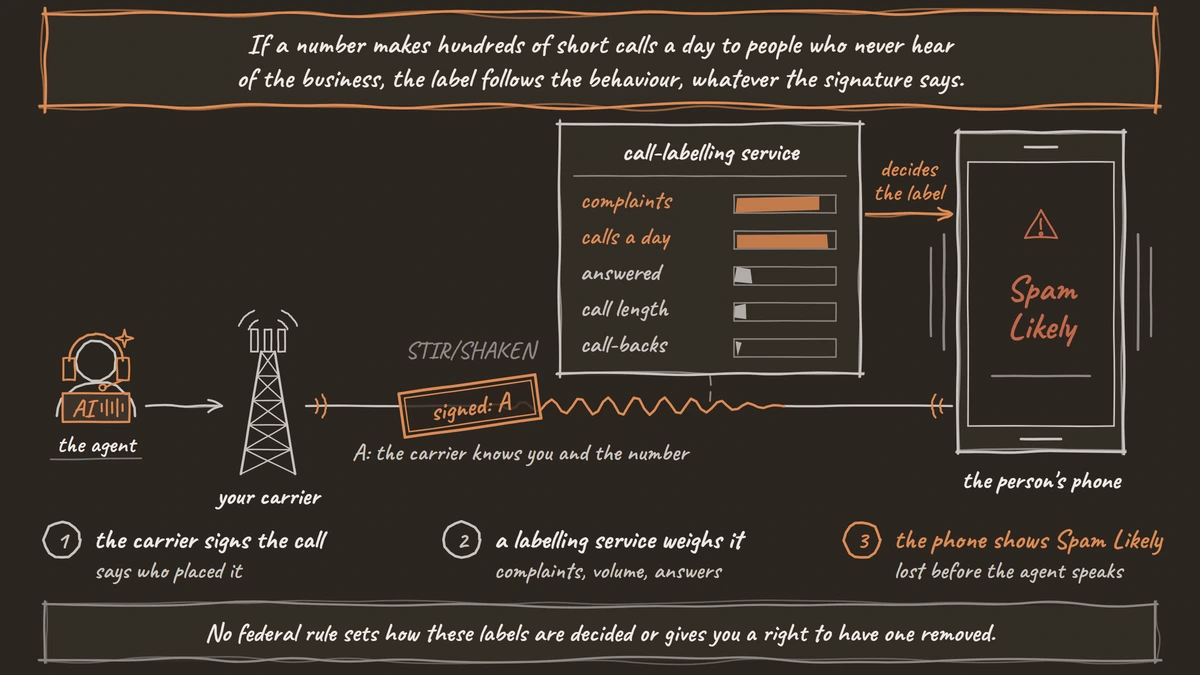
So an A-attested call can still show "Spam Likely". If a number makes hundreds of short calls a day to people who never hear of the business, the label follows the behaviour, whatever the signature says. A weak attestation adds to the problem, but a strong one does not cancel the rest.
No federal rule sets how these labels are decided or gives you a right to have one removed. The FCC's rules on call blocking, covered in the last section, give you rights when calls are blocked. A label alone is up to the analytics firm, which is why the registry and branded caller ID below matter.
Registering numbers and branded caller ID
Registration tells the labelling firms who owns a number before they have to guess. The Free Caller Registry, run by First Orion, Hiya and TNS, lets a business register its outbound numbers for free, up to 20 by hand or more in a file. The registry itself says registration "does not guarantee redress", so treat it as a way to put your details on file, not as a cure.
Branded caller ID goes further by showing your name, logo and the reason for the call on the person's phone. Branded Calling ID, a CTIA service, sends this inside calls signed with STIR/SHAKEN, after authorised partners vet the number, the name, the logo and the call reason. Enterprises pay only when delivery of the branded call is confirmed.
Neither one fixes a calling pattern people dislike. A branded call that people do not want still draws complaints, and those still count against the number. Register first and brand where your carrier offers it, then keep the volume per number in line with the answers you get.
Join the Dograh Community
Dograh is an OSS alternative to Vapi. Join our Slack community for queries, releases, best practices & community interactions.
How Dograh picks the caller ID for each call
In Dograh, the numbers on a telephony configuration are the caller IDs. The Phone numbers list describes them as numbers used as caller ID for outbound calls and accepted for inbound matching. You can self-host it with your own carrier and SIP trunks or run it on Dograh Cloud, and either way the numbers come from your own carrier account.
One number can be set as the Default caller ID for the configuration. It is used for one-off calls, such as test calls from the editor or API Trigger calls that name no number. When neither applies, one of the active numbers is picked. An API Trigger request can also name the number to call from.
Campaigns work differently. A campaign rotates across all the active numbers on its telephony configuration, one after another, and does not use the Default caller ID. The campaign form shows how many caller IDs you have and notes that they rotate and may be reused on simultaneous calls. Our guide to AI dialers covers pace and concurrency, which decide how hard each number works.
Rotation spreads the volume. It should never be used to hide a number that people have complained about, because the complaints follow the pattern to the next number. Self-hosted Dograh has no per-minute platform fee, but servers, model keys and phone minutes still cost money. Dograh Cloud charges a 1¢-a-minute platform fee.
How to recover a flagged number
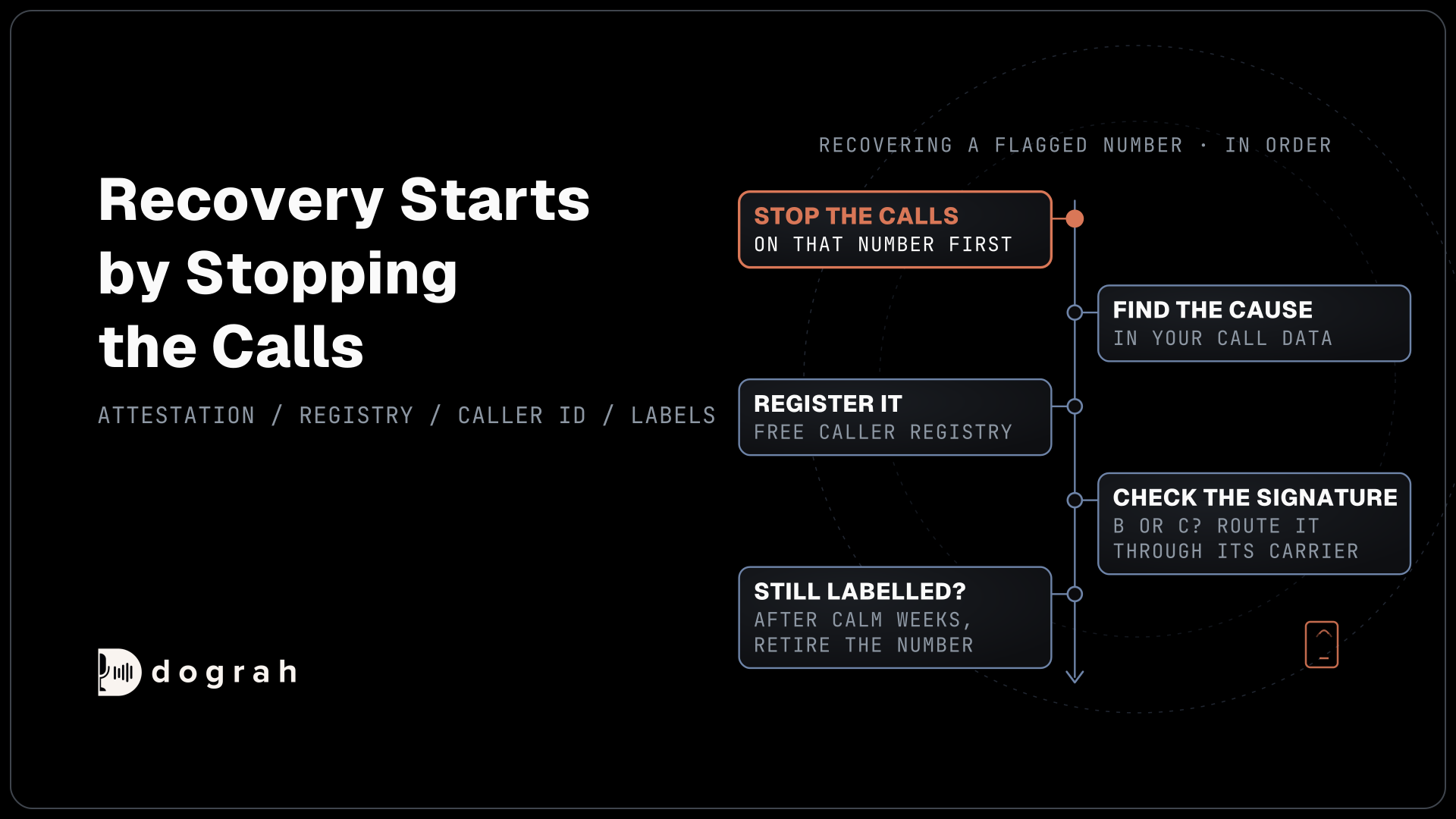
Recovery starts by stopping the calls that caused the label. Take the number out of active campaigns, or set it inactive in the telephony configuration, so it stops adding to its own record. Then look for the cause in your call data: a list without consent, opt-outs that were not honoured, a burst of short calls or a time slot that reached people at night.
Next, put your details on file and check the signature. Register the number with the Free Caller Registry if you have not, and ask your carrier which attestation your calls from that number receive. If it is B or C, route the number's calls through the carrier that issued it.
If calls are blocked, not just labelled, the FCC's call-blocking rules give you rights with the carrier that blocks them. It must offer a point of contact for complaints, give a status update within 24 hours, stop blocking promptly if it was wrong and charge you nothing. On request, it must also send a list of your calls it blocked in the past 28 days, within 3 business days. That is a summary in plain words, so confirm with counsel before you rely on these rights in a dispute.
Some numbers do not come back. If a number stays labelled after the cause is fixed and a few weeks of calm calling, retire it, and start the new one slowly with a consented list. Then the next number earns a clean record instead of inheriting the old pattern.
Glossary
- Attestation
- The signed statement a carrier adds to a call under STIR/SHAKEN. A means it knows the caller and that the caller may use the number, B means it knows the caller but not the number, and C means it only passed on a call from elsewhere.
- Originating provider
- The carrier that first places your call on the phone network. It decides the attestation level, which is why calls should leave through the carrier that issued the number.
- Call-labelling service
- A company that scores calls for phone networks and phone makers and decides labels such as Spam Likely. It weighs attestation together with complaints, volume, answer rates and call length.
- Branded caller ID
- Showing a business's name, logo and call reason on the person's phone. Branded Calling ID sends this inside signed calls after the number, name and reason are vetted.