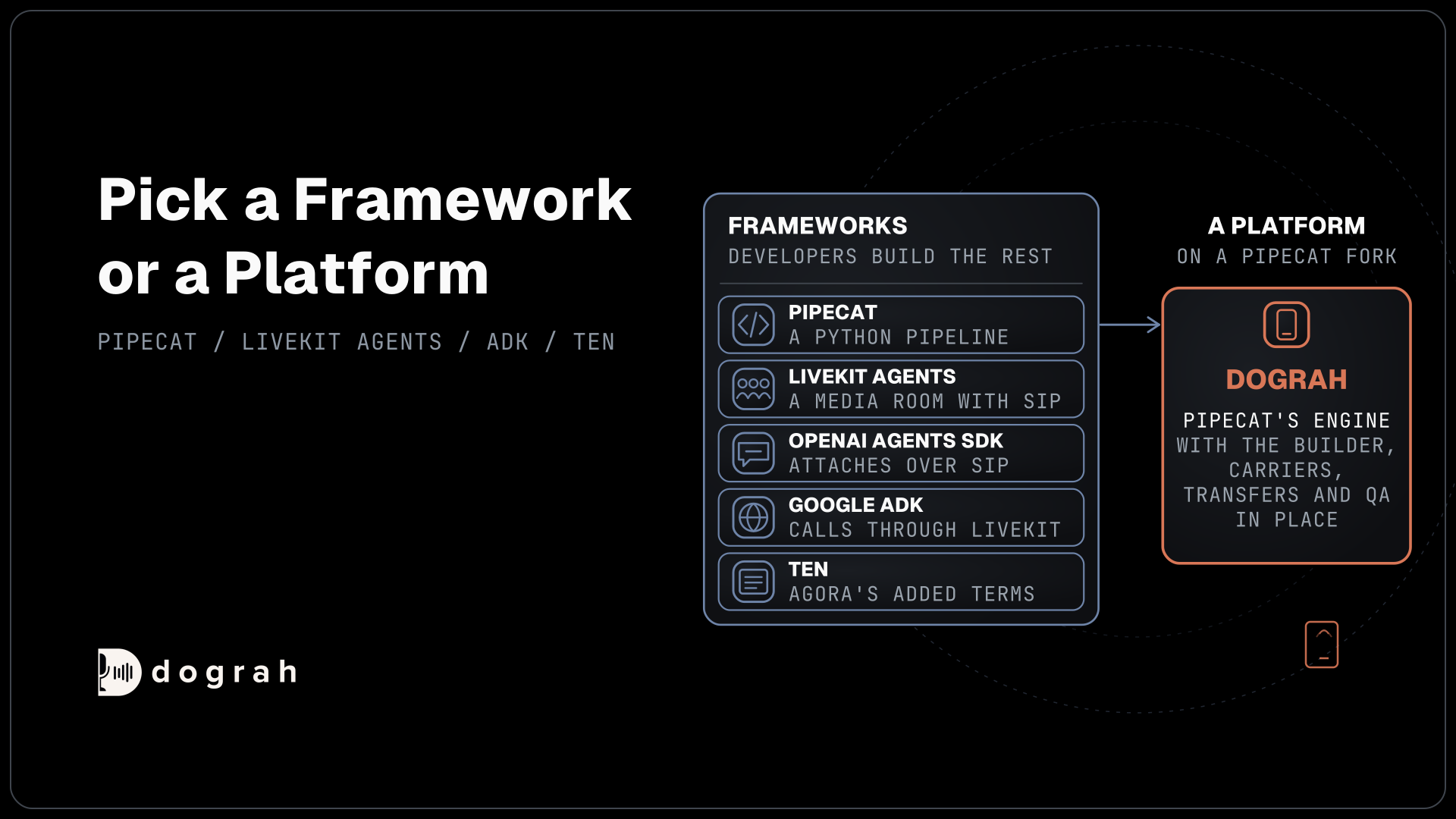

The best voice AI frameworks in 2026 are Pipecat and LiveKit Agents, with OpenAI's Agents SDK and Google's ADK as newer SDKs from model makers. TEN carries extra license terms, and Vocode was last updated in November 2024. For a platform, Dograh is built on a Pipecat fork, and you can self-host it or use Dograh Cloud.
Key Takeaways
- Pipecat and LiveKit Agents both ship frequent releases and real phone routes.
- OpenAI's Agents SDK attaches to calls over SIP, and ADK reaches phones through LiveKit.
- Vocode is MIT licensed and was last updated in November 2024.
A voice AI framework gives developers the parts of a voice agent in code and leaves the product to them. We rank six frameworks on what a phone call needs, list what you still build around each, then talk about where a platform such as Dograh fits.
What a phone call needs from a framework
A framework runs the conversation loop, listening, thinking and speaking, and you write everything else in code. A platform adds the product around that loop, such as a builder, phone connections, call history and QA. Our guide to open-source voice AI frameworks explains each project's design, so this list ranks them on one practical test, a real phone call.
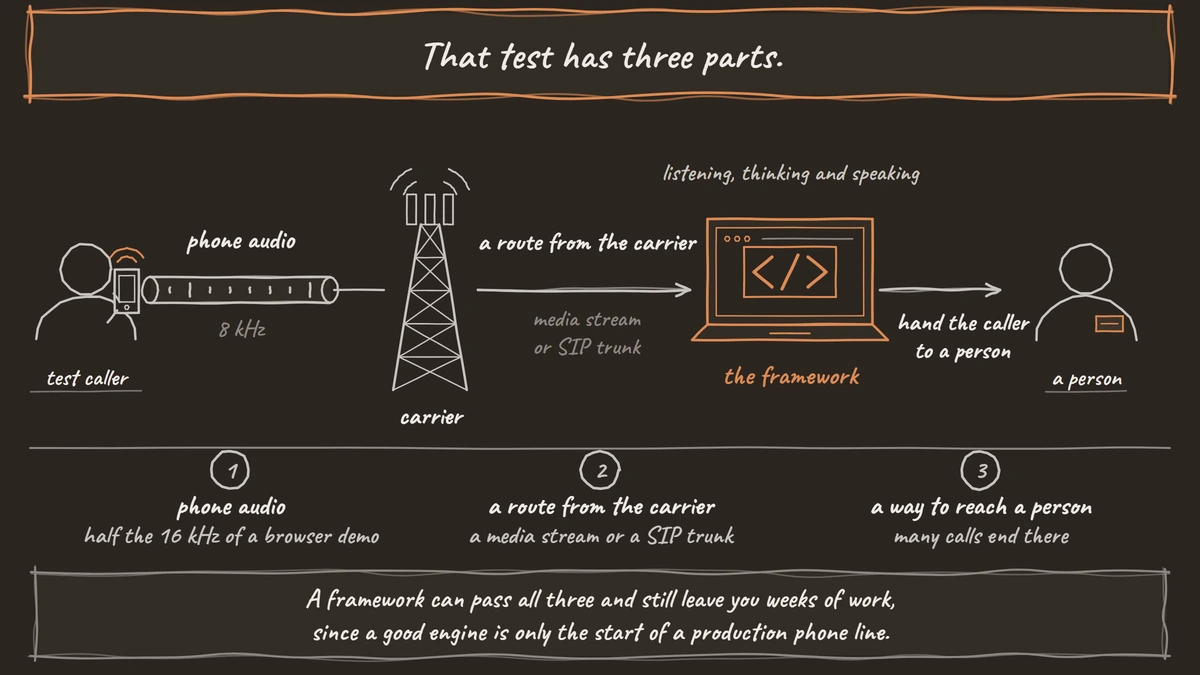
That test has three parts. The framework has to handle phone audio, and most phone calls still reach the agent as 8 kHz audio, half the 16 kHz a browser demo runs at. It needs a route from the carrier, either a media stream from a provider such as Twilio or a SIP trunk. And it needs a way to hand the caller to a person, because many calls end there. A framework can pass all three and still leave you weeks of work, since a good engine is only the start of a production phone line.
Voice AI frameworks compared
The table checks each project's license and latest release on its own repository, then the phone-call test. Dograh is in the last row as the platform option, since it is built on one of these frameworks.
| Framework | License | Latest release | How phone calls arrive | Transfer to a person | Status |
|---|---|---|---|---|---|
| Pipecat | BSD-2-Clause | v1.16.0, November 2026 | WebSocket media streams from Twilio, Telnyx, Plivo and Exotel, or SIP and Daily PSTN | On SIP and Daily routes, not on WebSocket streams | Active |
| LiveKit Agents | Apache-2.0 | 1.8.12, November 2026 | SIP trunks into a LiveKit room, numbers on LiveKit Cloud | Cold transfer by SIP REFER, plus agent-assisted transfer | Active |
| OpenAI Agents SDK | MIT | v0.24.0 alpha, November 2026 | Attaches to a call over SIP on the Realtime API | Built in your code | Active, alpha releases |
| Google ADK | Apache-2.0 | v2.14.1, November 2026 | Through LiveKit for telephony | Through LiveKit | Active, live agents marked Experimental |
| TEN Framework | Apache 2.0 with Agora's added conditions | 0.11.75, November 2026 | Agora RTC, needs an Agora App ID | Built in your code | Active |
| Vocode | MIT | v0.1.114 alpha, August 2024 | Twilio and Vonage | TransferCall action on Twilio and Vonage | Last updated November 2024 |
| Dograh (platform) | BSD 2-Clause | v1.51.0, November 2026 | Twilio, Telnyx, Plivo, Vonage, Exotel, Vobiz, Cloudonix, Asterisk ARI | Transfer Call on Twilio, Telnyx, Plivo, Cloudonix and Asterisk ARI | Active, runs on a Pipecat fork |
Pipecat and LiveKit Agents
Pipecat and LiveKit Agents are the two frameworks most production phone agents are built on, and both pass the phone-call test in different ways. Pipecat is a Python pipeline that you point at a transport. Pipecat's telephony guide lists WebSocket media streams for Twilio, Telnyx, Plivo and Exotel, and says plainly that this route has "No advanced call center features like transfers or reconnects". For transfers, it points to SIP or Daily's phone service.
LiveKit Agents puts the agent inside a media room, and phone callers join that room over SIP. LiveKit's telephony docs cover inbound and outbound calls through SIP trunks tested with Twilio, Telnyx, Exotel and Plivo, and LiveKit Cloud sells US numbers too. A cold transfer sends a SIP REFER through your trunk, and an agent-assisted mode briefs the person first. If you self-host LiveKit, the SIP service has to be deployed separately.
Hosting is the other half of the choice. Both run on your own servers, and both makers sell a hosted cloud for teams that would rather not run the media side themselves. Self-hosting keeps call audio on your machines, which matters for regulated lines, but it also makes scaling, uptime and upgrades your job.
Both are strong bases, and the choice between them comes down to rooms or a pipeline, how each detects turns and where you host it. Our post on LiveKit vs Pipecat works through those points side by side.

Open Source Alternative to Vapi / Retell
Self-hosted voice agent platform — no per-minute fees
dograh-hq/dograh
Star on GitHub
Agent SDKs from OpenAI and Google
Two model makers now ship open-source agent SDKs that do voice, and both work best with their own models. OpenAI's Agents SDK is MIT licensed. Its realtime agents are built on the OpenAI Realtime API over WebSocket transport, the Python SDK has no browser WebRTC, and the documented way onto a phone call is attaching over SIP. A separate VoicePipeline runs speech-to-text, your own workflow code and text-to-speech in turn, with OpenAI's speech models by default.
Google's Agent Development Kit (ADK) is Apache-2.0. ADK's live agents hold an open two-way connection, so the caller can interrupt mid-sentence. They run end to end on the Gemini Live API, or as a cascade of speech-to-text, any text model and text-to-speech. Live support is marked Experimental, and for phone calls ADK points to LiveKit.
These SDKs suit teams already committed to one model maker who want agent logic, tools and handoffs between agents in one library. For a phone line, each still leans on another layer, SIP on the Realtime API or LiveKit for ADK, and the work around the call stays with you.
TEN Framework and Vocode
TEN Framework and Vocode both appear on most framework lists, and each has something to check first. TEN builds agents as graphs of extensions and is under active development. GitHub cannot match its license to a standard one, because it adds Agora's conditions to Apache 2.0, and its real-time transport runs on Agora's network with an Agora App ID. Read the license file before you build a product on it.
Vocode was one of the first open voice agent libraries, and it is MIT licensed. Vocode's repository shows the last release as an alpha in August 2024 and its last commit in November 2024, and the project invites community maintainers. Its code still runs, including a TransferCall action on Twilio and Vonage. Our guide to Vocode alternatives covers moving a Vocode codebase when you need newer providers.
What you still build around each framework
A framework runs the conversation, and your team builds the rest. The table shows what each one leaves to you on a phone line, with Dograh's row for comparison.
| What a phone line needs | Pipecat | LiveKit Agents | OpenAI Agents SDK | Google ADK | Dograh |
|---|---|---|---|---|---|
| Carrier connection | Transport code per carrier | SIP trunk setup, separate SIP service when self-hosted | SIP attach | Through LiveKit | Built in for each listed carrier |
| Transfer to a person | SIP or Daily route | Built in over SIP | You build it | Through LiveKit | Transfer Call, built in |
| Call history and recordings | You build it | You build it, or use LiveKit Cloud | You build it | You build it | Built in |
| QA on calls | You build it | You build it | You build it | You build it | QA node on test and live calls |
| Outbound lists | You build it | You build it | You build it | You build it | Campaigns with retries |
| Builder for non-developers | None | None | None | None | Agent Builder and canvas |
The rows that say you build it are rarely one-off jobs. Carrier APIs change, models are swapped, and every new prompt needs a way to test it on real calls before callers hear it. A team that picks a framework also picks up that upkeep, usually as a small group of developers who own the phone line long after launch. That is a fair trade when the agent is the product. When the agent is one tool inside a support or sales team, the same hours often go further on the calls themselves.
Join the Dograh Community
Dograh is an OSS alternative to Vapi. Join our Slack community for queries, releases, best practices & community interactions.
Dograh: a platform built on a Pipecat fork
Dograh runs its call pipeline on a fork of Pipecat, so the engine is one this list already ranks, and the product around it is open source too. The whole platform is BSD 2-Clause. It adds the parts the table above leaves to you, starting with an Agent Builder that builds an agent from a description and a canvas for hand edits. Our post on Pipecat alternatives covers when keeping the engine and adding a platform makes sense.
On the phone side, it connects to your own carrier account, whether that is Twilio, Telnyx, Plivo, Vonage, Exotel, Vobiz, Cloudonix or Asterisk ARI. Transfer Call works on Twilio, Telnyx, Plivo, Cloudonix and Asterisk ARI. Dograh calls the destination first and connects the caller only when someone answers. No answer, a busy signal or a failed transfer sends the call back to the agent, which keeps talking with the caller. On Exotel, Vobiz and Vonage, the agent books a callback request through an HTTP API tool instead.
After the call, transcripts and recordings are saved, and the QA node scores each step of test and live calls. View Trace opens a call's trace in Langfuse with speech-to-text, AI and voice time for every turn, and Campaigns dial outbound lists with retries. Models are picked per agent, from Dograh's models, your own keys or open-weight models served on your own machines.
Where it runs sets the cost. You can self-host it with Docker Compose on a server with 8 GB of RAM and 4 vCPUs. Running Dograh yourself means no per-minute platform fee. You still pay for servers, model keys and phone minutes, and your team looks after the database and upgrades. Support comes from the open-source community, and Enterprise adds custom SLAs. If you would rather not host it, Dograh Cloud runs it for a 1 cent a minute platform fee.
Picking a framework or a platform
Pick a framework when your developers want the agent in their own code and are ready to build the rest. Pipecat suits a team that wants a Python pipeline with many model and carrier options, and LiveKit Agents suits one that wants a media room with SIP built in. OpenAI's Agents SDK or Google's ADK fit teams already set on one model maker, and TEN fits teams fine with Agora's terms. Vocode still suits an existing app that works as it is.
Pick a platform when the phone line matters more than owning every line of code. If you want Pipecat's engine with the builder, carriers, transfers and QA already in place, start with Dograh. Our list of AI voice agent builders compares the platforms' builders. Whichever way you go, make a real phone call through it, with a transfer, before you commit.
Glossary
- Framework
- A code library that runs the voice agent's conversation loop, such as Pipecat or LiveKit Agents. Your team builds the phone wiring, call history and QA around it.
- SIP REFER
- A SIP message that asks the phone network to send the caller to another number. LiveKit uses it for cold transfers, and the agent leaves the call when it succeeds.
- Media stream
- A WebSocket connection that carries call audio between a carrier such as Twilio and the agent. Pipecat's stream route handles audio but not transfers.
- Cascade pipeline
- Separate speech-to-text, language model and text-to-speech steps in a row. ADK and OpenAI's VoicePipeline both offer one beside a single speech-to-speech model.