
AI voice agents for trade schools and bootcamps call each enquiry back as soon as it arrives, answer program questions from the school's published pages, qualify the lead and book an advisor, then follow accepted students to their first day. Every call relies on consent collected in the enquiry form, and a for-profit school's sales call needs written consent.
Key Takeaways
- A for-profit school's enrollment call needs prior express written consent.
- The agent answers only from the school's published program pages.
- Funding and eligibility questions go to the financial aid office.
Below, we follow a prospective student from the enquiry form to the first day, cover the consent and claims rules, and show how each part works in Dograh, the open-source AI voice agent platform we build. You can self-host it or run it on Dograh Cloud.
Why the first callback wins the student
A short-program school competes on the first conversation, because the prospect is rarely waiting for only one school. Someone looking for an electrician course or a coding bootcamp often fills in several forms from one search. The school that reaches them first gets to answer their questions first, and often gets the visit.
Short programs make this sharper. A university with few intakes a year loses little to a slow reply. A trade school or bootcamp with a new start every few weeks has a seat that either fills this month or stays empty.
More people are looking. The National Student Clearinghouse enrollment estimates show undergraduate certificate enrollment up 4.8% in their spring estimates, and enrollment at public two-year colleges with a strong vocational focus up 11.7%, about 91,000 students, for the third year in a row. More enquiries arrive at programs whose admissions teams did not grow at the same pace.
The fastest call only wins if the school is allowed to make it. That is where the enquiry form comes in.
The consent your enquiry form must collect
Every AI call to a prospect relies on consent the enquiry form collected, so design the form before the agent. The FCC's ruling on AI-generated voices treats them as artificial voices under the Telephone Consumer Protection Act (TCPA), and an artificial-voice call to a mobile needs the prior express consent of the person called.
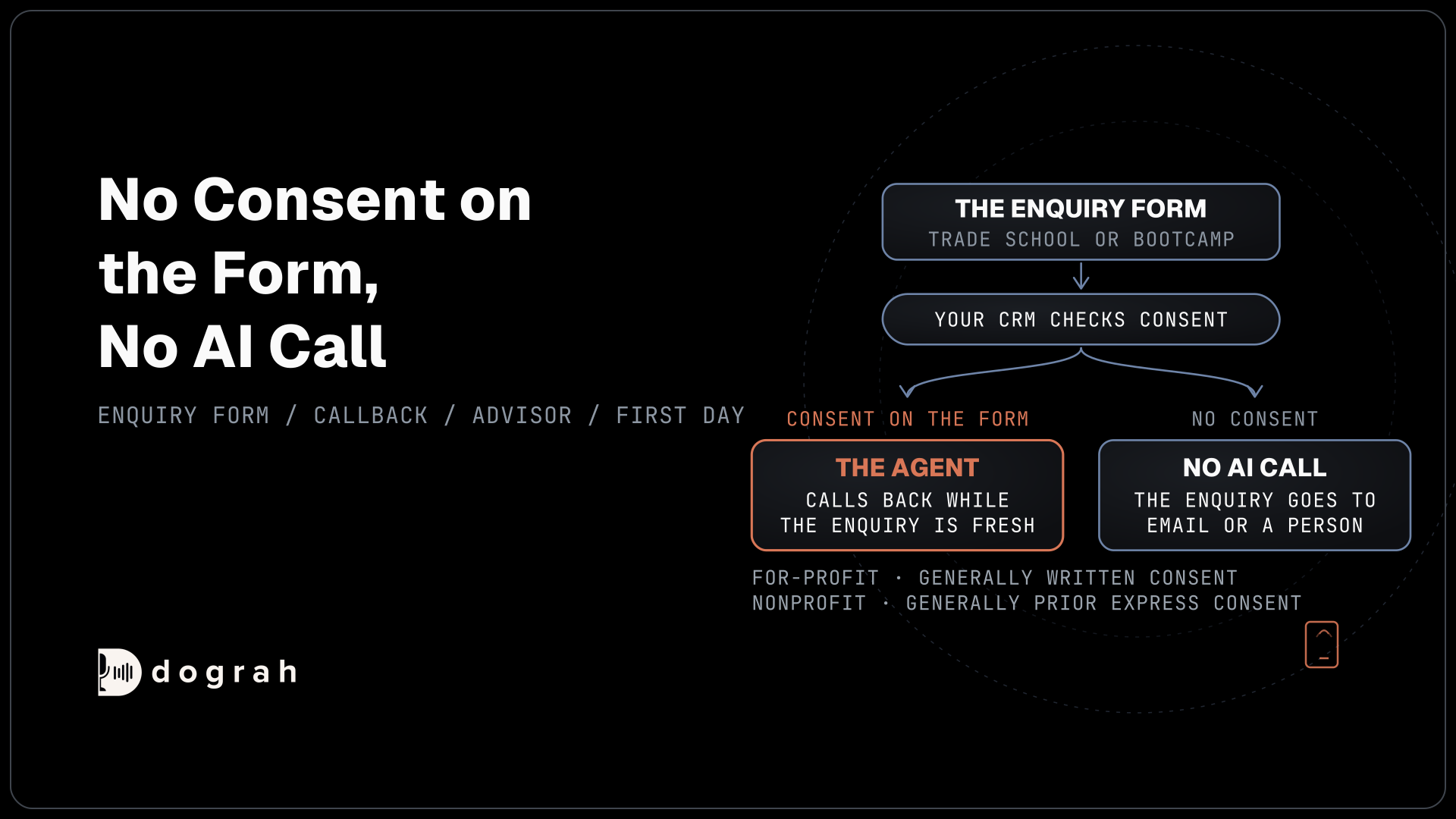
For a for-profit school or bootcamp, a call that encourages someone to enroll in a paid program is telemarketing. Under the FCC's calling rules, that call needs prior express written consent. That means a signed agreement, with an electronic signature allowed, that names the school and the phone number and clearly says the calls may use an artificial voice and that agreeing is not a condition of enrolling. A tax-exempt nonprofit school needs only prior express consent for the same call.
The call says who is calling at the start and gives a callback number. Sales calls from a for-profit school may not reach a home line before 8 a.m. or after 9 p.m. at the prospect's local time. A prospect can revoke consent any reasonable way, and the request must be honoured within 10 business days.
Check consent in your CRM before any call goes out. No consent on the form, no AI call, and the enquiry goes to email or a person instead. Keep each signed consent with the enquiry record, so you can show what the prospect agreed to and when. Confirm your form wording and calling rules with counsel before the first callback goes live. Schools wanting this on their own hardware can read about self-hosted voice AI for trade schools and bootcamps, where callbacks start only on form consent.
Calling back while the enquiry is fresh
The callback should start from the enquiry itself, so no one has to notice the form. Your form handler or CRM sends a request to the API Trigger on the agent, with the prospect's number and the enquiry fields, such as the program and preferred start, in initial_context. The call starts as soon as the request comes in from your system.
That speed needs one guard. The API Trigger has no calling-hours setting, so your CRM holds evening and night enquiries until morning and sends them then. Our guide to starting a voice agent call from any system covers the request and the test and production URLs.
The opening carries the school's name and a callback number, so put it in the Greeting Text on the Start Call node and switch off Allow Greeting Interruption, which is on by default, so the full opening plays. A short recorded clip in a real admissions officer's voice works well here, with the model's voice covering the rest of the call. The prospect hears a person they may meet on campus.

Open Source Alternative to Vapi / Retell
Self-hosted voice agent platform — no per-minute fees
dograh-hq/dograh
Star on GitHub
Prospects who call the school first
Many prospects skip the form and call the number on the ad or the website, often in the evening. Point that number at the same agent through its Inbound workflow setting, so a caller gets the same answers the callback would give.
The agent answers from the school's own pages: program length, schedule options, campus location and what the published tuition covers. Upload those pages to the Knowledge Base, and replace them whenever a page changes, because an outdated tuition page gives the agent an outdated answer. Start dates change every few weeks, so keep them in the system that owns them and let the agent read them through an HTTP API tool during the call.
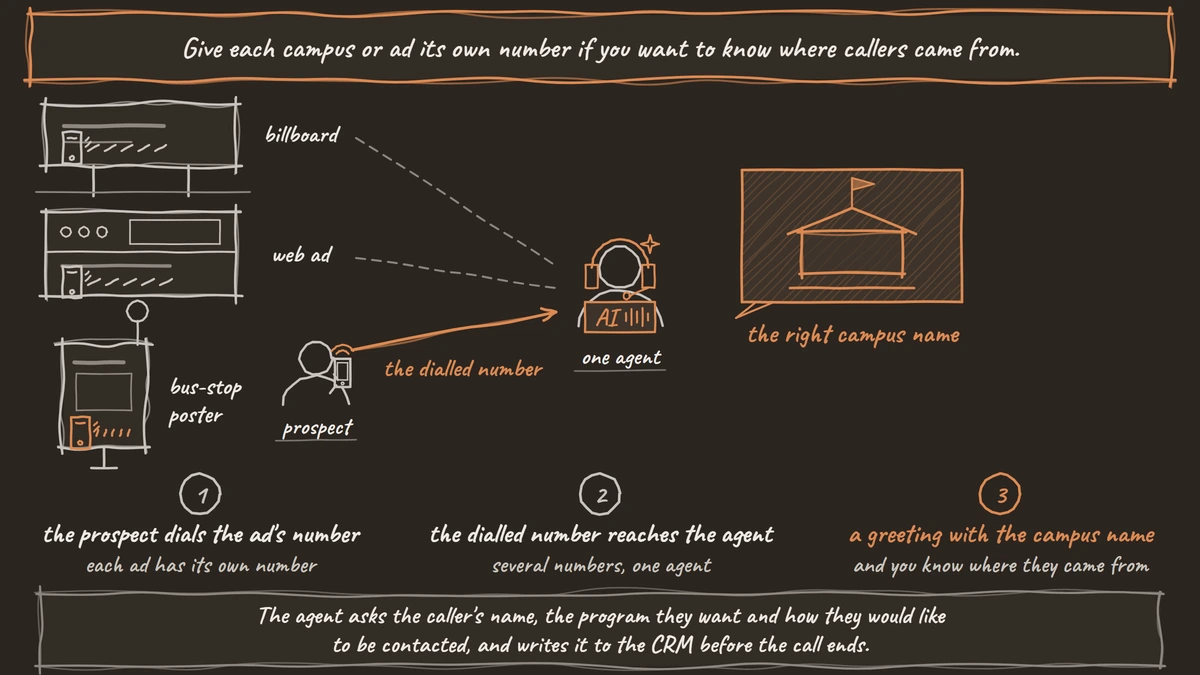
The agent asks the caller's name, the program they want and how they would like to be contacted, and writes it to the CRM before the call ends. If the caller asks the school to call back about enrolling, the agent records that request in the caller's own words, with the number to use. The admissions team then knows exactly what the prospect asked for.
Give each campus or ad its own number if you want to know where callers came from. Several numbers can point at one agent, and the dialled number reaches Pre-Call Data Fetch as to_number, so the agent can greet the caller with the right campus name.
Qualifying the enquiry
The first call finds out whether the prospect is ready to talk to an advisor. The agent asks which program they want, when they could start, whether day, evening or weekend classes suit them, and how they plan to pay. Each answer is recorded as the prospect said it and sent to your admissions system.
The admissions system applies the school's rules to those answers, never the agent. A prospect who is ready goes to an advisor the same day, by transfer or a booked call. One who is not ready yet gets the next step the school chooses, such as a campus tour or an information session.
Funding questions are recorded, never answered with a yes or no. Our deep dive on AI student lead qualification calls covers the questions, the hand-off and how results reach the admissions system.
Join the Dograh Community
Dograh is an OSS alternative to Vapi. Join our Slack community for queries, releases, best practices & community interactions.
From application to the first day
Between applying and the first class, a student can go quiet for many reasons. Paperwork for funding may have stalled, a document may be missing, the start date may no longer work, or second thoughts may have set in.
A follow-up call finds which one. For a missing document, the agent names the item and why it is needed, then asks the school's system to send its secure upload link by text or email. Documents are never collected on the call itself. For a start date, the agent confirms it or offers the next one and writes the answer to the student system. For first-day logistics, it covers the address, the schedule and what to bring, such as tools or a laptop.
Doubt needs a person. The agent books an advisor call, because a student with second thoughts deserves a real conversation with someone at the school. Our deep dive on admissions and enrollment follow-up calls with AI covers each of these calls.
What the agent never promises
Job, pay and funding answers carry legal weight at a school, so the agent reads them and never improvises them. The Department of Education's misrepresentation rules apply to schools in federal student aid programs, to their staff and to any company the school hires for marketing, recruiting or admissions. A voice agent the school runs falls under the same rules.
Under those rules, a misleading statement to a prospect about jobs, pay, placement, licensure eligibility, pass rates, employment rates or financial aid counts as misrepresentation. The Department of Education's rule on job and earnings claims spells out the employment part. So the agent answers those questions only from the school's published, approved text, word for word where it can, and offers an advisor for anything beyond it.
Funding brings a new question. The Workforce Pell final rule extends Pell Grants to short workforce programs of at least 8 and under 15 weeks, which, counted in clock hours, means at least 150 and under 600. Each program needs Department of Education approval and must show at least a 70% completion rate and a 70% job placement rate. Prospects will ask whether their program qualifies.
The agent records that question, along with any about the GI Bill, loans or employer funding, and books a call with the financial aid office. It never tells anyone they or their program qualify.
Student support once enrolled
Enrolled students call with practical questions, and most answers sit in documents the school already has. Add class schedules, kit lists, attendance policies and campus directions to the same Knowledge Base, and the agent answers from them.
Anything about a student's own record, such as grades, attendance or balances, comes after an identity check with an approved detail like a student ID and date of birth. For schools that take federal aid, education records carry their own privacy rules, which our guide to AI voice agents for edtech and universities covers in full.
A student in a crisis, or one with a complaint, goes to a person. Dograh calls the staff member first and connects the student only when someone answers.
Where applicant data goes
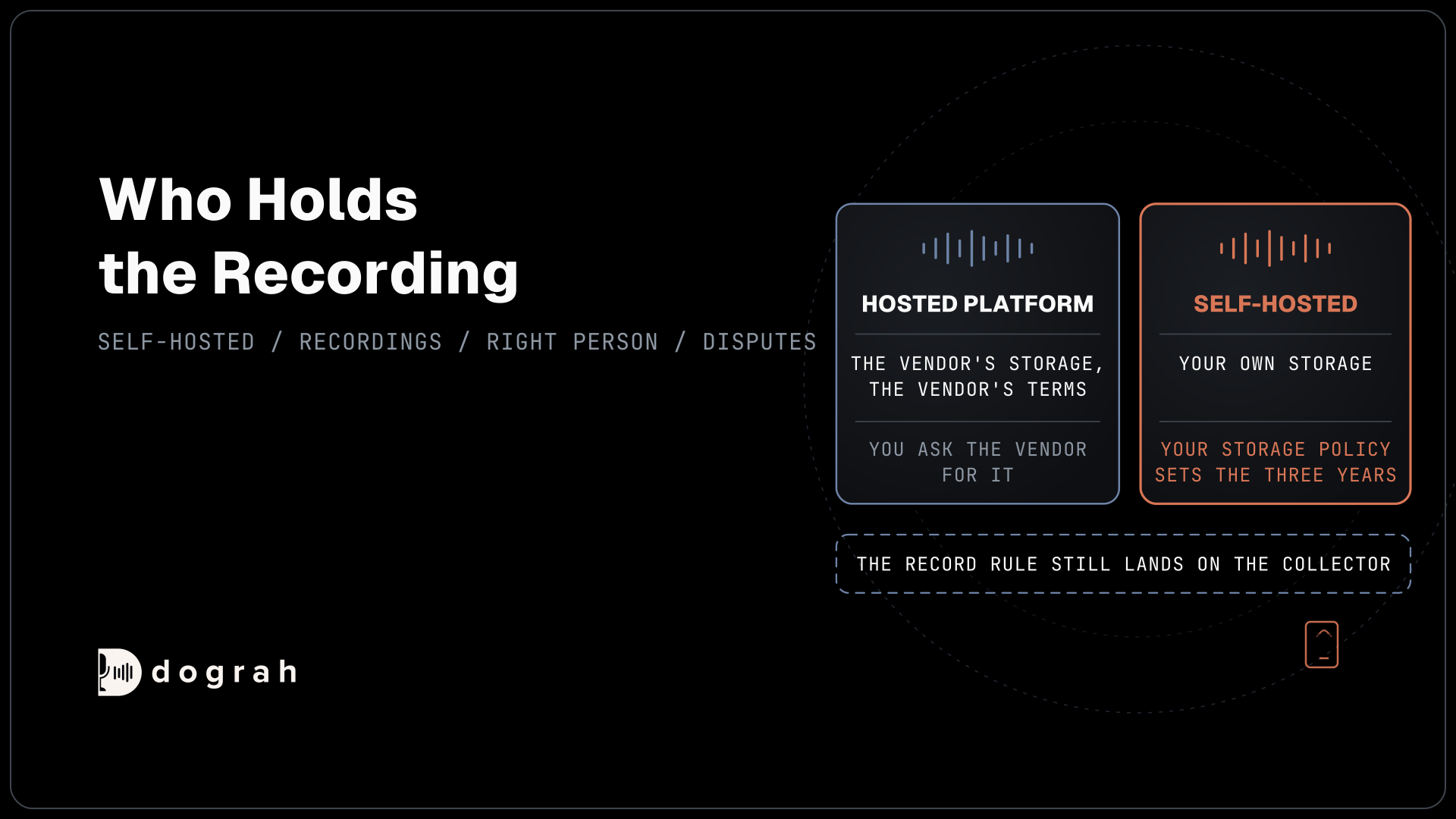
Applicant and student calls carry dates of birth, funding details and sometimes disability or veteran status, so where the calls run matters. Dograh is open-source, so you can self-host it and keep recordings, transcripts and answers on the school's own servers. Our page on self-hosted voice AI for universities covers that setup for education.
To keep full control, run open-weight speech and language models on those same servers as well. Using your own keys for hosted models puts the data under your own contract with each provider, and the audio still reaches that provider. Self-hosted Dograh has no per-minute platform fee, but servers, model keys and phone minutes still cost money. Dograh Cloud charges a 1¢-a-minute platform fee.
Each call's View Trace button shows what the agent heard and why it answered as it did. Built-in QA reviews calls after they end and scores each step, so write its prompt to flag any salary figure, job-placement claim or funding promise that is not in the approved text.
Where to start
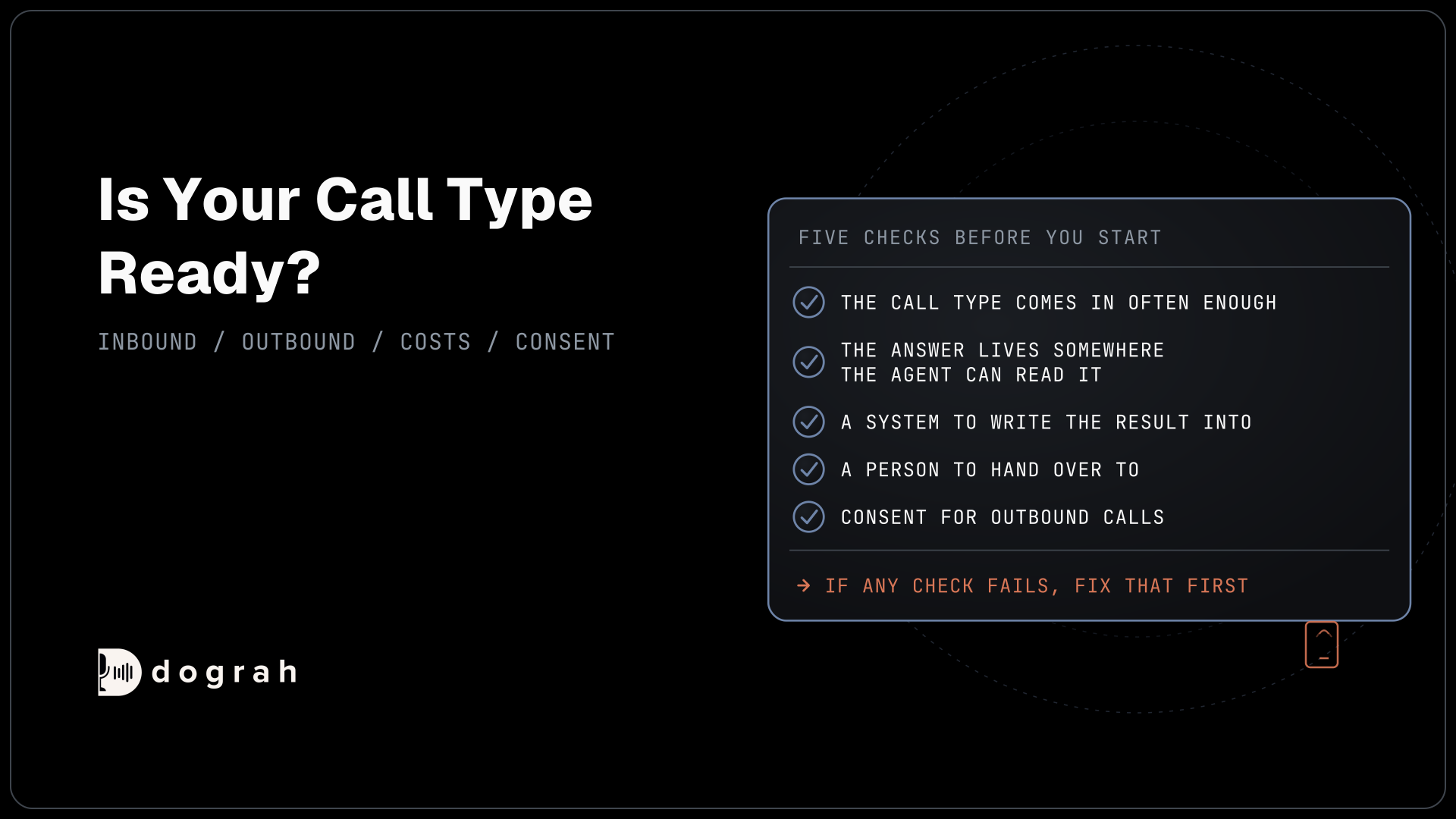
Start with the enquiry callback, once the form collects the right consent and the CRM checks it. Add lead qualification next, then the application-to-first-day calls, then student support. Test each call over a real phone line before launch. Most phone calls still reach the agent as 8 kHz audio, while a browser test runs at 16 kHz, so program and certification names can sound different to the speech model.
Each call above has its own deep dive:
- AI Student Lead Qualification Calls for Trade Schools and Bootcamps
- Admissions and Enrollment Follow-up AI Calls for Career Schools
Glossary
- Prior express written consent
- A signed agreement, electronic signatures allowed, that names the school and the phone number and says calls may use an artificial voice. A for-profit school's AI sales call to a mobile needs it.
- Misrepresentation rules
- The Department of Education's rules against misleading statements to students and prospects about jobs, pay, licensure and financial aid. They cover the school and anyone it hires for recruiting or admissions.
- Workforce Pell
- Pell Grants for approved short workforce programs of 8 to under 15 weeks. Whether a program or a person qualifies is a financial aid answer, never the agent's.
- API Trigger
- A Dograh setting that lets your form handler or CRM start an outbound call with one request, passing the enquiry fields to the agent. It places the call at once and has no calling-hours window.