
Admissions and enrollment follow-up calls with AI reach accepted students who have gone quiet before their first day. The agent verifies the student, names any missing document and asks the school's system to send an upload link, confirms or moves the start date, covers first-day logistics and books an advisor call when the student has doubts.
Key Takeaways
- Verify the student before naming any missing item or start date.
- Documents go through the school's upload link, never the call itself.
- Doubt goes to an advisor call that the agent books.
This post is part of our guide to AI voice agents for trade schools and bootcamps, where doubt goes to an advisor. Below, we cover missing documents, start dates and the advisor call. Along the way, we show how the follow-up call runs in Dograh, the open-source AI voice agent platform we build.
Why accepted students go quiet
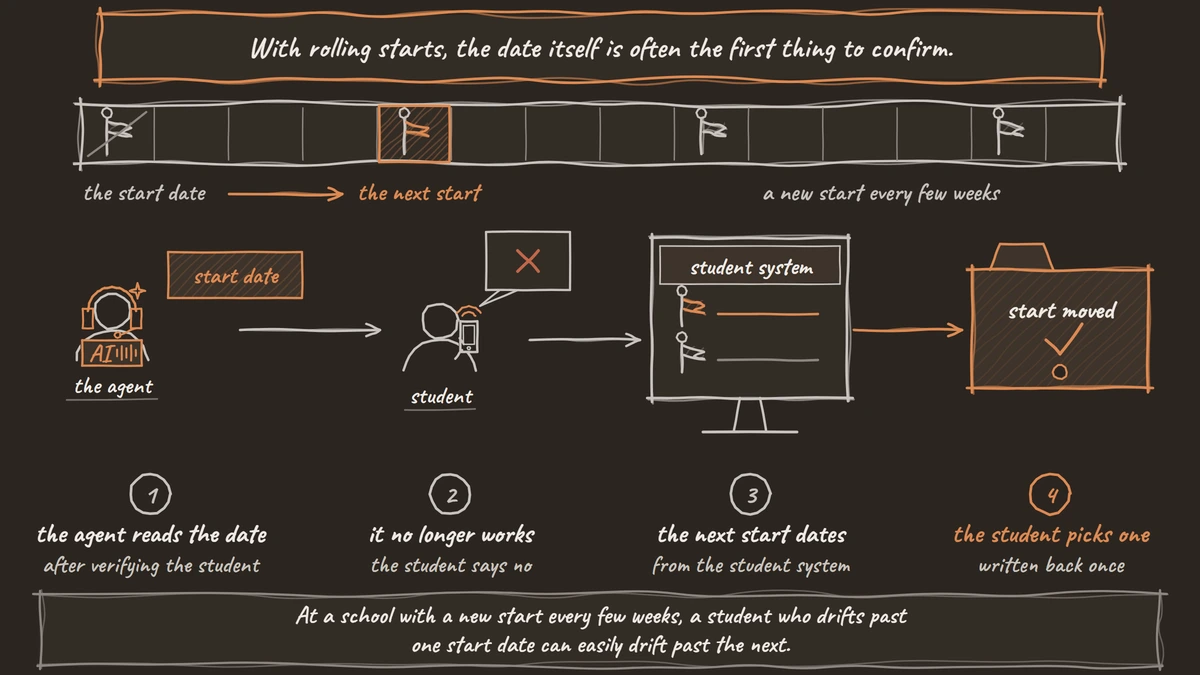
An accepted student who stops replying usually has one specific blocker. A document is missing, the funding paperwork stalled, the start date no longer works, or they are having second thoughts. At a school with a new start every few weeks, a student who drifts past one start date can easily drift past the next.
The follow-up call finds which blocker it is and fixes what the school's systems can fix. It does not replace the advisor. NCAN's summary of the evidence on summer melt points the same way: reminders and nudges reach many students, and a person handles the complex questions. The agent covers the reminders and books the person.
This call starts where the first call ends. Before an application, the job is finding out whether a prospect is ready, which our post on AI student lead qualification calls covers. Here, the student has applied or been accepted, and the goal is the first day.
Building the call list
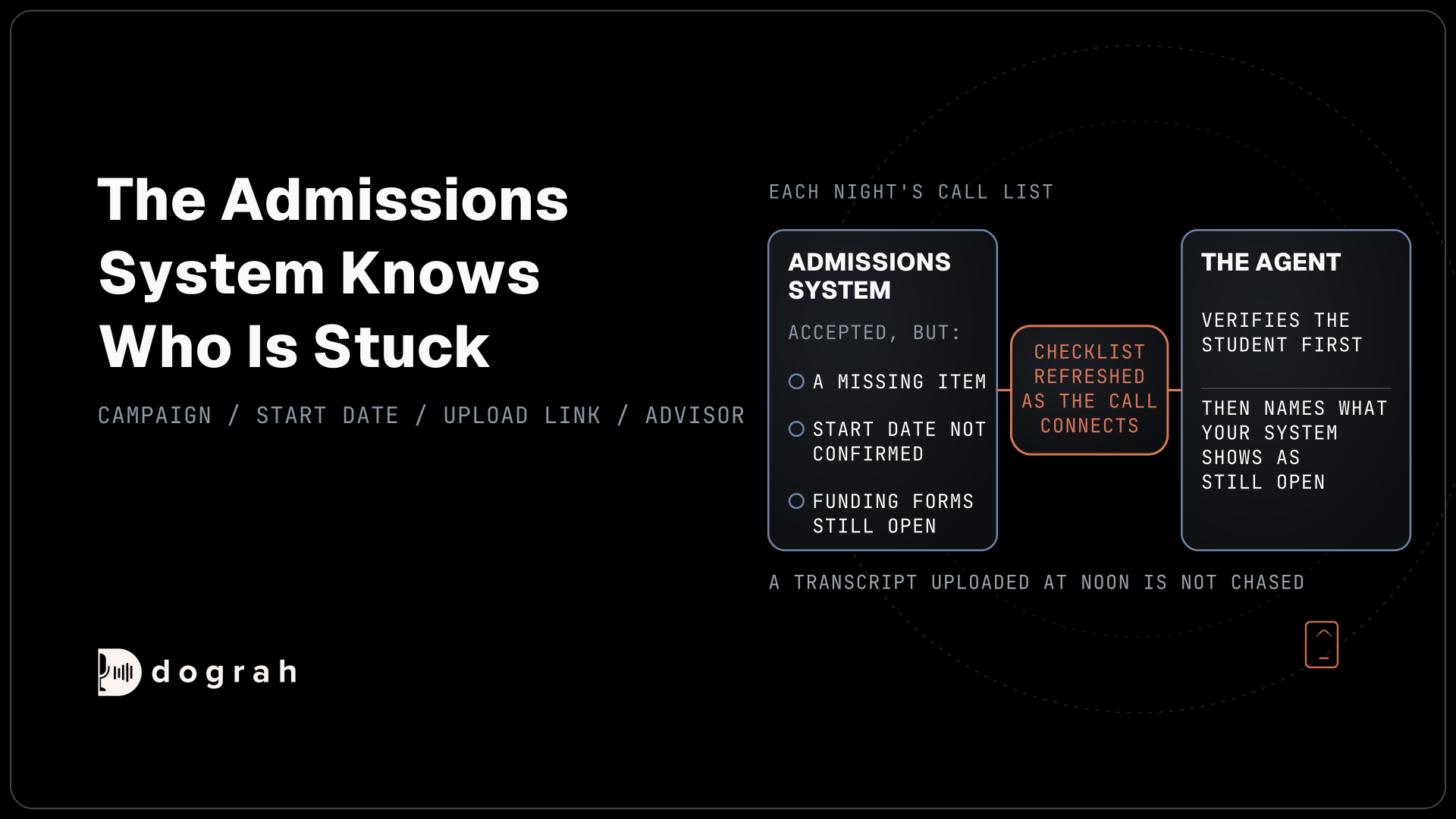
The admissions system knows who is stuck, so the call list comes from it. Each night, export the students who are accepted but have a missing item, an unconfirmed start date or open funding forms, and run the export as a campaign. Extra columns, such as the missing item and the start date, become variables the agent can read.
Set Pre-Call Data Fetch to Outbound calls only, and it refreshes the student's checklist from your system when the call connects. A transcript uploaded at noon is then not chased at 4 p.m. Calling hours are set by weekday in one time zone per campaign, so split the list if your campuses span time zones. You set the retries (0 to 10) and the delay between them.
The purpose of the call matters for consent. Under the FCC's calling rules, an AI-voice call to a mobile needs prior express consent. A call about the student's own application and start generally sits outside telemarketing, while pitching a different paid program or an upgrade turns it into a sales call that needs written consent. Keep the follow-up to the student's own enrollment, and confirm the split with counsel before the first campaign.
Missing documents: name it, send the link
A missing document gets named, explained and sent by link. The agent greets the student, confirms identity with the date of birth or the last digits of the application ID, and only then names the item, such as a high-school transcript or a photo ID, and why the school needs it.
Then an HTTP API tool asks the school's own system to send its secure upload link by text or email during the call. Documents are never collected on the call itself.
Keep a sensible cap on how often a student is chased for the same item, enforced in your own system, so the call never starts to feel like collections. Our post on AI voice agents for application follow-up covers the missing-item call in detail.

Open Source Alternative to Vapi / Retell
Self-hosted voice agent platform — no per-minute fees
dograh-hq/dograh
Star on GitHub
Start dates and funding paperwork
With rolling starts, the date itself is often the first thing to confirm. The agent reads the student's start date from the call data and asks whether it still works. A yes is written back to the student system through an HTTP API tool. A no gets the next start dates from the same system and a new choice, with a Preset Parameter named workflow_run_id set to {{initial_context.workflow_run_id}} so a repeated request does not move the student twice.
Funding paperwork stalls quietly. The agent names what your system shows as still open, such as the enrollment agreement or an aid verification form, and offers to book a call with the financial aid office. It never says whether a student qualifies for aid or how much they will get.
Workforce Pell adds a new question. The Workforce Pell final rule extends Pell Grants to approved programs of 8 to under 15 weeks. Students will ask whether theirs is one of them, and that answer belongs to financial aid. The agent records the question and books the call.
First-day logistics and the advisor call
Some students go quiet because the first day feels unclear. The agent answers from the school's own documents in its Knowledge Base: the campus address and entrance, parking, the first-day schedule, and what to bring, such as steel-toe boots or a laptop.
Doubt is different. A student who says the evening schedule may not work, or who wonders whether the program is right, needs a person. The agent books a call in the advisor's calendar through an HTTP API tool, or, if an advisor is free, uses the Transfer Call tool. Dograh calls the advisor first and connects the student only when someone answers. On Twilio, it can play a short spoken introduction to both people before connecting them. If nobody answers within 30 seconds by default, the student stays with the agent, which books the callback instead.
Join the Dograh Community
Dograh is an OSS alternative to Vapi. Join our Slack community for queries, releases, best practices & community interactions.
Results and checks
Every call should end with a status the admissions team can act on. A Webhook node sends it after the call, such as start confirmed, start moved, link sent, aid call booked or advisor booked, along with links to the recording and transcript.
Voicemail handling is off by default. If you set it to Leave a message, keep that one fixed message to the school's name and a callback number, with nothing about the student's application. Built-in QA reviews calls after they end, so write its prompt to flag any job, pay or aid statement beyond the school's published text, which our pillar explains in its section on what the agent never promises.
Student records stay with the school when it self-hosts. Self-hosted Dograh has no per-minute platform fee, but servers, model keys and phone minutes still cost money. Dograh Cloud charges a 1¢-a-minute platform fee.
Start with start-date confirmation calls for the next intake. The list is small, and every confirmed date is a seat that stays filled.
Glossary
- Summer melt
- Accepted students who never start. At a short-program school, it shows up as students who drift past one start date and then the next.
- Secure upload link
- A link the school's own system sends by text or email so a student can upload a document. The agent asks for it to be sent and never takes documents on the call.
- Rolling start
- A schedule with a new class starting every few weeks. A student who misses one start can move to the next, so the call confirms or moves the date.
- Enrollment agreement
- The contract a student signs with the school before starting. The agent can name it as still open and offer an advisor, but never explains its terms.