
AI student lead qualification calls reach each enquiry as soon as the form arrives. The agent asks which program, which start date, which schedule works and how the student plans to pay, records each answer and sends it to the admissions system. Ready leads go to an advisor the same day, and funding questions go to financial aid.
Key Takeaways
- Ready to enroll is what the lead says, recorded as answers.
- The admissions system decides who reaches an advisor, using the school's rules.
- Funding questions get a financial aid booking, never an eligibility answer.
This post is part of our guide to AI voice agents for trade schools and bootcamps, where the enquiry form starts the call. Below, we cover the readiness questions and where answers go. Throughout, we show how the qualification call runs in Dograh, the open-source AI voice agent platform we build.
What ready to enroll means
A lead is ready to enroll when they can name a program, a start date that works, a schedule they can keep and a way to pay. Those are facts the lead states. Many qualification tools turn the answers into a score inside the calling tool and drop leads below a line, so the school never sees why a lead was filtered out.
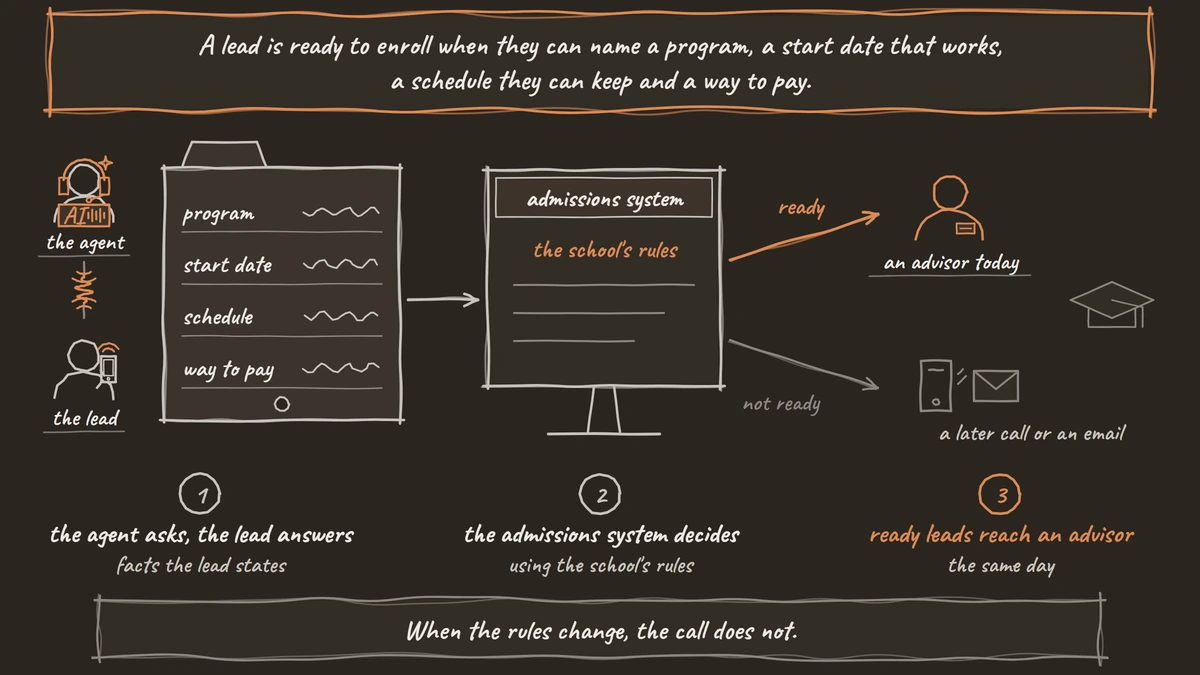
This post takes the other route. The agent records each answer in the lead's own words and sends it to the admissions system. The school's rules there decide who reaches an advisor today and who gets a later call or an email. When the rules change, the call does not.
The general version of this call, for any business, is in our post on AI voice agents for lead qualification. This one stops at the advisor hand-off. After an application, the call changes to the one in our post on admissions and enrollment follow-up calls with AI.
Calling when the enquiry arrives
At a school with a new start every few weeks, the enquiry form is the start of the call. With the API Trigger, the call is placed as soon as your system sends the request. Pass the form fields in initial_context, such as the name, the program they clicked and the campus, so the agent opens with what the lead already told you.
The API Trigger has no calling-hours setting of its own, so your system decides when to send. Enquiries that arrive at night are held in the CRM and sent in the morning. A for-profit school's sales call may not reach a home line before 8 a.m. or after 9 p.m. local time.
Consent is checked before the request is sent. Under the FCC's calling rules, a call that encourages someone to enroll in a paid program is telemarketing, so a for-profit school generally needs prior express written consent on the form for an AI-voice call to a mobile, while a tax-exempt nonprofit school needs prior express consent. Our pillar covers the form wording in full, and your counsel should confirm it before the first call.

Open Source Alternative to Vapi / Retell
Self-hosted voice agent platform — no per-minute fees
dograh-hq/dograh
Star on GitHub
The questions the agent asks
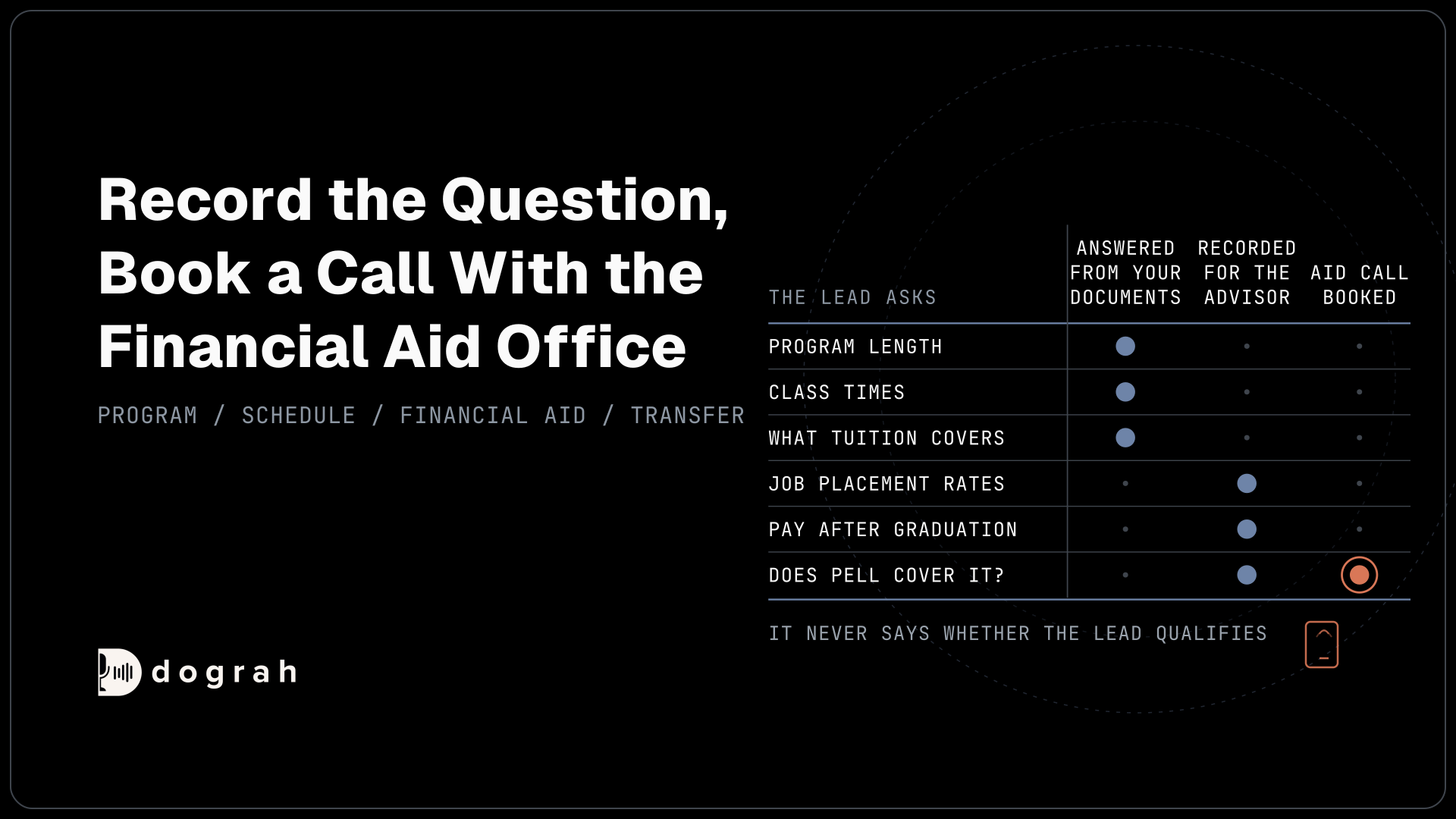
Four questions do most of the work: which program, which start date, which schedule fits around work or family, and how the lead plans to pay. The agent greets the lead by name, says it is the school's AI assistant and asks the questions in a natural order, following up when an answer is vague. If the lead asks something about the program, such as the length, the class times or what the tuition covers, the agent answers from the school's own documents in its Knowledge Base. Anything outside those documents is recorded as a question for the advisor.
The agent never talks about job placement rates, pay after graduation or licensure pass rates, even when the lead asks directly. Those statements fall under the Department of Education's misrepresentation rules, and our pillar explains why the advisor gives them from the school's published text. On the call, the agent says the advisor will cover outcomes and records the question.
Turn on Enable Variable Extraction on the Agent node and each answer becomes a named field, such as program, start_date, schedule and funding_plan, ready to send at the end of the call.
Funding questions go to financial aid
Money comes up on many of these calls. The rule for the agent is simple: record the question, book a call with the financial aid office and never say whether the lead qualifies.
Workforce Pell makes the rule more pressing. The Workforce Pell final rule extends Pell Grants to approved programs of 8 to under 15 weeks, and short-program students will ask whether theirs is one. Whether a program is approved, and whether a student can get the grant, is for financial aid to answer.
The Department of Education's rule on financial aid statements treats a misleading statement about the availability, amount or nature of aid as misrepresentation, and that covers anyone a school pays to recruit. Booking the aid call keeps every eligibility answer with the people who can stand behind it.
Handing ready leads to an advisor
When the admissions system marks a lead ready during the call, the agent can connect them to an advisor straight away. The Transfer Call tool rings the advisor's line. Dograh calls the advisor first and connects the lead only when someone answers. Twilio lines can add a short spoken introduction, played to the lead and the advisor before they are joined.
If nobody answers within 30 seconds by default, the lead stays with the agent, which books a callback in the advisor's calendar through an HTTP API tool. Leads the system does not mark ready get a booked call or the next step your rules set.
Join the Dograh Community
Dograh is an OSS alternative to Vapi. Join our Slack community for queries, releases, best practices & community interactions.
Sending results to the admissions system
Every call ends with a record your admissions team can sort. A Webhook node sends the extracted answers, the funding question if there was one, the outcome (transferred, callback booked, aid call booked, not interested) and links to the recording and transcript.
Your admissions system scores and routes from there, with rules your team can read and change. Built-in QA reviews calls after they end, so write its prompt to flag any statement about jobs, pay or aid eligibility. Self-hosted Dograh has no per-minute platform fee, but servers, model keys and phone minutes still cost money. Dograh Cloud charges a 1¢-a-minute platform fee.
Start with the enquiries for your next start date. The questions are few, and each answer lands where your team already works.
Glossary
- API Trigger
- The Dograh entry point the school's form handler or CRM calls to start a qualification call, with the form fields passed along. Night enquiries wait in the CRM, because it has no calling-hours setting.
- Ready to enroll
- Whether a lead can name a program, a start date, a schedule they can keep and a way to pay. The agent records those answers, and the admissions system decides.
- Prior express written consent
- A signed agreement, electronic signatures allowed, naming the school and the phone number and saying calls may use an artificial voice. A for-profit school's sales call needs it.
- Advisor hand-off
- Passing a ready lead straight to an advisor during the call. With Transfer Call, the advisor is rung first and the lead joins only once someone answers.