
AI voice agents for title and escrow answer order-status calls and place closing and chase calls, reading every answer from the title production system after verifying the caller. They never give, confirm or change wiring instructions by phone. Wiring questions go to a person, and callers phone their escrow officer at the number in their opening documents.
Key Takeaways
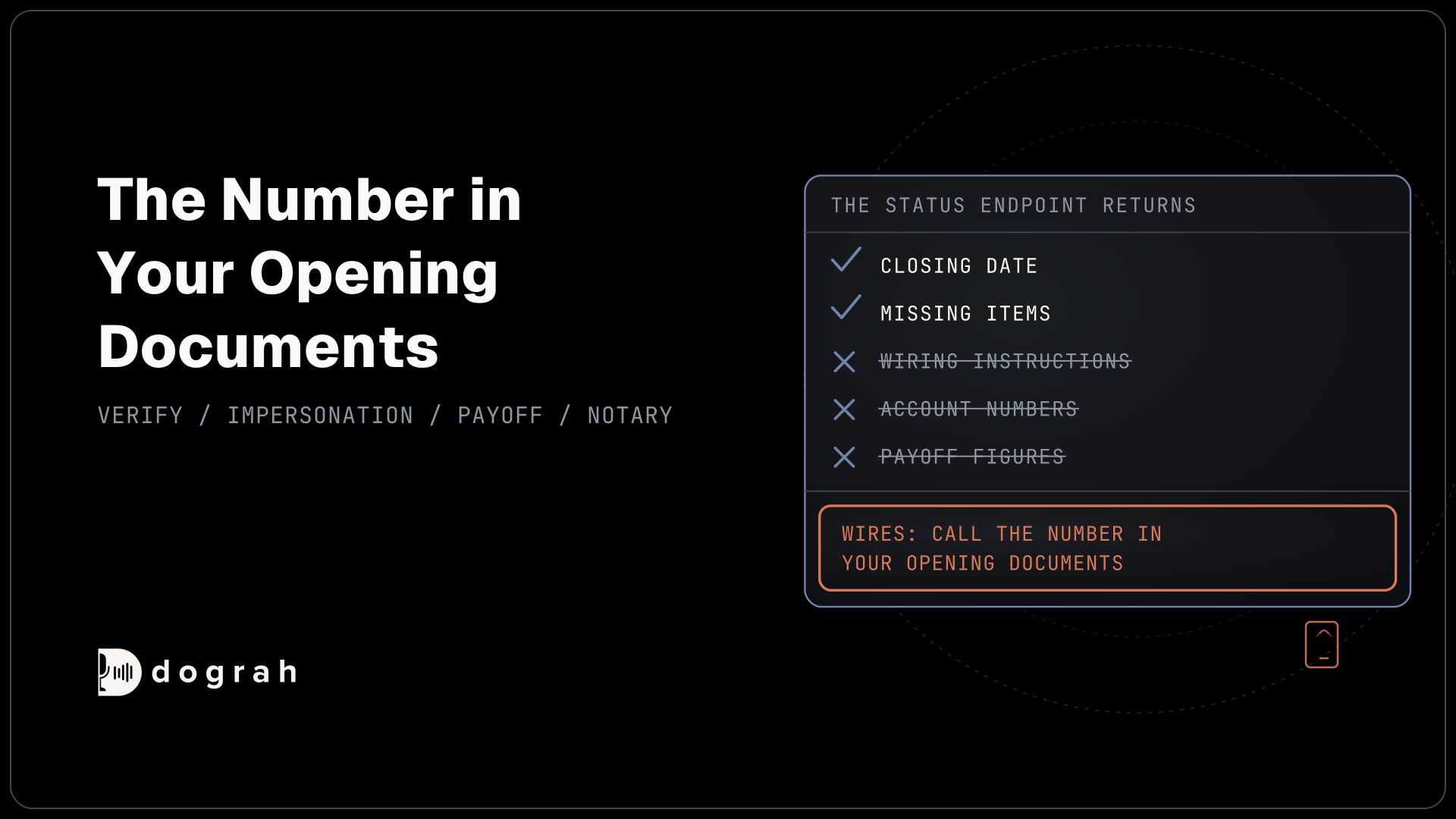
- The status endpoint returns no wiring data, so the agent cannot read any out.
- Point callers to the number in their opening documents, never one spoken on calls.
- A phone number finds the file, but only an approved check proves who's calling.
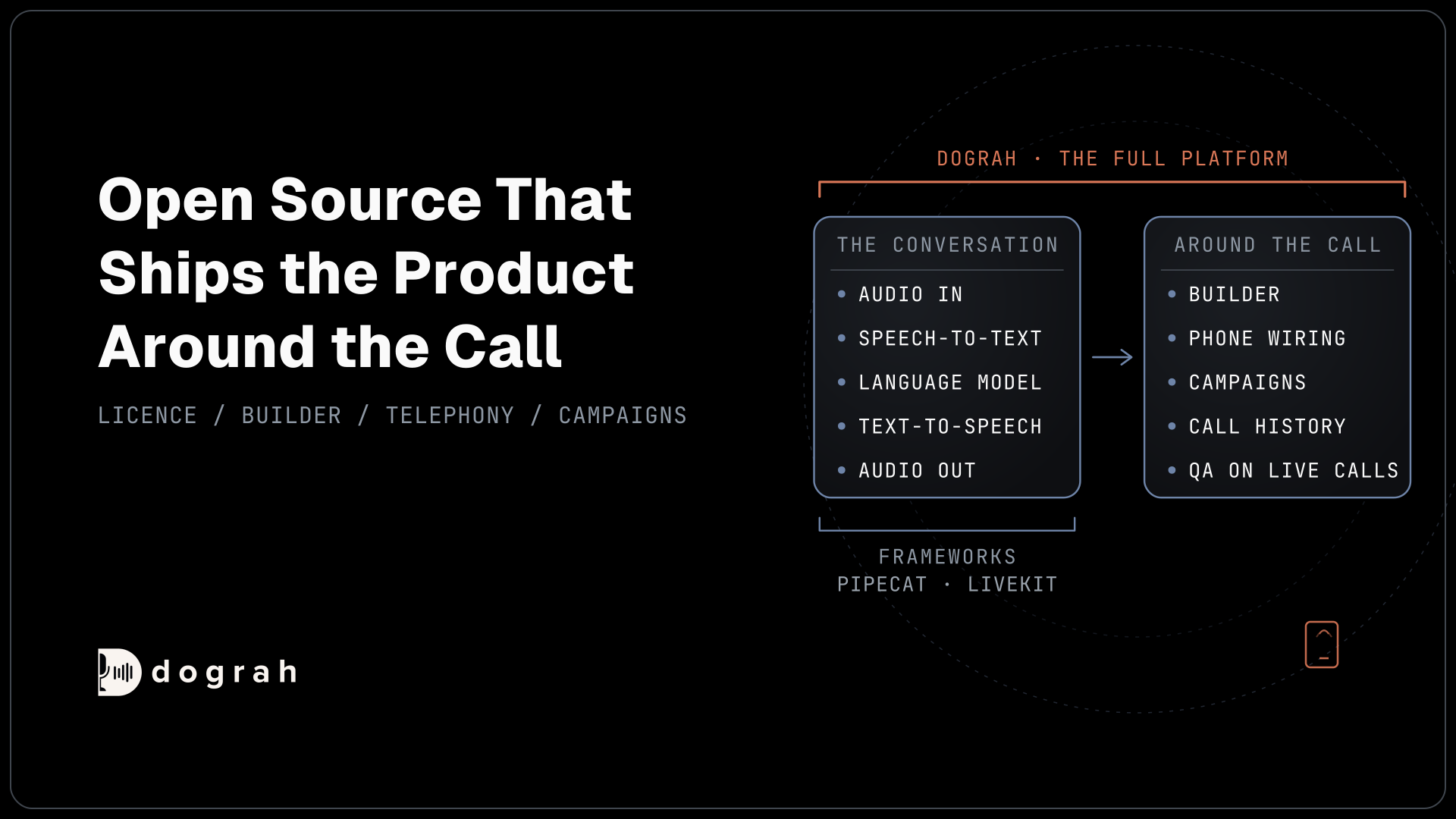
This guide covers which title and escrow calls a voice agent can take, and the wire-fraud rules that hold on every one. We show how each part works in Dograh, the open-source AI voice agent platform we build. You can self-host it or run it on Dograh Cloud.
What a title and escrow phone line hears
Many calls to a title or escrow office ask where a file stands, and the answer already sits in the title production system. Real estate agents and lenders want to know whether the title commitment is out and when the closing is set. Buyers and sellers ask what happens next and what to bring. HOA management companies and lenders' payoff departments call back about documents the office asked for, and mobile notaries confirm signings.
A voice agent can take these calls if it reads the answer from your system during the call. In Dograh, an HTTP API tool asks your title production system for the file's status, and a second one writes a note back after the call. There is no built-in title production connector, so each tool points at your system's own API, or at a small service your team builds in front of it.
The agency side of the same deal, from the first lead to the viewing, is covered in AI voice agents for real estate. This guide stays with the title or escrow office and every party that calls it about a file.
Wire fraud is the risk on every call
Closing funds are what criminals are after, so the agent is never a channel for wiring instructions, in either direction. The FBI's 2025 Internet Crime Report put reported losses from Business Email Compromise (BEC) at just over $3 billion in 2025, up from about $2.77 billion in 2024. The FBI counts scams that use a hacked email account or phone number to get money moved as BEC, and fake closing wiring instructions are one of them.
The phone is part of the attack now. In ALTA's 2026 study, nearly six in ten title professionals said manipulated voice or image technology is becoming common in seller impersonation attempts. The FBI's May 2025 warning on AI-generated voice messages says a cloned voice can sound nearly identical to the real person, and tells people to find the number on their own and call back.
That advice shapes what the agent says. If an agent reads out a verified number, a criminal's fake agent can read out one too. So the office's line points callers to a number they already hold:
"We never give, confirm or change wiring instructions by phone. Before you send any money, call your escrow officer at the number in your opening documents."
Set the wording to match your office's real policy, for example if instructions go out only through a secure portal. Then make it hold in two ways.
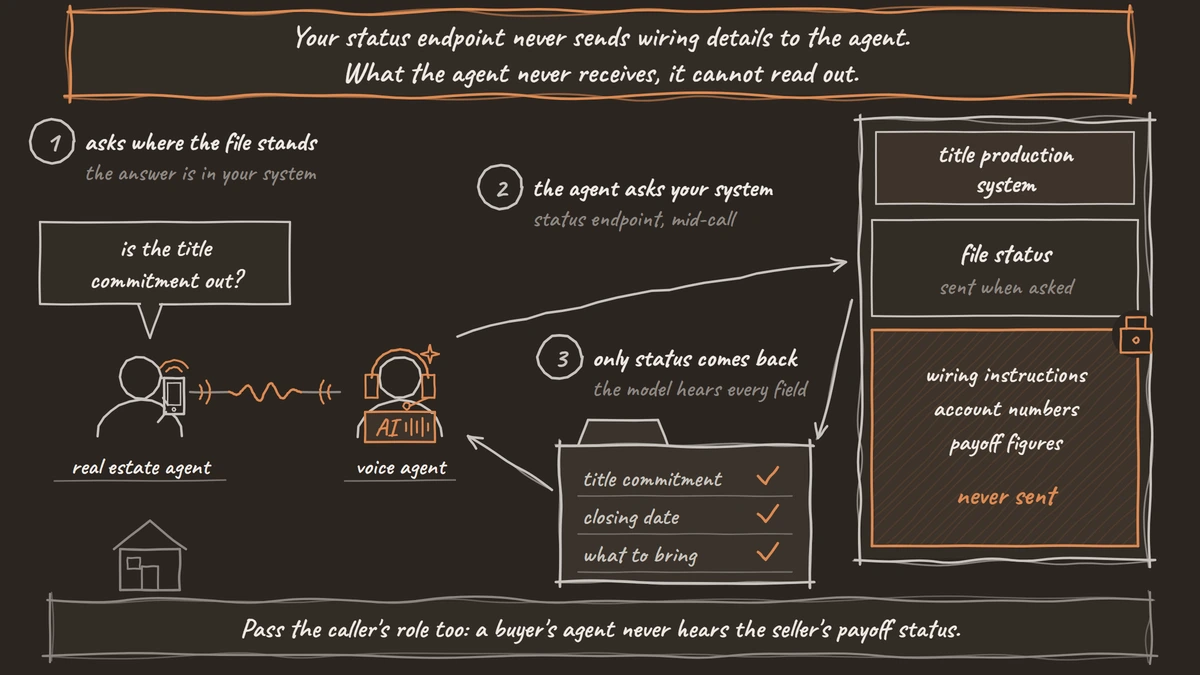
First, build the status endpoint so it never returns wiring instructions, account numbers or payoff figures. An HTTP API tool hands the whole response to the language model, with no setting to filter fields, so anything the endpoint returns, the agent can say. Data the agent never receives is data it cannot read out, even to a convincing caller.
Second, play the line as fixed words. A prompt cannot guarantee wording, because the model avoids a banned phrase and then says the banned meaning in other words. Exact wording holds only where Dograh plays fixed text or a recording, such as a pathway's Transition Speech. It plays with the caller muted, so it runs in full. Put the line on the pathway into closing details and on a pathway for any wiring question. Choosing that pathway is the model reading the condition you wrote, so test it with many phrasings, and read the transcripts to prove the line played. Our post on prompt and flow design patterns explains this split. On a speech-to-speech model, text lines there do not play, so record the line as a clip.
The prompt adds the soft rules. The agent never reads out or confirms an account or routing number, even one the caller reads aloud. If a caller starts reading numbers, it stops them, because transcripts keep whatever is said, and hands the call to a person. Fraud-alert callbacks follow the same principle, where the agent tells and never asks for anything a criminal would want.
A caller who says they have already wired money needs a person now. The agent writes the details to your system and transfers the call. The FBI's report says time is of the essence, and advises contacting the bank immediately to ask for a recall of the funds. Its Recovery Asset Team froze about $679 million of $1.16 billion in attempted theft in 2025, a 58% success rate, so the minutes count.
Verify the caller before any file detail
A phone number finds the file, but it does not prove who is calling. In ALTA's study, spoofed contact information was the most common seller impersonation tactic, named by 87% of respondents. Caller ID is the first thing a criminal fakes.
Every call runs greet, verify, then disclose. The Greeting Text names the office. If you want to tell callers they're speaking with an automated assistant, or your location requires it by law, write that there too. Pre-Call Data Fetch can load the file that matches the calling number as the call connects, and the prompt keeps every detail from it unspoken until the check passes.
Your office decides the check for each kind of caller. A buyer or seller might give their date of birth, or a passcode set when the file opened. An agent or lender might give the file number plus a detail your office already holds for them. If the check fails, the agent shares nothing about the file, records a callback request and gives the office's name.
The endpoint can enforce who hears what. Pass the verified caller's role to it, and return only what that party may hear. A buyer's agent then never hears the seller's payoff status, because the endpoint never sends it.

Open Source Alternative to Vapi / Retell
Self-hosted voice agent platform — no per-minute fees
dograh-hq/dograh
Star on GitHub
Seller impersonation: record it, hand it over
Seller impersonation fraud is a criminal posing as an owner to sell a property they do not own, and the agent's job is to record what it hears and pass it on. In ALTA's 2026 seller impersonation fraud study, a survey of 245 title professionals, 59% of firms reported at least one attempt in 2025, up from 28% in ALTA's 2024 study. Among firms with an attempt, one in four had a paid claim.
The leading red flag was a seller who avoids meetings, phone calls or video. Requests for a mail-away signing with the seller's preferred notary also ranked among the most common warning signs. Those requests often arrive by phone, and the agent should never book them.
Tell the agent in the prompt to record any request to change the signing method, the notary or where proceeds go, as the caller stated it, and to hand the file to a person. It never tells a caller they are suspected, and it never decides who is genuine. Staff do that. In the same study, direct contact with sellers through independently verified channels was among the highest-rated tools, at 90%, and that callback is a person's job, made with contact details the office found on its own.
Closing coordination calls
The coordination calls get every party to the signing, and they run from what your system already knows. The agent confirms the signers and the time and place, or the mobile notary. It also says what to bring. It names any missing item and has your system send its secure upload link. It books or moves a signing only from slots your system returns, and the wire line plays on every call. A seller who asks for a different notary goes to a person.
AI voice agents for closing coordination calls covers each of those steps. The lender's own call to the borrower, with the Closing Disclosure timing, is in AI voice agents for mortgage closing scheduling and reminders.
Payoff and HOA estoppel chase calls
Chase calls ask when a document will arrive and record the answer, and a person acts on what comes back. Before closing, the office needs a payoff statement from each lender with a loan on the property, and, where there is one, an HOA estoppel letter from the association. Much of the work is calling to ask where they are.
The agent calls the HOA management company or the lender's payoff department, gives the office's name and file reference, and asks for the status of the request and the date it will be sent. It records the answer as stated and writes it to your system. The document itself arrives in writing through the usual channel, and a person reviews it. If a payoff statement shows new account details, a person checks them with the lender at a number the office found on its own.
The agent never takes down account details or new wiring instructions on a chase call. If a payoff line opens with a keypad menu, the agent can't get through it, because Dograh has no keypad (DTMF) tool. Those requests stay with staff or the lender's own portal.
Campaigns suit a daily list of open requests. A campaign's calling hours run in one time zone, so split the list by time zone and run one campaign per zone.
Handing over to the escrow officer on the file
Wiring questions and impersonation red flags go to a person, and the call should reach the right one. Transfer Call works on Twilio, Telnyx, Plivo, Cloudonix and Asterisk ARI. Dograh calls the destination first and connects the caller only when someone answers. On Twilio, it can play a short spoken introduction to both people before connecting them.
To reach the escrow officer assigned to the file, set the destination source to Dynamic HTTP Resolver. During the call, Dograh asks your system for the number, and your system returns the officer on that file. No summary travels with the call by default, so the agent writes the details to your system first. The officer opens the file already knowing why the caller is there.
If nobody answers within the 30-second default, the caller stays with the agent. Tell it in the prompt to offer a callback and write that request to your system. Browser test calls cannot transfer, so test every transfer on a real phone line.
Join the Dograh Community
Dograh is an OSS alternative to Vapi. Join our Slack community for queries, releases, best practices & community interactions.
Consent and recording on title calls
A call about a party's own closing is a service call, and that sets the consent question. The FCC's calling rules under the Telephone Consumer Protection Act (TCPA) require the called party's prior express consent for a call to a mobile that uses an artificial or prerecorded voice, and AI voices count. The stricter written consent is for telemarketing, meaning calls that encourage a purchase. A coordination or chase call generally encourages none, so the consent a buyer or seller gave with their number for the transaction generally covers it.
Recording adds a second rule. Some states require every party's consent before a call is recorded, so say in the greeting that the call is recorded. Our post on call-recording consent laws shows how to set that up.
A caller who asks not to be called again comes off your own list, because Dograh keeps no do-not-call list. The agent writes the opt-out to your system during the call, and those numbers come out before the next campaign upload, and counsel can confirm the process.
Where title call data sits
Every title call carries nonpublic personal information, so decide where the audio and transcripts live before the first call. Because Dograh is self-hostable, you can run it on your own servers, and then the platform never sees your callers' data. We built a dedicated landing page for self-hosted voice agents at title and escrow companies covering status calls that never carry wiring data.
Dograh is the orchestration layer that runs the call flow, tools and telephony, and the speech and language models are a separate layer you choose. Bringing your own keys (BYOK) to a model provider changes whose contract covers the models, but the audio still reaches that provider. Data stays fully in-house only with open-weight models on your own servers, such as Qwen3.8 27B for language, Parakeet TDT 0.6B v2 for speech-to-text and Magpie TTS for the voice. The phone carrier stays on the call either way, and so does your cloud provider if the servers run in one.
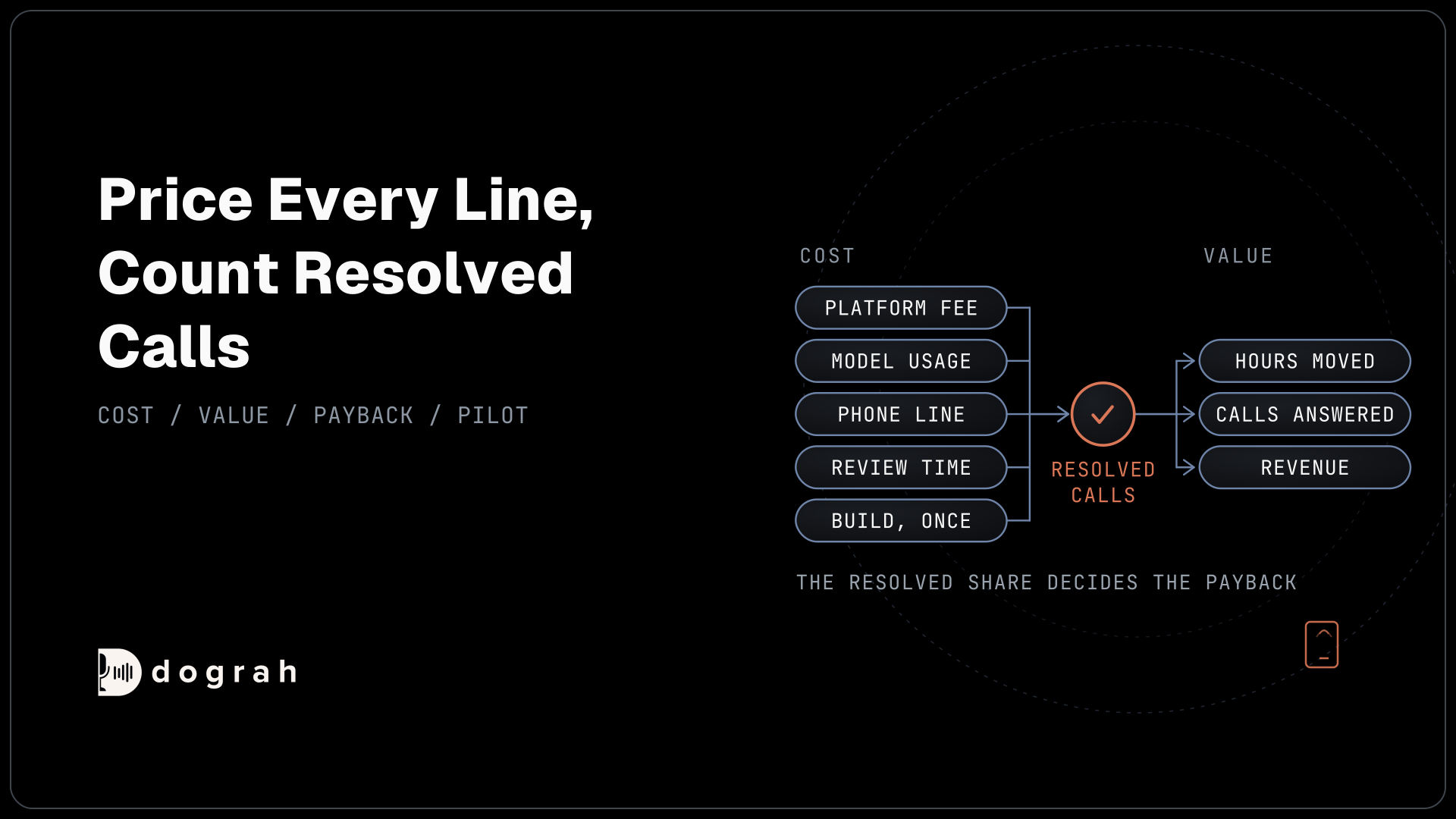
The platform has no retention setting and no automatic deletion for recordings and transcripts, so your own retention schedule handles them. Self-hosted, recording can be switched off only server-wide, and transcripts are still saved. The self-hosting guide covers the install. Self-hosted Dograh has no per-minute platform fee, though servers, model keys and phone minutes still cost money, and Dograh Cloud has a 1¢-a-minute platform fee.
Which call to hand over first
Start with inbound order-status calls from agents and lenders, because the agent only reads, after a check, from an endpoint with no wiring data. Add closing coordination calls next, then chase calls for payoffs and HOA estoppels. Seller identity checks stay with people.
Test on a real phone number before launch. Most phone calls reach the agent as 8 kHz audio, while a browser test runs at 16 kHz, so file numbers and street names can sound different to the speech model. Ask about wiring in as many ways as your staff can think of, and check that the fixed line plays each time.
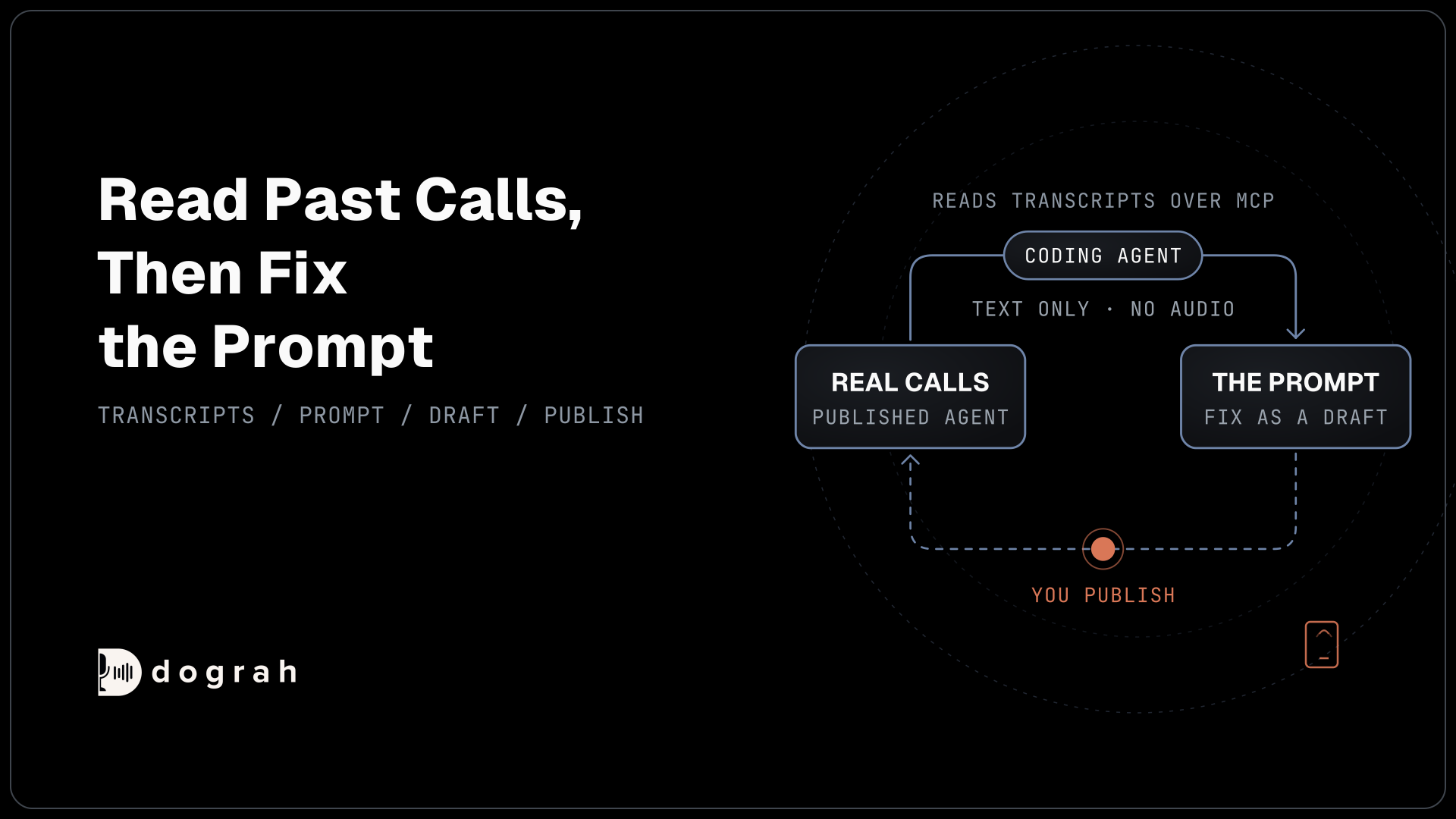
Once live, use QA as the safety net. Replace its system prompt with title-specific instructions that flag any call where wiring, an account number or a change of instructions came up, and keep the Sample Rate at 100% for that check. A flagged call goes to the escrow officer the same day.
The closing coordination call has its own deep dive:
Glossary
- Business Email Compromise (BEC)
- The FBI's crime type for scams that compromise email accounts or other channels, such as phone numbers, to get money moved. Fake closing wiring instructions fall under it, which is why title calls never carry wiring details.
- Seller impersonation fraud
- A criminal posing as a property's owner to sell it, using spoofed contact details and a notary of their choosing. The voice agent records unusual requests and hands them to staff, who verify the seller.
- Payoff statement
- The lender's written figure to pay off a loan on a set date, with payment details. The agent chases its status by phone, but the statement arrives in writing and a person checks any change in account details.
- HOA estoppel letter
- The homeowners association's written statement of what the owner owes, such as dues and assessments, needed before closing. Chase calls ask when it will be sent and record the answer.