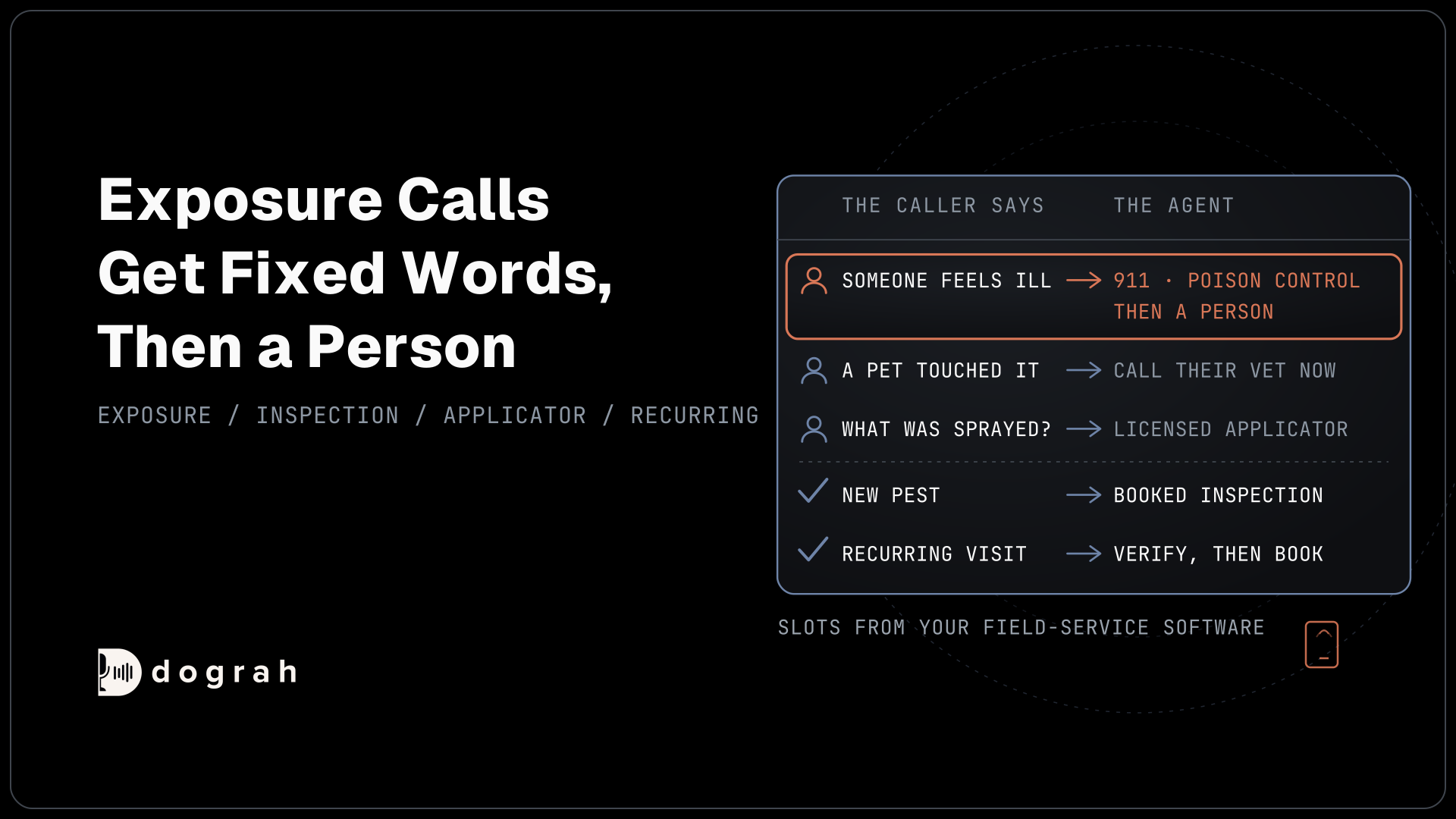

AI voice agents for pest control answer and place routine customer calls, such as new pest inquiries, inspection bookings, recurring visit changes and reminders. Every answer comes from your field-service software. A caller who reports pesticide exposure or symptoms hears fixed words naming 911 or Poison Control, then goes straight to a person. It gives no safety or re-entry advice.
Key Takeaways
- Exposure calls get fixed words naming 911 or Poison Control, then a person.
- Re-entry and treatment-safety questions go to a licensed applicator, never the agent.
- Every slot and visit is read from, and written to, your field-service software.
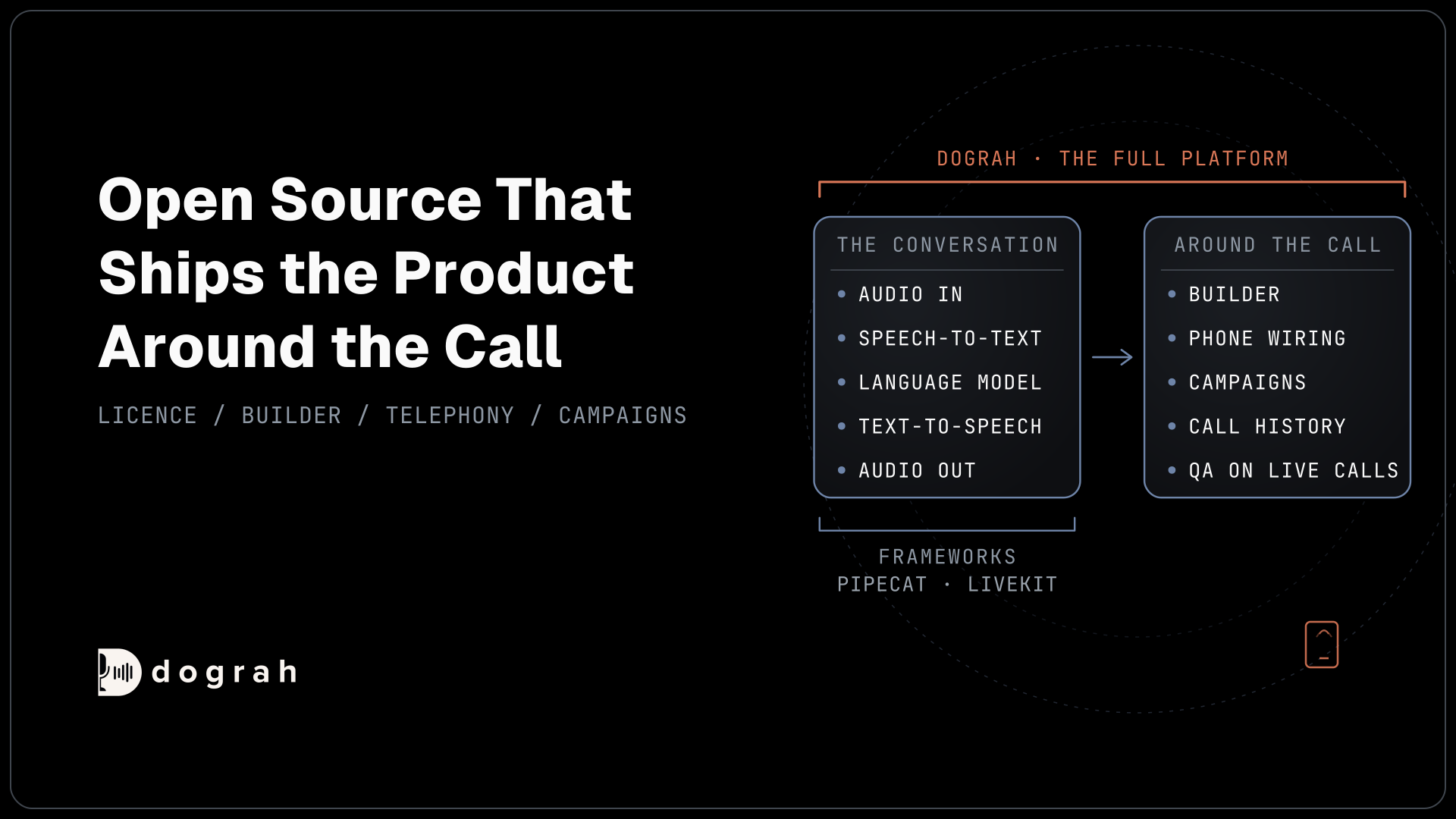
This guide covers the calls a pest control office takes, starting with the safety path for exposure calls, and shows how each one runs in Dograh, the open-source AI voice agent platform we build, reading and writing your field-service software. You can self-host it or run it on Dograh Cloud.
What a pest control phone line hears
Most calls to a pest control office are routine, and a few cannot wait. New customers call about ants in the kitchen or wasps by the door. Homebuyers call about termite inspections. Recurring customers call to move a visit or to ask why the technician did not come inside. Now and then someone calls because a person or pet feels unwell after a treatment.
The routine calls are the business. NPMA's report on the industry in 2025, drawing on Specialty Consultants' annual industry analysis, put US structural pest control revenue at $13.416 billion, up 6%, across 16,565 firms. Recurring service made up 85.4% of residential service revenue. In the survey of 800 owners and managers behind it, 36.8% said too few technicians held back their growth. Short-staffed offices feel every call. A technician who answers the phone between stops is not treating a house, and a missed reschedule leaves a hole in tomorrow's route.
Every answer the agent gives comes from your field-service software, such as PestPac or FieldRoutes. That is where the account, the service plan, the next visit and the open slots live. The agent reads them during the call and writes the result back, so the office sees the same record the caller heard.
Safety first: exposure calls get fixed words
When a caller says someone feels ill after a treatment, the agent stops booking and plays one approved line. Then it hands the call to a person.
The thresholds come from public health guidance. EPA's first aid guidance for pesticide exposure says to call 911 if the person is unconscious, having trouble breathing or having convulsions, and to call Poison Control for first-aid help when a pesticide has been swallowed, inhaled, or got into the eyes or onto the skin. Poison Help, run by America's Poison Centers, puts callers through to a poison expert at 1-800-222-1222, free and confidential, 24 hours a day.
The same EPA page says to induce vomiting only if emergency personnel on the phone or the product label say to. A generated sentence must never improvise an instruction like that. So the agent gives no first aid at all. It points the caller to the people who do.
Here is an example line. Your safety lead approves the final words: "If anyone has collapsed, is having trouble breathing, or has had a seizure, call 911 now. For any other symptoms after contact with a treatment, call Poison Control at 1-800-222-1222, open 24 hours. I'm connecting you to our team now."
Exact words only hold where Dograh speaks fixed text. Put the line in the Transition Speech on the pathway into the safety step, as text or a recorded clip. Text lines do not play on speech-to-speech models, so use a recording there. The line plays before any identity check, because it says nothing about the caller's account.
Choosing that pathway is the language model reading the pathway's written condition, so it is never a hard rule. Write the condition broadly, so it covers any mention of feeling sick, a rash, coughing, burning eyes, or a child or pet touching a treated area. Then add the same rule to the Global Node, whose prompt is added to every step that has Add Global Prompt switched on, as it is by default. A caller who mentions symptoms halfway through a booking can still reach the safety step. The Global Node steers the agent, but it does not fix the words.
The safety step's prompt tells the agent to start Transfer Call at once, with no questions first. Transfer Call works on Twilio, Telnyx, Plivo, Cloudonix and Asterisk ARI. Dograh calls the destination first and connects the caller only when someone answers. Put the same line in the tool's Pre-Transfer Message, so the caller hears it again before the transfer rings. No summary goes with the call by default. On Twilio, a short spoken introduction can play to both people.
If nobody answers within the 30-second default, the caller stays with the agent, and from that point its words are generated. Tell it in the prompt to repeat the 911 and Poison Control advice, then write an urgent callback request to your system through an HTTP API tool.
Poison Control is for people. A pet that touched a treatment gets its own pathway and its own fixed line telling the owner to call their vet now, and the agent never sends anyone to 911 about a pet. Our post on after-hours vet triage covers pet poison lines in more detail.
The same shape, a fixed line and then a person, runs gas-leak calls in AI voice agents for emergency intake in utilities. Test the safety path over a real phone call, since browser test calls cannot run Transfer Call. Once live, have a person read every call that took it.
New pest calls: from the pest to a booked inspection
A new pest call collects the same facts every time, then books the visit from live slots. The agent asks what the pest is and where it shows up, then how long it has been going on. It checks the address against your service area. Urgency comes from your own list, written into the prompt, such as stinging insects near a door or rodents in a food area ahead of ants in a pantry. An urgent case goes to the on-call technician through Transfer Call, and everything else gets a booked inspection.
Booking reads open slots from your software and writes the chosen one back during the call. Add a Preset Parameter named workflow_run_id with the value {{initial_context.workflow_run_id}} to the booking tool, so your software can ignore a duplicate if the request is sent twice. The agent quotes only prices your software or price list returns. Anything else waits for the technician's inspection.
A new caller has no account yet, so there is nothing to verify before booking. The agent takes their name, address, phone number and best time to reach them as they state them, and the transcript stays as the exact record. AI voice agents for solar and home services covers the same booking loop for other home-service trades.

Open Source Alternative to Vapi / Retell
Self-hosted voice agent platform — no per-minute fees
dograh-hq/dograh
Star on GitHub
Recurring visits: the calls that pay the bills
Recurring customers bring in most of the revenue, so their calls about the next visit are where an agent earns its keep.
Before the agent names a visit date or an address, it verifies the caller. A phone number finds the account but does not prove who is speaking, so the agent asks an approved check, such as the last digits of the account number. Then it reads the next visit, moves it or records a skip with the reason the customer gives, and writes the change back.
Outbound calls work best where the customer has to answer, such as interior access, a skipped visit that needs a new date, prep that can move the date, or a locked gate the technician needs opened. Plain notices can stay with the reminders your software already sends. AI voice agents for pest control scheduling and recurring service reminders covers those calls in full.
Questions only a licensed applicator answers
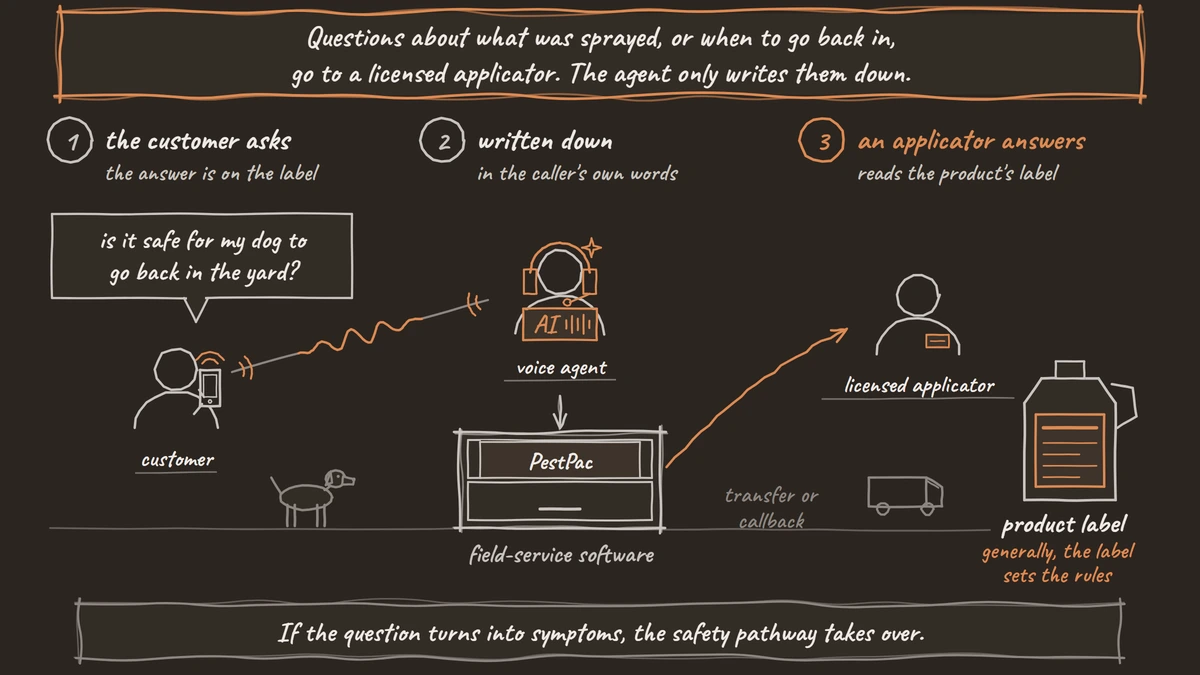
Questions about what was sprayed, how long to stay off a treated area, whether a product is safe near a fish tank, or a state's notice rules go to a licensed applicator, never to the agent.
EPA's introduction to pesticide labels puts it in five words: "the label is the law." Re-entry intervals and safety directions come from the label of the product that was used, read by someone licensed to apply it. A caller asking "is it safe for my dog to go back in the yard?" needs that person.
So the agent records the question as the caller states it and writes it to your software. Then it transfers the call or books a callback with an applicator. Keep product labels out of the agent's Knowledge Base, so it has nothing to read a safety answer from. If the question turns into symptoms, the safety pathway takes over.
Outbound calls and consent
A reminder about a visit already on the plan is a service call. A call that sells something is telemarketing, and the consent needed is different.
The FCC's calling rule under the Telephone Consumer Protection Act (TCPA) requires the called person's prior express consent for an artificial-voice call to a mobile number, and the FCC treats AI-generated voices as artificial voices. A telemarketing call made that way needs prior express written consent, meaning a signed agreement that clearly authorizes the business to call. So a reminder generally rests on the number the customer gave for the plan, while a seasonal add-on pitch or a call asking a cancelled customer to come back generally needs written consent on file.
Keep offers off reminder calls and run them as their own campaign, built only from customers with written consent, and have counsel confirm that split. Our post on service reminders in home services explains why a reminder carries no offer.
Connecting your field-service software
There is no built-in PestPac or FieldRoutes connector in Dograh, so each connection points at your software's own API. Pre-Call Data Fetch, at the bottom of the Start Call node, can load the customer's account once the call connects. The caller hears ringing until the data is in. During the call, HTTP API tools read slots and write bookings, skips and callback requests. Each waits 5 seconds by default and does not retry, so keep these lookups quick. After the call, the Webhook node sends the outcome to your software and retries a temporary failure automatically.
Access depends on your vendor. WorkWave's developer site says PestPac's API is open to PestPac customers or approved developers working for them, with a one-time setup fee. FieldRoutes and other systems connect the same way through whatever API access their vendor gives you. Our guide to integrating voice agents with your stack walks through each connection type.
Join the Dograh Community
Dograh is an OSS alternative to Vapi. Join our Slack community for queries, releases, best practices & community interactions.
Where customer call data goes
Pest control is not covered by HIPAA, but its calls still carry home addresses, gate codes, when nobody is home and whether children or pets live there.
On a hosted platform, that call can pass through the voice platform and the model providers behind it, plus the phone carrier. In Dograh, the call flow and telephony run in one orchestration layer, and the speech and language models are a separate layer you choose. Self-hosted, it keeps recordings and transcripts on your own servers. Bringing your own keys changes whose contract covers the models, not where the audio goes. The audio stays in-house only when open-weight models run on your servers too.
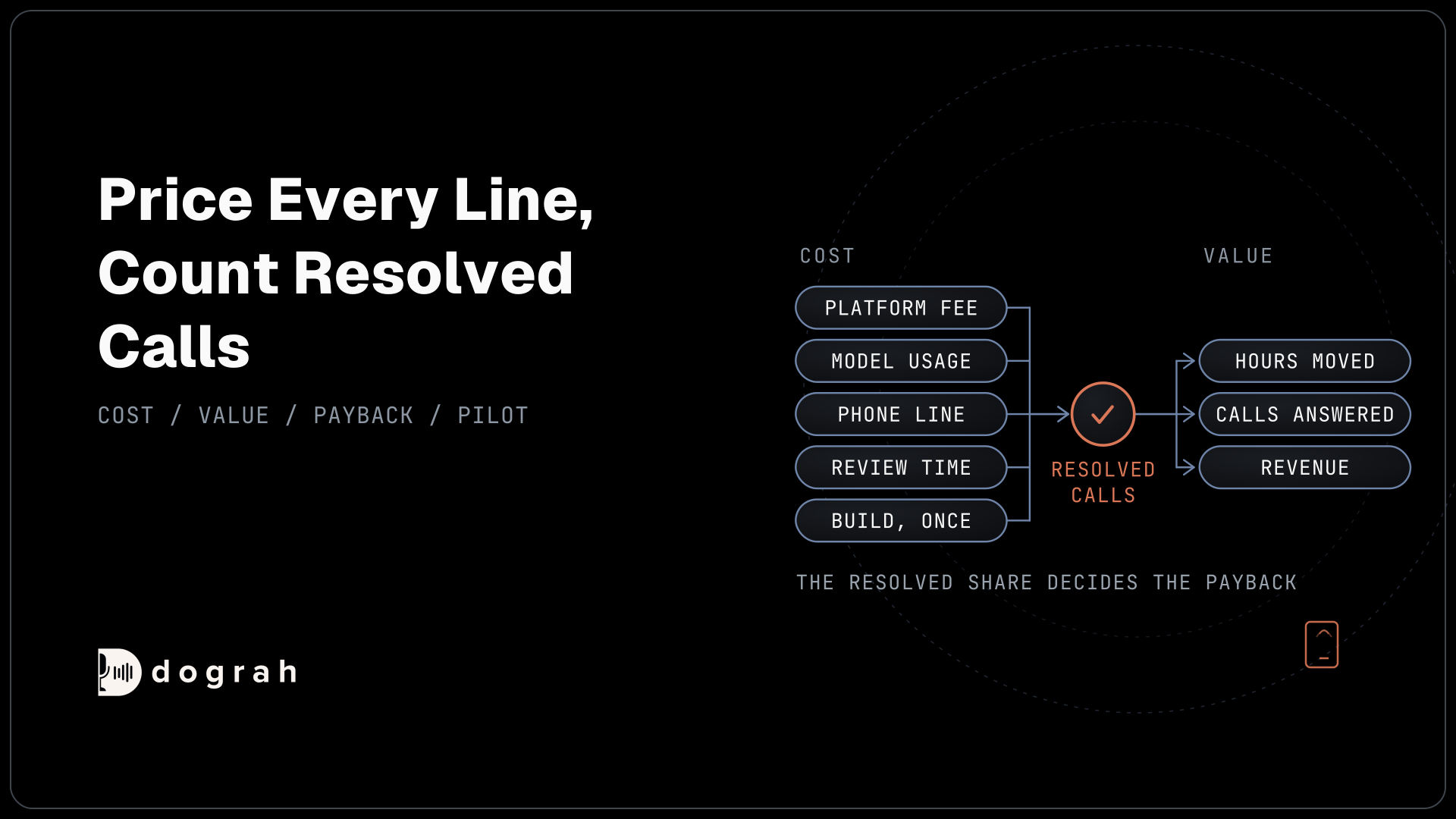
Self-hosted, recording can be switched off only server-wide, and transcripts are still saved. There is no retention setting, so your own policy decides how long calls are kept. Self-hosted Dograh has no per-minute platform fee (servers, model keys and phone minutes still cost). Dograh Cloud has a 1¢-a-minute platform fee.
Both run 10 concurrent calls by default. Self-hosted teams can raise that with DEFAULT_ORG_CONCURRENCY_LIMIT, and Dograh Cloud customers contact Dograh for more.
Which pest control call to automate first
Start with inbound calls that only book, such as new pest calls after hours and the overflow when the office line is busy. Recurring reschedules come next, once your verification check is tested. Outbound reminders follow, and offers wait until your consent records are clean. The safety pathway is in every agent from day one, whichever call goes live first.
Test every agent on a real phone line, because most phone calls reach the agent as 8 kHz audio while a browser test runs at 16 kHz, and transfers only work on phone calls. Once live, run quality assurance (QA) on a random 5 to 10% sample of calls, on top of reading every safety-path call. Dograh's QA scores the agent at each step, so you see where a call went off course.
Each pest control call above has its own deep dive:
Glossary
- Transition Speech
- Fixed text or a recorded clip that Dograh plays word for word when the agent moves along a pathway. It is where an exposure line lives, because the words inside a step are generated. Text versions do not play on speech-to-speech models.
- Global Node
- A Dograh step whose prompt is added to every step with Add Global Prompt switched on. It steers the agent toward the safety pathway from anywhere in the call, but it cannot fix wording.
- Re-entry interval
- How long people or pets must stay off a treated area after an application, set by the product label. A licensed applicator answers it, never the voice agent.
- Licensed applicator
- A person licensed by the state to apply pesticides. Questions about products, active ingredients, re-entry and state notices go to them, because the label is the law.