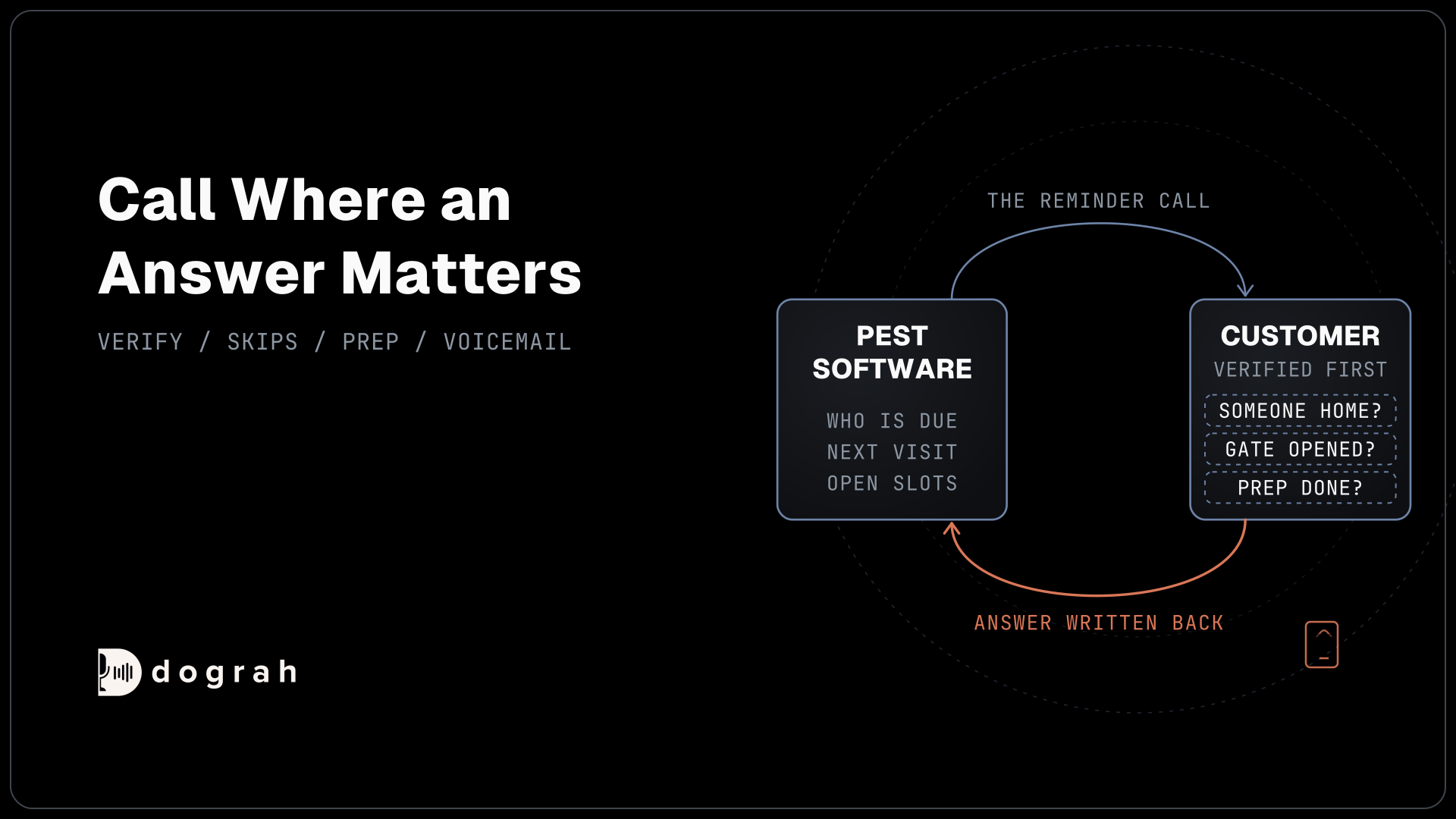

AI voice agents for pest control scheduling and recurring service reminders call customers only where an answer is needed, such as interior access, a skipped visit, prep that can move the date or a locked gate. After verification, the agent books or moves the visit from live slots in your field-service software, and your system sends the prep sheet.
Key Takeaways
- Your pest software decides who is due. The agent calls where an answer matters.
- Your system sends prep sheets in writing, and the agent confirms they arrived.
- Reminder calls carry no offer, and win-back calls generally need written consent.
This post is part of our guide to AI voice agents for pest control. Below, we cover why outbound calls for recurring visits work best where the customer has to answer. Then we follow those calls to the rebooked visit in Dograh, the open-source AI voice agent platform we build.
Which recurring visits are worth a phone call
A recurring visit is worth a call when the customer has to tell you something before the technician arrives. The visits matter because the plan is the business. NPMA's report on the industry in 2025 counted nearly 13.29 million residential customers and found that recurring service made up 85.4% of residential service revenue. In the survey of 800 owners and managers behind it, 36.8% said too few technicians held back their company's growth. When technicians are short, a visit that fails at the door costs a slot someone else could have used.
Most of those visits need no call. Pest software often sends its own reminders by text or email, and a plain notice can stay there. The call earns its place in four cases. The technician needs to come inside, and someone has to be home. A visit was skipped and needs a new date. The treatment needs prep that can move the date if it is not done. Or the gate is locked and the technician needs it opened. First bookings for new customers are a separate call, covered in AI voice agents for home-services appointment booking.
Who gets called, and when
The call list comes from your pest software, which knows each customer's recurring service plan and next visit. Export the customers whose visit needs an answer, leaving out anyone who asked not to be called, then upload the list as a CSV to Campaigns. Each extra column, such as the visit date or the service type, becomes a variable the agent can use. Or start each call from your own system through the API Trigger, which dials at once.
Campaigns set calling hours by weekday in one time zone per campaign, UTC by default, so split a list that spans time zones. Retries run from 0 to 10, 2 by default, with a delay between 30 seconds and an hour (2 minutes by default). Separate switches decide whether a busy line, an unanswered call or voicemail gets a retry. Campaigns have no per-customer call cap, so your own list sets how often anyone is called, or retries are set to 0.
Voicemail handling is off by default. If you turn it on and choose "Leave a message", keep the message to the business's name and a callback number. The visit date and the address stay off a voicemail, because anyone in the household can play it.
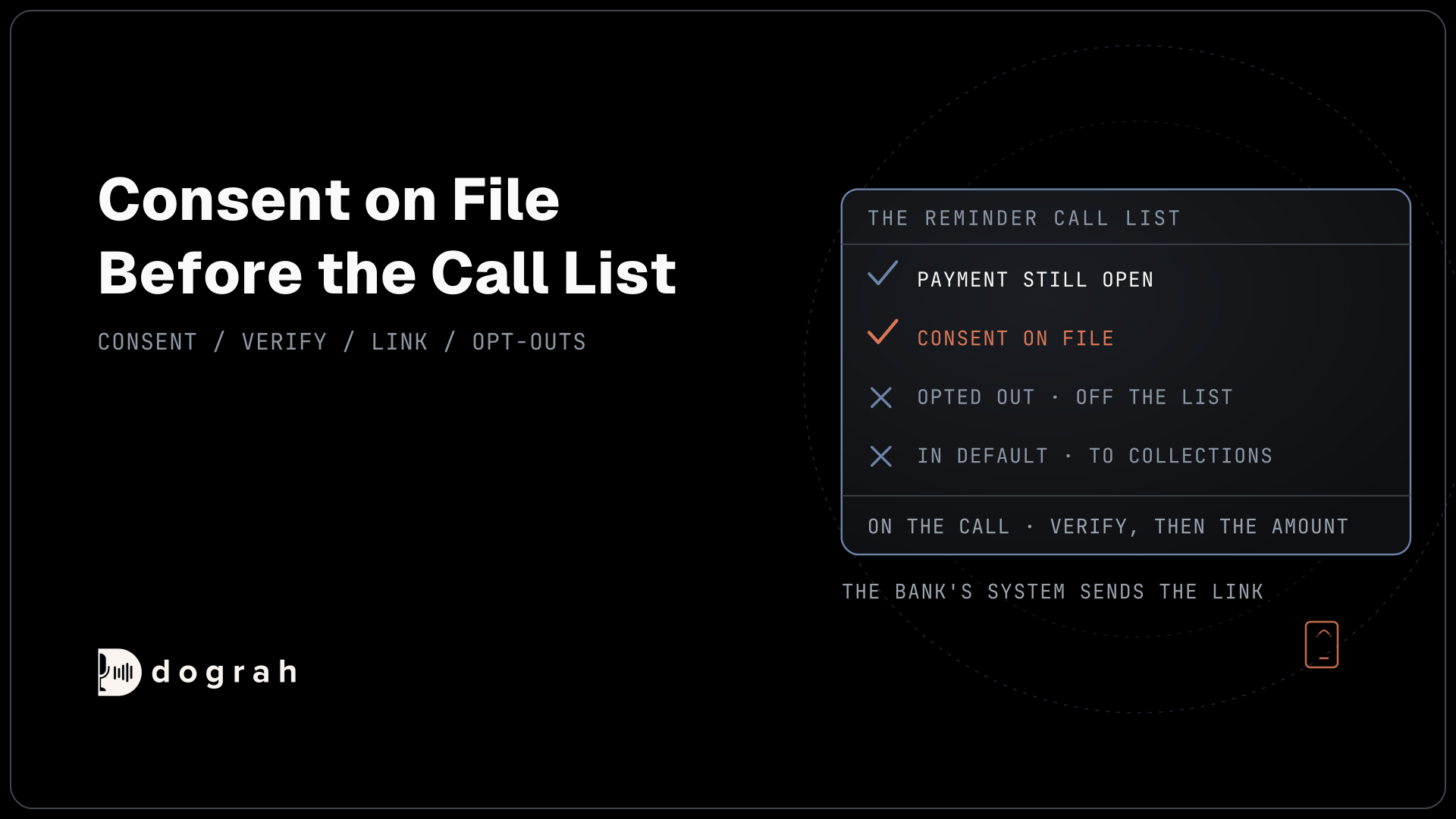
The FCC's calling rule under the Telephone Consumer Protection Act (TCPA) needs the called person's prior express consent for an artificial-voice call to a mobile number, and the FCC treats AI voices as artificial. Selling something on that call needs prior express written consent. So a reminder about a visit already on the plan generally rests on the number the customer gave, while a seasonal add-on or a call asking a cancelled customer to come back generally needs written consent on file. Keep those offers on their own campaign. Our post on service reminders in home services explains why a reminder carries no offer.

Open Source Alternative to Vapi / Retell
Self-hosted voice agent platform — no per-minute fees
dograh-hq/dograh
Star on GitHub
The reminder call: verify, then the visit
The call opens with the business's name and a check on who is speaking. Only then does it talk about the visit.
Greeting Text is the fixed line Dograh plays word for word as the call connects. Put the business's name there. If you want to tell customers they're speaking with an automated assistant, or your location requires it by law, write it in the Greeting Text along with the business's name.
A phone number finds the account but does not prove who is speaking, so the agent asks an approved check, such as the last digits of the account number. If the check fails, or someone else answered, the agent leaves the business's number and says nothing about the visit or the address.
Once the customer is verified, the agent reads the visit. Pre-Call Data Fetch can load the account as the call connects, so a visit the office moved that morning is already current. Write the prompt so the agent uses none of it until the check passes.
Then the agent asks the question the call exists for, such as whether someone will be home to let the technician in. An HTTP API tool writes the answer to your software during the call. It waits 5 seconds by default and does not retry, so keep the request quick.
Skips, moves and prep that changes the date
A skipped visit gets a reason and a new date in the same call, so the route does not carry a gap.
The agent records why the visit was missed as the customer states it, for example a locked gate, nobody home, a dog in the yard or rain on the day. Then it reads open slots from your software and books the new one. Add a Preset Parameter named workflow_run_id with the value {{initial_context.workflow_run_id}} to the booking tool, so your software can ignore a duplicate if the request arrives twice.
Prep is where a date most often moves. Bed bug and termite treatments can need laundry bagged, furniture moved, fish tanks covered or pets taken out before the technician arrives. Prep that touches safety comes from the product label, and EPA's introduction to pesticide labels is plain that "the label is the law." So your licensed applicator writes the prep sheet, and the agent never reads out how long to stay off a treated area.
Dograh sends no texts. During the call, the agent asks your own system to send the prep sheet by text or email. The agent then confirms the sheet arrived and asks whether the prep will be done in time. If it will not, the agent moves the visit. Our post on home-services reschedules and cancellations covers the reschedule call in more depth.
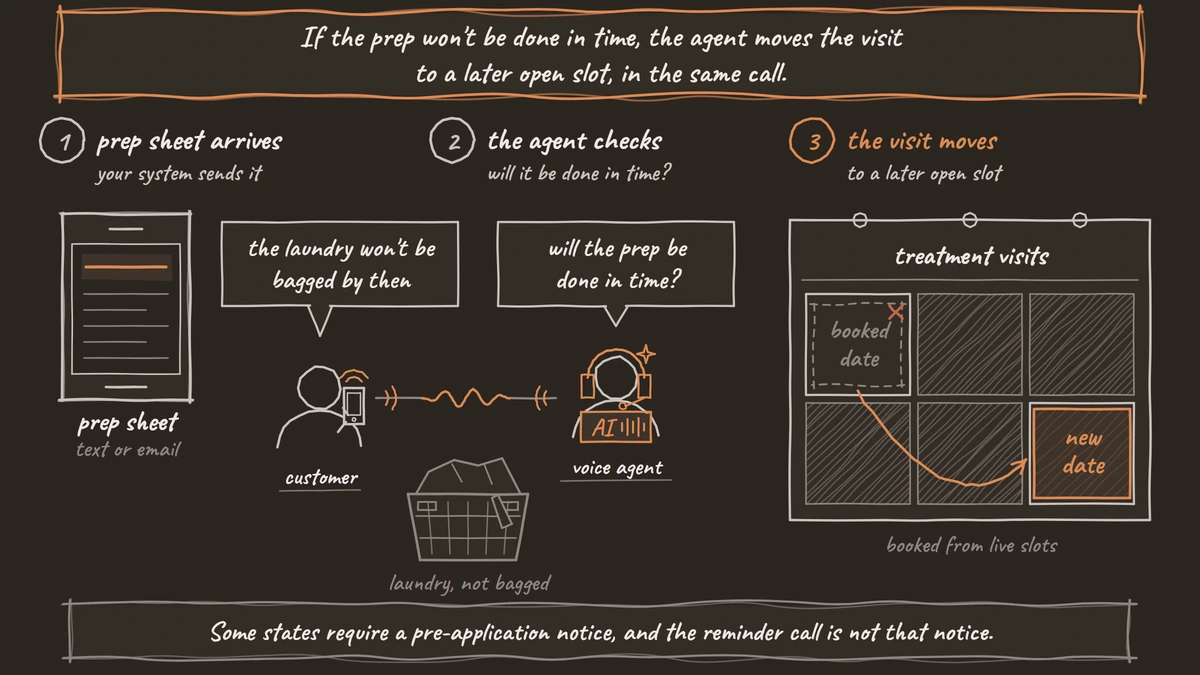
Some states also require a pre-application notice to registered people before a treatment, such as Pennsylvania's pre-application notice rule, which sets what the notice must say and when it goes out. That notice stays with your applicator's own process, and the reminder call is not the notice.
Handing over and writing it back
Anything the agent cannot settle from your software goes to a person, and every answer ends up in your own system.
A billing dispute, a complaint about the last treatment, a request to cancel the plan or a question only a licensed applicator can answer goes to the office through Transfer Call. It works on Twilio, Telnyx, Plivo, Cloudonix and Asterisk ARI. Dograh calls the destination first and connects the customer only when someone answers. No summary goes with the call by default, so the agent writes the details to your software first. If nobody answers within the 30-second default, the customer stays with the agent. Tell it in the prompt to offer a callback and write the request to your system.
A customer who says "stop calling me" is opting out. A do_not_call call outcome records it but never blocks a future call, so the agent writes the request to your own list and those numbers come off before the next upload. After each call, the Webhook node sends the outcome to your software. Self-hosted Dograh has no per-minute platform fee (servers, model keys and phone minutes still cost). Dograh Cloud has a 1¢-a-minute platform fee.
A customer who mentions that someone felt ill after the last treatment leaves the reminder and takes the safety path set out in our pest control guide, with fixed words naming 911 or Poison Control, then a person.
Join the Dograh Community
Dograh is an OSS alternative to Vapi. Join our Slack community for queries, releases, best practices & community interactions.
Glossary
- Recurring service plan
- A customer's standing agreement for visits at a set interval, such as quarterly, held in the pest software. It decides who is due. The voice agent only calls where a visit needs an answer.
- Skipped visit
- A recurring visit the technician could not complete, for example because a gate was locked. The agent records the reason as the customer states it and books a new date from live slots.
- Pre-application notice
- A notice some states require before a pesticide application, sent to people on a registry with set content and timing. It stays with the applicator's own process, never the reminder call.
- Calling hours
- The weekday time windows a Dograh campaign may dial in. They run in one time zone per campaign, UTC by default, so a list across time zones needs separate campaigns.