
An AI answering service for property management answers tenant calls at any hour. It sorts maintenance by urgency, logs work orders in your system, answers leasing and rent questions and hands true emergencies to the on-call person. Property managers who want to own it can run Dograh, the open-source AI voice agent platform, self-hosted or on Dograh Cloud.
Key Takeaways
- Most renters expect a maintenance response the same day.
- The agent never screens prospects, decides on rent or takes a payment.
- In Dograh, an HTTP API tool logs the work order before any transfer.
A tenant's call at 1 a.m. is rarely about the lease. We follow one night of tenant calls and the lines the agent never crosses, then we talk about how Dograh logs work orders and reaches the on-call technician, and how the night is handed back to your team.
What an answering service does for a property manager
A human answering service takes a message, pages the on-call technician when something is urgent and bills for its time. Moneypenny's US plans, as one example, list a live receptionist at $422 a month for 200 minutes, then $2.39 a minute, and an AI receptionist at $199 a month for 100 calls, then $2.19 a call.
Tenants judge you on how fast someone responds. In Buildium's survey of 1,500 renters, 84% said they expect a response to a maintenance request within 24 hours, and 61% expect the same day or faster. A message taken at midnight that nobody reads until morning is a long wait against that expectation.
The choice is between people, an agent or both. A live service handles odd calls well and costs more as minutes climb. An agent answers every call on the same rules, writes straight into your property management system (PMS) and hands the calls that need judgment to a person. One sensible split is the agent at night and your staff by day.
One night of tenant calls
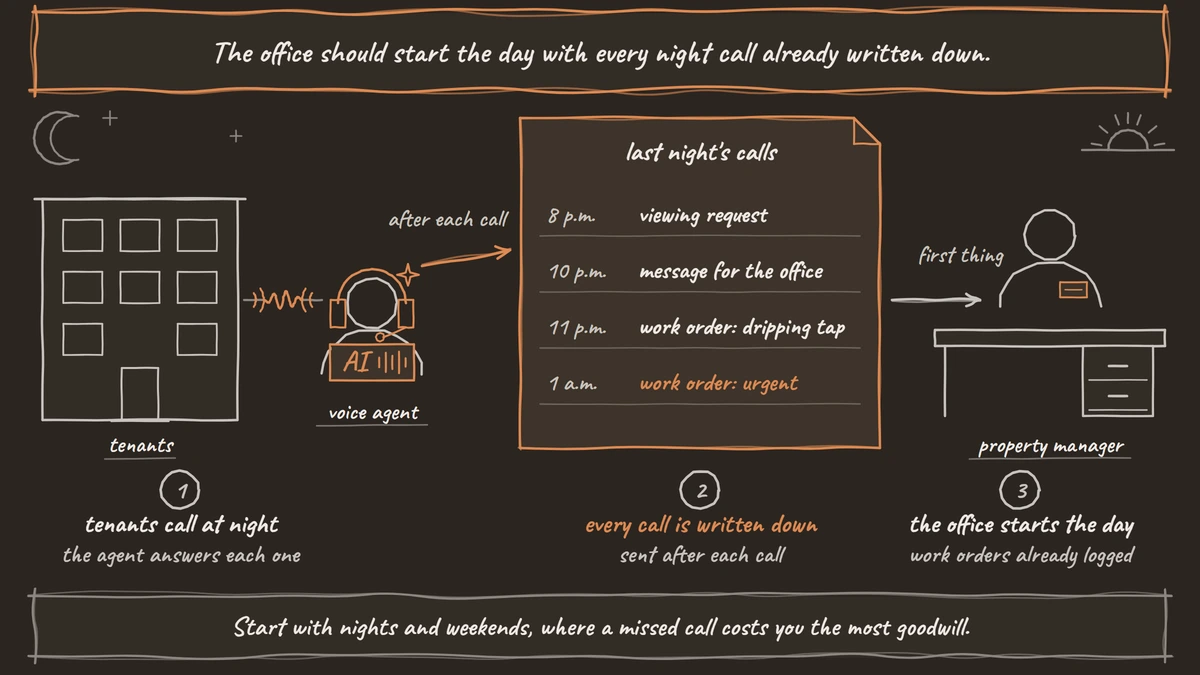
Here is how one night of tenant calls goes, and where each one should end. At 8 p.m., a prospect asks whether the two-bedroom allows dogs and when they can see it. The agent answers from the listing and the building rules you uploaded, and books or requests a viewing. Our guide to AI voice agents for property management covers the leasing side in full.
At 10 p.m., a tenant asks why a late fee appeared. After the agent confirms who is calling, it can read the balance your system returns, and anything that asks for a decision, such as waiving the fee, becomes a message for the office.
At 11 p.m., a kitchen tap is dripping. That is a routine repair, so the agent logs a work order with the details and tells the tenant when the office will be in touch. At 1 a.m., water is coming through a bedroom ceiling, or the heat has failed on a freezing night. Those are urgent, so the agent logs the work order and transfers the call to the on-call technician. Our post on maintenance-request intake shows how to sort repairs by how fast a person is needed.
A few calls get one fixed line before anything else. A tenant who smells gas hears "Leave the unit now without touching any light switches, then call 911 from well away from the leak." A fire or a sounding carbon monoxide alarm gets "If you're in danger, get to safety and call 911." These lines are set as a pathway's Transition Speech or a recorded clip, so they play exactly as written.
What the agent never decides
Some decisions stay with your staff, whatever time the call comes in. Under the Fair Housing Act, the agent never screens a prospect, never steers anyone toward or away from a building and answers every caller the same way from the listing. Our post on leasing inquiries gives the fixed reply for fair housing questions.
Rent decisions belong to people too. A tenant asking for a payment plan or hardship help gets a message or a transfer during office hours, as our post on rent reminder calls explains. Money never changes hands on the call. If the tenant wants to pay, an HTTP API tool asks your PMS or payment provider to send its own secure link, and the tenant answers every question by voice.
The agent also gives no repair advice beyond the fixed safety lines, because a tip about the shutoff valve from a voice agent is a liability if it goes wrong. What counts as an emergency is your call, since local habitability rules differ, so write the urgent list with your maintenance lead. Confirm your fair housing script and that list with counsel before the agent goes live.

Open Source Alternative to Vapi / Retell
Self-hosted voice agent platform — no per-minute fees
dograh-hq/dograh
Star on GitHub
One agent for every building
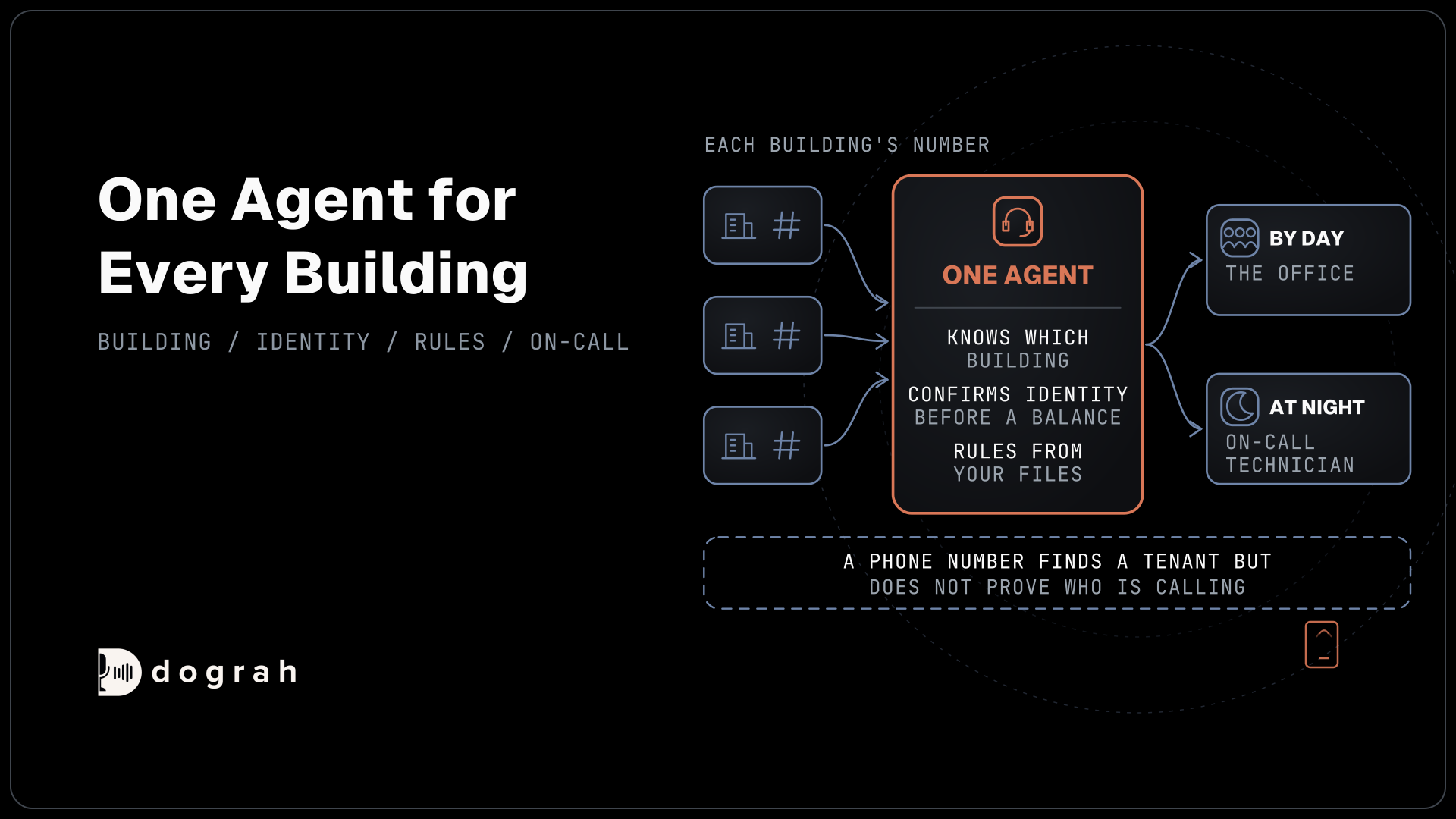
Most managers run more than one property, and one agent can serve all of them. Each building's phone number points at the same agent through its Inbound workflow setting. The dialed number reaches Pre-Call Data Fetch at the bottom of the Start Call node, so your system can return which building was called and the tenant record that matches the caller's number before the greeting.
A phone number finds a tenant but does not prove who is calling. The agent confirms identity with a check you approve, such as the unit number and date of birth, before it reads back an open work order or a balance. Nothing about the account is read out before that check.
Building rules come from your own documents. Pet policies, parking and trash days go in the agent's Knowledge Base as PDF, DOCX or TXT files of up to 5 MB each. Built-in time variables such as {{current_time_America/Chicago}} tell the prompt the local hour, so the same agent transfers to the office by day and to the on-call technician at night.
Logging the work order through an HTTP API tool
The work order is the heart of the worked example. In Buildium, for instance, the Open API includes "Create a work order" and needs a Premium subscription. Other PMS platforms have their own endpoints, so check your vendor's API terms before you plan the flow.
An HTTP API tool sends a POST to that endpoint during the call. The fields come from what the agent gathered, including the unit, the problem as the tenant stated it, where in the home it is, how long it has been happening, permission to enter and any pets. The agent records each answer as the tenant stated it, and the transcript and recording stay as the exact record.
Make the request retry-safe. Add a Preset Parameter named workflow_run_id with the value {{initial_context.workflow_run_id}}, so your system can ignore a second copy if the request is sent twice. The tool's Messages play a short line as it starts, and an update if it runs long, so the tenant hears "I'm logging that now" rather than silence.
When your system returns the work order number, the agent reads it back. HTTP API tools wait 5 seconds by default and do not retry on their own, so if the PMS does not answer in time the error goes to the agent, which takes the details as a message and tells the tenant the office will confirm in the morning.
Join the Dograh Community
Dograh is an OSS alternative to Vapi. Join our Slack community for queries, releases, best practices & community interactions.
Handing emergencies to the on-call technician
A true emergency needs a person on the phone tonight. Transfer Call works on Twilio, Telnyx, Plivo, Cloudonix and Asterisk ARI. Dograh calls the destination first and connects the caller only when someone answers, so the tenant is never dropped into a voicemail box.
The on-call technician changes through the week, so the Dynamic HTTP Resolver asks your on-call schedule system for tonight's number at the moment of transfer. No summary travels with the call by default, which is why the agent logs the work order first. The technician can open it on their phone while the tenant explains.
If the technician does not answer within the timeout, 30 seconds by default, the tenant stays with the agent. It tells them when to expect a call back, and an HTTP API tool writes an urgent callback request your team sees first thing. Try the transfer from a real phone before go-live, because a browser test call cannot transfer.
The morning hand-back, hosting and cost
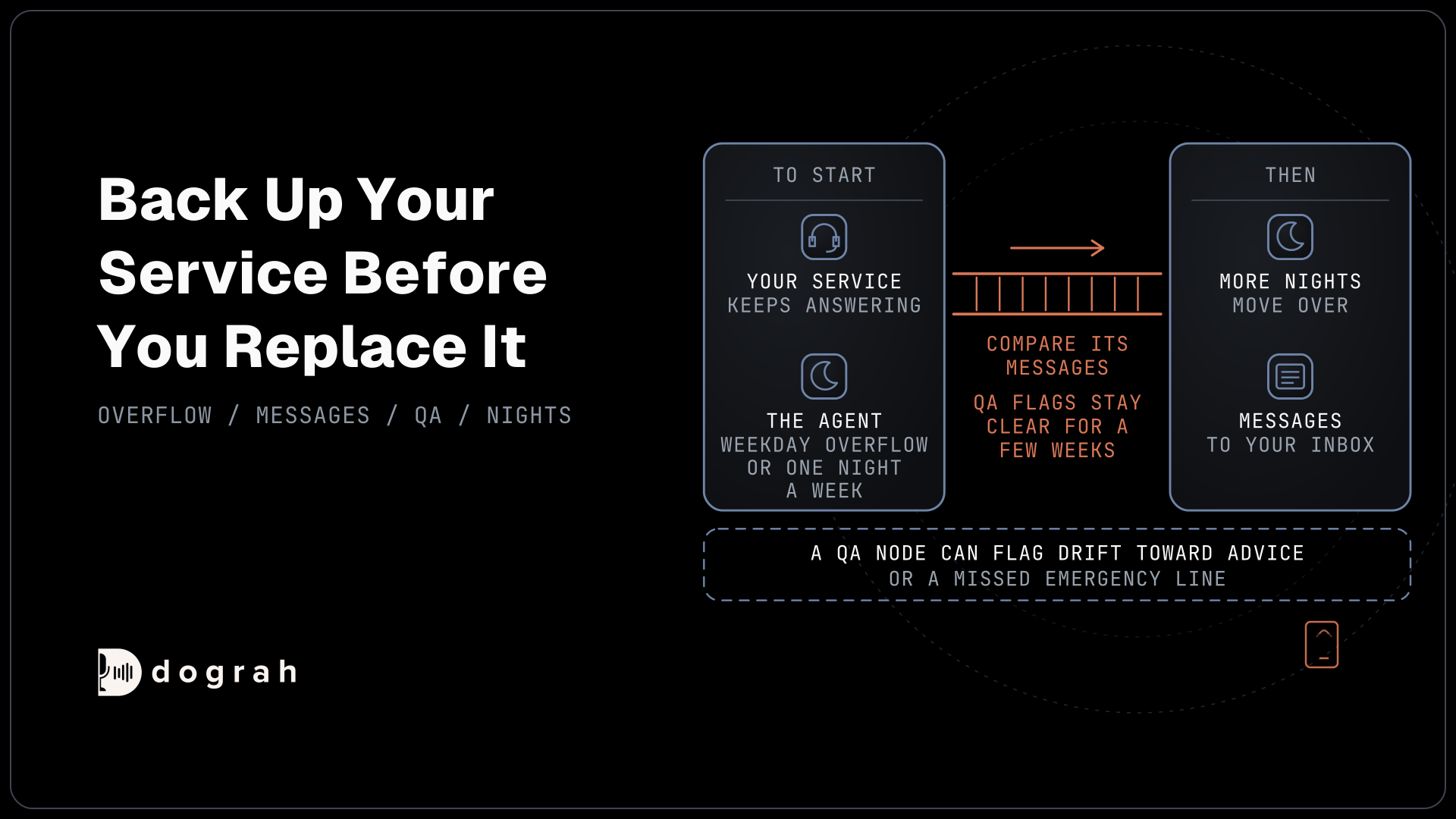
The office should start the day with every night call already written down. A Webhook node runs after each call and sends the gathered details, the transcript link and the outcome to your PMS or team inbox, retrying a temporary failure automatically. A QA node with your own prompt can flag calls where the agent gave repair advice or skipped a safety line, and its Sample Rate (%) setting scores a random share.
Where the agent runs sets the bill. A portfolio that hosts Dograh itself pays no per-minute platform fee. Servers, model keys and phone minutes still land on the bill, and your team keeps the database running and handles upgrades. For help, you have the open-source community, and Enterprise adds custom SLAs. For a manager who would rather hand off the hosting, Dograh Cloud runs it for a 1¢-a-minute platform fee. Self-hosting also keeps tenant recordings and transcripts in your own storage.
Where to start
Start with nights and weekends, where a missed call costs you the most goodwill. Build one building first, run a test night with your team calling in as tenants with a leak, a late fee and a gas smell, and check that every urgent call reached the technician or left a callback request before you add the rest of the portfolio.
Glossary
- Work order
- The record in your property management system that tells a technician what to fix, where and when they may enter. The agent creates it through an HTTP API tool.
- Steering
- Guiding a prospect toward or away from a building or unit because of who they are. The Fair Housing Act bars it, so the agent answers every caller the same way.
- Preset Parameter
- A fixed value added to a tool's request, such as the workflow run ID, so your system can ignore a second copy of the same request.
- Pre-Call Data Fetch
- A request Dograh makes when a call connects, carrying the caller's and the dialed numbers, so your system can return the building and tenant record.