
AI voice agents for roofing contractors answer every call when a hail storm floods the line. The agent asks about the damage, books the inspection, sends active leaks to a person and lines up callbacks for missed calls. For roofers who want to own that setup, Dograh, the open-source AI voice agent platform, runs self-hosted or on Dograh Cloud.
Key Takeaways
- Size the agent for your worst hail day, since storm calls arrive all at once.
- The agent never says insurance will pay or offers to cover a deductible.
- In Dograh, missed storm calls become a callback campaign the next morning.
A hail storm can fill a quiet phone line with worried homeowners within an hour. We start with what a storm day does to your calls, then we talk about booking inspections, the lines the agent never crosses and how Dograh handles urgent leaks and next-day callbacks.
What a storm day does to a roofer's phone line
Storm calls arrive all at once, because a whole neighborhood saw the same hail. Verisk's 2025 US Roof Report, as reported by Insurance Business, found severe hail on more than 20% of roofs in 16 states in 2025, up from 12 states a year earlier. Kansas led with 51.8% of its roofs hit.
The jobs behind those calls are large. The same report puts the average residential roof replacement at $17,631 in 2025 and the average repair at $4,699. Allianz put insured losses from severe convective storms at about $60 billion in 2025, nearly half of all insured natural catastrophe losses, and hail drives 50% to 80% of them, as Insurance Journal reported.
Answering is where those jobs slip away. Invoca's 2026 home services benchmarks found that 52% of calls to home services businesses reach a person, with answer rates from 32% to 74% across sub-industries, and that 45% of leads convert on the call. A crew lead on a ladder cannot take that call, and neither can an office of two.
So plan for your own worst day. If a hail day brings ten times your usual calls, an office that handles 30 calls on a normal day faces 300, most of them in the first few hours. That figure is an example, so use your own call log. Our post on what a missed call costs in the trades shows how to count those calls and what each one is worth.
Sorting storm calls in the first minute
Most storm calls fall into four kinds, and each one ends differently. Water coming into the house right now is urgent and goes to a person. Visible damage with a dry interior becomes an inspection booking. A homeowner who has already opened a claim gets the same booking with the claim noted for your estimator, and an existing customer asking about a job becomes a message for the office.
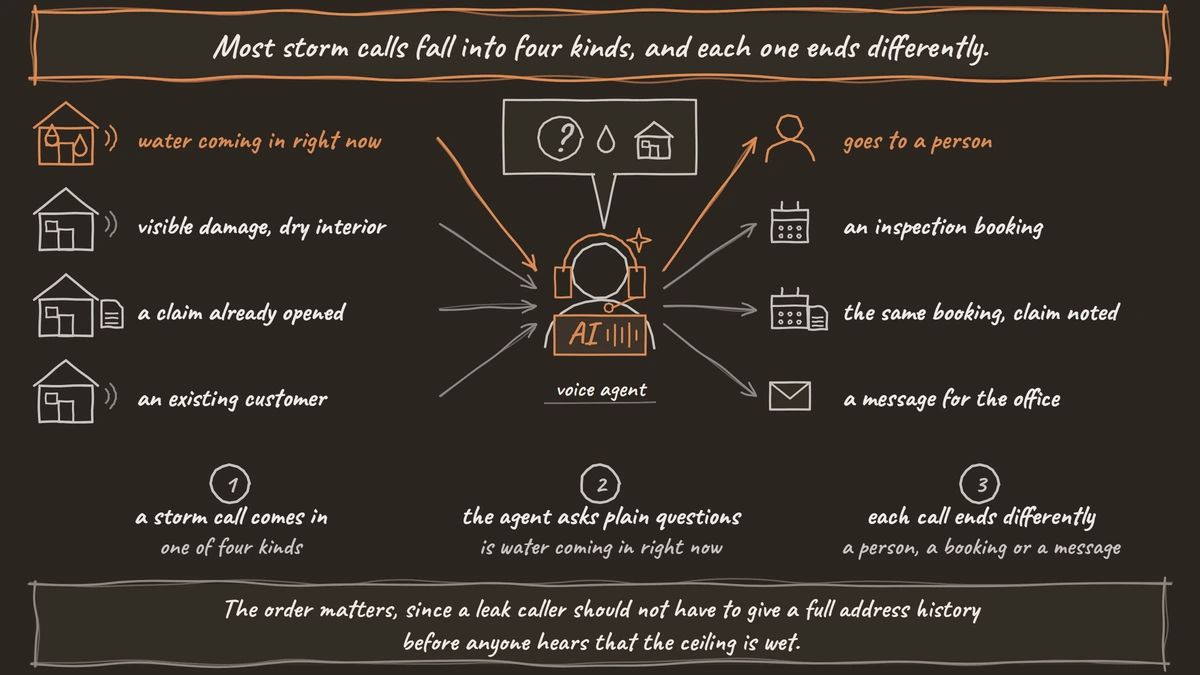
The agent tells these apart with plain questions, such as whether water is coming in right now and whether the caller owns the home. It records each answer as the caller stated it, and the transcript and recording stay as the exact record. The order matters, since a leak caller should not have to give a full address history before anyone hears that the ceiling is wet.
Some leak calls carry danger, such as water running near light fittings or a ceiling that has started to sag. Those callers hear one fixed line before anything else, "If you're in danger, get to safety and call 911." Exact wording only holds where the platform speaks set text, so this line goes in a pathway's Transition Speech or a pre-recorded clip rather than in a prompt. Our post on a contractor answering service with AI covers the wider contractor call flow this builds on.

Open Source Alternative to Vapi / Retell
Self-hosted voice agent platform — no per-minute fees
dograh-hq/dograh
Star on GitHub
Qualifying the lead and booking the inspection
A qualified storm lead is one your office can schedule without calling back. The agent gathers the address, the kind of damage the homeowner can see, whether a claim is open, the roof type if they know it and the best time for a visit. Each answer becomes a value the booking step can use.
Booking runs through an HTTP API tool during the call. The tool reads open inspection slots from your calendar or roofing CRM and writes the booking where that system's API allows. AccuLynx's public API, for example, lets other applications add leads to it, and most roofing CRMs publish something similar. The agent reads the day and time back, and the booking counts once your system confirms it.
Storm days bring dropped calls and retries, so make the booking retry-safe. Add a Preset Parameter named workflow_run_id with the value {{initial_context.workflow_run_id}} to the tool, and your system can use that ID with the slot to ignore a second copy. Callers answer by voice, and texts go out through your own provider via an HTTP API tool, for example a confirmation with the inspection time.
Some callers only want a quote or a call from the owner. For them the agent takes a message, and a Webhook node sends the details to your CRM after the call, retrying automatically if your system is briefly down.
Active leaks go to a person
Water coming through a ceiling needs a person, even in the middle of the storm. Transfer Call works on Twilio, Telnyx, Plivo, Cloudonix and Asterisk ARI. Dograh calls the destination first and connects the caller only when someone answers, so the homeowner never lands on a dead line.
The destination can follow what the agent learned. Context Mapping picks the number from a gathered value such as the service area, so a north-side leak rings the north-side crew lead. No summary travels with the transfer by default, so the agent first writes the address and what the homeowner described to your system through an HTTP API tool.
If nobody answers within the timeout, 30 seconds by default, the caller stays with the agent. It confirms the details, tells them when to expect a call within the window you set, and an HTTP API tool writes an urgent callback request. The agent gives no repair or safety advice beyond the fixed line, since a tarp tip from a voice agent is not something you want on record.
Insurance promises and callback consent
Insurance is where a storm call can go badly wrong. The agent never says insurance will pay and never offers to pay or waive a deductible. Under the Texas Business and Commerce Code, a seller paid from a property insurance claim who pays, waives or rebates the insured's deductible commits a Class B misdemeanor. Other states have their own rules, so the agent answers coverage questions with "your adjuster decides that" and books the inspection.
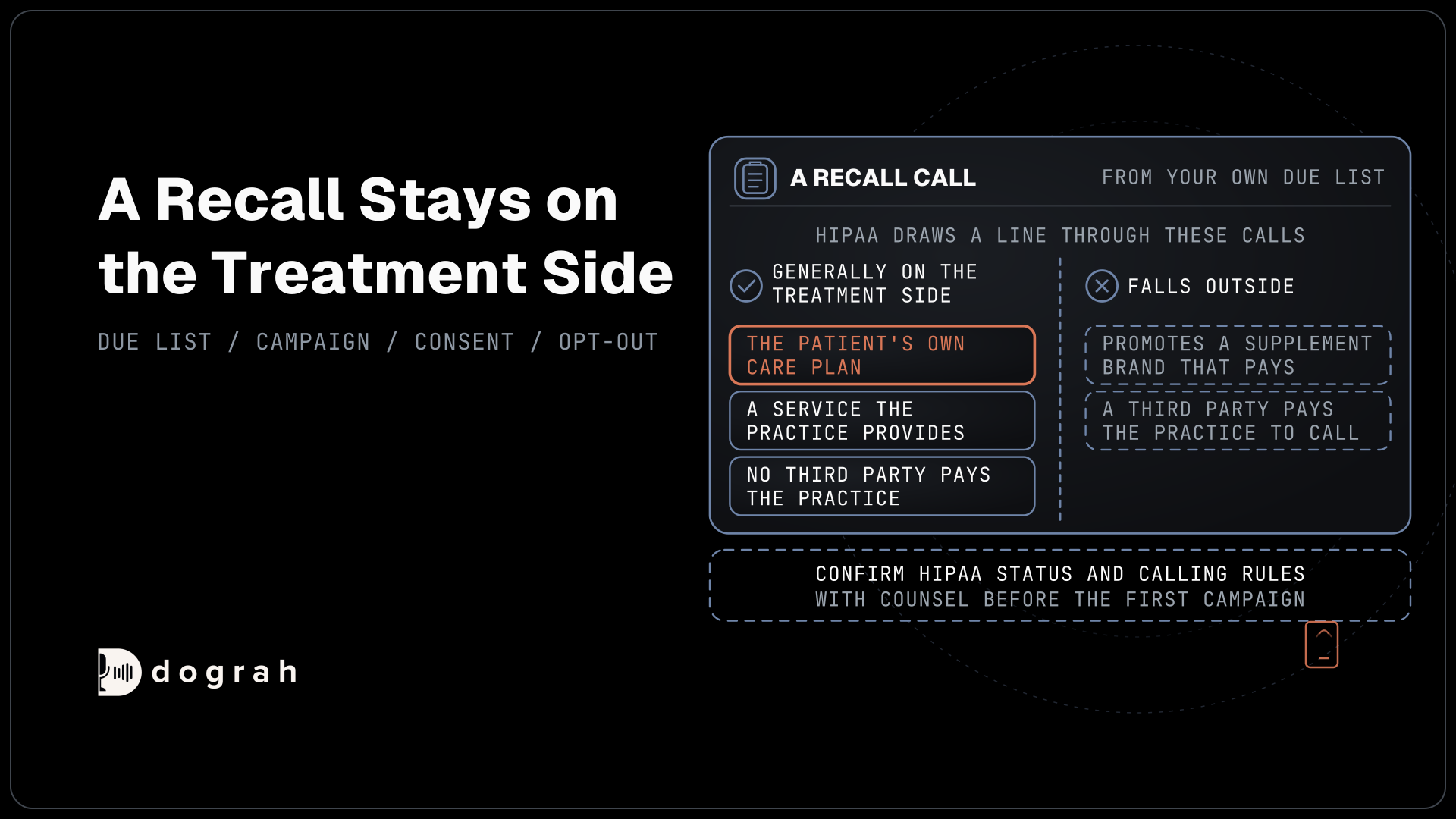
Callbacks have rules too. The Telephone Consumer Protection Act (TCPA) covers calls made in an artificial voice, and the FCC's ruling released 8 February 2024 confirmed that AI-generated voices count. A call to a mobile in an artificial voice needs the person's prior express consent, and a marketing call needs written consent. Returning a call the homeowner made about their own roof is the usual case, while a call that pitches gutters or solar needs a closer look. Confirm the deductible rule and your callback consent with counsel for each state you work in.
Join the Dograh Community
Dograh is an OSS alternative to Vapi. Join our Slack community for queries, releases, best practices & community interactions.
Calling back the calls you missed
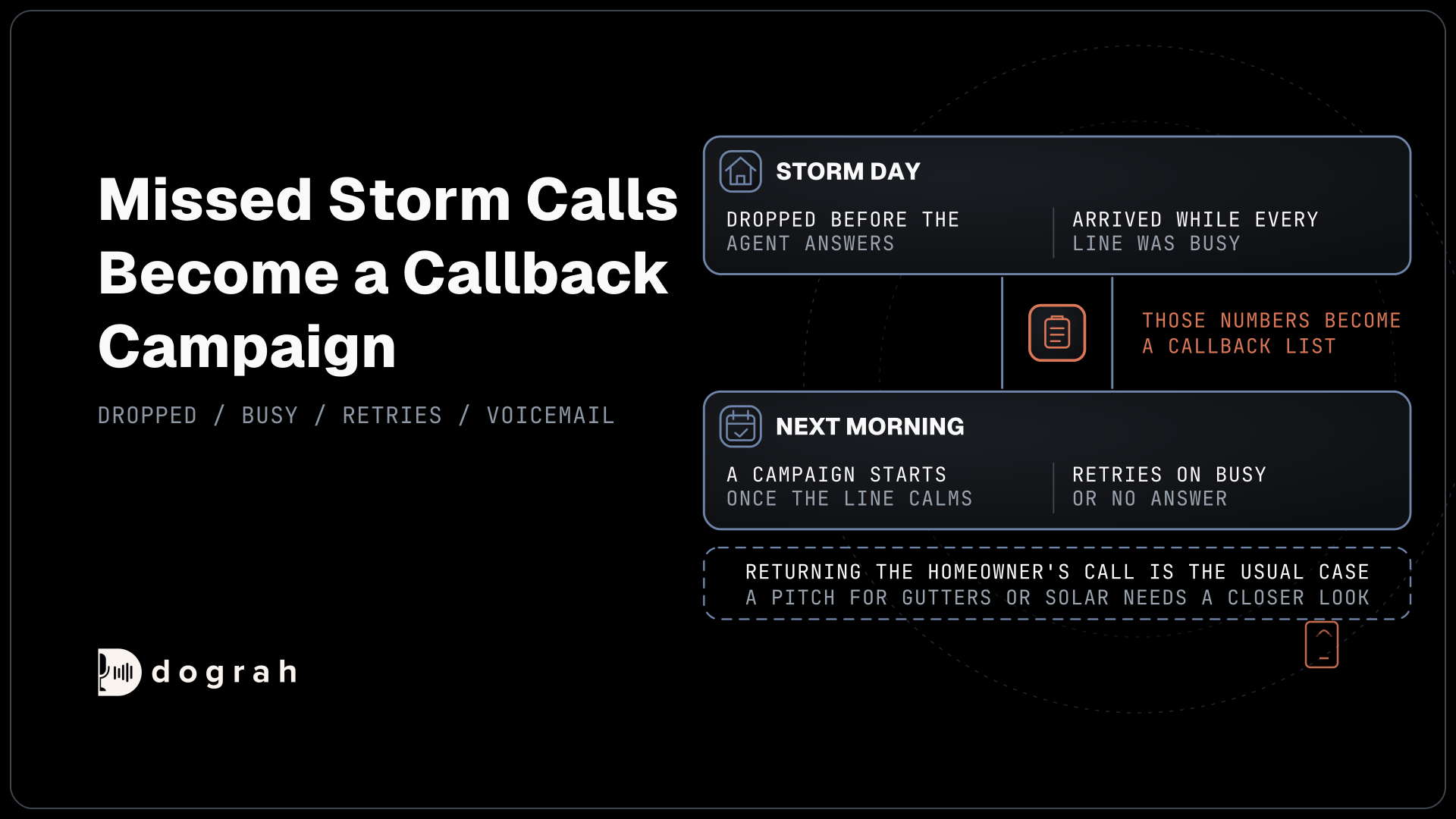
Some callers drop before the agent answers, and some calls arrive while every line is busy. Those numbers become a callback list for the next morning. A Campaign calls a sheet of numbers with retries from 0 to 10 (2 by default), a retry delay from 30 seconds to an hour, and switches to retry on busy, no answer or voicemail.
Campaign calls use the same concurrent-call limit as inbound calls, so pause the campaign while storm calls are still coming in and start it once the line calms. Calling hours run in one time zone per campaign, so split a list that crosses time zones into two campaigns.
Voicemail handling is off by default. Once you turn it on, "When voicemail is detected" starts on Disconnect the call, and switching it to Leave a message plays a short note asking the homeowner to call back. Our roundup of voice AI with voicemail detection compares how platforms tell a person from a machine.
Setting it up in Dograh, with capacity and cost
You describe the agent in the Agent Builder, for example "Answer storm calls for a roofing company, book inspections and send active leaks to the on-call crew lead." The builder may ask a few questions and shows "Your agent requirements" for you to approve. Then it builds the agent, and you add the booking and transfer tools. Roofing words such as TPO, drip edge or a local subdivision name go in the agent's Dictionary in Settings, so speech-to-text hears them right.
Capacity is the number to check before hail season. Inbound calls share one concurrent-call limit, which is 10 by default on a self-hosted install and can be raised with DEFAULT_ORG_CONCURRENCY_LIMIT. Dograh Cloud's Pay as you go plan includes 10 concurrent calls, and you can contact Dograh for more. If your worst day brings more callers at once than that, your carrier needs a second route for the extra calls, which our post on overflow call handling works through.
A staffed answering service bills for its people's time, usually by the minute, and the bill climbs fastest on exactly the days you need it most. When you run Dograh on your own servers, no per-minute platform fee applies. The servers, model keys and phone minutes are still on your bill, and your team keeps the database running and installs each upgrade. Help comes from the open-source community, and Enterprise adds custom SLAs. If you would rather skip the hosting, Dograh Cloud runs the whole thing for a 1¢-a-minute platform fee.
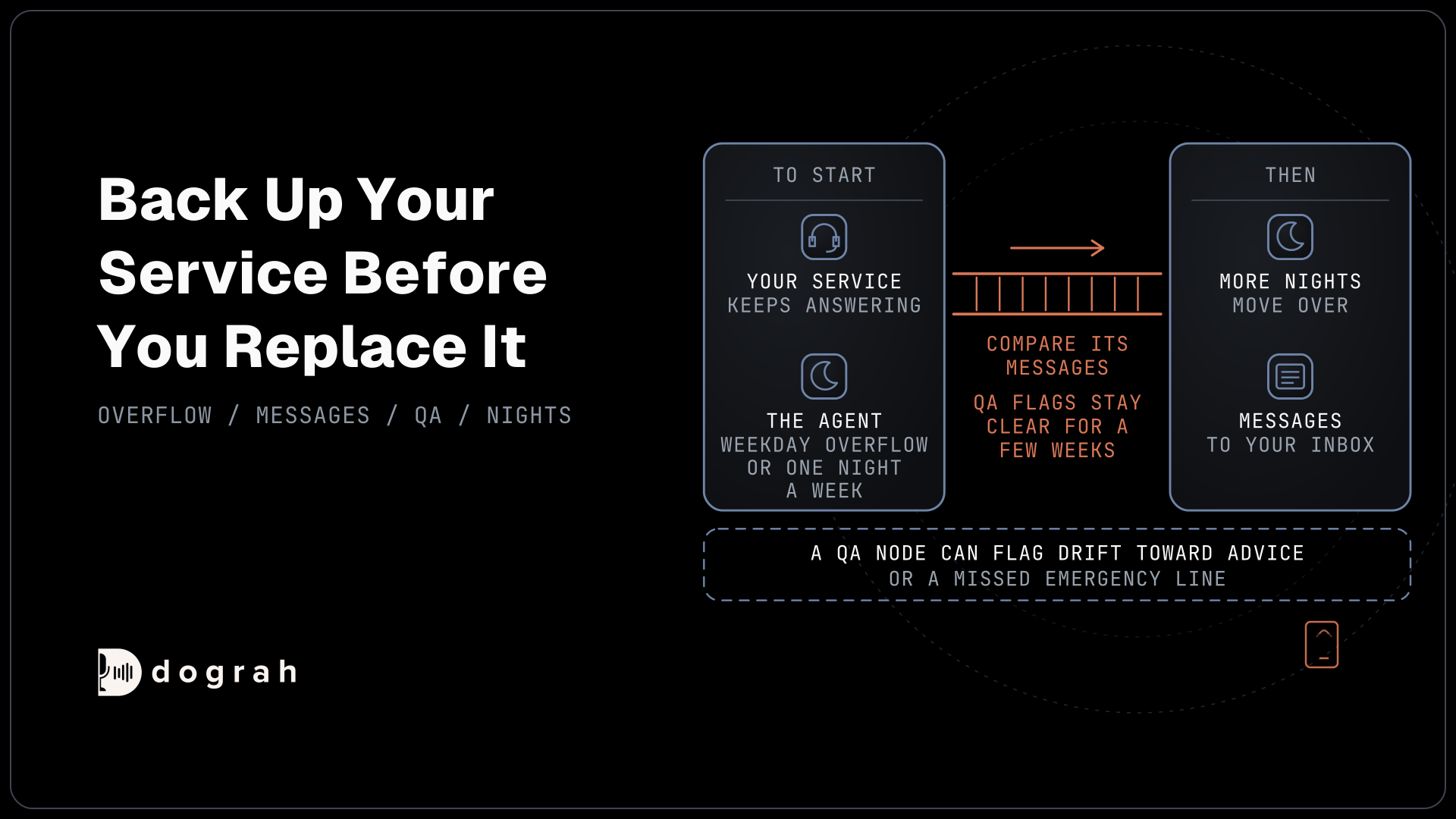
Check the storm calls after the first busy day. A QA node with your own prompt can flag any call where the agent talked about coverage or skipped the safety line, and its Sample Rate (%) setting scores a random share of calls. Test transfers on a real phone call first, since a browser test call cannot make one.
Where to start
Put the agent on after-hours calls first, then on overflow when the office line is busy. Before hail season, run a test morning with your team calling in as homeowners with leaks, claims and existing jobs, and check that every leak call reached a person or left an urgent callback request.
Glossary
- Severe convective storm
- A thunderstorm that brings hail, damaging wind or tornadoes. Insurers group these losses together, and hail drives most of the roof claims.
- Deductible rebate
- A contractor paying, waiving or refunding the homeowner's insurance deductible. Texas makes it a crime for a seller paid from the claim, so the agent never offers it.
- Context Mapping
- A Transfer Call setting that picks the destination number from a value the agent gathered, such as the service area, using rules checked from top to bottom.
- Callback campaign
- A Dograh campaign that calls a list of missed numbers with set retries and calling hours, run once the storm calls have slowed.