
An AI medical answering service takes a practice's after-hours and overflow calls. It sends urgent calls on your list to the on-call doctor, books or requests appointments, takes refill requests and messages, and never gives clinical advice. Practices that want to own it can build it on Dograh, the open-source AI voice agent platform, self-hosted or on Dograh Cloud.
Key Takeaways
- The agent follows your written routing list and never judges how serious a symptom is.
- Refill requests become messages, and the agent confirms nothing about the prescription.
- In Dograh, Transfer Call rings tonight's on-call doctor before connecting the patient.
Many practices pay a human service to answer the phone at night and page the on-call doctor. We go through what that service handles today and each call type an agent takes over, then we talk about the on-call handoff, HIPAA and how Dograh runs it.
What a medical answering service does today
A human medical answering service takes messages, pages the on-call doctor for urgent calls and bills for the minutes. Specialty Answering Service, one service that lists HIPAA compliance, charges $649 a month for 500 minutes and $1.34 for each minute after that. Patching a caller through to a doctor adds $0.10 a minute, and calls are billed by the second.
Practices are now asking whether software can take some of that work. In an MGMA Stat poll of 177 practice leaders in February 2026, scheduling (31%) and calls (27%) topped the list of front-office tasks they were focusing AI and automation on. MGMA's advice was to keep "an easy path to a human for anything clinical, sensitive, or complex."
That advice is the design brief for an AI answering service. The agent handles the calls that follow clear rules and hands everything clinical to a person. The rest of this post goes through the five calls a service takes, from urgent calls and appointment requests to refills, messages for the doctor, and results and billing, so you can decide whether an agent replaces your service or backs it up.
Urgent calls after hours
The urgent call is where the agent needs the firmest limits. ECRI ranked misuse of AI chatbots the top health technology hazard for 2026. So the agent never answers a clinical question and never decides how serious a symptom sounds.
Instead, the practice writes the routing list. Reasons named on it, such as a patient home from surgery the same day who reports a problem, go to the on-call doctor. Everything else becomes a message for the morning team. The agent matches what the caller says against your list, and your clinicians own the list. Our post on patient intake and triage shows how to write that table and test it.
A caller describing an emergency hears one fixed line, "If this is a medical emergency, please call 911 now." That line is set as a pathway's Transition Speech or a recorded clip, so it plays exactly as written every time. Choosing that pathway is still the model reading the condition you wrote, so test it with many phrasings, including vague ones such as "I just feel really wrong." Mental health crisis calls need their own fixed wording and routing too.
Appointment requests
Most after-hours callers want a visit, not a doctor tonight. An HTTP API tool can read open slots from your scheduling system during the call and book the one the patient picks, where that system's API allows outside bookings. Where it does not, the agent writes a request with the patient's preferred times for staff to confirm in the morning.
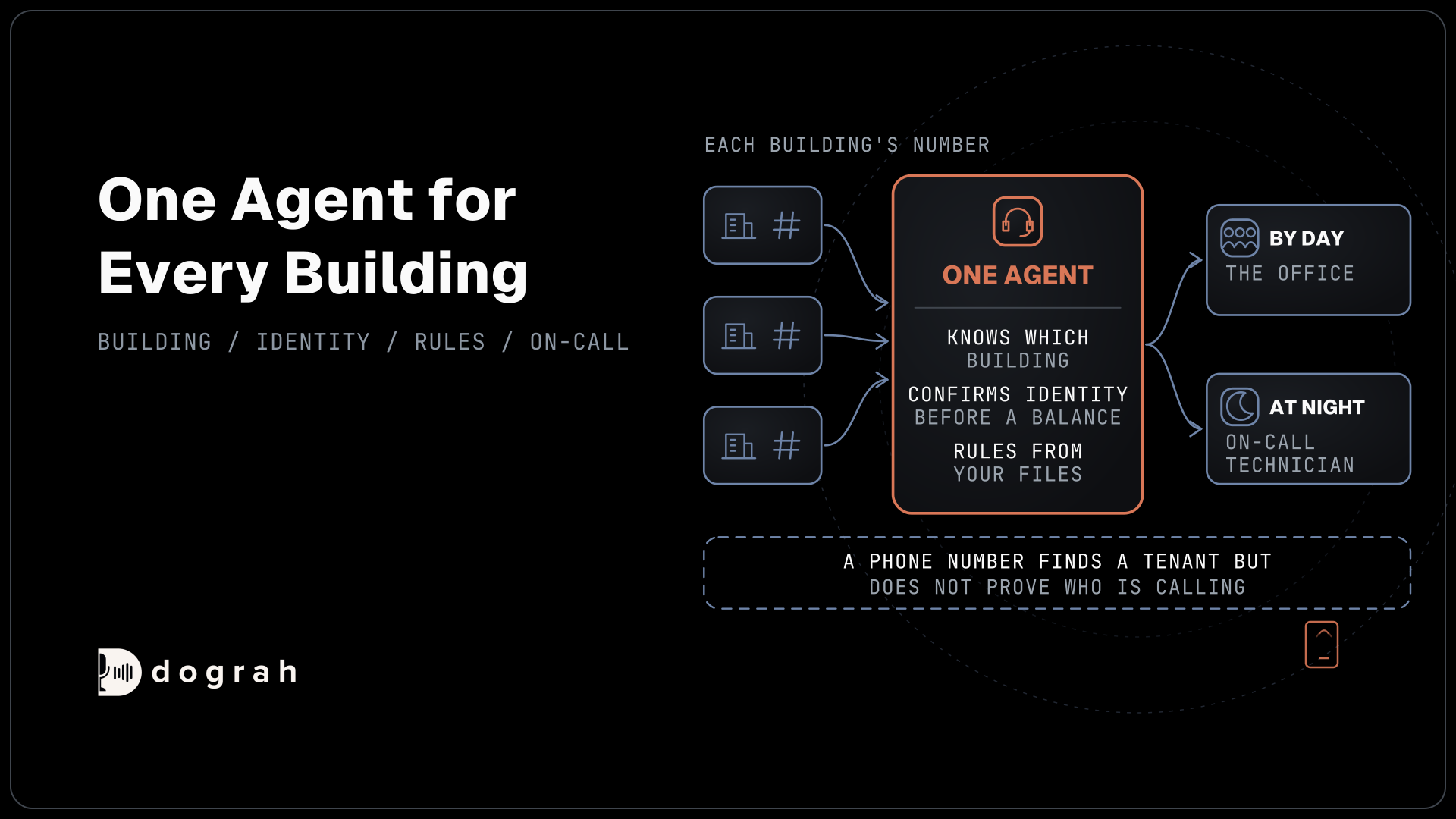
Before it reads back an existing appointment, the agent confirms who is calling. A phone number finds a record but does not prove identity, so the agent checks the date of birth first. Nothing is disclosed before that check. For a new booking, it reads the day and time back, and the booking counts once your system confirms it.
One agent can behave differently in and out of office hours. Built-in time variables such as {{current_time_America/New_York}} and {{current_weekday_America/New_York}} tell the prompt the local time and day, so daytime overflow calls can go to the front desk while night calls follow the on-call list.

Open Source Alternative to Vapi / Retell
Self-hosted voice agent platform — no per-minute fees
dograh-hq/dograh
Star on GitHub
Refill requests and messages for the doctor
A refill request is a message, never a decision. The agent takes the patient's name, date of birth, the medication as the caller states it, the pharmacy and a callback number. It confirms nothing about the prescription, including whether it will be renewed or when, because that is the doctor's call. Extraction is an AI step, so the answer is recorded as the caller stated it, with the transcript and recording as the exact record.
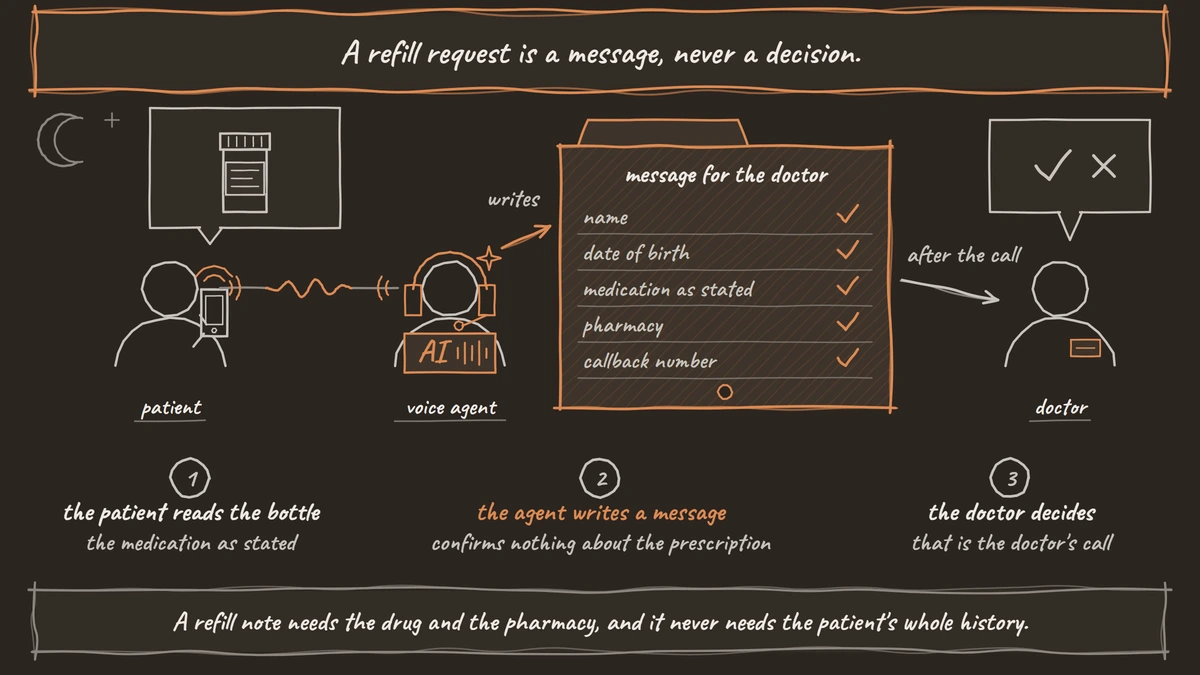
Messages reach your team after the call. A Webhook node sends the details to your messaging system or EHR inbox, retrying a temporary failure automatically, up to five attempts in all. Our post on an AI after-hours answering service covers how to write a message the morning team can act on.
Keep each message short. Under HIPAA's minimum necessary standard, a message carries only what the on-call doctor or the morning team needs to act. A refill note needs the drug and the pharmacy, and it never needs the patient's whole history.
Other messages follow the same shape. A patient who wants the doctor to call about a side effect gets a message marked for the morning, unless the reason is on your routing list. The agent never suggests stopping or changing a medicine, even when the caller asks it directly, and says the doctor will answer that question.
Results, billing and simple questions
Results questions get a kind answer and a message. The agent shares no results and no chart details, even after it verifies the caller, and tells them the care team will call back about results. It can say when the office opens and take the best number to reach them.
Simple questions need no message at all. Office hours, directions, parking and which insurance plans you accept can come from documents you upload to the agent's Knowledge Base, such as a PDF or DOCX of up to 5 MB each. Anything those documents do not cover becomes a message rather than a guess.
Billing questions follow the same pattern. A verified patient asking about a balance gets a message for the billing team, or a transfer to the office during business hours. Money never changes hands on the call. If the patient wants to pay, an HTTP API tool asks your billing system or payment provider to send its own secure link, and the patient answers every question by voice.
Join the Dograh Community
Dograh is an OSS alternative to Vapi. Join our Slack community for queries, releases, best practices & community interactions.
The on-call handoff
The handoff is the call that matters most at night. Transfer Call works on Twilio, Telnyx, Plivo, Cloudonix and Asterisk ARI. Dograh calls the destination first and connects the caller only when someone answers, so a patient never lands in an empty voicemail box.
The destination changes every night, so the Dynamic HTTP Resolver asks your on-call schedule for tonight's number at the moment of transfer. No summary travels with the call by default, so the agent first writes the patient's details to your system through an HTTP API tool. On Twilio, an optional spoken introduction that both people hear can be turned on, and it is off by default.
If the doctor does not answer within the timeout, 30 seconds by default, the patient stays with the agent. It tells them when to expect a call back within the window your practice sets, and an HTTP API tool writes an urgent callback request. Test this on a real phone call, since a browser test call cannot make a transfer.
Practices with several locations can run one agent for all of them. Each location's number points at the same agent through its Inbound workflow setting, and the dialed number reaches Pre-Call Data Fetch, so the agent knows which office the patient called and which on-call list applies.
HIPAA, hosting and cost
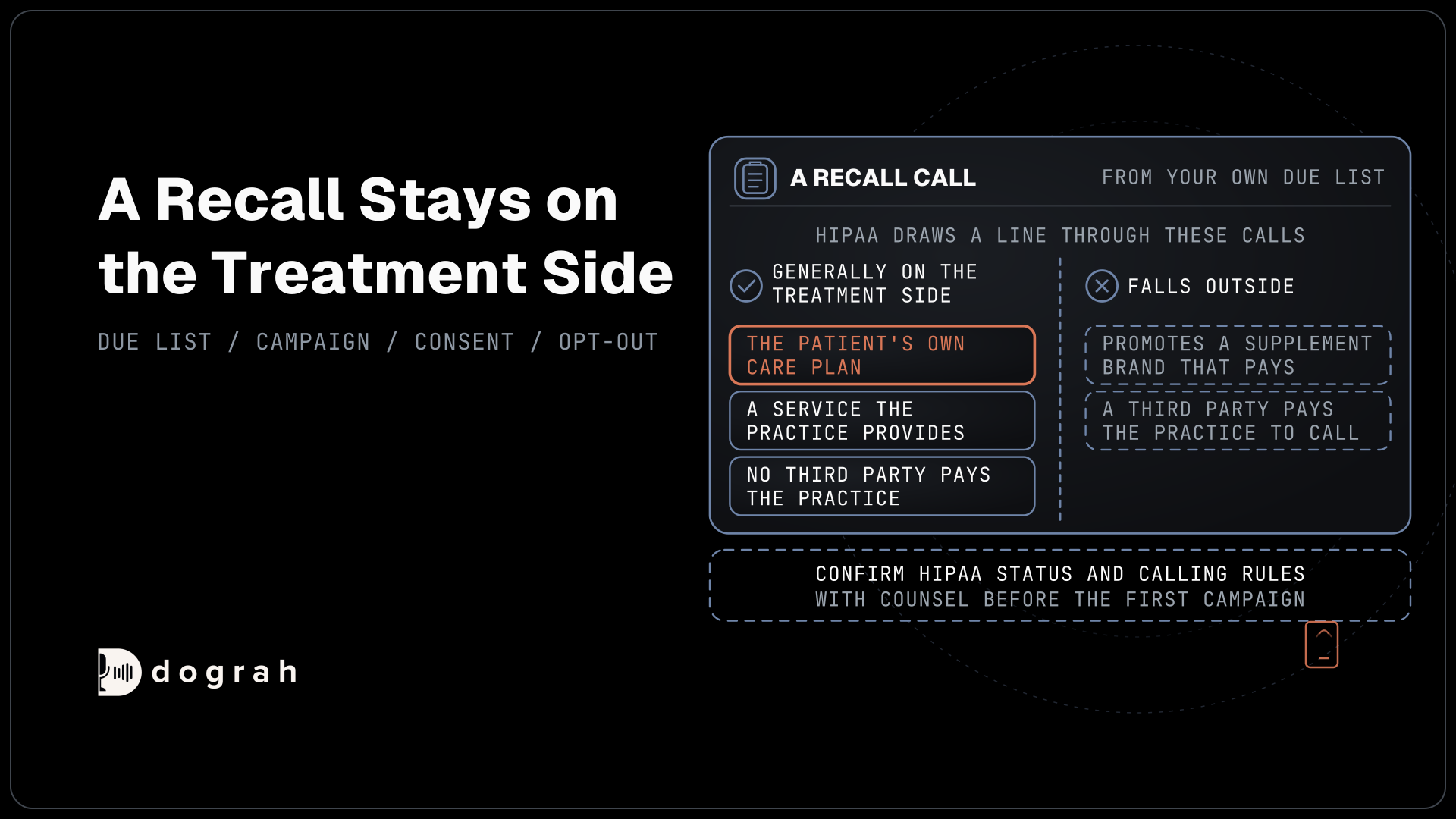
HIPAA treats your answering service the same way whether a person or an agent answers. The practice is the covered entity, and a vendor that handles patient information for it is a business associate that needs a business associate agreement (BAA). A BAA delegates duties and never moves the practice's liability. Our post on a HIPAA-compliant AI receptionist walks through the vendor questions, and our guide to build a HIPAA-compliant voice agent covers the build.
Self-hosting changes who signs what. A self-hosted install needs no BAA with Dograh, but model providers that handle patient information may need their own, a cloud host such as AWS needs one, and the phone carrier may need one depending on what it stores. For HIPAA practices, self-host, or ask Dograh about its Enterprise compliance support. Confirm your BAAs and any state rules on after-hours coverage with counsel before the agent takes a patient call.
Hosting sets the bill too. On your own servers, Dograh carries no per-minute platform fee. Your practice still pays for those servers, the model keys and the phone minutes, and your IT person or vendor looks after the database and each upgrade. Support comes from the open-source community, while Enterprise adds custom SLAs. If you want it run for you, Dograh Cloud handles the hosting for a 1¢-a-minute platform fee. Recordings and transcripts stay in your own storage, and a self-hosted install can switch recording off server-wide.
Where to start
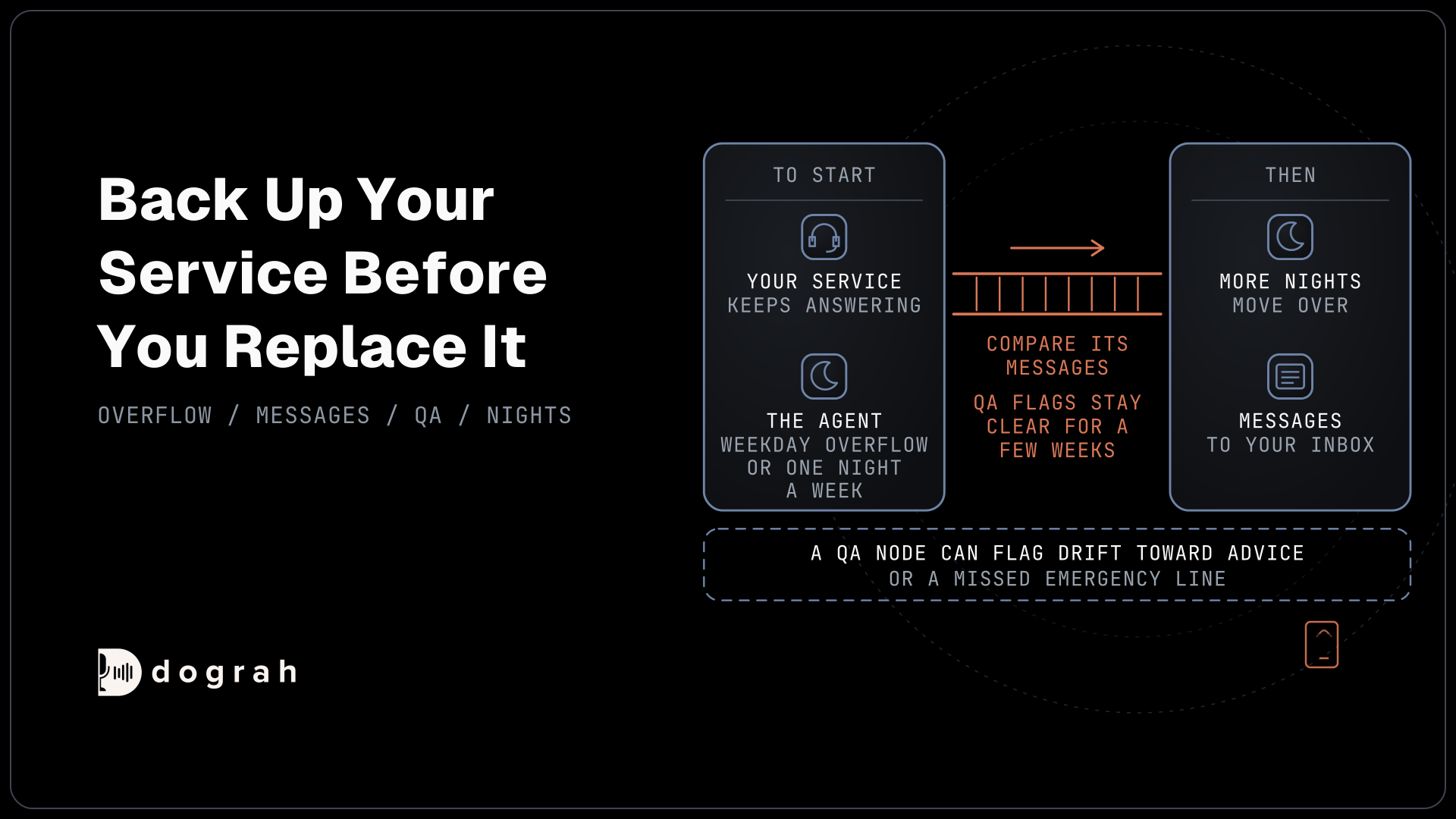
Back up your service before you replace it. Put the agent on weekday overflow or one night a week, and compare its messages with the ones your service sends. A QA node with your own prompt can flag any call where the agent drifted toward advice or missed the emergency line, and once those flags stay clear for a few weeks, move more nights over.
Glossary
- Routing list
- The practice's written list of reasons that go to the on-call doctor tonight. The agent matches the caller's words against it and never judges severity itself.
- Minimum necessary
- The HIPAA standard that limits patient information to what a task needs. For an answering service, each message carries only what the reader must act on.
- Patching
- A human answering service connecting a caller to the on-call doctor, often billed by the minute on top of the answering plan.
- Dynamic HTTP Resolver
- A Transfer Call setting that asks your own endpoint, such as an on-call schedule, which number to dial at the moment of transfer.