
An AI receptionist for chiropractors answers new-patient calls, takes intake details, books or requests the visit and calls lapsed patients due for care. It never gives clinical advice or says whether an adjustment will help. For practices that want to own the setup, Dograh, the open-source AI voice agent platform, runs self-hosted or on Dograh Cloud.
Key Takeaways
- On Jane, the agent writes a booking request, since Jane accepts no AI scheduling tools.
- The agent never says whether chiropractic care will help a caller's condition.
- In Dograh, recall calls run as a campaign from your own due list.
A chiropractic front desk is often one or two people who also help patients in the room. We start with the calls a chiropractic desk hears and new-patient intake, then we talk about booking, what the agent must never say, recalls and how Dograh runs them.
What a chiropractic front desk hears
Chiropractic is a small-practice business, and the phone shows it. The Bureau of Labor Statistics counts about 61,700 chiropractor jobs in 2025, and 36% of chiropractors are self-employed. In a practice that size, the person who answers the phone is often the one checking the next patient in.
The calls fall into four kinds. New patients ring after an injury or a flare of back pain and want to know the cost and whether you take their insurance. Existing patients move an adjustment, and since adjustments are short visits booked in a series, one care plan can mean many of these calls. Patients who stopped mid-plan need a call back, and some callers describe their symptoms and ask whether you can help.
The first two kinds are routine booking work that an agent handles well. The third is outbound work with its own rules, and the fourth is where an agent needs firm limits written before it takes a single call.
New-patient intake on the first call
A good intake call means the first visit starts on time. The agent gathers the caller's name, date of birth, the reason for the visit in their own words, how they heard about you and whether they will use insurance or pay cash. It records each answer as the caller stated it, with the transcript and recording as the exact record.
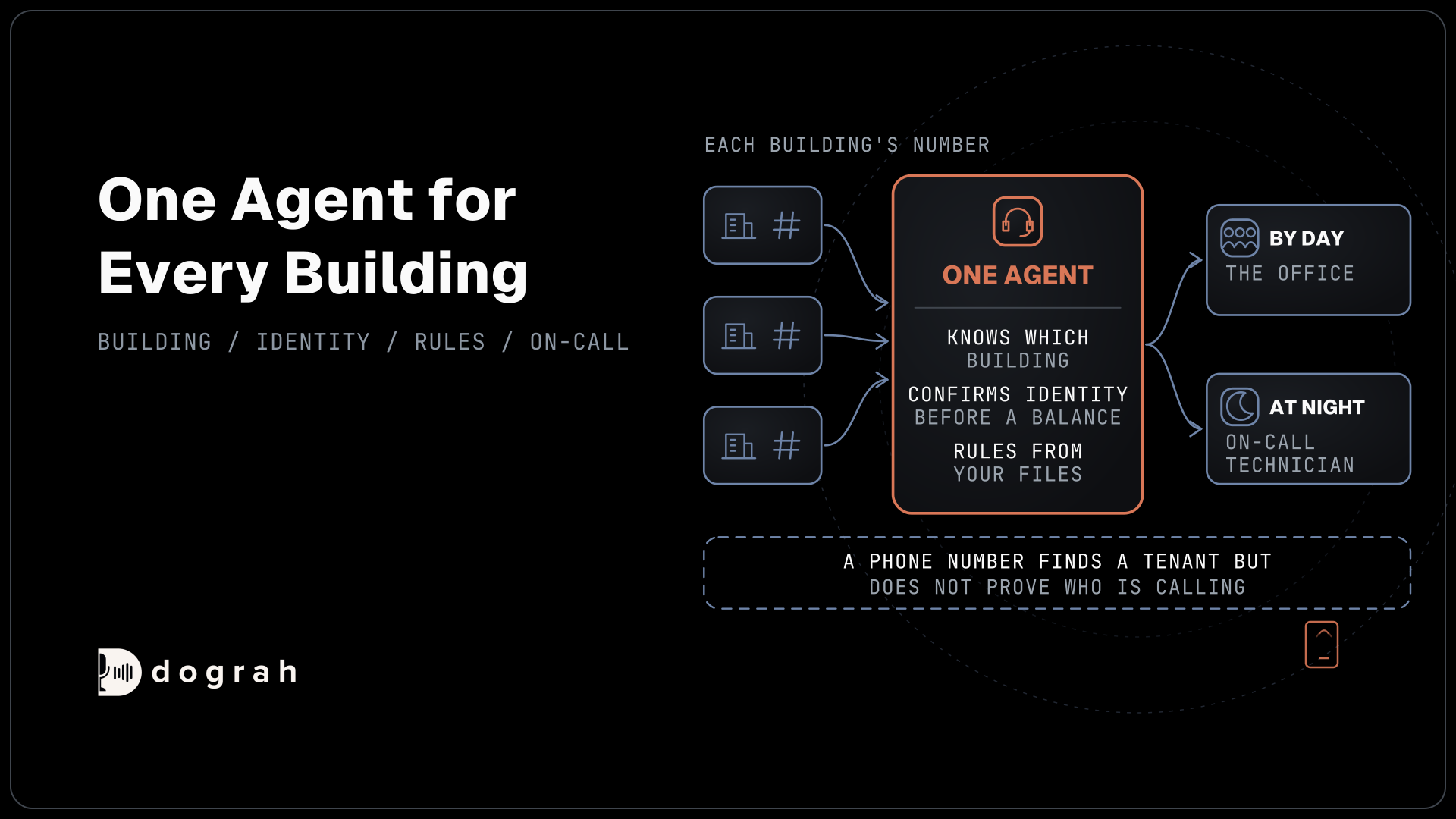
Existing patients need a check before anything personal is said. Pre-Call Data Fetch at the bottom of the Start Call node can look the caller up by phone number before the greeting. A number finds a record but does not prove who is calling, so the agent confirms the date of birth before it mentions any appointment. The agent always verifies before it discloses anything.
Callers answer by voice, and texts go out through your own provider via an HTTP API tool, such as a link to your new-patient form. Insurance questions get a plain answer from the carrier list you give the agent, and a question about what a plan will pay goes to your staff, who check benefits before the visit.
Booking into Jane, Cliniko or your own system
Whether the agent can book directly depends on your practice software. Jane's integration policy says it is "not looking to work with AI scheduling or AI scribe tools" and that "Posting directly into Jane's calendars is not supported." On Jane, the agent writes a booking request with the patient's preferred times, and your staff confirm it the next morning.
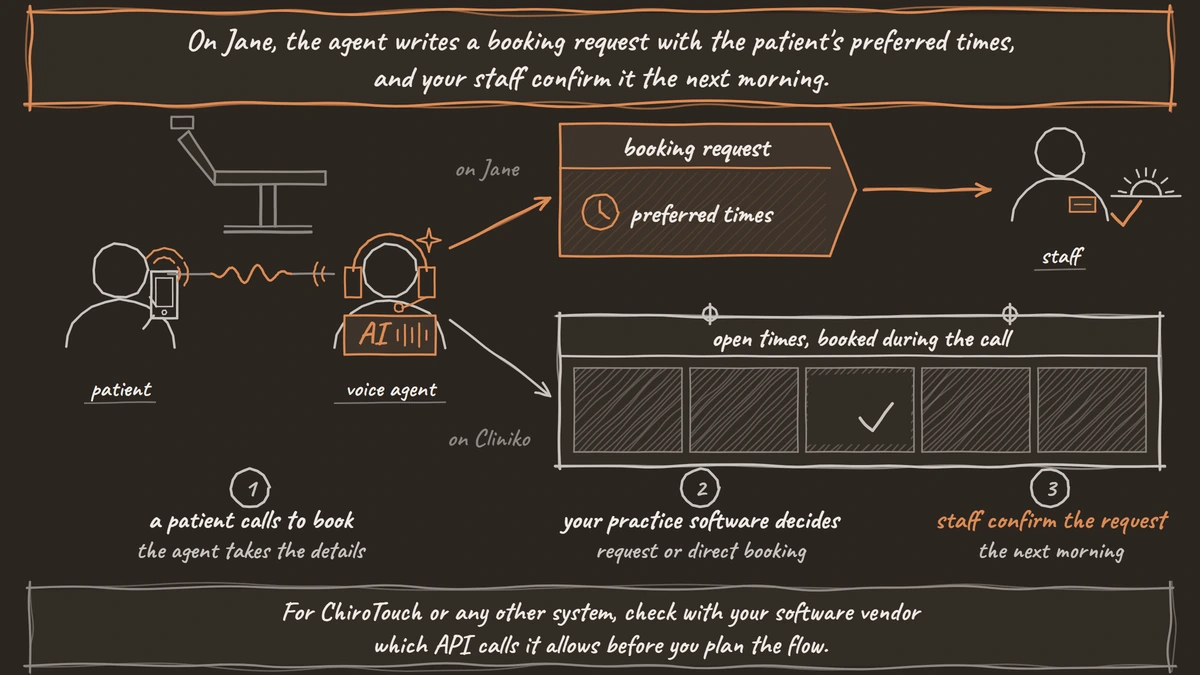
Other systems open their calendars to outside tools. Cliniko's API includes Available Time and Individual Appointment resources, so an HTTP API tool can read open times and book the visit during the call. For ChiroTouch or any other system, check with your software vendor which API calls it allows before you plan the flow.
Where the agent books directly, it reads the day and time back, and the booking counts once your system confirms it. Add a Preset Parameter named workflow_run_id with the value {{initial_context.workflow_run_id}}, so a retried request does not create a second visit.

Open Source Alternative to Vapi / Retell
Self-hosted voice agent platform — no per-minute fees
dograh-hq/dograh
Star on GitHub
What the agent must never say
Callers will ask health questions, and some will expect an answer. In a Pew Research Center survey of 5,111 US adults in October 2025, 22% said they get health information from AI chatbots at least sometimes. Among those users, more called it not too or not at all accurate than highly accurate, 23% against 18%.
The agent never says whether chiropractic care will help a condition, never reads meaning into symptoms and never comments on a treatment plan. A caller asking whether an adjustment will fix their sciatica hears that the chiropractor answers that at the visit, then gets two times to choose from. That answer is friendlier than it sounds, because it moves the caller toward the person who can actually examine them.
A prompt cannot guarantee wording, since a model told not to say something can still say the same thing in other words. So the practice writes its own list of symptoms that go straight to the chiropractor or to emergency care. A caller describing an emergency hears one fixed line, "If this is a medical emergency, please call 911 now," set as a pathway's Transition Speech or a recorded clip so it plays exactly as written. Choosing that pathway is the model reading the condition you wrote, so test it with many phrasings before go-live.
HIPAA, hosting and cost
HIPAA applies to a chiropractor who is a covered entity, which in practice means one that sends health information electronically in standard transactions such as insurance claims. A cash-only practice may sit outside it. Any vendor that creates, receives, keeps or sends patient information for a covered practice is a business associate and needs a business associate agreement (BAA), which delegates duties but never moves the practice's liability.
Self-hosting changes who needs that agreement. With a self-hosted install there is no BAA to sign with Dograh. Model providers that touch patient information may need their own, any cloud host such as AWS needs one, and the carrier may need one, depending on what it stores. For HIPAA practices the route is simple. Self-host, or ask Dograh about its Enterprise compliance support. Our post on a HIPAA-compliant AI receptionist lists the questions for any hosted vendor, and our guide to build a HIPAA-compliant voice agent covers the build.
Hosting also sets the bill. A practice that runs Dograh itself pays no per-minute platform fee. It still pays for the server, the model keys and the phone minutes, and someone on the team keeps the database healthy and applies upgrades. Support comes through the open-source community, with custom SLAs on Enterprise. A practice that wants none of that upkeep can use Dograh Cloud, which runs everything for a 1¢-a-minute platform fee. Recordings and transcripts sit in your own storage with no automatic deletion, and on a self-hosted install recording can be switched off server-wide.
Join the Dograh Community
Dograh is an OSS alternative to Vapi. Join our Slack community for queries, releases, best practices & community interactions.
Recall and reactivation calls
Recall calls bring back patients who are due for a visit or who stopped partway through a plan. A Campaign calls a list exported from your practice system, with retries from 0 to 10 and calling hours set by weekday in one time zone. The campaign follows the list you give it, so your list carries the rule on how often one patient hears from you.
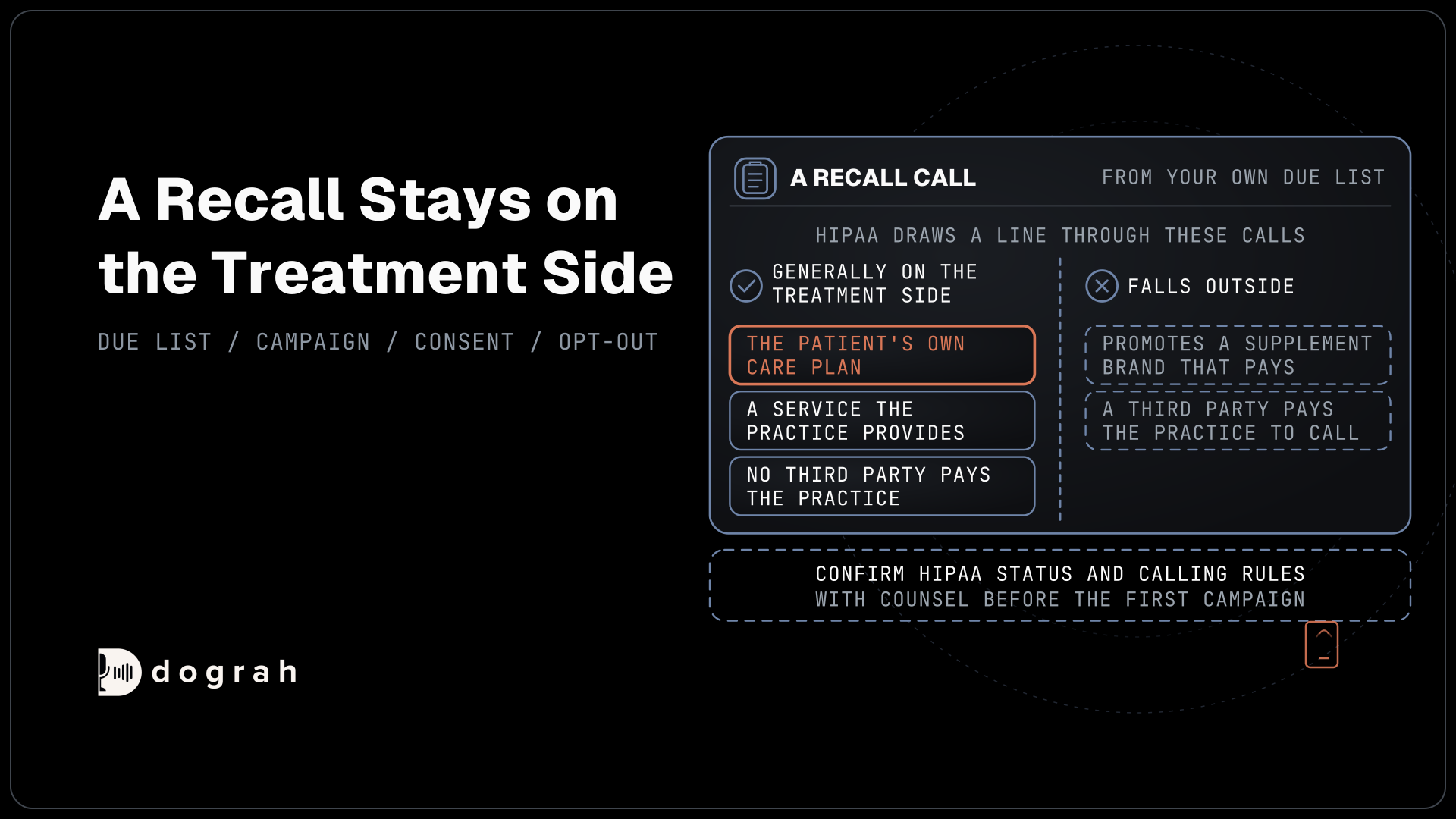
HIPAA draws a line through these calls. Under HIPAA's marketing definition, a call about the patient's own treatment or a health service the practice itself provides is not marketing, unless a third party pays the practice to make it. A recall about the patient's own care plan stays on the treatment side, while a call promoting a supplement brand that pays the practice does not.
The Telephone Consumer Protection Act (TCPA) adds its own rules, and the FCC confirmed in February 2024 that AI-generated voices count as artificial. A call in an AI voice to a mobile needs prior express consent. A covered practice's healthcare message can reach a mobile under an FCC exemption for set purposes such as appointment reminders and wellness checkups. It must cost the patient nothing, stay short, run at most one a day and three a week, carry no sales or billing content and offer an easy opt-out. A reactivation call that pitches a package falls outside it. Confirm your HIPAA status, your BAAs and these calling rules with counsel before the first campaign runs.
How the receptionist runs in Dograh
You describe the agent in the Agent Builder, for example "Answer calls for a two-chiropractor clinic, take new-patient intake, book adjustments and never give clinical advice." The builder may ask a few questions and shows "Your agent requirements" for approval before it builds. You choose the speech-to-text, language model and voice for the agent, and words such as subluxation, Activator or decompression go in its Dictionary in Settings so speech-to-text hears them right.
Some calls need a person, such as an upset patient or a billing dispute. Transfer Call works on Twilio, Telnyx, Plivo, Cloudonix and Asterisk ARI, and Dograh calls the destination first and connects the caller only when someone answers. If the desk does not pick up within 30 seconds, the default, the caller stays with the agent and an HTTP API tool writes a callback request.
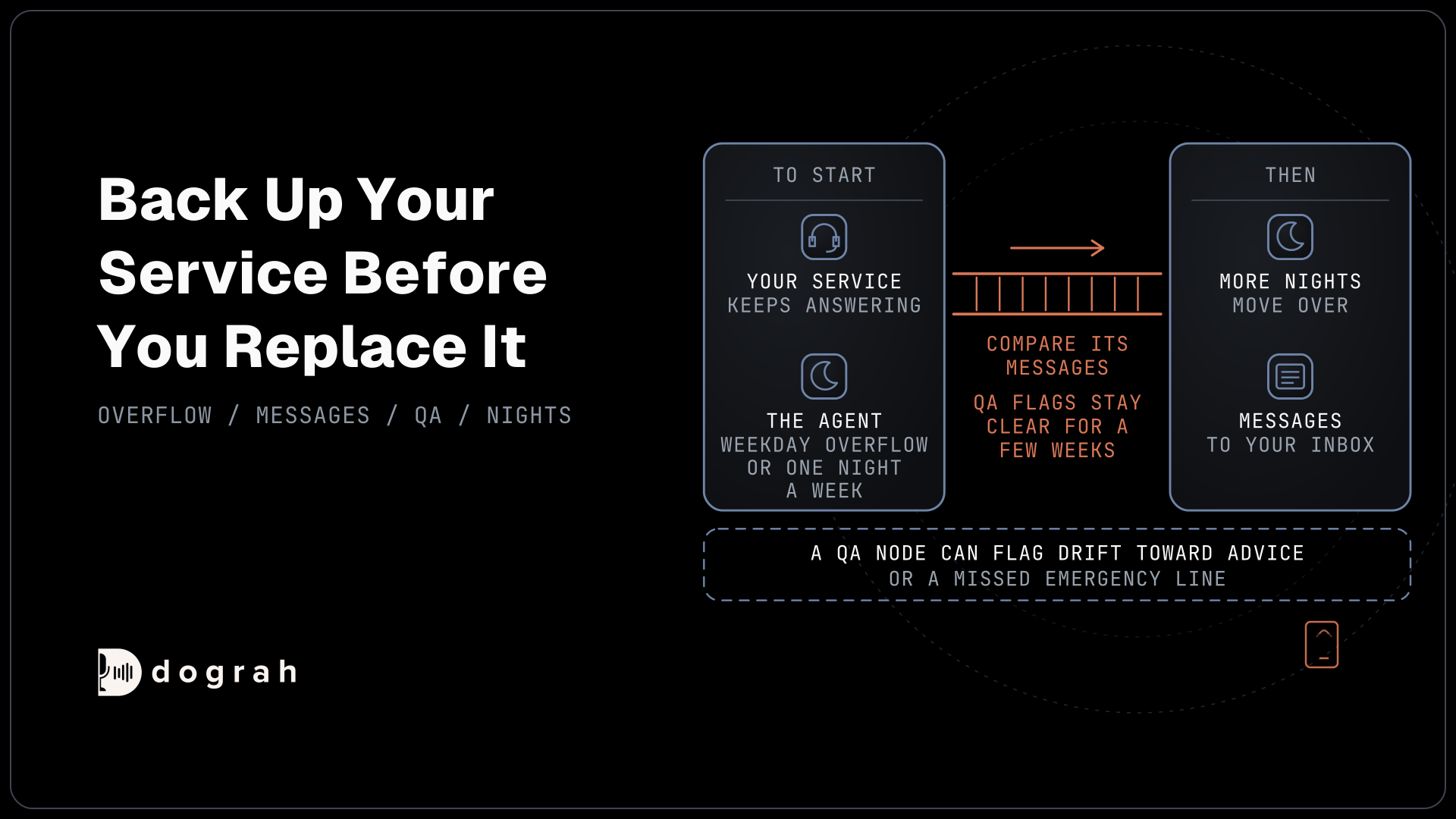
A QA node with your own prompt can flag any call where the agent drifted toward clinical advice, and its Sample Rate (%) setting scores a random share of calls. Test transfers over a real phone call, since a browser test call cannot make one.
Where to start
Start with after-hours new-patient calls and booking requests, where a missed call usually means a patient booking elsewhere. Add a recall campaign to a short list next, and read the QA flags each week. Dental offices make the same after-hours choices, covered in our post on an AI dental answering service.
Glossary
- Prior express consent
- Permission to call a mobile with an AI voice. Healthcare reminders can fall under an exemption, while sales calls need written consent.
- Care plan
- A series of short visits the chiropractor sets for a patient. One plan can mean many booking and rescheduling calls, and a patient who stops partway gets a reactivation call.
- Booking request
- A note the agent writes with the patient's preferred times when the practice software does not accept outside bookings. Staff confirm it in the software.
- Reactivation call
- An outbound call to a patient who stopped partway through a care plan. Under HIPAA it stays a treatment call unless a third party pays for it.