
An AI dental answering service takes calls after hours, on weekends and at lunch. It books where practice software allows, tells emergency callers to call 911, sends urgent pain to the on-call dentist and never gives clinical advice. For practices keeping patient data on their servers, Dograh, the open-source AI voice agent platform, runs it self-hosted or on Dograh Cloud.
Key Takeaways
- The lunch hour loses calls too, so forward unanswered calls to the agent.
- The agent never diagnoses, names a medicine or suggests home care.
- A Dograh agent writes each morning message to your practice system.
A cracked tooth at 7 p.m. and a new patient at lunch both meet a closed front desk. We cover what the service handles, lunch-hour overflow, emergencies, the morning message and HIPAA. Then we talk about how Dograh runs it, from the on-call transfer to the bill.
What a dental answering service covers
A dental answering service covers the hours the front desk cannot, which means nights and weekends, plus the lunch hour and the first hour of a busy morning. A human service answers in the practice's name, takes a message and patches true emergencies through to the on-call dentist. Specialty Answering Service's pricing, a human service that lists HIPAA compliance, bills by the minute and adds a per-minute charge for patching a call through.
Each missed call matters more when chairs sit empty. In the ADA Health Policy Institute's fourth-quarter 2025 data, one-third of dentists reported insufficient patient volume, and about 40% said they plan to add staff in 2026. A new patient who calls at 7 p.m. and reaches voicemail is often booked with another practice by morning.
An AI agent does more of the job on the call. It can book a cleaning into an open slot, answer questions from the practice's own files and send an emergency to the on-call dentist, so the morning starts with fewer callbacks. Patients still reach a person when it matters, since the on-call dentist stays one transfer away.
Lunch hours and the morning rush
The front desk loses calls during the day too, when the team is at lunch or checking in a full waiting room. Keep the practice line ringing first and set your phone system to forward unanswered calls to the agent's number, so staff take what they can and the agent takes the rest.
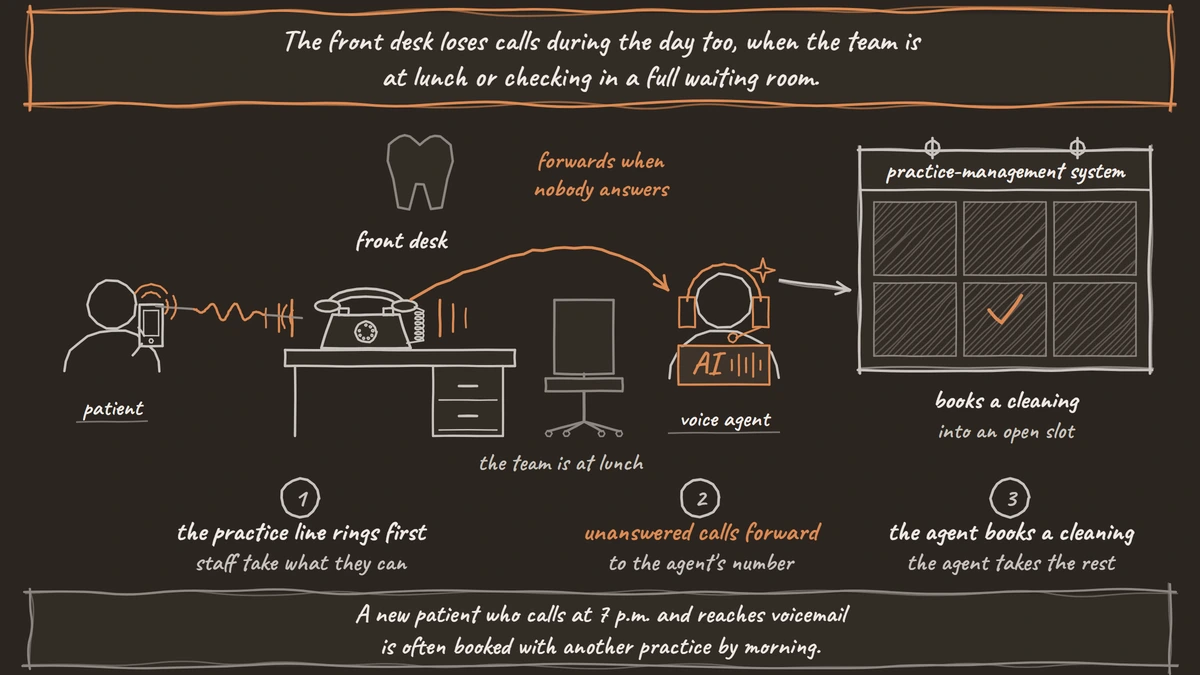
One agent can cover day and night. Dograh fills built-in time variables such as {{current_time_America/New_York}} in the prompt, so the agent books into today's open slots during office hours and switches to emergencies and morning messages after closing.
Booking during the call runs through an HTTP API tool that reads open slots from your practice-management system's API and writes the appointment back. Visit types, chair time and family bookings have their own rules, and our post on AI dental appointment scheduling covers them. A caller canceling at lunch is a chance to fill the slot, and AI dental no-show recovery calls covers the same-day rebooking that follows.
Emergencies without clinical advice
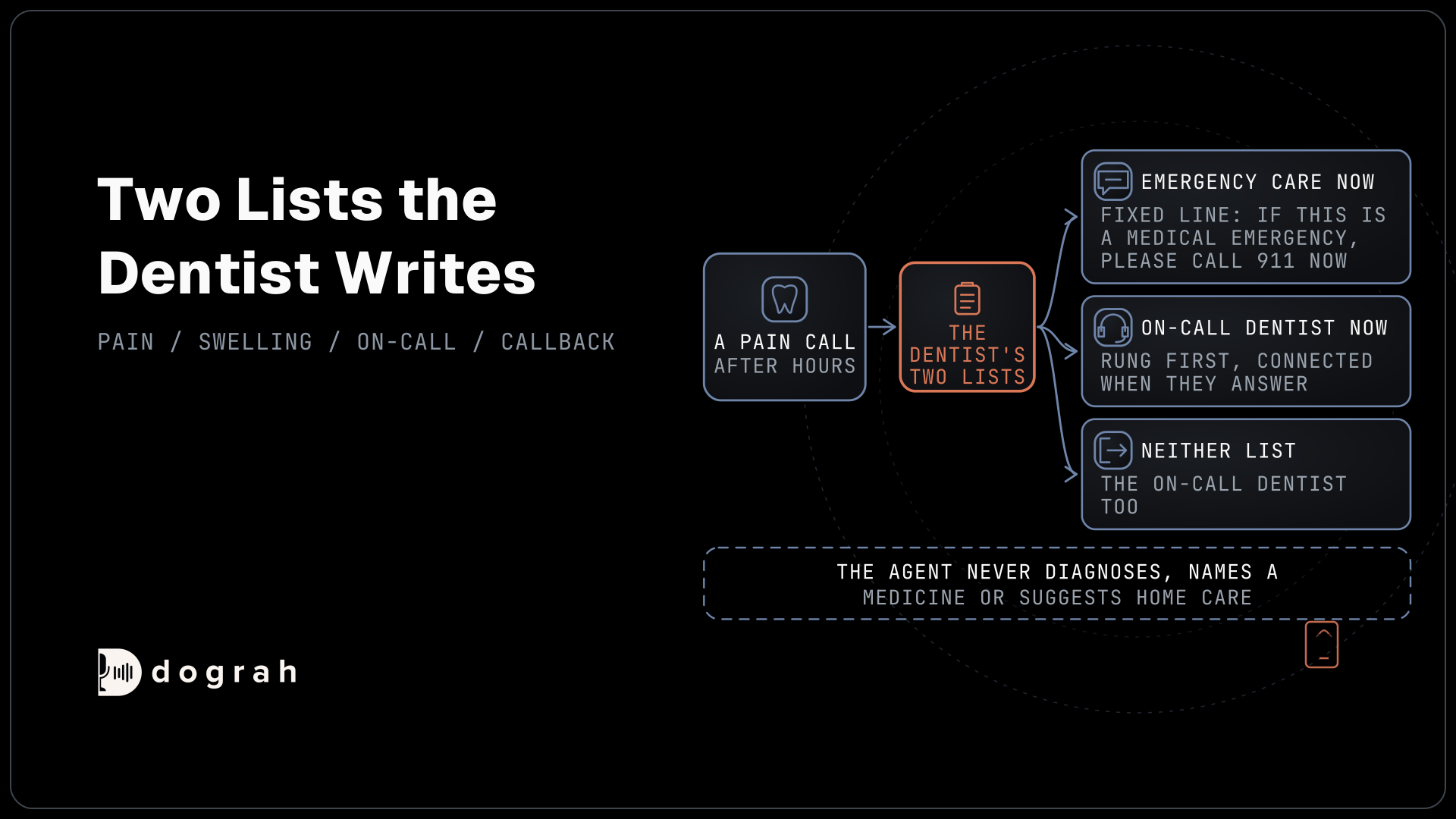
After hours, the agent checks a pain call against two lists the dentist writes, one for emergency care now and one for the on-call dentist now. It never judges how serious the problem is on its own. AI voice agents for dental reception covers how those lists are built and tested.
Calls on the first list, such as facial swelling that affects breathing or swallowing, hear a fixed line, "If this is a medical emergency, please call 911 now." Calls on the second list go to the on-call dentist. Pain that matches neither list goes to the on-call dentist too, as does any caller who asks for a person.
The harder rule is what the agent never says. It does not diagnose, name a medicine or a dose, or suggest a rinse, a cold pack or any home care, unless the dentist wrote that exact wording and it plays as fixed text. A caller who asks "Can I take something for the pain?" hears that the dentist will answer that on the callback, and the question goes into the message as the caller stated it.
Test both lists before any patient reaches them, with the words patients really use, such as "my face is swelling up" or "I knocked a tooth out playing hockey". Browser test calls cannot transfer to a phone number, so place the test calls from a real phone and let the on-call phone ring out once to hear what the caller hears next.

Open Source Alternative to Vapi / Retell
Self-hosted voice agent platform — no per-minute fees
dograh-hq/dograh
Star on GitHub
The message the team reads at 8 a.m.
Every call that is not booked or transferred ends as a message, and it should let the morning team act in one read. Record whether the caller is a patient or new, their name, date of birth, callback number, the reason in a short category, whether there is pain or swelling and their preferred times. Leave out symptom history the team does not need. A good message reads like "New patient, Maria L., callback +1415555XXXX, cracked lower molar, mild pain, no swelling, prefers mornings this week."
The agent greets, verifies and only then discloses. A phone number finds a patient record but does not prove who is calling, so the agent names no appointment, balance or treatment until the caller passes the check your practice uses, such as date of birth.
After the call, a Webhook node sends the fields to your practice-management system or patient messaging inbox, and retries temporary failures by itself, up to 5 attempts. Tell the team to read pain calls first, then new patients, then everything else, and give each outcome an owner so no message sits unread.
HIPAA and the business associate agreement
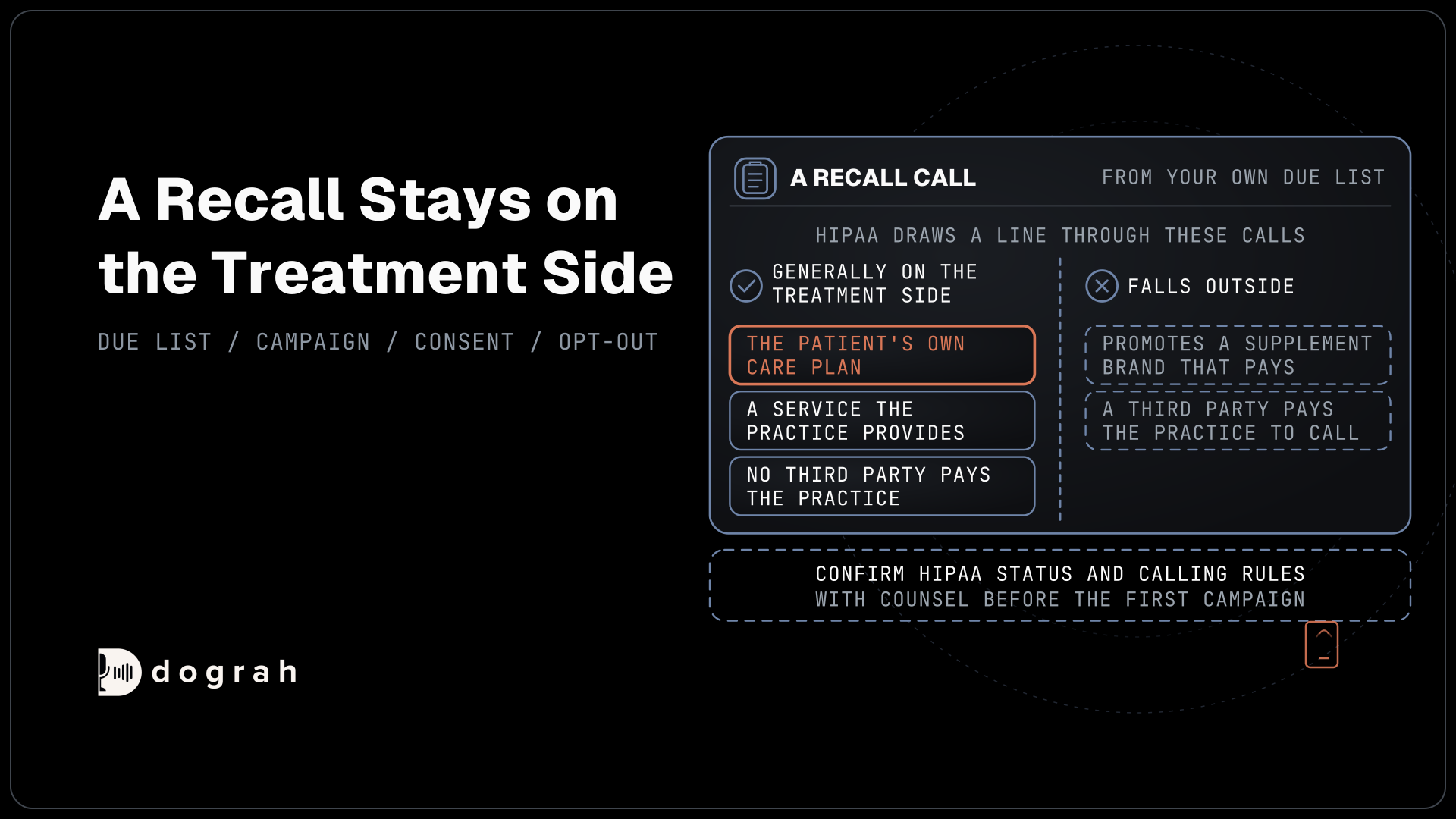
A US dental practice is a HIPAA covered entity, and any answering service that handles patient information on its behalf is a business associate. That includes a human service and an AI one. HIPAA's business associate rules require a written agreement, the business associate agreement (BAA), before that service handles protected health information.
A BAA delegates duties to the vendor, and the practice keeps its own. If the practice learns of a pattern of activity that breaches the agreement and does nothing, it is out of compliance too, so signing the BAA starts the oversight rather than ending it. Confirm with counsel which vendors in your setup need one and what each agreement must cover.
Our post on HIPAA-compliant voice AI for dental clinics covers what the agent may say on each dental call. For the full build, see how to build a HIPAA-compliant voice agent.
Join the Dograh Community
Dograh is an OSS alternative to Vapi. Join our Slack community for queries, releases, best practices & community interactions.
How this runs in Dograh
Emergency handoffs use Transfer Call, which works on Twilio, Telnyx, Plivo, Cloudonix and Asterisk ARI. Dograh calls the on-call dentist first and connects the caller only when the dentist answers. No summary travels with the transfer by default, so the agent writes the caller's details to your system first. If nobody picks up within the 30-second default, the caller stays with the agent, which takes a callback request and pages the backup dentist through an HTTP API tool.
The 911 line belongs in a pathway's Transition Speech or a pre-recorded clip, where it plays exactly as written. Text Transition Speech does not play on speech-to-speech models, so build this agent as a cascade with separate speech-to-text, language and voice models. A QA node with a custom prompt can review calls and flag any answer that sounds like clinical advice.
Self-hosting changes the BAA picture. Running the platform on your own servers means no BAA with Dograh is needed. The model providers may need their own when they handle patient information, a cloud host such as AWS needs one, and the phone carrier may need one depending on what it stores. If you would rather not run servers, ask Dograh about its Enterprise compliance support.
Where the agent runs also sets the bill. A practice running Dograh on its own servers pays no per-minute platform fee. Those servers, the model keys and the phone minutes still cost money, and the practice or its IT vendor maintains the database and installs upgrades. The open-source community answers support questions, while Enterprise adds custom SLAs. Practices that prefer to skip hosting can use Dograh Cloud, which runs the agent for a 1¢-a-minute platform fee.
Glossary
- Practice-management system
- The software a dental office runs for its schedule, patient records and billing. The agent books by reading open slots from its API and writing the appointment back.
- Emergency lists
- Two lists the dentist writes, one for calls that hear the 911 line and one for calls that go to the on-call dentist. The agent matches the call and never judges severity.
- Morning message
- The note the agent writes for every call it did not book or transfer, read by the front desk at opening. It holds the caller's details, the reason and any pain or swelling.
- Cascade agent
- An agent built from separate speech-to-text, language and voice models. Text Transition Speech plays on it, so fixed emergency lines need this setup.