
AI dental no-show recovery calls reach a patient on the day they miss a visit. The practice system starts the call once the appointment is marked missed. The agent verifies the patient, offers the next openings for the same visit type and provider, rebooks, asks one short question about what got in the way, and writes the outcome back.
Key Takeaways
- Call the same day, while the provider's next openings are still known.
- Rebook the same visit type and provider, never just any free slot.
- Keep fees off the call, since exempt healthcare calls carry no financial content.
This post is part of our guide to AI voice agents for appointment reminders and confirmations, where each call must change the booking. Following AI voice agents for dental clinics, we cover the call after a missed visit and how it runs in Dograh, the open-source AI voice agent platform we build.
An empty chair is lost capacity
A missed visit leaves a chair empty that the practice could have filled, and many practices have room to fill. In the ADA Health Policy Institute's dental economy reports, about a quarter of dentists said in Q2 2026 that they were not busy enough and could have treated more patients.
Most practices already know who missed. The practice management system (PMS) marks the visit as a no-show or a broken appointment, and the patient lands on a list someone means to call. On a busy day nobody gets to it, and by next week the patient has drifted.
The confirmation call before the visit is a different job, covered in AI voice agents for dental reminders and confirmations. This post is about the call after the chair sat empty.
Start the call the same day
The best time to call is the same day, while the provider's next openings are still known and the patient still remembers the visit. The PMS already marks the appointment missed, so let that status start the call. Your practice system sends the patient's record reference to the API Trigger, and Dograh places the call as soon as the request arrives.
Some practices prefer one batch at the end of the morning. Export the day's missed visits as a CSV for a Campaigns run, with columns such as the visit type and provider, which become variables the agent can use after the check. Calling hours run in one time zone per campaign, so a group with offices in different zones needs one campaign per zone.
You set the retries, from 0 to 10. Healthcare calls to mobiles that rely on the exemption are limited to one a day, so set retries to 0 for those campaigns. The next day, Redial Campaign creates a new campaign that calls only the patients whose last call ended in no answer, busy or voicemail.

Open Source Alternative to Vapi / Retell
Self-hosted voice agent platform — no per-minute fees
dograh-hq/dograh
Star on GitHub
The call: verify, then rebook
The call follows greet, verify, then talk about the visit. The Greeting Text on the Start Call node names the practice and gives a callback number. Allow Greeting Interruption is on by default, so switch it off and that opening plays in full. Then the agent asks for the patient by name and confirms their date of birth before it mentions any appointment.
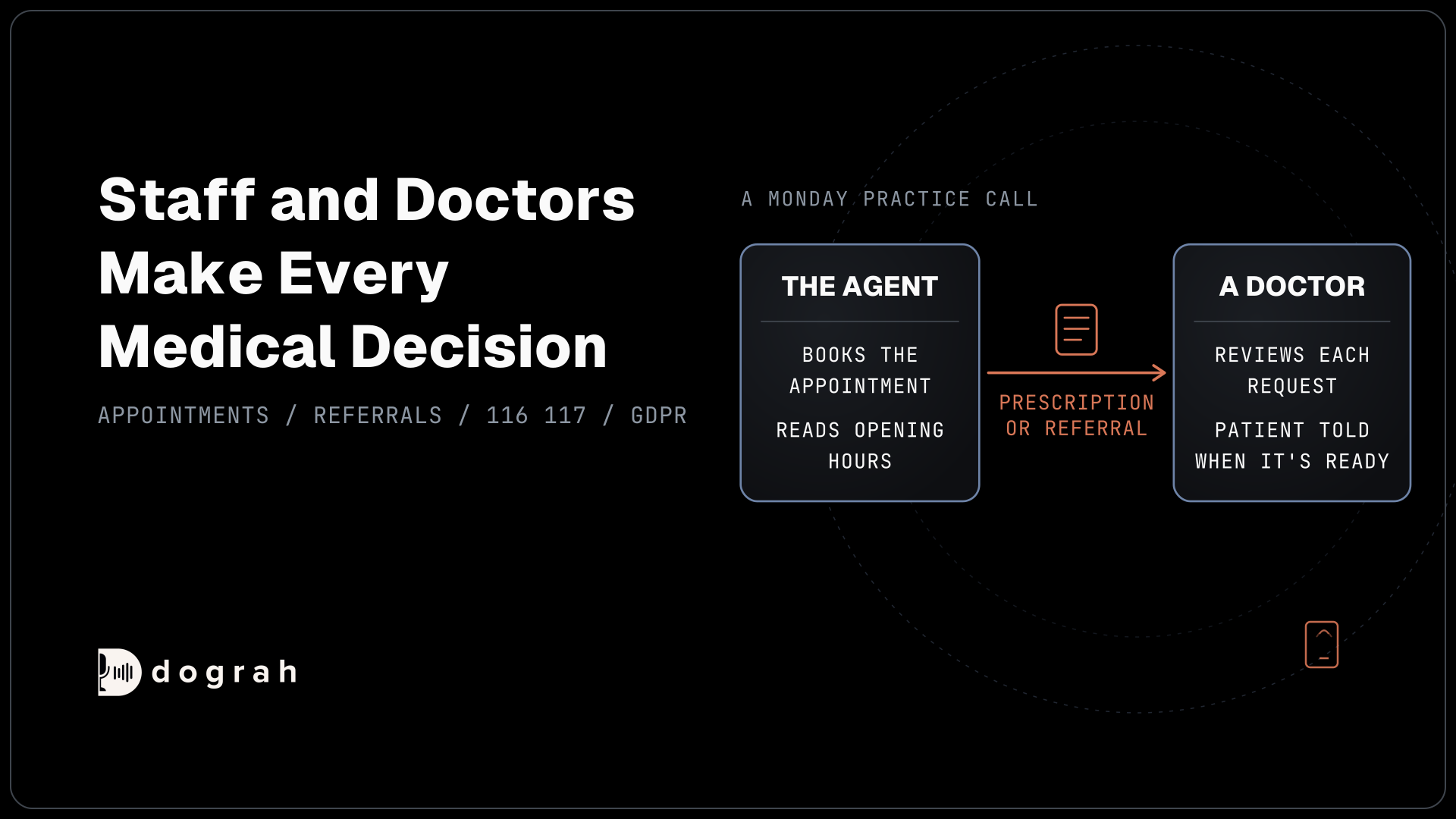
Only after the check does the agent say the practice missed them today. Then it rebooks into the same visit type and provider. A missed crown seat needs the dentist and a longer slot, while a missed cleaning needs a hygienist, so the agent asks the PMS for openings of that visit type through an HTTP API tool and offers only what comes back. A short line such as "Let me look at the schedule" plays while the request runs, typed or as a recorded clip, so the patient never hears silence.
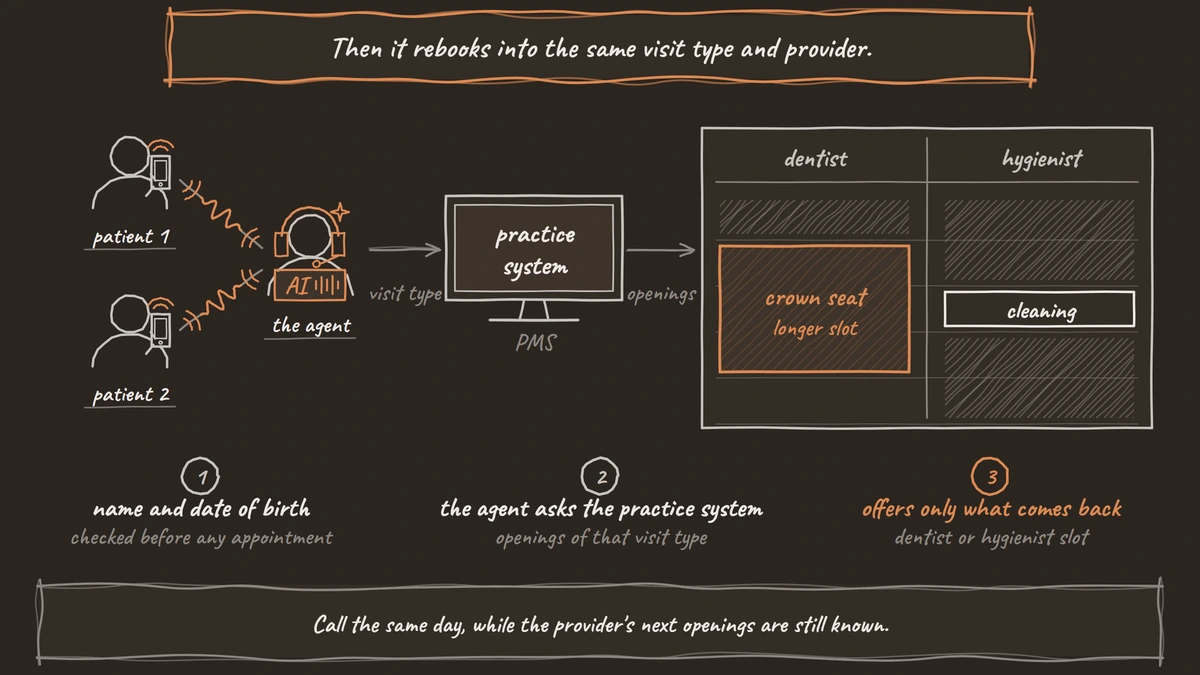
Then it asks one open question, such as "Was there anything that got in the way today?" The agent records the answer as the patient said it, and the transcript and recording keep the exact words. It never comments on the reason. AI voice agents for therapy appointment reminders and no-show recovery explains why that one question earns its place.
What the call never says
A no-show call does not lecture, and it does not talk about money. Most calls to mobiles lean on the Federal Communications Commission's healthcare exemption under the Telephone Consumer Protection Act (TCPA). It covers calls to the number the patient gave, about set purposes such as appointments, that state the provider's name and contact details. It allows one call a day and three a week to each patient, generally a minute or less, with no billing or other financial content.
A missed-appointment fee is financial content, so it stays off the call. If the patient asks about one, the agent says the front desk will explain the practice's policy and writes a callback request. A call that rebooks can run past a minute, so consent on file, collected when the patient registered, is generally the safer basis. Treat that as a reading of the rule and confirm your setup with counsel. Our post on AI voice agents for dental recall and recare outreach works through consent and opt-outs.
Voicemail handling is off by default. To leave a message, turn it on in the agent's Settings and set "When voicemail is detected" to Leave a message. Keep the message to the practice name and a callback number. Never name the procedure or say the visit was missed, because anyone in the house may hear it.
A patient who mentions swelling that affects breathing or swallowing hears a fixed line on its own pathway, played as Transition Speech: "If this is a medical emergency, please call 911 now."
Outcomes back to the broken-appointment list
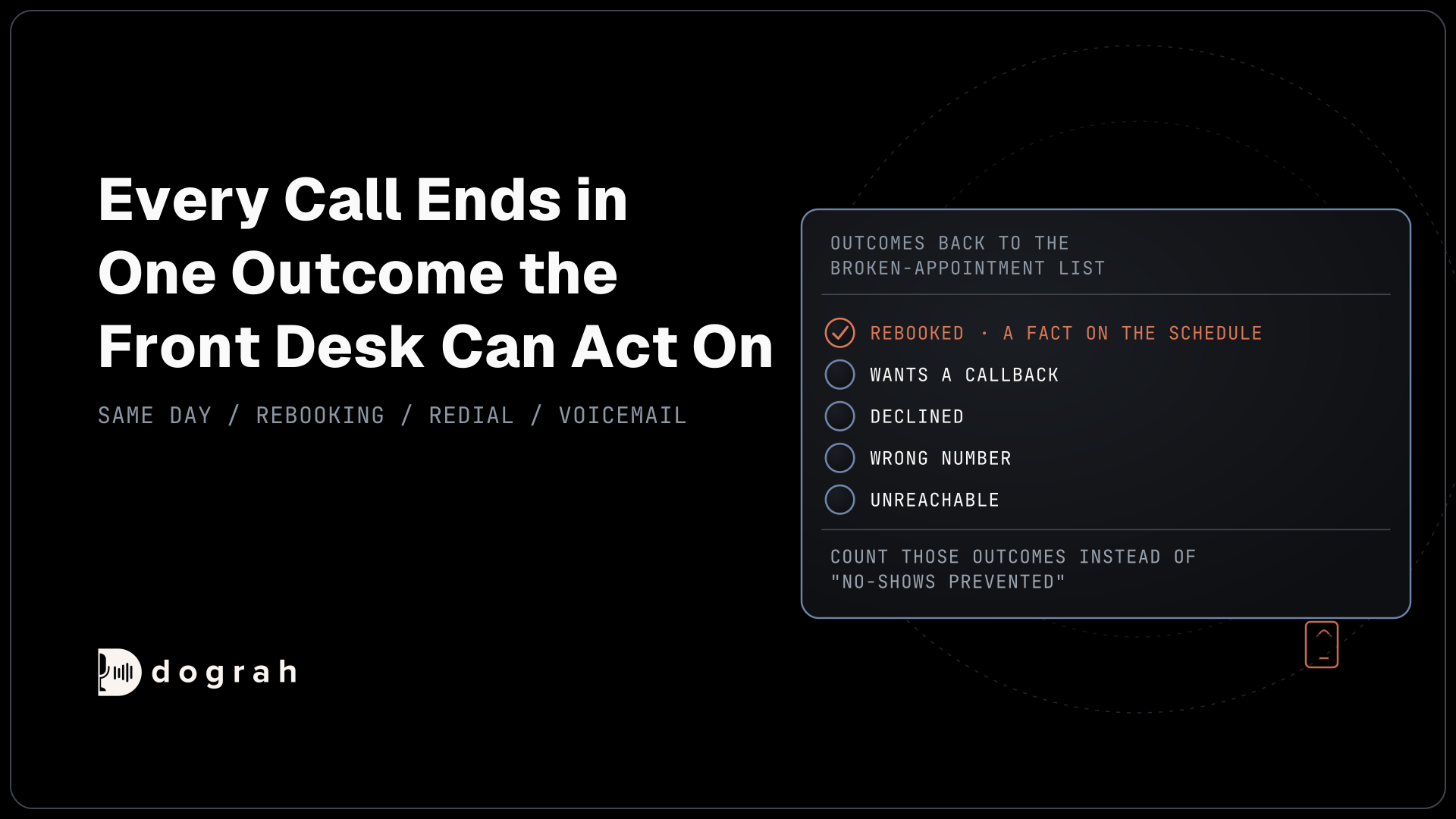
Every call ends in one outcome the front desk can act on: rebooked, wants a callback, declined, wrong number or unreachable. The agent records it during the call, and a Webhook node sends it to the PMS or your practice system afterwards, with links to the transcript and recording.
Count those outcomes instead of "no-shows prevented". Nobody knows who would have come back on their own, while a rebooked visit is a fact on the schedule.
Dograh's built-in QA reads a sample of calls after they end and scores each step separately. Write its prompt to flag any call where the agent named the visit before verification or mentioned a fee.
Join the Dograh Community
Dograh is an OSS alternative to Vapi. Join our Slack community for queries, releases, best practices & community interactions.
Where the patient data sits
A recovery call names a missed visit, which is protected health information. Self-hosting puts Dograh on the practice's own servers, so recordings and transcripts stay there and no business associate agreement (BAA) with Dograh is needed. The model providers that hear the call may need their own BAA when they handle patient data, unless those models run on your servers as well.
Whether the phone carrier needs one depends on what it stores, and many carriers, Twilio among them, offer one. Servers in a cloud account such as AWS, Google Cloud or Azure need a BAA with that cloud provider, while the practice's own data centre does not.
Self-hosted Dograh has no per-minute platform fee, but servers, model keys and phone minutes still cost money. Dograh Cloud charges a 1¢-a-minute platform fee. You can bring your own keys for any speech and language models or run open models locally, and each call keeps a full trace.
Start with one provider's missed visits for a week. Read the transcripts against the outcomes, then add the rest of the schedule.
Glossary
- Broken appointment
- A visit the patient missed or cancelled too late to fill, marked as such in the practice management system. It is the trigger for the recovery call.
- API Trigger
- A Dograh endpoint your own system calls to start an outbound call to one person. It lets the PMS start the recovery call the moment a visit is marked missed.
- Healthcare exemption
- The part of the FCC's calling rules that lets healthcare providers call the mobile number a patient gave for set purposes, at most one call a day and three a week, with no financial content.
- Redial Campaign
- A Dograh campaign action that creates a new campaign calling only the contacts whose last call ended in no answer, busy or voicemail. It suits next-day retries under a one-call-a-day limit.