
AI voice agents for therapy appointment reminders and no-show recovery make two logistics calls. Before a session, the agent verifies the client and confirms or moves it, and any voicemail gives only a first name, a neutral practice name and a callback number. After a missed session, it offers the next open slot and asks what got in the way.
Key Takeaways
- Most calls to therapists reach a machine, so voicemail wording is the privacy decision.
- After a miss, one open question is recorded as said, never discussed.
- Crisis words leave the reminder flow for fixed 988 and 911 lines.
Anyone near a client's phone can play a voicemail from a therapy practice. We cover the session reminder, what a voicemail may say, the call after a missed session, crisis lines, consent and where session data sits, each set up in Dograh. For the wider picture, see our guide to appointment reminders and confirmations.
Two calls, both about logistics
A therapy practice needs two calls, and neither one touches care. The reminder settles the next session. The recovery call follows a missed one. The agent schedules and records, and it never counsels or asks how someone feels.
Voicemail is where most of these calls end. In a 2026 secret shopper study in JAMA Health Forum, researchers called mental health clinicians from October 2025 to March 2026, and 61.3% of the calls could not be evaluated. Most often the caller reached only an answering machine or an automated system. Calls going the other way meet the same machines, so the voicemail message is the main privacy decision.
Many sessions are video visits, and the reminder for those also checks the join link. Our post on telehealth reminders and confirmations covers that step.
The reminder before the session
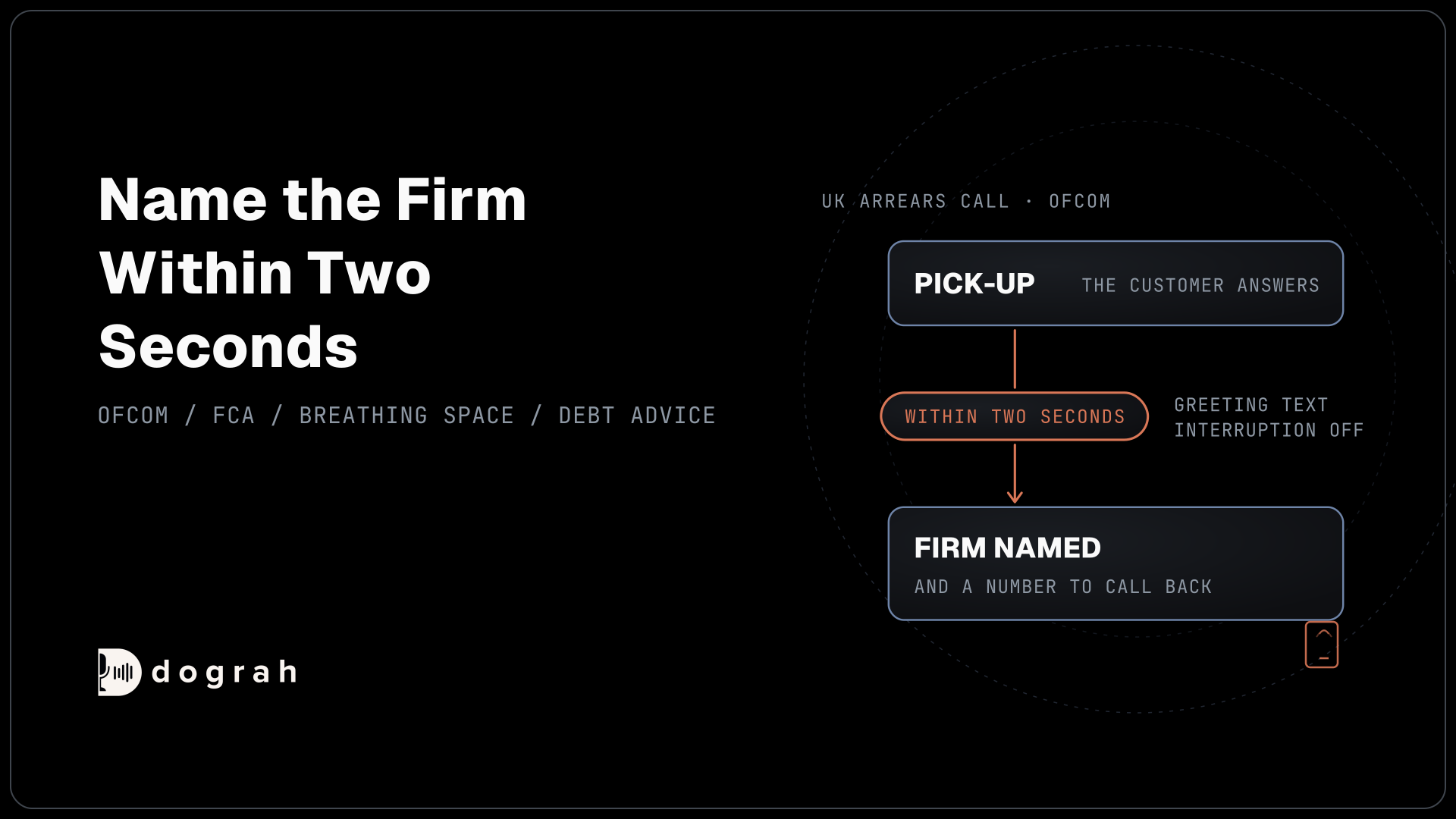
The reminder starts with a neutral greeting. The Greeting Text gives the practice's neutral name and a callback number, and never the clinician's name, since a therapist's name alone can reveal why someone is seen. Allow Greeting Interruption is on by default on the Start Call node, so switch it off to make sure the callback number plays in full.
Then the agent verifies. The client's number opens their file, yet a partner or parent could just as easily be holding the phone. The agent asks for a date of birth, and only after that check does it mention a session. Someone else who answers hears the practice name and a callback request, and nothing more.
The verified client hears the day and time and is asked whether it still works. A no leads to open slots read from your scheduling system, and the agent books the one the client picks. If your practice has a late-cancellation policy, the reminder says "please let us know a day ahead if you need to change". It never names a fee or an amount.
A session given up on a reminder call is worth filling. Our post on therapy waitlist and cancellation calls covers who gets the call when a slot opens.
What a voicemail may say
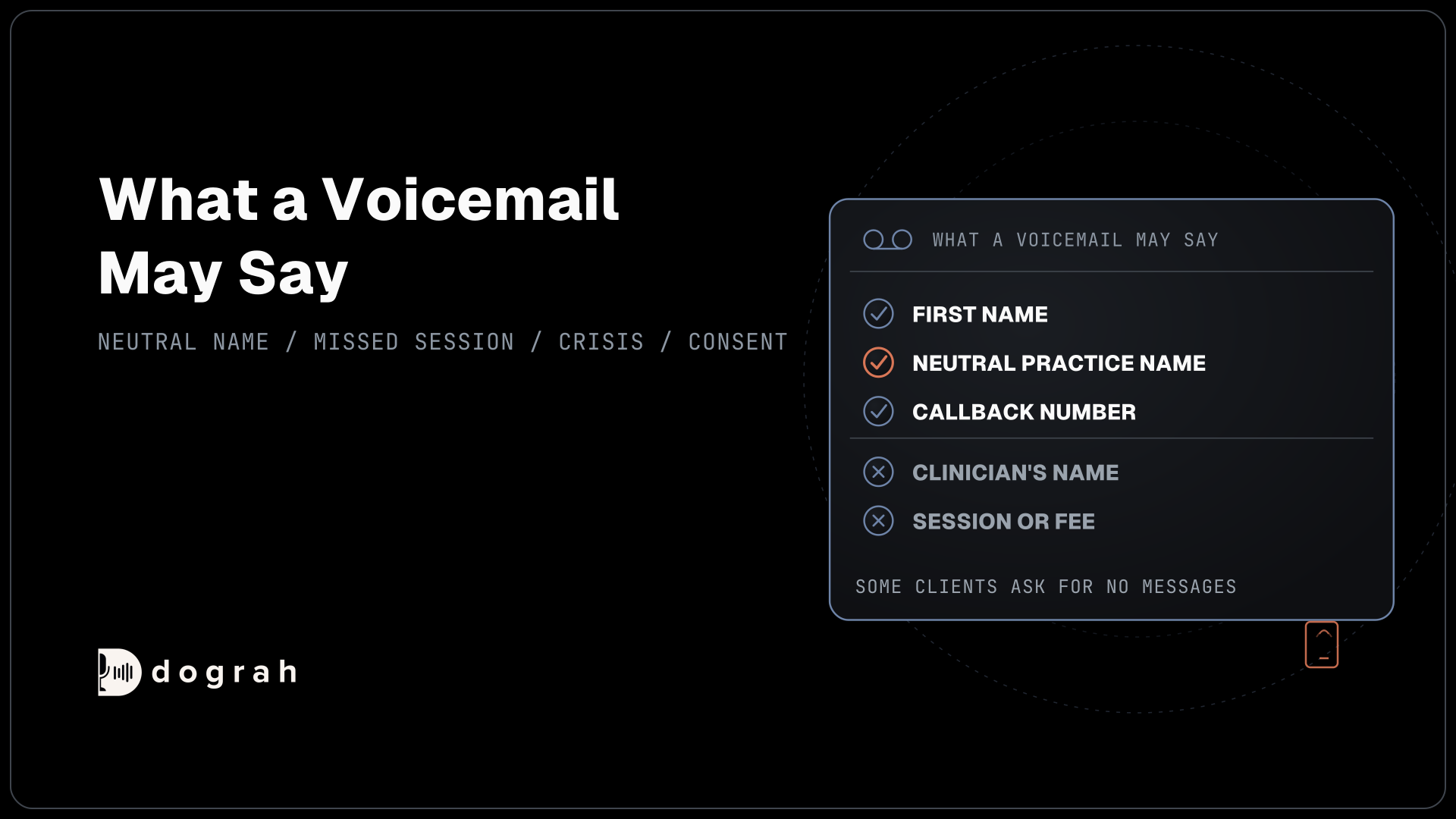
A voicemail can be played by anyone near the phone, so it says a first name, the practice's neutral name and a callback number. Voicemail handling is off by default. In the agent's Settings, turn on "Enable voicemail and screening handling", then set "When voicemail is detected" to "Leave a message":
"Hi {{first_name | there}}, this is Maple Street Practice. Please call us back at +1415555XXXX. Thank you."
Some clients ask for no messages at all, a kind of confidential communications request. Under the Health Insurance Portability and Accountability Act (HIPAA), providers must accommodate reasonable requests for confidential communications, such as calls to another number only. Store that choice on the client record. Voicemail handling is set per agent, so run those clients on a second agent set to "Disconnect the call".
Substance use programs need extra care. Under the Confidentiality of Substance Use Disorder Patient Records rules, 42 CFR Part 2, a message that names a Part 2 program can count as a disclosure that someone applied for treatment. Use a neutral name there too. If a phone screens the call and asks who's calling, the Screening message gives the practice name and says it's a scheduling call.

Open Source Alternative to Vapi / Retell
Self-hosted voice agent platform — no per-minute fees
dograh-hq/dograh
Star on GitHub
The call after a missed session
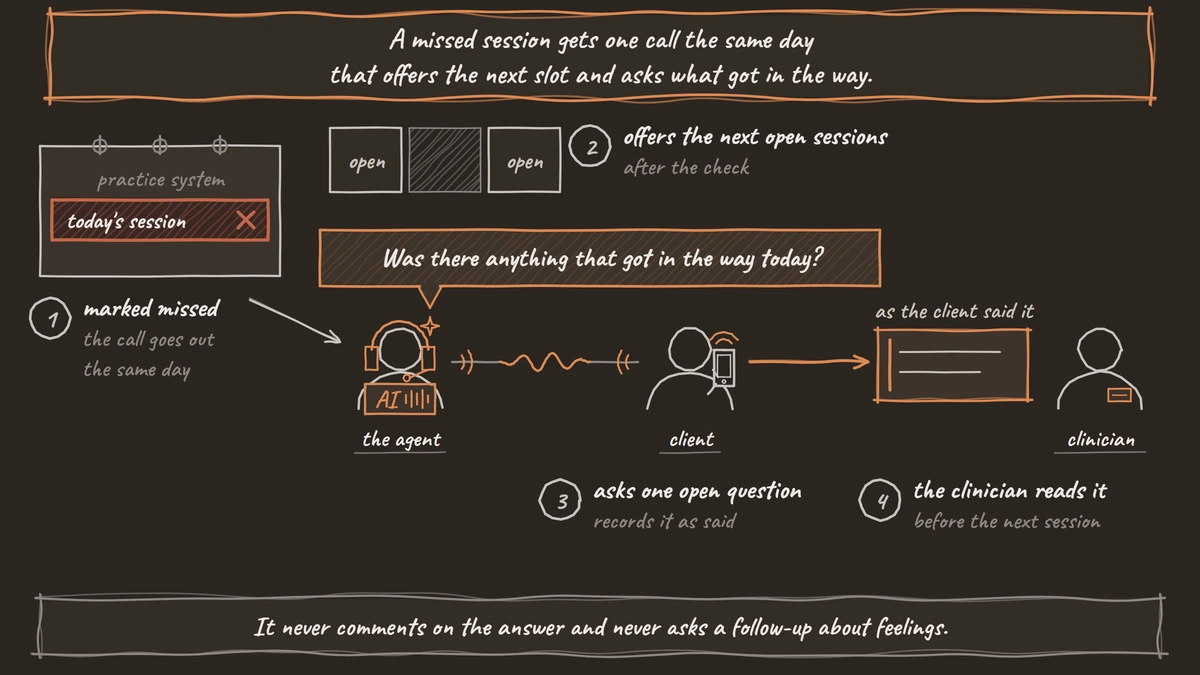
A missed session gets one call the same day that offers the next slot and asks what got in the way. That pairing has measured support from one clinic. In a quality-improvement poster from Humber River Health, staff at an early psychosis clinic for young people called each patient who missed an appointment to reschedule and ran a short phone survey on why. The average no-show rate fell from 36.91% to 17.07%. It was one clinic, with calls made by staff, in a poster rather than a peer-reviewed study, so treat it as a strong hint.
The call starts when your practice system marks the session missed. It sends the client's record reference to the API Trigger, so the call goes out the same day. After the check, it says the practice missed the client today and offers the next open sessions, read from your schedule by an HTTP API tool.
Then it asks one open question: "Was there anything that got in the way today?" The agent records the answer as the client said it, and the transcript and recording keep the exact words. It never comments on the answer and never asks a follow-up about feelings. A Webhook node sends the new booking and the answer to your system, so the clinician reads it before the next session.
When a client sounds in crisis
Any sign of crisis takes the call out of the reminder flow and onto fixed words. A pathway's Transition Speech plays fixed text or a recording exactly as written, so the crisis lines live on a crisis pathway. A client in distress hears "If you're having thoughts of suicide or you're in crisis, call or text 988, the Suicide and Crisis Lifeline." A medical emergency hears "If this is a medical emergency, please call 911 now." Someone in danger hears "If you're in danger, get to safety and call 911."
After the fixed line, Transfer Call connects the client to the on-call clinician, on Twilio, Telnyx, Plivo, Cloudonix or Asterisk ARI. The on-call clinician's phone rings first, and the client joins only after that clinician picks up. Our post on after-hours crisis routing in mental health covers who answers at night.
The model picks that pathway by reading the condition you wrote, so test it with many phrasings and read the transcripts. Set the QA node to flag any call where the agent said anything clinical, and have a person review those calls each week.
Join the Dograh Community
Dograh is an OSS alternative to Vapi. Join our Slack community for queries, releases, best practices & community interactions.
Consent and where session data sits
Most reminders to mobiles rest on the FCC's healthcare calling exemption, under the Telephone Consumer Protection Act (TCPA), which allows one call or text a day and three a week, generally a minute or less, with no marketing and no billing content. That is why a fee never appears on the call. Since any retry lands the same day, set Max Retries to 0. A recovery call that rebooks can run past a minute, so consent on file, collected at intake, is generally the safer basis. The guide's consent section has the detail, and your counsel should confirm your own setup.
A practice can host Dograh itself or use Dograh Cloud. Hosted on the practice's own servers, the platform never sees a client's session details, so the platform needs no business associate agreement (BAA). Each speech or language provider reached with your own keys still hears the client's voice and needs a BAA of its own, unless open-weight models also run on those servers. A carrier may need one too, depending on what it keeps, and any cloud provider hosting the servers does.
Anonymous usage telemetry is switched on in a fresh self-hosted install. A practice that wants nothing leaving its servers sets ENABLE_TELEMETRY=false and deletes POSTHOG_API_KEY. Running it yourself carries no per-minute platform fee, though the practice still pays for servers, model keys and phone minutes. On Dograh Cloud, the practice pays a 1¢-a-minute platform fee instead.
Before launch, run both calls on a real phone line and listen to the voicemail as a roommate would hear it.
Glossary
- Confidential communications request
- A client's HIPAA right to ask that the practice reach them another way or at another place, such as no voicemail or a different number. The practice stores it on the record and routes those clients to an agent that never leaves messages.
- Recovery call
- A call the same day as a missed session that offers the next open slot and asks one open question about what got in the way, recorded as said for the clinician to read.
- Part 2 program
- A substance use disorder program covered by 42 CFR Part 2, where even confirming that someone applied for treatment can count as a disclosure. Reminder voicemails for these programs use a neutral name only.
- Crisis pathway
- A separate route in the agent's flow that plays fixed crisis lines, including 988 and 911, and then transfers to the on-call clinician. The model chooses it by reading a written condition, so it is tested with many phrasings.