
AI voice agents for telehealth reminders and confirmations call patients before a virtual visit, verify them, and confirm or move the visit in the same call. They ask where the patient will be during the visit, check by asking that the join link arrived and opens, and have the clinic's own system resend the link when it hasn't.
Key Takeaways
- Ask where the patient will be, because licensure follows the patient's location.
- A phone call checks the device by asking, then has the link resent.
- The join link is never read aloud on the call.
A reminder text carries the join link, yet it can't tell you whether that link opens on the patient's device. We cover confirming or moving the visit, the patient's location for licensure, the link check, voicemail and consent, and where call data sits in Dograh. It builds on our guide to appointment reminders and confirmations.
What the call adds to a reminder text
A telehealth reminder text already carries the join link, so the call is for what a text can't settle. It confirms or moves the visit and asks where the patient will be. It also checks that the link works on the device they plan to use.
Telehealth is a large share of care, and much of it is mental health care. In FAIR Health's telehealth tracker, 14.9% of privately insured patients had a telehealth claim in January 2025, and 58.5% of those patients had a mental health diagnosis. So a telehealth reminder line often reaches therapy clients, and privacy on the call matters as much as the link. Our post on therapy reminders and no-show recovery covers that side.
Not every patient needs this call. Your telehealth system knows who confirmed and who finished its device test, and AI Voice Agents for Telehealth: The Call Behind the Join Link explains how to call only the rest.
Confirm or move the virtual visit
The call starts like every confirmation call: greet, verify, then name the visit. The Greeting Text names the clinic and gives a callback number. It never names the clinician or the visit type, since a therapist's name alone can reveal why someone is seen.
The number on file leads to the patient's record, yet someone else may have answered. The agent asks for a date of birth plus one more item your clinic chooses, such as the appointment date. Only after that check does it name the time of the visit.
If the time no longer works, an HTTP API tool reads open virtual slots from your scheduling system during the call, and a second request books the new one. Add a Preset Parameter named workflow_run_id with the value {{initial_context.workflow_run_id}}, so a repeated request never books twice. The agent reads back the new time before it moves on.
The daily list runs as one of Dograh's Campaigns, from a CSV with a phone_number column, where other columns such as the visit time and the clinician become variables. Calling hours run in one time zone per campaign, and telehealth lists often span several, so split the list by zone.
Ask where the patient will be
Under the patient location rule, licensure follows the patient, so the call asks where they will be during the visit. Under the Interstate Medical Licensure Compact, medicine is practised in the state where the patient is located, and that state's laws apply. A patient who plans to join from a cabin across the state line may be outside the states where the clinician is licensed.
The agent asks one plain question: "Where will you be during your visit on Thursday?" It records the answer as the patient states it, as a variable on the call. Your system compares that state with the clinician's list.
When the state is outside that list, the agent stays neutral. The prompt tells it to say a team member will call to sort out the time, and to write that callback request to your system. Staff then reschedule the visit or move it to another clinician.
Check the link by asking, then resend it
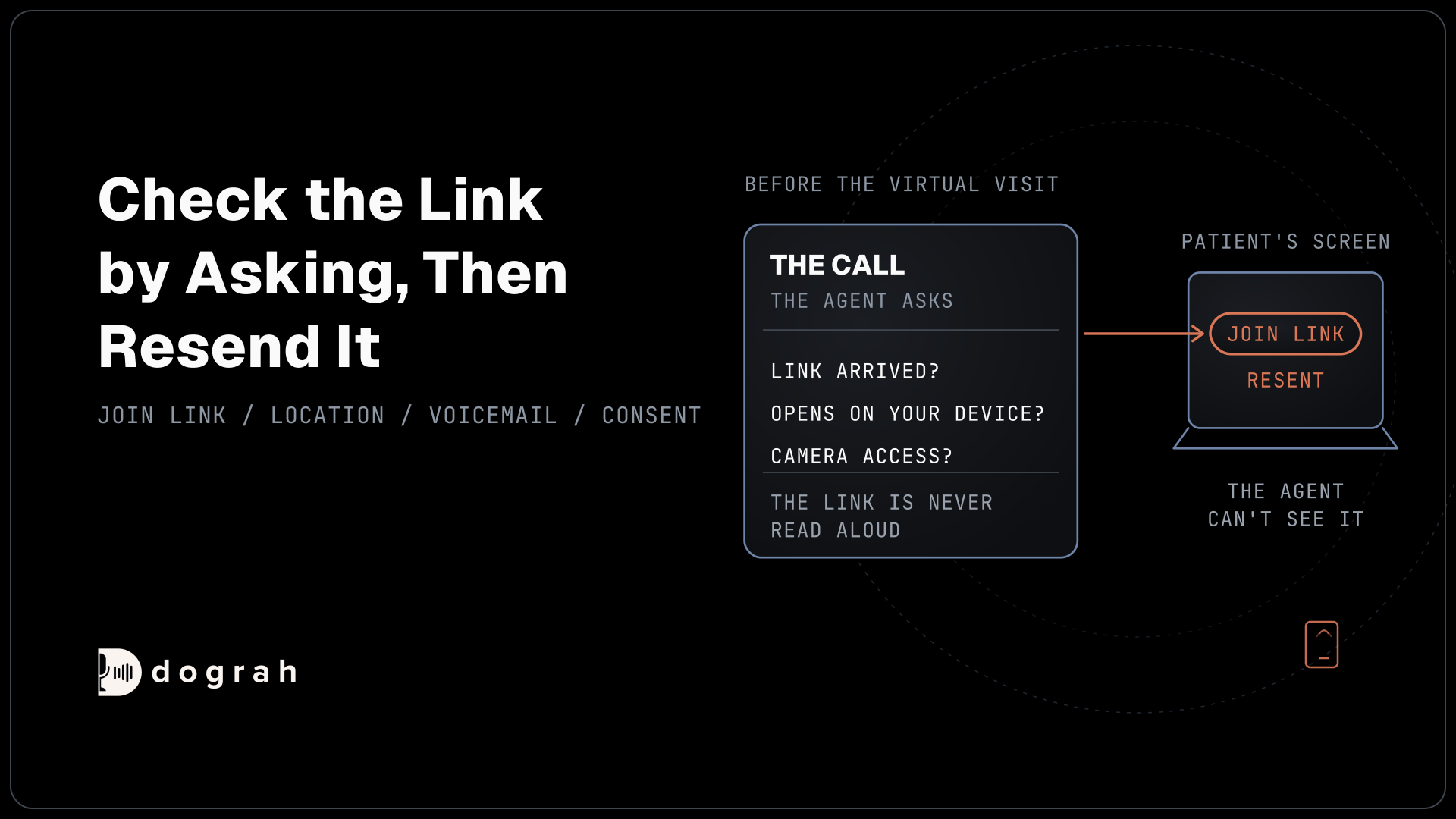
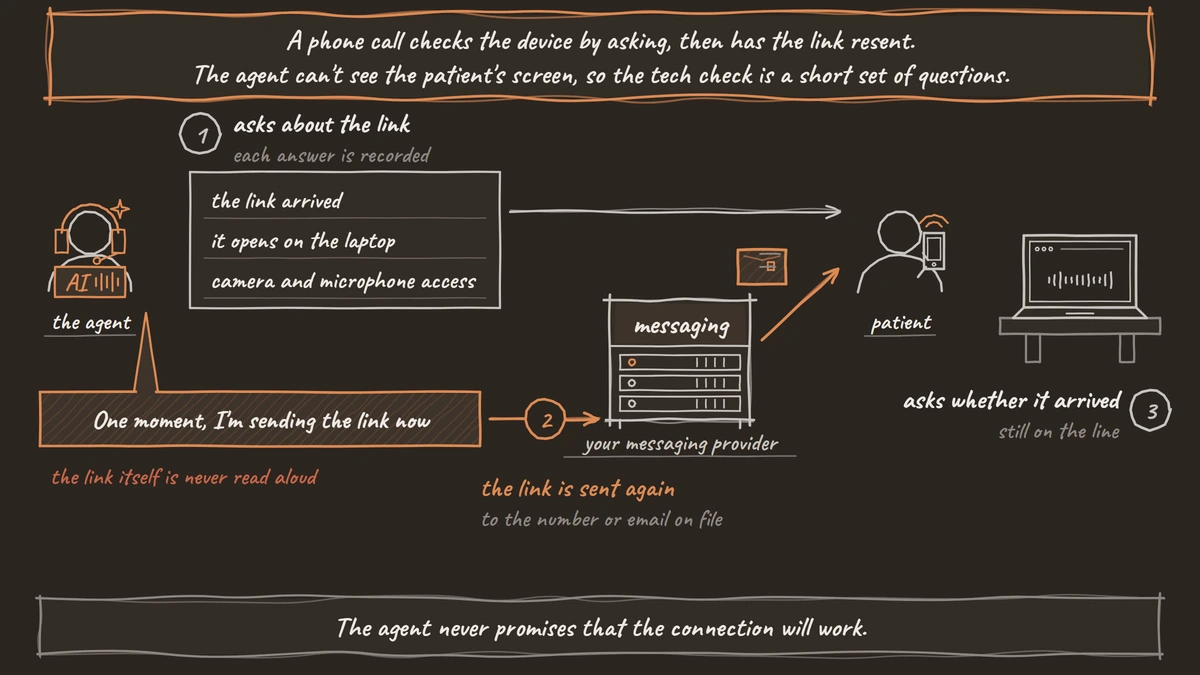
The agent can't see the patient's screen, so the tech check is a short set of questions. It asks whether the link arrived and opens on the phone or laptop the patient plans to use, and whether the browser asked for camera and microphone access. Each answer is recorded. The agent never promises that the connection will work.
The link itself is never read aloud. When the patient can't find it, an HTTP API tool asks your messaging provider to send it again to the number or email on file. A line such as "One moment, I'm sending the link now" plays as the tool starts, while the request runs. The agent then asks whether it arrived.
If video still won't work, the fallback is your clinic's decision. When your scheduling system returns an audio-only visit as an option, the agent can offer it. For Medicare patients, the Consolidated Appropriations Act, 2026 extends telehealth flexibilities, audio-only visits included, through December 31, 2027. Otherwise the agent offers a staff callback before the visit, or a new time.

Open Source Alternative to Vapi / Retell
Self-hosted voice agent platform — no per-minute fees
dograh-hq/dograh
Star on GitHub
Voicemail, consent and emergencies
Many reminder calls reach voicemail, so the message says only a first name, the clinic's name and a callback number. Voicemail handling is off by default. Turn it on in the agent's Settings and set "When voicemail is detected" to "Leave a message".
Most telehealth reminders to mobiles rest on the FCC healthcare exemption, under the Telephone Consumer Protection Act (TCPA). It allows one call or text a day and three a week, generally a minute or less, with the provider's name and contact number. Put both in the Greeting Text, and switch off Allow Greeting Interruption on the Start Call node, which is on by default, so the whole notice plays. Because any retry lands on the same day, set Max Retries to 0 and redial the next day. Calls that move a visit can run longer, so consent on file from booking is generally the safer basis, and the guide's consent section covers the rest. Confirm your own setup with counsel.
The agent never gives medical advice. A symptom or a clinical question goes to a nurse through Transfer Call, on Twilio, Telnyx, Plivo, Cloudonix or Asterisk ARI. Dograh rings the nurse first, and the patient joins only once the nurse picks up. For a medical emergency, a separate pathway plays the fixed line "If this is a medical emergency, please call 911 now."
Join the Dograh Community
Dograh is an OSS alternative to Vapi. Join our Slack community for queries, releases, best practices & community interactions.
Where telehealth call data sits
Telehealth reminder calls carry names and visit times, so decide where they live before launch. Dograh runs on your own servers or on Dograh Cloud. On your own servers, patient data never reaches the platform, which means the platform itself needs no business associate agreement (BAA).
Speech and language providers reached with your own keys still receive the patient's voice, so each one needs its own BAA, unless open-weight models also run on your servers. Whether the phone carrier needs a BAA depends on what it stores, and a cloud provider hosting your servers needs one as well. Telemetry is the other default to change, since a self-hosted install sends anonymous usage data unless you set ENABLE_TELEMETRY=false and remove POSTHOG_API_KEY. For the clinic, self-hosting means no per-minute platform fee, though servers, model keys and phone minutes are still paid for, and Dograh Cloud carries a 1¢-a-minute platform fee.
Before launch, run the call on a real phone line and read the transcripts. Check that the location question gets a clear answer and that the resend reaches the patient while they're still on the line.
Glossary
- Join link
- The unique web address a patient opens to enter a virtual visit. It goes by text or email from the clinic's own system, and a reminder call asks about it but never reads it aloud.
- Patient location rule
- The licensure principle that a telehealth visit takes place where the patient is, so the clinician must be able to practise in that state. A reminder call records the patient's location and leaves the decision to staff.
- Audio-only visit
- A virtual visit done over the phone alone, with no camera. The agent offers it only when the clinic's scheduling system returns it as an option, because it is a clinical and billing decision.
- FCC healthcare exemption
- The part of the FCC's calling rules that lets providers call the mobile number a patient gave for reminders, within limits: one a day, three a week, generally a minute or less, and no marketing or billing content.