
The best voice AI with voicemail detection shows how it decides and what the agent does next, from a message to a retry. Vapi, Retell, Bland and ElevenLabs build it in, and LiveKit and Pipecat offer code. For teams that want to read and tune the classifier, Dograh is the open-source AI voice agent platform built for that.
Key Takeaways
- Every published voicemail accuracy figure is measured by the vendor on its own audio.
- Dograh's detection classifies outbound calls with phrase patterns, then a language model.
- Twilio's carrier detection costs $0.0075 a call and judges speech timing.
Voicemail detection decides whether an outbound agent is talking to a person or a machine, and every platform makes that call differently. We set the criteria and rank the platforms with open-source Dograh first, then we talk about what the law asks of a recorded message.
What to judge voicemail detection on
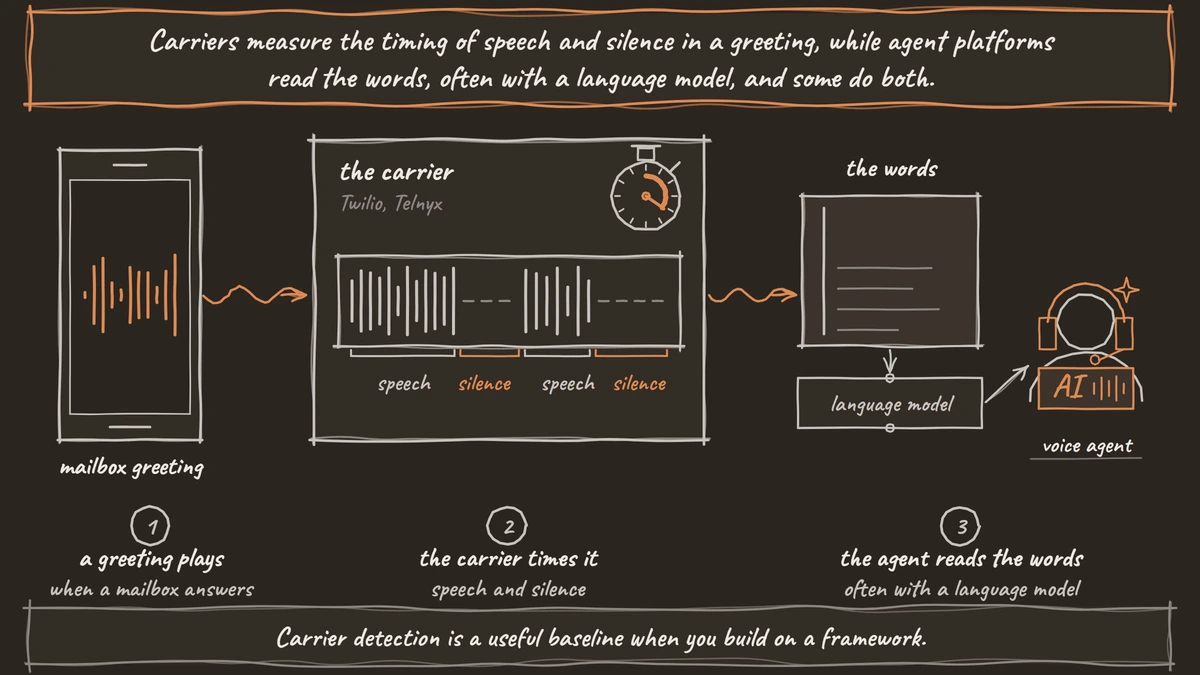
Start with how a system decides, because that sets what it can get wrong. Carriers measure the timing of speech and silence in a greeting, while agent platforms read the words, often with a language model, and some do both. Our post on how voicemail detection works explains the two approaches in depth.
The next question is what happens to an unsure answer. Calling a person a machine is the expensive mistake, because the agent hangs up on a real prospect. Calling a machine a person only wastes a few seconds of talk into a mailbox. A good system is built to fail open, so an unsure result goes to the agent as a person.
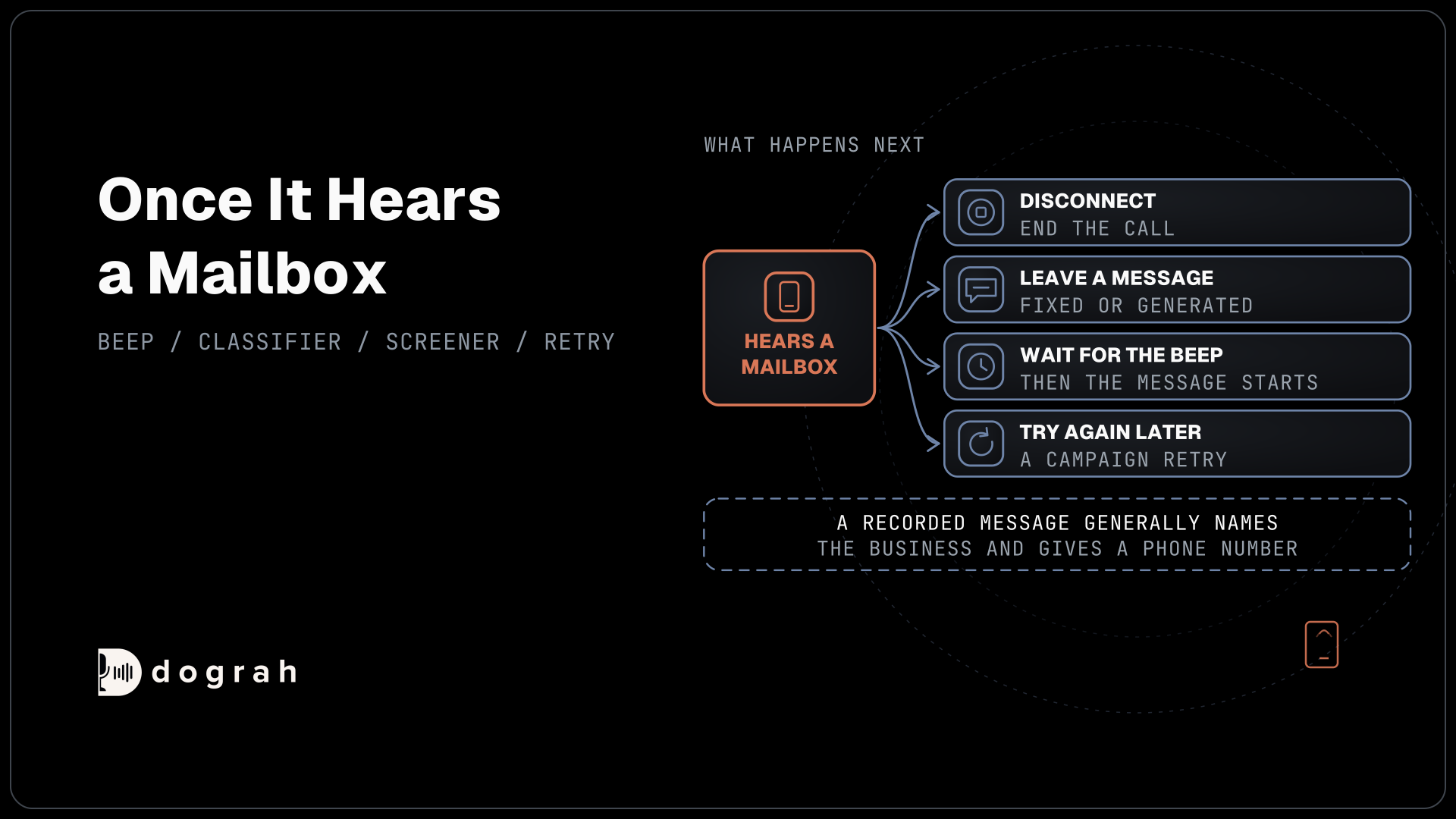
After that, look at what the agent can do once it hears a mailbox. The options are to disconnect, leave a fixed or generated message, wait for the beep or try again later. Call screeners and phone menus need their own handling, and you should be able to see and change the classifier that makes the call.
Accuracy is missing from this list on purpose. Every published voicemail accuracy figure is measured by the vendor on its own audio, with its own mix of greetings and phone lines, so the numbers cannot be compared with each other. Rank on method and control, then measure on your own calls.
Voicemail detection compared
The table sets each option on the same three questions. Dograh comes first, then the open frameworks, the hosted platforms and the carrier baseline.
| Platform | How it decides | What happens next | Code and where it runs |
|---|---|---|---|
| Dograh | Phrase patterns, then a language model on the transcript | Disconnect or leave a text or recorded message, screening wait, campaign retry | Open source, runs where Dograh runs |
| LiveKit Agents | Quick rule for short greetings and an LLM, in parallel | Your code leaves a message or ends the call, IVR navigation in Python | Open source framework |
| Pipecat | VoicemailDetector after speech-to-text, with a classifier you pick | Your code acts on a voicemail event | Open source framework |
| Vapi | Vapi's own detector, Google, OpenAI or Twilio | Waits for the beep, then plays text or a recording | Vapi's cloud |
| Retell AI | Detection during the first 3 minutes | Hang up, or leave a fixed or generated message | Retell's cloud |
| Bland AI | Built-in detection | Hang up, leave a message, add a text, or ignore | Bland's cloud |
| ElevenLabs Agents | A system tool the LLM calls on automated greetings | Leave a custom message or end the call | ElevenLabs' cloud |
| Twilio and Telnyx | Speech and silence timing, or Telnyx's premium model | Return a result to your app | Carrier |
Dograh, open detection you can tune
Dograh decides in two steps and leans toward the person. In the agent's Settings, the Voicemail & Screening section turns on with "Enable voicemail and screening handling", which is off until you switch it on. Once on, Dograh checks the first words of the call against phrase patterns for common mailbox greetings in English and Italian, then asks a language model, with a 3-second budget, when the patterns do not settle it. An unsure or late answer goes to the agent as a person.
"When voicemail is detected" offers two actions. Disconnect the call is preselected, and Leave a message plays a text or recorded message you set, then ends the call. A call screener, such as a phone's assistant asking who is calling, hears your screening message, and the agent waits up to 30 seconds for the person to pick up, at most twice. A full mailbox or a phone menu ends the call, since the agent answers by voice.
The classifier is yours to read and change. Under Classification model, "Use Workflow LLM" is on, so the agent's own language model makes the call, or you pick another provider and model. The Classifier instructions box holds the prompt it follows. These settings apply to outbound calls on agents with separate speech and language models, not to speech-to-speech models.
Detection runs inside the platform rather than at the carrier, so it works on whichever servers run your agents. A voicemail call gets the voicemail_detected disposition, and campaigns can retry it, since Retry On includes Voicemail, with new campaigns starting at 2 retries 2 minutes apart.
Running Dograh yourself means no per-minute platform fee on these calls. Servers, model keys and phone minutes still cost money, including the short calls that end at a mailbox, and your team keeps up the database and each upgrade. Support comes from the open-source community, with custom SLAs on Enterprise, and Dograh Cloud runs the platform for a 1¢-a-minute platform fee.

Open Source Alternative to Vapi / Retell
Self-hosted voice agent platform — no per-minute fees
dograh-hq/dograh
Star on GitHub
LiveKit Agents and Pipecat, detection in code
The two open frameworks give you detection as code, and your engineers write what happens next. LiveKit's answering machine detection runs once, on the first thing the callee says, and holds the agent's speech until it decides. A quick rule handles short greetings followed by silence, and a language model handles longer ones, with Google's Gemini 3.1 Flash Lite used when LiveKit's hosted inference is available.
LiveKit returns human, machine-ivr, machine-vm, machine-unavailable or uncertain, and treats uncertain as a person. In Python a phone menu starts its automatic menu navigation by default, which Node.js does not offer. A mailbox result lets your code leave a callback message, and a full or unset mailbox ends the call.
Pipecat's VoicemailDetector sits after speech-to-text with a classifier you choose, such as an LLM classifier, and fires a voicemail event your code acts on. Both leave the message, retries and records to you.
Vapi, Retell, Bland and ElevenLabs, built in
The hosted platforms build detection in, and each offers a different set of next steps. Vapi's voicemail settings let you pick its own detector, which it strongly recommends, Google, OpenAI, or Twilio as a legacy option it calls prone to false positives. It waits up to 30 seconds for a beep by default, then plays a text or recorded message, and switches back to conversation if a person picks up. A separate Voicemail Tool lets the assistant decide for itself.
Retell listens for voicemail during the first 3 minutes after the call connects, and says this generally adds under 30 milliseconds. On a mailbox the agent hangs up straight away or leaves a message, either a fixed sentence or one generated from a prompt. New agents made in the dashboard start with detection on and hang up by default, and hanging up on phone menus is a separate setting.
Bland sets the action per call. It hangs up by default, or it can leave a message after the beep, leave a message and send a text, or ignore the mailbox. A retry setting can use a different voicemail action on the next attempt. ElevenLabs Agents treats voicemail as a system tool the language model calls when it hears an automated greeting, then leaves your custom message or ends the call.
Join the Dograh Community
Dograh is an OSS alternative to Vapi. Join our Slack community for queries, releases, best practices & community interactions.
Carrier detection from Twilio and Telnyx
Carriers detect voicemail before any agent platform hears the call, and they judge timing rather than words. Twilio's answering machine detection measures the periods of speech and silence in the greeting. A long unbroken greeting leans machine, and a short "hello" followed by silence leans person. Twilio warns that it will not always return the right answer, and charges $0.0075 a call for it in the US.
Twilio offers two modes. One returns a result as soon as it decides, and the other waits for the end of the greeting, a form of beep detection, so a message can start after the beep. If no decision arrives within 30 seconds by default, the result is unknown. Telnyx offers several modes, with a premium mode that uses speech recognition and machine learning, and it recommends treating an unsure result as a person.
Carrier detection is a useful baseline when you build on a framework. It still returns only a label, so your application decides what the agent says and does next.
What a recorded message must say
A message left on a machine is a prerecorded or artificial-voice call under the Telephone Consumer Protection Act (TCPA), and the FCC's rules for those calls set what it must contain. The message names the business at the start and gives a phone number during or after it. A telemarketing message left on an answering machine also gives a toll-free number that reaches an automated opt-out.
An AI voice counts as artificial. The FCC's declaratory ruling FCC 24-17, released 8 February 2024, says AI-generated voices fall under the TCPA's artificial-voice rules, so consent and these message rules generally apply to an agent's voicemail too. Confirm the rules for your calls and states with counsel. Our post on outbound calling rules for voice agents covers consent and calling hours.
How to test detection on your own calls
Your own calls are the only fair test, since every published figure comes from someone else's audio. Build a test list that covers real mailboxes with long and short greetings, full mailboxes, phone menus, a phone with call screening on, and people who answer with a quick "hello". Place the calls over the same carrier and numbers you will use in production.
Count both mistakes for each list, the people the agent hung up on and the mailboxes it talked into. Read the transcripts of the unsure calls, then adjust the classifier instructions or the message. A short message also helps the retry, and our post on low answer rates covers what to say and when to call back. For the wider outbound setup, see our guide to AI outbound calls.
Glossary
- Answering machine detection (AMD)
- A carrier or platform feature that labels who answered an outbound call, a person or a machine. Carriers judge speech timing, while agent platforms often read the words.
- Fail open
- A design where an unsure detection result goes to the agent as a person, so a real caller is never dropped because the system could not decide.
- Call screener
- A phone assistant that answers for the person and asks who is calling. The agent states its reason and waits, rather than treating it as a mailbox.
- Beep detection
- Listening for the tone at the end of a voicemail greeting, so a recorded message starts after it and is not cut off.