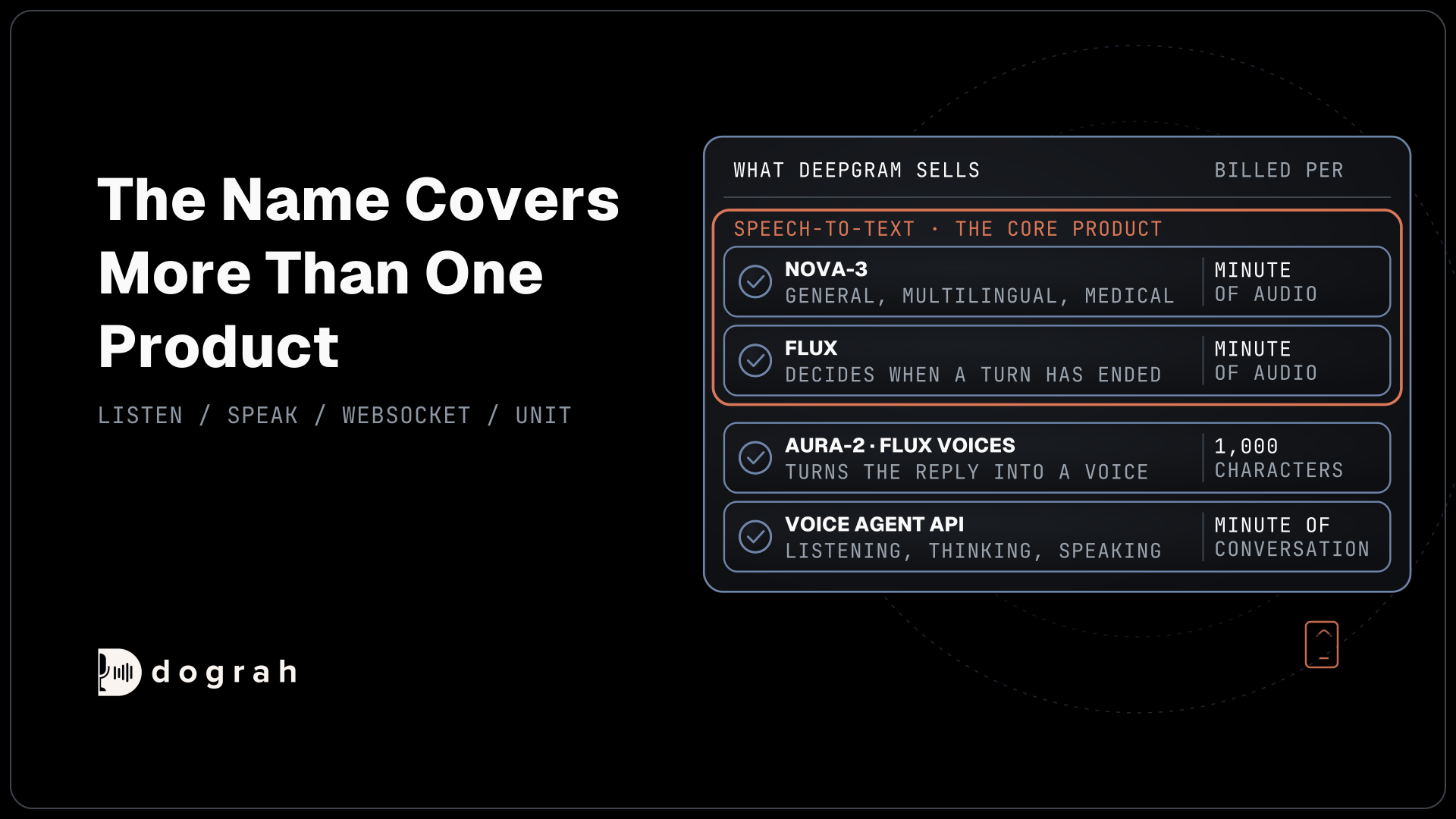

Deepgram is a speech AI company. It sells speech-to-text (Nova-3 and Flux), text-to-speech (Aura-2 and Flux voices) and a Voice Agent API that runs a whole conversation over one connection. For teams that want to own the agent layer, Dograh, the open-source AI voice agent platform, runs Deepgram's models on your own key, self-hosted or on Dograh Cloud.
Key Takeaways
- Nova-3 streaming costs $0.0048 a minute on pay as you go, and Flux English $0.0065.
- The Voice Agent API runs listening, the language model and speaking for $0.075 a minute.
- Dograh runs Deepgram's speech-to-text and voices on your own key, per agent.
Deepgram is one of the first speech providers most voice agent builders meet, and the name covers more than one product. We explain what it sells, how a phone call moves through it and who uses it, cover cost and hosting, then we talk about how it runs inside Dograh.
What Deepgram is and who uses it
Deepgram is a speech AI company that sells its own models through an API. It started with speech-to-text, added text-to-speech, and now also sells a Voice Agent API that runs the whole conversation. You do not download Deepgram's models in the normal plans. You send audio or text to Deepgram's servers and get words or speech back.
Deepgram describes its reach in large numbers. On its home page, Deepgram says it has processed over 200,000 years of audio for over 650,000 developers and over 5,000 organizations. Its testimonials name Vapi, Cloudflare and NICE, companies that build Deepgram into products of their own. These are Deepgram's own figures, not an independent count.
Accuracy is where an outside view helps. Our Deepgram review covers how Nova-3 and Flux score on independent tests, how they handle phone audio and who should pick them, so this guide stays on what each product is.
Nova-3 and Flux for speech-to-text
Speech-to-text is Deepgram's core product, and it comes in two families. Nova-3 is the general model, offered as a monolingual version for one language and a multilingual version that can follow a caller who switches languages. Nova-3 Medical is a version trained for clinical words, such as drug names and conditions, which a general model often mishears on a clinic's phone line.
Flux is the newer family, built for conversation. It transcribes the caller and also decides when the caller has finished a turn, so the agent knows when to reply without a separate silence detector. Flux English came first, and Flux Multilingual covers 10 languages, from Spanish and Hindi to Japanese and Dutch, according to Deepgram's models and languages page.
That turn decision matters more than it looks. In many voice agents, speech-to-text is one of the steps that adds wait, because the system has to be sure the caller has stopped before it can start thinking. A model that judges the end of a turn from the words, and not only from silence, can cut that wait without cutting the caller off mid-thought.
Aura-2 and Flux voices
Deepgram's text-to-speech turns the agent's reply into a voice. Aura-2 is the main voice model, billed per 1,000 characters of text, and Deepgram's home page also shows Flux voices built for expressive conversation. Deepgram says its text-to-speech covers "45+ languages and 100+ voice profiles".
Aura-2 voices are built for business calls, with clear and steady delivery, where the brief is a voice that reads order numbers and dates without drama. Teams that want a more expressive or cloned voice often pair Deepgram's speech-to-text with another provider's voice, since each layer can come from a different company.

Open Source Alternative to Vapi / Retell
Self-hosted voice agent platform — no per-minute fees
dograh-hq/dograh
Star on GitHub
The Voice Agent API
The Voice Agent API is Deepgram's answer to building the whole agent for you. Instead of wiring speech-to-text, a language model and text-to-speech together yourself, you open one WebSocket and Deepgram runs the loop. In Deepgram's own words on the Voice Agent docs, it "handles the full speech pipeline (listening, thinking, and speaking)".
Inside that connection, Flux or Nova-3 hears the caller, a language model writes the reply and Aura-2 speaks it. The language model can be one Deepgram manages, from providers such as OpenAI, Anthropic or Google, or one you bring. The agent can call your functions in the middle of a conversation, stop talking when the caller interrupts, and connect to phone networks through guides for Twilio and Plivo, among others.
On Deepgram's price page, the Standard tier costs $0.075 a minute. That price covers the whole loop, which makes it easy to budget, while the trade is that the conversation logic, tools and call handling live inside Deepgram's service and its settings.
How a phone call moves through Deepgram
There are two ways a phone call can use Deepgram, and the choice decides who owns the agent. In the first, your own agent layer receives the call from the phone carrier, streams the caller's audio to Deepgram's speech-to-text, sends the words to a language model you pick and sends the reply to a voice provider. Deepgram is a part inside your system.
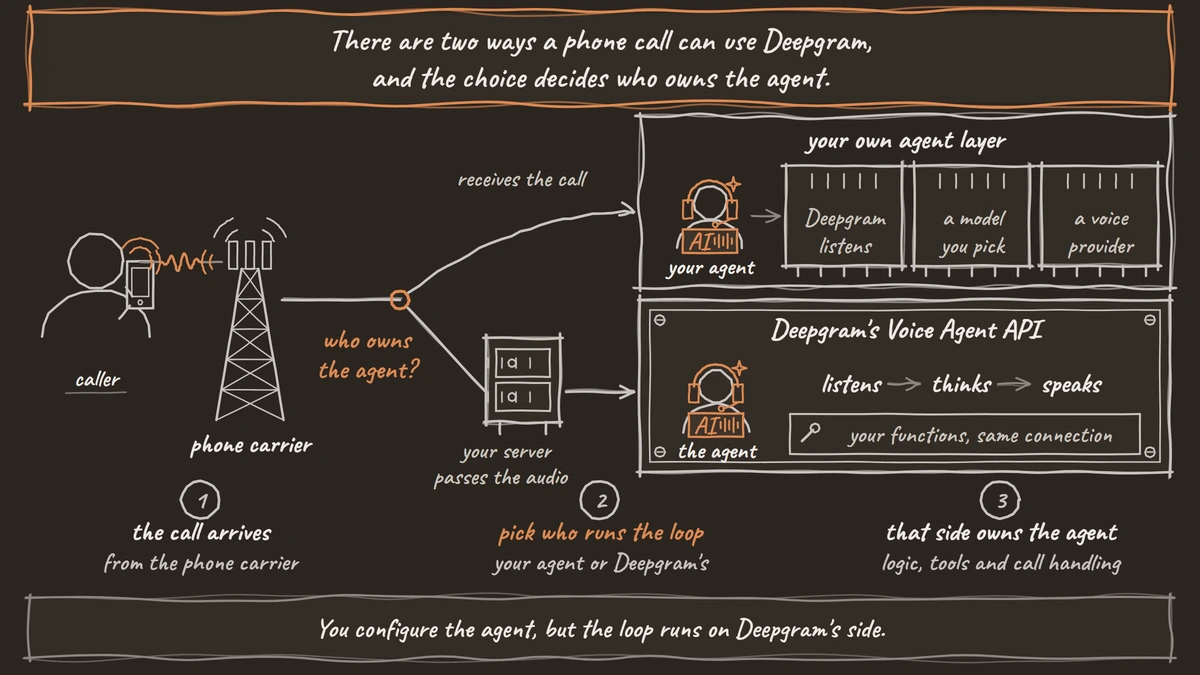
In the second, the Voice Agent API is the agent. Your server or a phone integration passes the audio to Deepgram, and Deepgram runs listening, the model and speaking, with your functions called over the same connection. You configure the agent, but the loop runs on Deepgram's side.
The right shape depends on what else the call needs. The Voice Agent API suits a team that wants one vendor and a working agent quickly. Your own agent layer suits a team that needs its own carrier, transfers to staff, many tools, recordings in its own storage or a voice from another provider, because each of those sits outside Deepgram's loop and has to be built around it.
Either way, the audio usually arrives from a phone line at 8 kHz, while a browser demo runs at 16 kHz, so judge accuracy on real calls. Because Deepgram's models are closed, you cannot run them on your own server in the normal plans. Keeping them close means picking the region nearest your agent, such as Deepgram's EU or Australia endpoint. Our post on Dograh vs Deepgram sets the two shapes side by side.
Join the Dograh Community
Dograh is an OSS alternative to Vapi. Join our Slack community for queries, releases, best practices & community interactions.
What Deepgram costs and where it runs
Deepgram bills each product in its own unit. Speech-to-text is per minute of audio, voices are per 1,000 characters and the Voice Agent API is per minute of conversation. Deepgram's price page lists Nova-3 streaming at $0.0048 a minute, or $0.0058 multilingual, Flux English at $0.0065 and Aura-2 at $0.030 per 1,000 characters on pay as you go.
New accounts get $200 of free credit that does not expire, which is how most teams test it. Pay as you go allows 150 streaming speech-to-text connections at once, which sets a ceiling on how many calls can be transcribed in parallel before you move to a larger plan. Our Deepgram pricing breakdown works through the plans and a priced month in full.
Deepgram runs in its own cloud by default, with US, EU and Australia endpoints. Self-hosting Deepgram on Docker or Kubernetes needs a Deepgram Enterprise Plan and a product contract, with Amazon SageMaker as a managed route. For teams weighing open models or other providers instead, our list of Deepgram alternatives covers both.
Deepgram inside Dograh, hosting and cost
Dograh is the agent layer, so it uses Deepgram for listening and speaking and runs the conversation, tools and phone line itself. Under Providers in the sidebar, click Add Provider and choose Deepgram to save your key. Then, under Models, click Add Configuration and choose BYOK, and pick the Deepgram connection on the STT tab, the TTS tab or both. Each agent picks its model configuration in the editor's Model tab.
On the STT tab, Dograh offers nova-3-general as the default model, plus nova-3-medical, flux-general-en and flux-general-multi. The language defaults to "multi", which lets Nova-3 detect the language, and Language Hints appear for Flux Multilingual. A base URL setting points at the US endpoint by default, or the EU or Australia endpoint to keep processing in that region, and the same key works on each. Words in the agent's Dictionary are passed to Deepgram so it listens for brand names and terms such as KYC.
On the TTS tab, the voice settings offer aura-2 as the default, plus aura-1 and flux, with aura-2-helena-en as the default voice, a speed control and an expressivity control for Flux voices. Our page on how to run Deepgram inside your own voice agent platform walks through the same setup.
Deepgram bills its usage to your own account wherever the platform runs. With Dograh on your own servers there is no per-minute platform fee, though you still pay for the servers, the model keys and the phone minutes. Upkeep of the database and each upgrade sits with your team, and support comes from the open-source community, with custom SLAs on Enterprise. Dograh Cloud runs the platform for you at a 1¢-a-minute platform fee. To judge the fit, build one agent with flux-general-en, place a real call with the editor's Phone Call button and read the speech-to-text time per turn in View Trace.
Glossary
- Nova-3
- Deepgram's general speech-to-text model, sold in monolingual and multilingual versions, with a Medical version trained for clinical words.
- Flux
- Deepgram's conversational speech-to-text family. It transcribes the caller and decides when a turn has ended, so the agent knows when to reply.
- Voice Agent API
- Deepgram's single WebSocket that runs speech-to-text, a language model and text-to-speech for a whole conversation, priced per minute.
- Regional endpoint
- A Deepgram API address in a given region, such as the EU or Australia. The same key works on each, and the region decides where audio is processed.