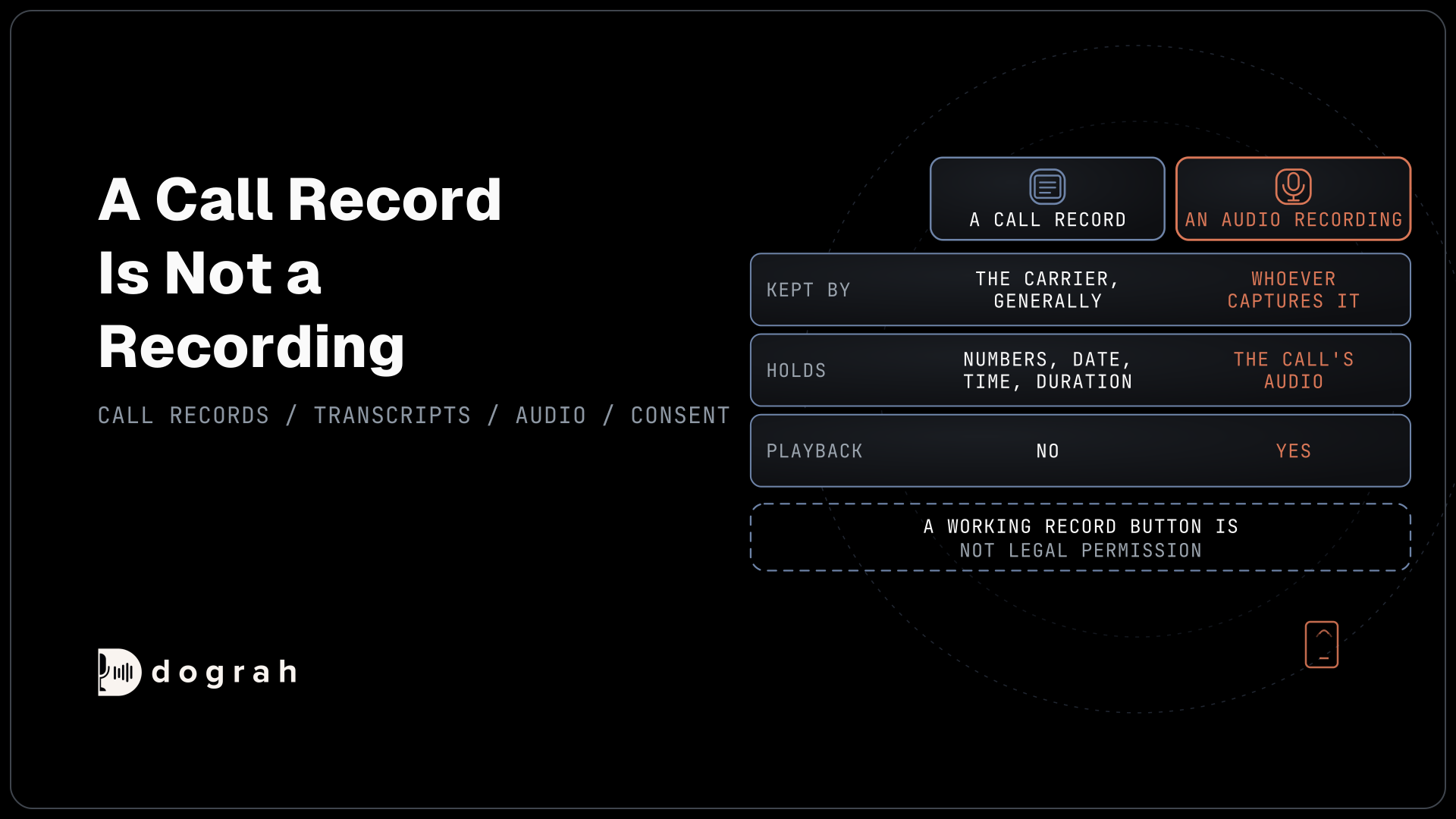

No. Most phone calls are not recorded by default. A recording exists only when someone on the call, a business system or a court-approved interception captures it. Carriers generally keep call records such as numbers, times and duration, not the audio. Whether a recording is lawful depends on the consent rules where each person is.
Key Takeaways
- A call record, a transcript and an audio recording are three different things.
- A working record button is not legal permission to record.
- Silence at the start of a call proves nothing either way.
A phone bill, a customer-service transcript and an audio recording are separate records, so the real question is which system captured what. We follow a call through the places it can be captured, then the consent rules, the checks a caller can run and the rules a business should set.
Are phone calls recorded by default?
There is no universal system that records every telephone conversation. A participant might switch on a recording feature, an employer might set its calling system to capture calls, or an authorized agency might intercept a call through a separate legal process. Carrying a call and storing its audio are separate jobs, so a personal call, an insurance claims call and a workplace support call can be recorded differently on the same handset.
Court figures are often quoted as if they measured ordinary recording. The U.S. Courts' wiretap reports show 1,735 authorized wiretaps in 2025, down 24 percent from 2,297 in 2024. Those numbers count court orders to intercept, not the share of calls that are recorded. They leave out recordings made by businesses or callers, so they show that interception happens, not that ordinary calls are all kept.
A better starting point is the people and systems on the call. A participant, an employer or a business may run a recorder of its own. The carrier and the calling app may each hold different records. The purpose matters too, since a support call, a personal call and an investigation come with different controls. These questions will not reveal every recording, but they stop the common mistake of assuming that a network able to carry your voice also keeps a copy.
Where a call leaves a record
A call can be captured at several independent points along its path. Your handset's recording setting does not control a business's contact center, and a contact center's setting does not control an app on the other person's phone. The table maps the points worth checking, not guaranteed settings for every product.
| Recording point | Default behavior | What it may keep | Who can access it |
|---|---|---|---|
| Handset or built-in call feature | Recording the user switches on, where supported | Local audio file, possibly synced elsewhere | Device owner and authorized account users |
| Third-party recording app | Manual or automatic capture | Audio file, sometimes a transcript | App account holder and authorized service staff |
| Calling app or PBX | Recording policy set by the company | Audio, call logs, possibly transcripts | Authorized company administrators |
| Mobile or landline carrier | Generally keeps call records rather than conversation audio | Numbers, date, time and duration | Carrier staff and parties with lawful process |
| Business contact center | Capture set by the organization for its stated purposes | Audio, screen captures, transcripts and notes | Authorized staff and service providers |
| Lawful interception | Switched on through legal authorization | Content plus intercept-related information | Authorized agencies under legal process |
| AI voice agent platform | Capture and retention set per deployment | Recordings, transcripts, model logs and traces | The deploying organization and authorized providers |
Say you call a clinic to change an appointment. Your phone shows the outgoing call, the carrier handles the connection and the clinic's app routes you to a voice agent. None of those events alone proves that an audio recording exists. The clinic might keep a transcript and an appointment update without audio, while your handset saves nothing beyond call history.
Reporting from RHCJC News on a false universal-recording rumor explains that providers generally keep numbers, dates, times and duration rather than every conversation's audio. Think of the audio as a letter and the call record as the writing on its envelope, which helps identify the connection without reproducing the conversation. That is why an itemized bill is no evidence that a provider can play your call back. Metadata still deserves protection, since a record linking a number to a clinic can be sensitive with no spoken words at all.
Interception follows its own path. The ETSI lawful-interception specification separates call content from intercept-related information such as identities, connection status and timestamps, and under an authorized process a provider can deliver both. A supported interception interface is not an active interception, so the capability does not mean every call is archived.
An AI voice agent can leave more behind than audio. Raw audio, transcripts, summaries, model inputs, app logs, debugging traces, exports and backups can all outlive the call. A voice-agent call-data retention inventory gives each of these an owner and a deletion rule, because deleting an audio file is not a full deletion if its transcript is still searchable somewhere else.

Open Source Alternative to Vapi / Retell
Self-hosted voice agent platform — no per-minute fees
dograh-hq/dograh
Star on GitHub
Consent rules that decide whether recording is legal
Whether a system can record and whether someone may lawfully use the recording are separate questions, and a working record button is not legal permission. Under a one-party consent rule, a participant's consent can generally be enough. Under an all-party consent rule, every participant generally has to agree, subject to the law's scope and exceptions. Neither lets an outsider who is not on the call record it.
The FCC's guide to recording telephone conversations says the agency has no rule of its own on how individuals record calls, and warns that some state laws prohibit or restrict the practice. That is a statement about FCC rules, not a claim that no federal recording law exists. The table below is a screening tool for those conversations, not a legal answer.
| Jurisdiction | Consent or data rule | What it means for recording |
|---|---|---|
| US federal law | Generally permits one-party consent, subject to legal conditions | Review federal requirements alongside state law |
| US one-party consent states | A participant's consent generally suffices | Confirm the rule covers the conversation and the intended use |
| US all-party consent states | Consent from every participant may be required | Get agreement before capture and check each state's scope and exceptions |
| European Union | GDPR governs personal data, alongside national recording rules | Establish transparency, a lawful basis, necessity and security |
| United Kingdom | UK GDPR, data protection rules and recording law apply | Decide the lawful basis and the disclosure duties for the use |
| Business calls, any location | Local law applies alongside company policy | A company policy cannot replace legal permission |
SnapDial's guide to call recording consent laws helps organize the state-by-state questions, and states such as California, Florida, Illinois, Pennsylvania and Washington are worth checking directly rather than by label. Our post on call-recording consent laws for voice agents shows how those rules turn into agent settings. These rules change, so confirm your position for each place you call with counsel.
Cross-border calls need a deliberate policy. When a caller in Florida speaks with an agent in Ohio, the caller's location and the way the two laws interact both matter, not only the rule for the agent's office. Where locations are uncertain, using the stricter consent standard is a cautious operating choice, so announce the recording and get agreement before capture starts. For European callers, a GDPR voice-AI review looks at the purpose of processing as well as the greeting, since even a transcript-only workflow needs a lawful basis.
Transfers, AI agents and regulated industries
A bank's collections line transfers a caller to a third-party agency. The caller hears the same music and carries on the same conversation, but a different organization now takes part and may run its own recorder. The bank's opening notice may not cover the agency's processing, access or purpose. Conference calls, call forwarding and handoffs to a person raise the same question, such as when an AI agent adds someone whose location or consent it does not know.
A notice is not the whole compliance decision. The lemlist guide to call-recording laws shows how consent requirements differ from GDPR duties such as transparency, a lawful basis, necessity and security. Teams in healthcare, banking, insurance and government should ask whether the full conversation needs keeping at all, since an appointment confirmation may serve its purpose without a patient's unrelated medical details.
Keep sensitive fields out of stored assets where you can. Removing card numbers from a transcript does not help if they are still audible in the recording, so payment details belong in a dedicated flow, as our post on payment-call controls for voice agents explains.
Outbound automation needs the same care as a dialer run by people. Tools such as Expressify AI speed-to-lead automation do not establish a recipient's location, permission to record or agreement to later transfers. Before connecting, identify the receiving organization and its recording policy. When the participants change, pause recording until the required notice and agreement are in place, and treat each new participant as a fresh reason to check.
Join the Dograh Community
Dograh is an OSS alternative to Vapi. Join our Slack community for queries, releases, best practices & community interactions.
How to check whether your calls are recorded
You usually cannot prove from your handset alone that nobody is recording. Start by listening at the start of the call, since an announcement shows the organization intends to record, though silence does not prove there is no recording. Then check your own phone, including the Phone app's recording controls, any other dialer, recording apps, automatic capture, account syncing and saved files.
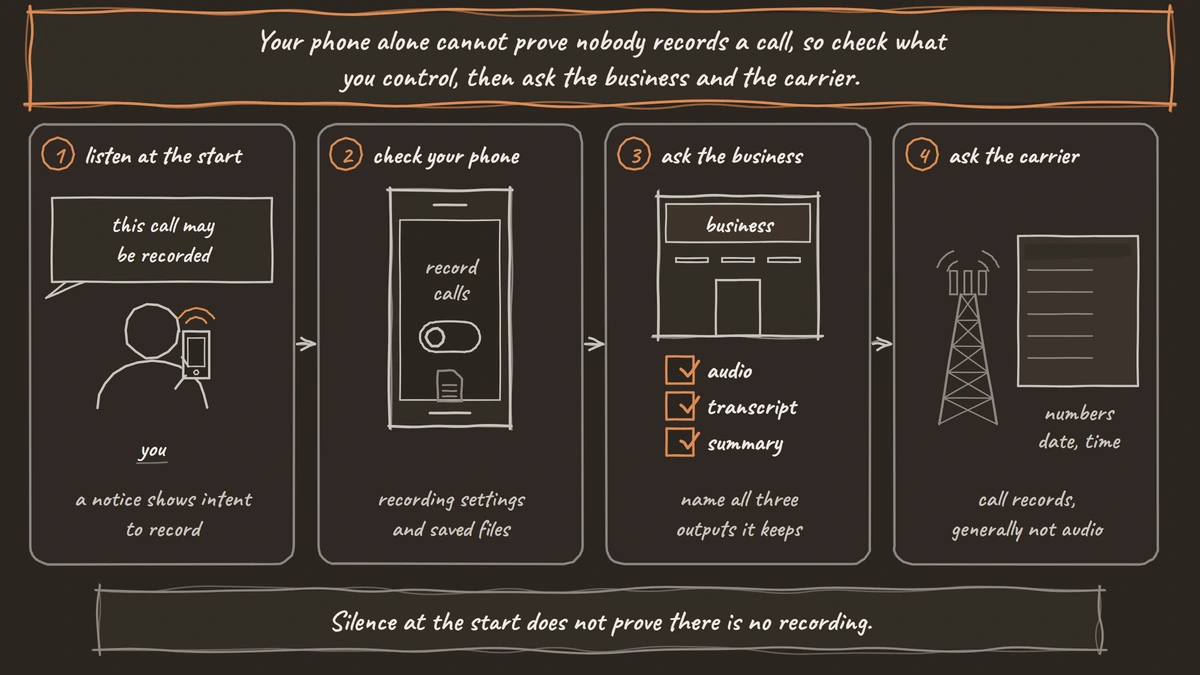
Next, ask the other party whether they keep audio, create a transcript or produce an automated summary. Naming all three stops an answer about audio alone from hiding other stored content. Ask what the recording is for, where it is held, when it is deleted and who can access it. For work calls, the company dialer or contact-center account may apply its own capture settings, so ask the administrator whether the policy covers forwarded calls and a personal phone linked to the work account.
The carrier is the last stop. Ask for billing or connection records separately from conversation audio, and remember that its answer will not describe what a separate business app keeps. In the EU or UK, a data access request that names the call can reach the relevant personal data. If you find an unexpected recording, keep the date, the organization and the number, ask for the legal basis and the retention period, and raise unresolved concerns with the relevant state regulator or data protection authority.
Set your recording rules before the next call
A business that records calls should settle its rules before the first live call. Start with every party and location, including the caller, the agent, the receiving organization and any conference participants, and record uncertainty rather than treating a number's prefix as proof of location. Have counsel review the jurisdictions and call purposes, then pick a cautious fallback for calls where the system cannot establish the facts it needs.
Capture should wait for the notice. Test when recording starts relative to the greeting, since a notice played after capture begins does not fix the earlier collection. Decide what happens when someone declines, including whether transcription, summaries and analytics stop too, and give those callers a path that does not record.
The last part is storage. Give audio, transcripts, summaries, metadata, logs, backups and exports a responsible owner and a deletion trigger, then check the result in storage and in every downstream system. Separate routine support access from admin rights, and review who can play, download, export and delete recordings. Test carrier, speech, model and analytics settings one by one, because a platform-level switch is no evidence of what every provider does.
How Dograh plays a recording notice
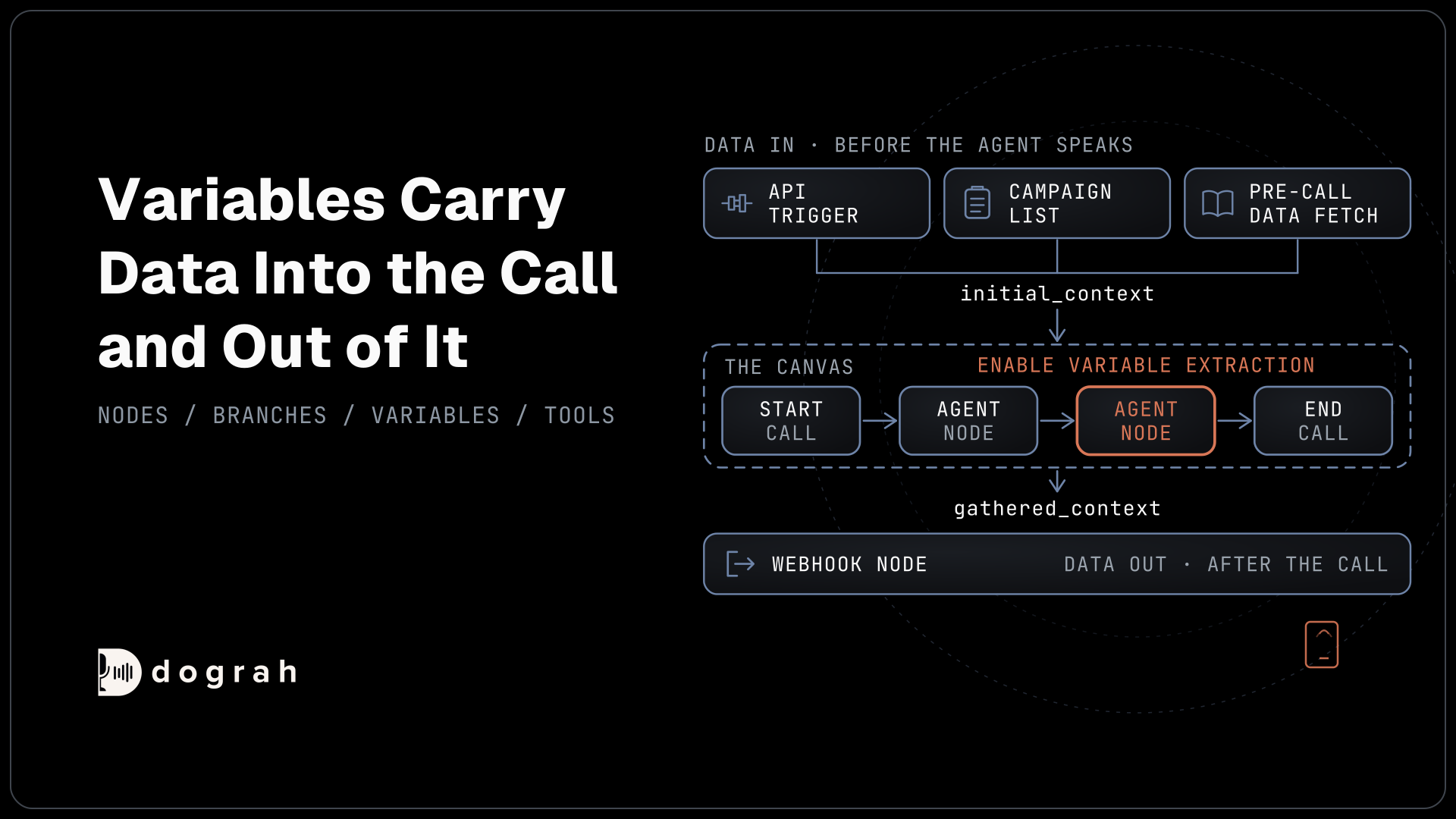
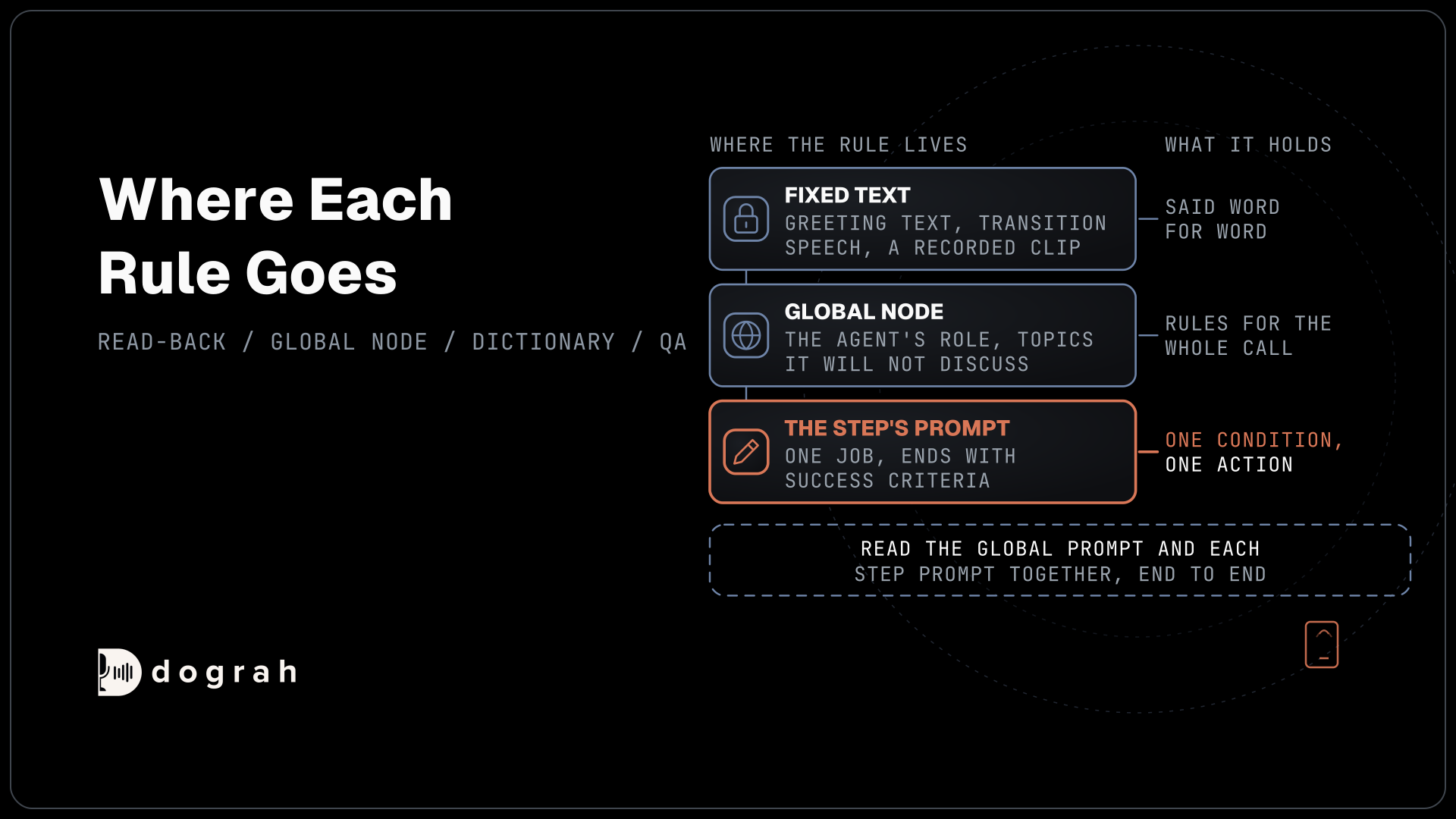
Dograh, the open-source AI voice agent platform, puts the recording notice in fixed text. The Greeting Text field of the Start Call node plays word for word, so the notice cannot drift the way an opening written by the language model can. With greeting interruption switched off, the caller's speech is held until the greeting ends, so the notice always plays in full before the conversation starts.
Where recordings live is the next question, and Dograh runs on your own servers, on premises or in your own cloud account, as well as on Dograh Cloud. When you self-host, recordings and transcripts sit in storage you run, so your retention schedule, access controls and deletion tests apply to them directly. Recording upload can be switched off for the whole server while transcripts are still saved, which suits the transcript-only workflows above.
If the speech and language models also run inside your network, calls, transcripts, prompts and model inference stay inside that boundary too. Because the code is open, your security team can read how calls are handled before one goes out. Dograh gives your team a defined setup to test the checklist against, and the recording rules themselves still need sign-off from qualified counsel before regulated calls go live.
Glossary
- One-party consent
- A recording rule under which one participant's agreement is generally enough to record a call they take part in.
- All-party consent
- A recording rule under which every participant generally must agree before a call is recorded, subject to the law's scope and exceptions.
- Call record
- Metadata about a call, such as the numbers, date, time and duration, kept by a carrier without the conversation audio.
- Lawful interception
- Capture of a call's content and related information by an authorized agency under a court order or other legal process.
Frequently Asked Questions
Built with Outrank tool