
Deepgram is worth it for most English voice agents. Nova-3 streams fast, Flux detects when callers finish, and billing is per second. Nova-3's accuracy trails the best rivals on independent tests, and Aura-2 voices speak seven languages. Dograh, the open-source AI voice agent platform we build, runs Deepgram with your own key. Self-host it or use Dograh Cloud.
Key Takeaways
- Nova-3 was among the fastest in Pipecat's test, though several models made fewer errors.
- Aura-2 voices speak seven languages. Flux voices add 41 more, many in Early Access.
- In Dograh, your Deepgram key runs Nova-3, Flux and every Deepgram voice family.
A speech model for voice agents has to be judged on a phone line, where audio arrives narrowband and every pause is heard. This review scores Deepgram on streaming accuracy, latency, languages, voices and price for live calls, and the last section covers running it inside Dograh.
Accuracy on streaming audio
Nova-3 is accurate enough for most English calls, and it is not the most accurate model you can buy. The Pipecat STT benchmark streams 1,000 short clips of people talking to voice agents through each service. It scores semantic word error rate, which counts only the mistakes that would change what an agent understands. Deepgram's nova-3-general scored 1.37%, with 77.7% of its transcripts perfect.
Several models did better on the same clips. Soniox stt-rt-v6 scored 0.71%, AssemblyAI Universal-3.6 Pro 0.80% and Speechmatics Linden 1 0.96%, while ElevenLabs Scribe v2 Realtime scored 3.13%. Nova-3 sits in the middle of the table. The benchmark has no row for Flux, Deepgram's conversational model, so these numbers describe Nova-3 only.
A second test gives the same order. On the Artificial Analysis Word Error Rate Index, which gives agent-style conversation half its weight, Nova-3 scores 5.2%. ElevenLabs Scribe v2 scores 2.2% and AssemblyAI Universal-3 Pro 3.1%. That index runs recorded files rather than live streams, so read it as a ranking of the models, not a forecast for your calls.
What phone audio does to accuracy
Neither test used phone audio, and a voice agent lives on the phone. A phone line usually delivers 8 kHz audio to the agent, half the 16 kHz a browser demo gets. The phone network also squeezes that audio through a codec before your speech model hears a word.
The clearest public measure comes from the WildASR study, Back to Basics: Revisiting ASR in the Age of Voice Agents. It ran Deepgram's older Nova 2 model on English clips, first clean and then through phone codecs. Its error rate went from 6.0% on clean audio to 6.6% through G.711, the standard codec on ordinary phone lines, and 7.9% through GSM, a mobile codec. The study did not test Nova-3, so treat it as a sign of direction and record your own calls before you trust any figure.
Deepgram is easy to feed from a phone line. Flux accepts mu-law audio at 8,000 Hz, the format Twilio streams, though Deepgram recommends 16,000 Hz where you have it. For names and jargon, keyterm prompting tells the model which words to listen for. It is a paid add-on at $0.0013 a minute on pay as you go, so count it in your budget.
Latency and turn detection
Latency is where Deepgram is strongest. On Pipecat's test, Nova-3 returned its final transcript in a median of 247 ms, with 298 ms at the 95th percentile and 326 ms at the 99th. Of the 25 rows, only NVIDIA's two Nemotron models had a lower median. Every model that made fewer errors than Nova-3 was also slower to return its final transcript.
The tail matters more than the median on a live call. Callers notice the odd slow turn, and Nova-3's 99th percentile sits only 79 ms above its median. In our experience, the whole reply needs to land within about 800 ms for the call to feel natural, and speech-to-text is usually the bottleneck. A steady speech model leaves more of that budget for the language model and the voice.
Flux moves turn detection into the speech model. Deepgram claims about 260 ms end-of-turn detection for Flux, so the model decides the caller has finished instead of waiting out a fixed silence. That figure is Deepgram's own, so measure it on your calls. Flux also sends an early end-of-turn signal so the agent can start a reply sooner, and Deepgram warns this can raise language model calls by 50 to 70%, because some early replies get thrown away.

Open Source Alternative to Vapi / Retell
Self-hosted voice agent platform — no per-minute fees
dograh-hq/dograh
Star on GitHub
Languages for each Deepgram model
Language coverage depends on the model, so check the one your agent will run. Deepgram lists 55 languages for Nova-3 in multilingual mode and more when you set one language per call. Nova-3 Medical's multilingual mode covers ten. Flux English handles English in any accent, and Flux Multilingual covers ten languages, which are English, Spanish, French, German, Hindi, Russian, Portuguese, Japanese, Italian and Dutch.
That split shapes the choice. If your callers speak a language outside Flux's ten, you are back on Nova-3, with turn-taking left to the platform around it. For a line that mixes Hindi and English, Flux Multilingual is a natural first test. In Dograh, language hints bias Flux Multilingual toward the languages you expect on that line.
Aura-2 and Flux voices on a call
Deepgram's voices are priced for phone agents, and their language list is short. Aura-2 costs $0.030 per 1,000 characters on pay as you go and speaks English, Spanish, German, French, Dutch, Italian and Japanese, seven languages in all. The older Aura-1 is English only. Flux TTS, the newer family, costs $0.045 per 1,000 characters and speaks English in several accents plus 41 other languages.
Read the detail before you plan a multilingual line on Flux voices. Deepgram marks 32 of those 41 languages as Early Access, without text normalisation, so numbers, dates and abbreviations are read as written unless you spell them out. The 41 languages are also not yet served from Deepgram's Australia endpoint. For a full test of the voices, see our comparisons of Cartesia vs Deepgram Aura and ElevenLabs vs Deepgram.
Price at real call volume
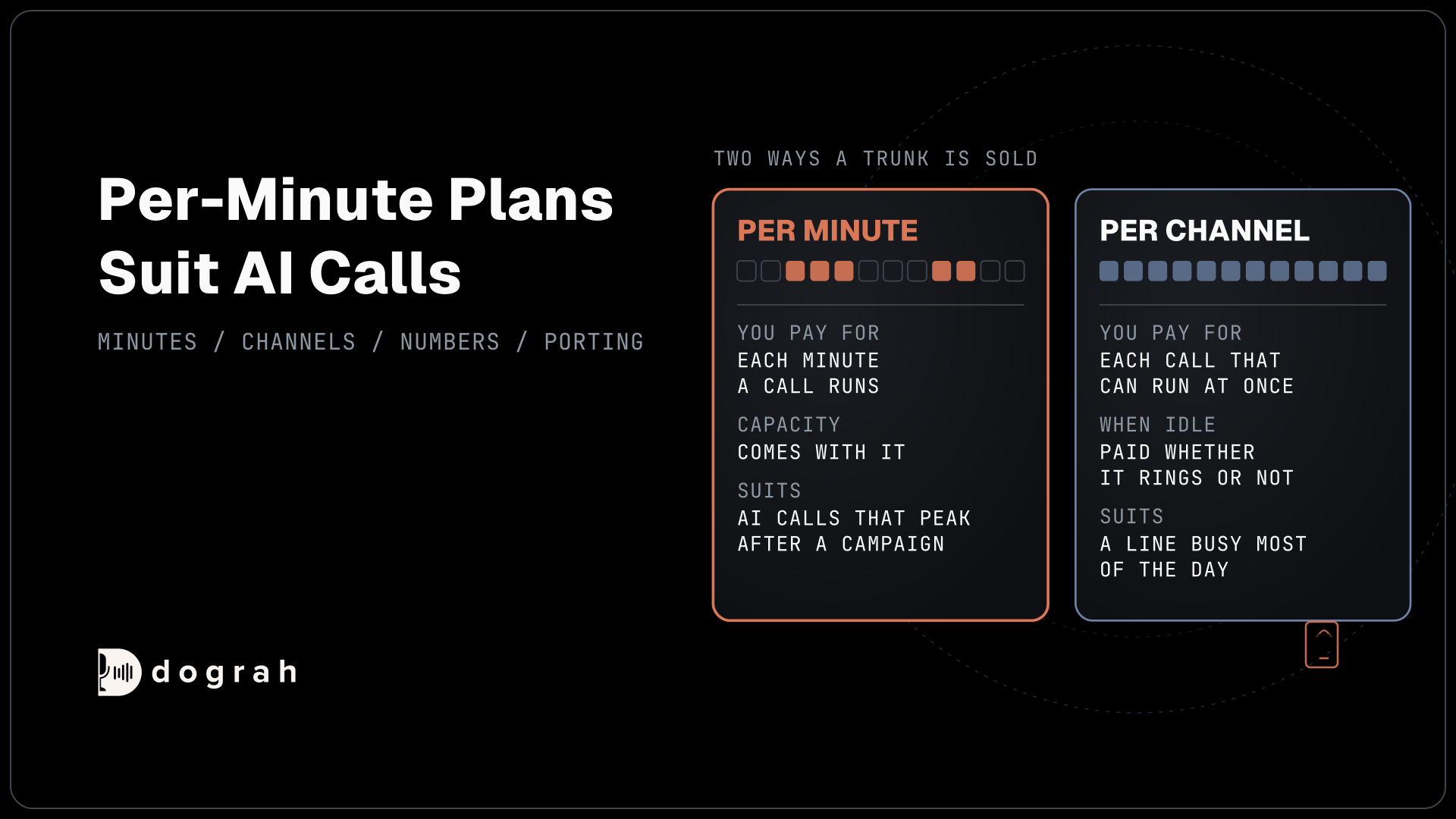
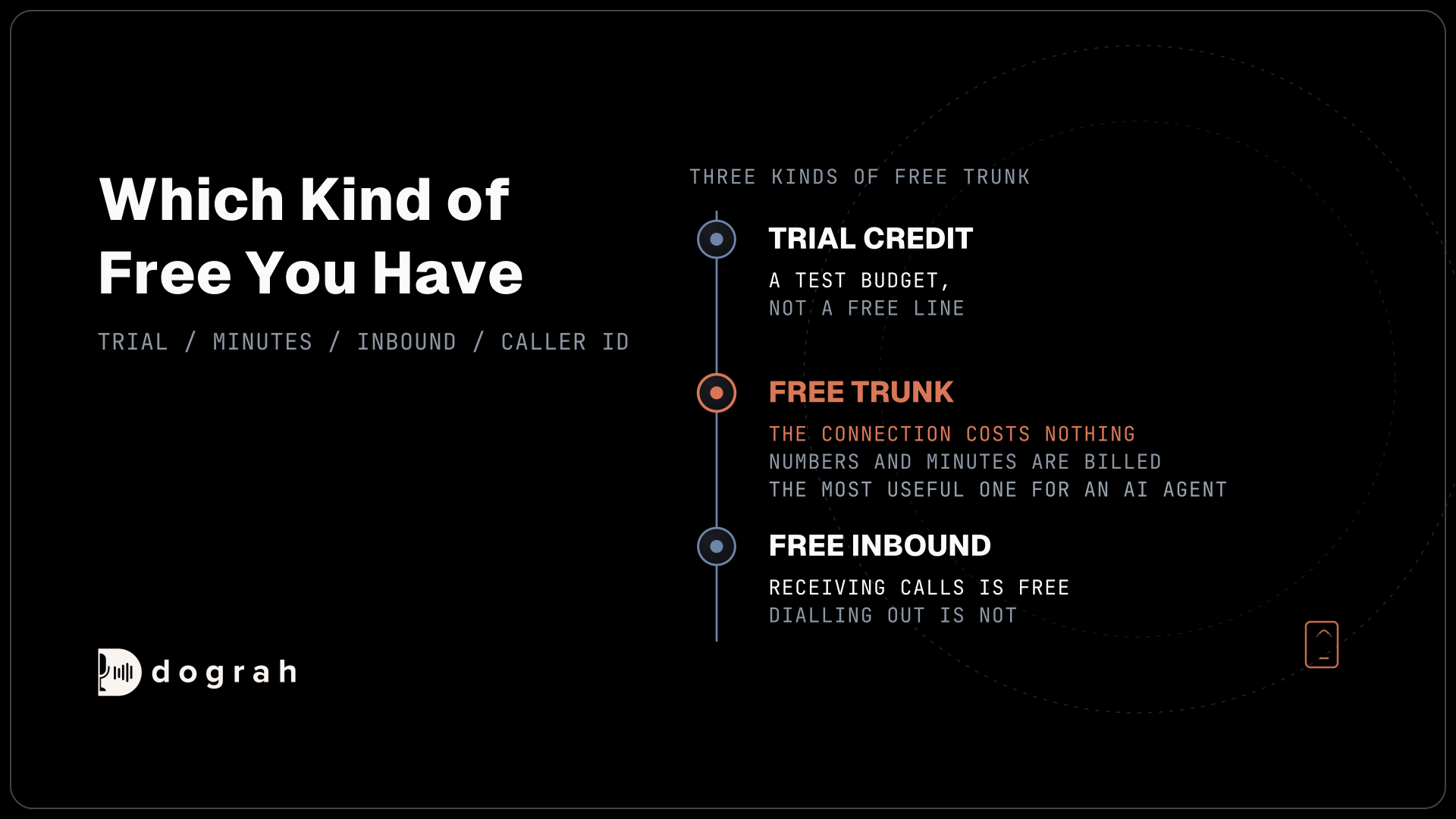
Deepgram's price for live transcription is easy to read. Deepgram charges $0.0077 a minute for Nova-3 streaming in one language and for Flux English on pay as you go, billed per second with no rounding up. Nova-3 multilingual is $0.0092 and Flux Multilingual $0.0078. A new account gets a $200 credit that does not expire.
Here is a worked example of 1,000 five-minute calls in a month, with keyterm prompting switched on.
| Line | Calculation | Cost |
|---|---|---|
| Flux English or Nova-3, streaming | 5,000 minutes x $0.0077 | $38.50 |
| Keyterm prompting | 5,000 minutes x $0.0013 | $6.50 |
| Speech-to-text for the month | $45.00 |
The voice bills on characters, so its cost follows how much the agent says, and the language model and phone line sit on their own bills. Our Deepgram pricing breakdown covers every add-on, the Growth plan and the Voice Agent API tiers.
Two things change at volume. Growth, a prepaid plan from $4,000 a year, lowers Flux English and Nova-3 to $0.0065 a minute. Concurrency is capped at 150 streaming connections on pay as you go and 225 on Growth, counted per project. Our post on STT and TTS concurrency limits explains when several keys add capacity and when they share one limit.
Join the Dograh Community
Dograh is an OSS alternative to Vapi. Join our Slack community for queries, releases, best practices & community interactions.
Running Deepgram inside Dograh
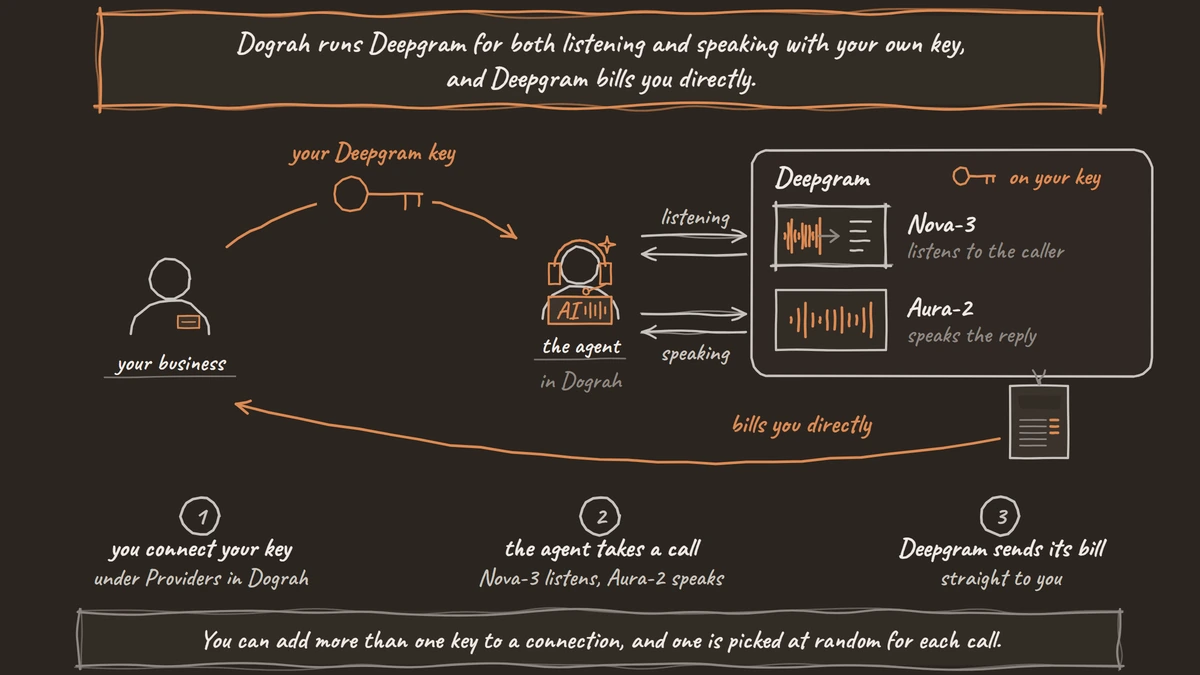
Dograh runs Deepgram for both listening and speaking with your own key, and Deepgram bills you directly. You connect the key under Providers, then pick Nova-3, Nova-3 Medical, Flux English or Flux Multilingual for speech-to-text and Aura-2, Aura-1 or Flux for the voice in a model configuration. Flux voices also take an expressivity setting, from -2 for calm to 2 for animated.
This takes the place of Deepgram's Voice Agent API, which costs $0.075 a minute on Standard, while keeping Deepgram's speech models. You build the call in a visual workflow and connect a phone provider such as Twilio, Telnyx or Plivo, with no phone bridge to write.
| What you need | Deepgram on its own | Deepgram inside Dograh |
|---|---|---|
| Speech-to-text | Nova-3 or Flux over Deepgram's API | Nova-3, Nova-3 Medical, Flux English or Flux Multilingual, on your key |
| Voices | Aura-2, Aura-1 and Flux TTS | Aura-2, Aura-1 and Flux voices, on your key |
| Agent and call logic | Voice Agent API, built in code | Visual workflow, tools, transfers and QA |
| Phone line | A bridge you write to your phone provider | Built-in phone providers such as Twilio, Telnyx and Plivo |
| Data region | Regional endpoints, EU and Australia among them | The default, EU or Australia endpoint, chosen in the configuration |
| Platform price | $0.075 a minute for the Voice Agent API on Standard | No platform fee self-hosted, 1¢-a-minute platform fee on Dograh Cloud |
The rest of the platform works around Deepgram's strengths. Words in the agent's Dictionary reach Deepgram as keyterms on Nova-3 and Flux, which is the paid add-on from the price section. You can add more than one key to a connection, and one is picked at random for each call. Each call's trace shows speech-to-text, language model and voice time for every turn, and QA scores each step of the calls you sample.
The voice bill has a second lever. Pre-recorded clips play for the lines your agent says most, and the TTS voice covers the rest, so fewer characters reach Aura-2. Self-hosted Dograh has no per-minute platform fee, but servers, model keys and phone minutes still cost money. Dograh Cloud charges a 1¢-a-minute platform fee.
Who should pick Deepgram
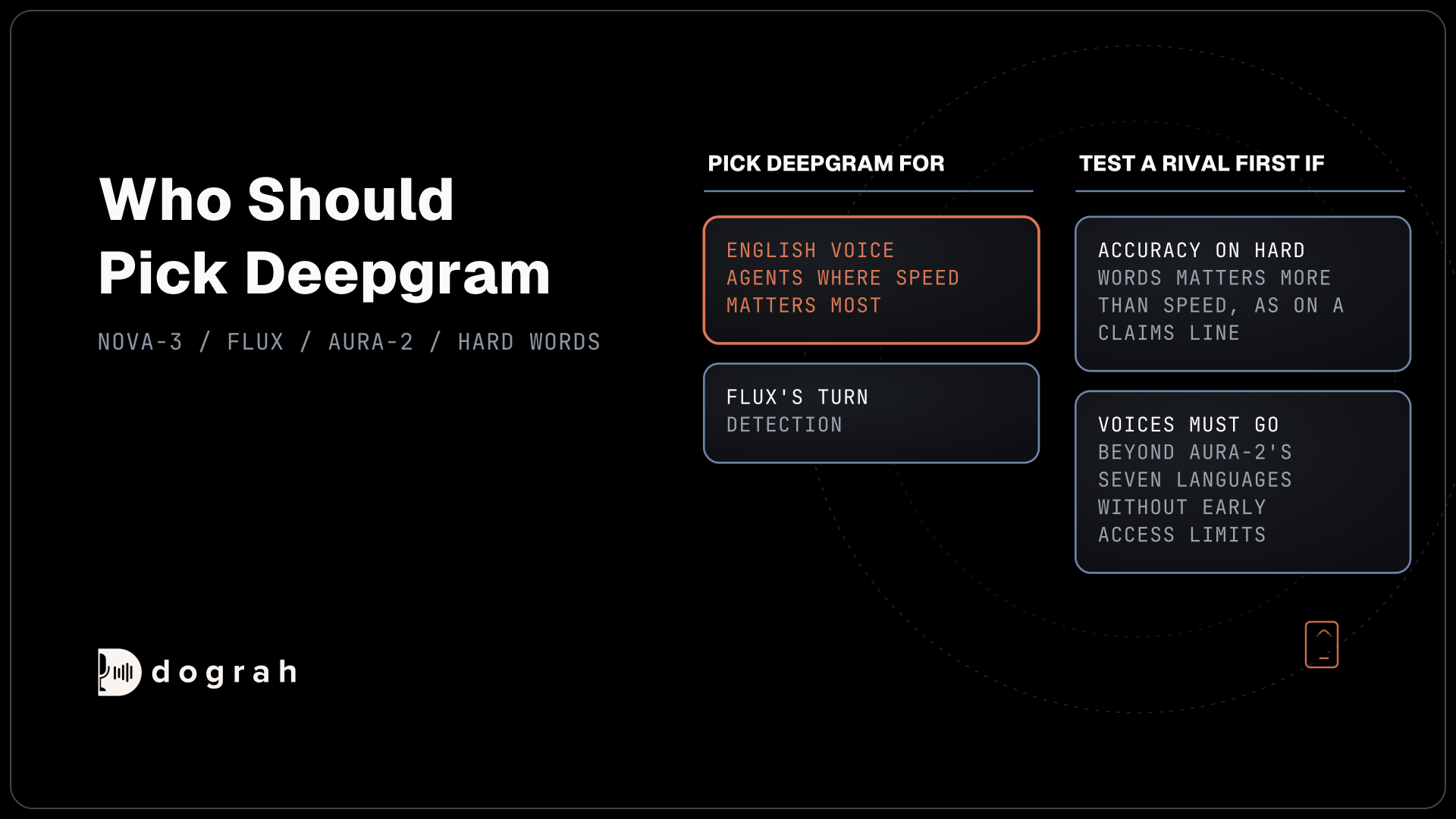
Deepgram is a strong pick for English voice agents where speed matters most. Nova-3's low, steady latency, Flux's turn detection, per-second billing and a credit that does not expire make it easy to start and fair to run. It suits a team that wants one vendor for listening and speaking at a modest per-minute rate.
Test a rival first if accuracy on hard words matters more than speed, as on a claims line full of policy numbers. Do the same if your voices must speak a language beyond Aura-2's seven without Early Access limits. Teams that must run the speech models on their own servers need Deepgram's Enterprise plan, and our Deepgram alternatives guide covers open models and Deepgram's compliance terms.
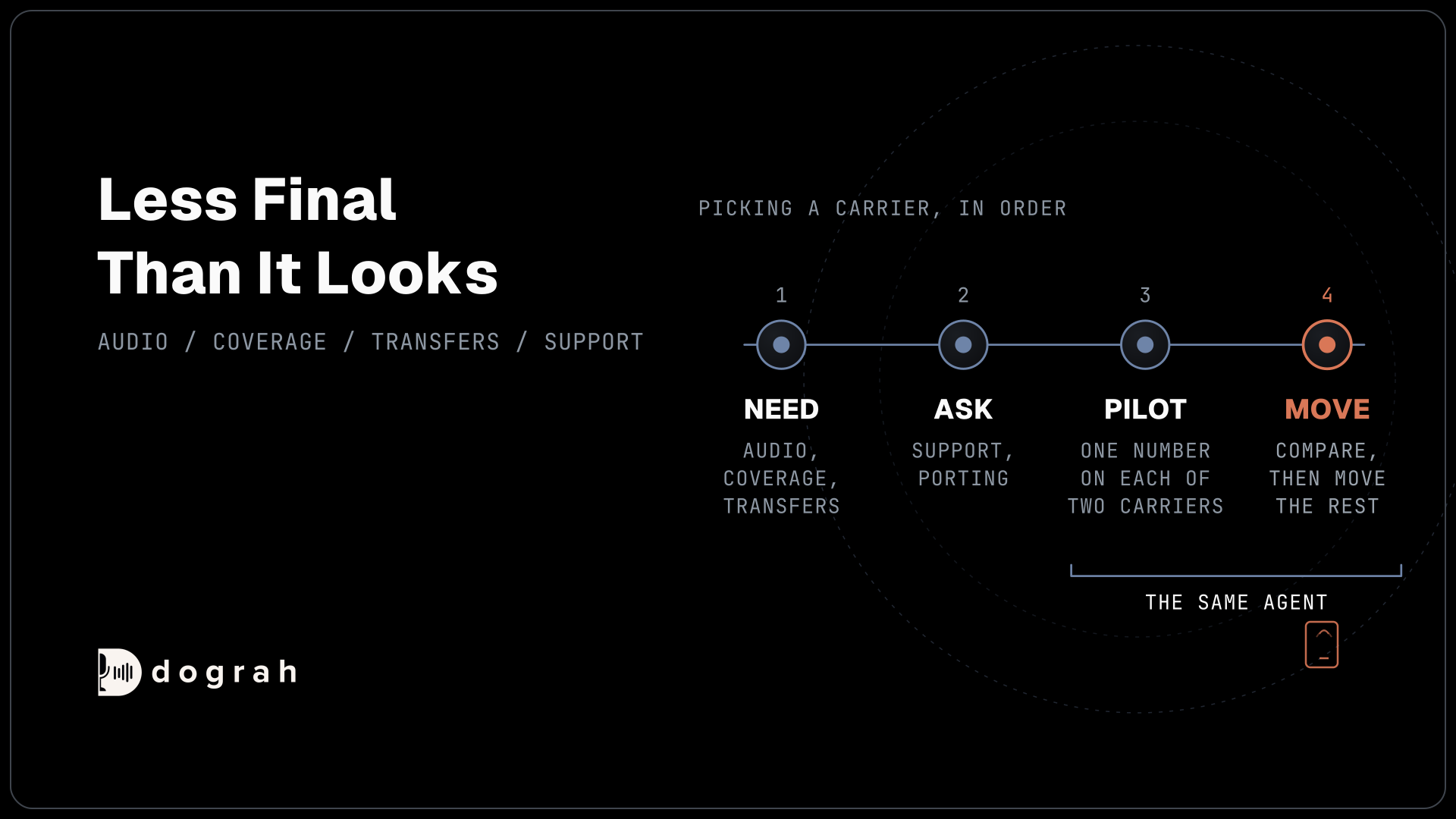
The choice does not have to be final. In Dograh, the speech-to-text and voice providers are settings on each agent, so you can run Deepgram on one agent and a rival on another. Compare the traces and transcripts from real phone calls, and keep whichever wins.
Glossary
- Semantic word error rate
- A word error rate that counts only the mistakes that change the meaning, such as a wrong digit or a misheard name, and ignores punctuation and filler words. Pipecat's benchmark scores Nova-3 at 1.37% on this measure.
- End-of-turn detection
- Deciding that the caller has finished speaking so the agent can reply. Deepgram's Flux does it inside the speech model, while Nova-3 leaves it to the platform around it.
- Keyterm prompting
- A Deepgram add-on that tells the model which words to listen for, such as product names, at $0.0013 a minute on pay as you go. Dograh sends the agent's Dictionary words to Deepgram this way on Nova-3 and Flux.
- Mu-law audio
- The compressed 8 kHz audio format that ordinary phone lines and Twilio's media streams carry. Deepgram's Flux accepts it at 8,000 Hz, though Deepgram recommends 16,000 Hz when the source allows it.