
ElevenLabs leads on voices, and Deepgram leads on live transcription in Pipecat's streaming test, though each now sells both jobs. A common setup listens with Deepgram and speaks with ElevenLabs. Dograh, the open-source AI voice agent platform we build, runs either vendor for either job with your own keys. You can self-host it or run it on Dograh Cloud.
Key Takeaways
- Deepgram Nova-3 led Pipecat's streaming test. ElevenLabs Scribe v2 led on recorded files.
- Eleven v4 tops a blind listening board. Aura-2 lists at $0.030 per 1,000 characters.
- Speech-to-text and voice are separate settings, so one agent can use both vendors.
ElevenLabs made its name with voices and Deepgram with speech recognition, yet each now sells the other's product. We compare them job by job, listening and then speaking, price one call for each mix, and finish with an agent that hears through Deepgram and talks through ElevenLabs in Dograh.
Both vendors now sell both jobs
Each company now sells the job it is not known for. Deepgram started with speech-to-text, and its live models are Nova-3 and Flux, which detects the end of a caller's turn inside the speech model. It also sells Aura-2 voices and newer Flux voices. ElevenLabs started with voices, from the fast Flash v2.5 up to Eleven v4, and now sells Scribe v2 Realtime for live transcription.
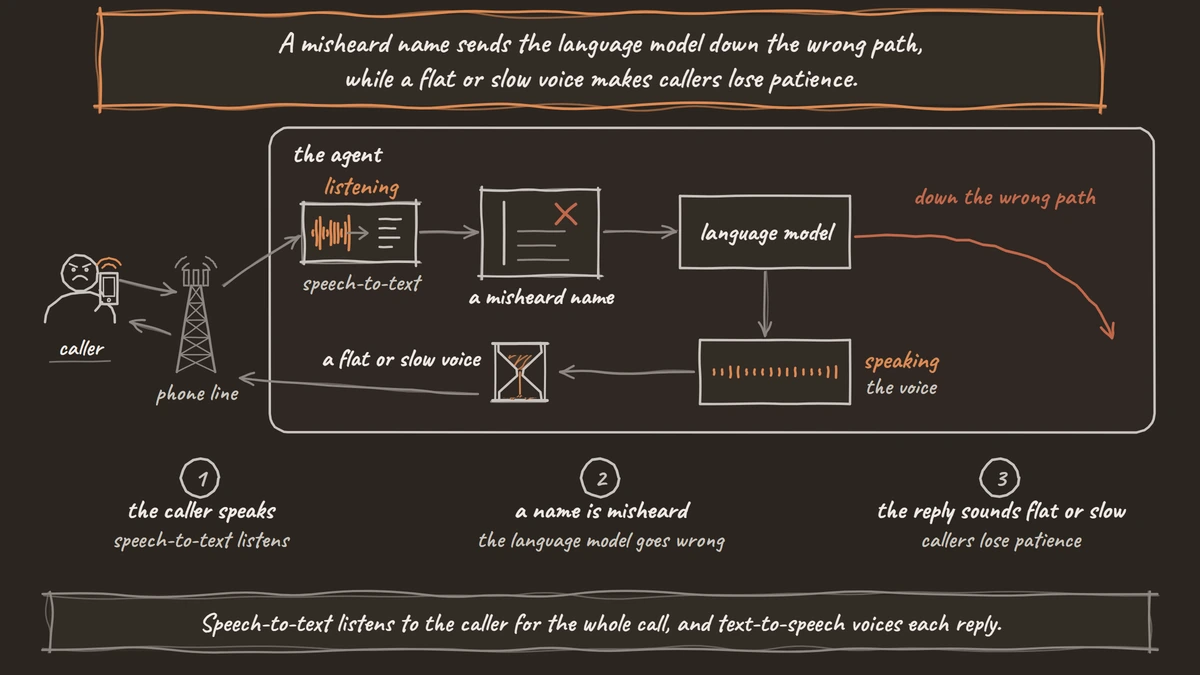
A voice agent runs both jobs on every call. Speech-to-text listens to the caller for the whole call, and text-to-speech voices each reply. The two jobs fail in different ways. A misheard name sends the language model down the wrong path, while a flat or slow voice makes callers lose patience. So judge each vendor on each job separately, and treat a strong voice as no proof of strong transcription, or the reverse. Both vendors also sell a bundled agent, which the last section covers briefly.
Listening: Nova-3 and Flux vs Scribe v2 Realtime
On live streams, Deepgram has the stronger independent result. The Pipecat STT benchmark streams 1,000 short speech clips through each service and scores semantic word error rate, which counts only mistakes that change the meaning. Deepgram's Nova-3 scored 1.37%, with a median time to final segment of 247 ms. ElevenLabs' Scribe v2 Realtime scored 3.13% at 281 ms. The benchmark has no Flux row.
Recorded files tell the opposite story. The Artificial Analysis word error rate index (AA-WER v2), scored on recorded files and weighted toward agent-style talk, puts ElevenLabs' Scribe v2 at 2.2% and Deepgram Nova-3 at 5.2%. Scribe v2 is the batch model, and an agent runs its streaming sibling, so that file result says less about a live call.
So ElevenLabs leads on recorded files and Deepgram on live streams, and neither test used a phone line. On a real phone line the agent hears 8 kHz audio, against the 16 kHz of a browser test. How much that costs in accuracy depends on the model and the phone path, so run both on 20 to 30 of your own recorded calls, with real names and numbers in them.
The prices sit close. Deepgram charges $0.0077 a minute for Flux English or Nova-3 in one language on pay as you go, $0.0078 for Flux Multilingual and $0.0092 for Nova-3 multilingual, billed per second. ElevenLabs charges $0.39 an hour for Scribe v2 Realtime, about $0.0065 a minute.
Language range is where Scribe pulls ahead. Scribe v2 Realtime lists more than 90 languages, against one for Flux English and ten for Flux Multilingual, with Nova-3's multilingual model covering more. Both vendors sell keyterm prompting as an add-on, Deepgram at $0.0013 a minute and ElevenLabs at $0.08 an hour for up to 50 terms. Deepgram allows 150 live streams at once on pay as you go.
In Dograh, both vendors appear in the transcriber settings, with Nova-3 (general or medical) and Flux (English or multilingual) for Deepgram and Scribe v2 Realtime for ElevenLabs. Words in the agent's Dictionary are sent to Deepgram as keyterms. Our deep dive on ElevenLabs Scribe speech-to-text covers Scribe's settings and latency in full.
Speaking: ElevenLabs voices vs Deepgram Aura-2
On sound, ElevenLabs has the clear lead, though only on its top models. On the Artificial Analysis Speech Arena, where listeners vote blind between pairs of clips, Eleven v4 and Eleven v4 Turbo hold the top two places. Flash v2.5, the default ElevenLabs model in Dograh, sits outside the top 50, and Deepgram's Flux voices rank 70th. The ElevenLabs edge belongs to the model you pick.
Deepgram lists lower prices per character. Aura-2 costs $0.030 per 1,000 characters on pay as you go, Aura-1 $0.015 and Flux voices $0.045. ElevenLabs charges $0.04 per 1,000 characters for Flash v2.5, Turbo, v4 Turbo and v3 Conversational, and $0.08 for Eleven v4, v3 and Multilingual v2. The top-ranked voice costs more than twice what Aura-2 does per character.
Languages and cloning favour ElevenLabs. Flash v2.5 speaks 32 languages, and Eleven v4 and v4 Turbo more than 90. Aura-2 covers seven, which are English, Spanish, German, French, Dutch, Italian and Japanese. Flux voices list English and 41 other languages, some still in early access. ElevenLabs also clones voices, and a cloned voice gets a voice ID like any other.
Each vendor publishes its own speed figures, measured from its own servers in its own way. Time both voices on your own phone path, from your own region, before the numbers decide anything.
In Dograh's voice settings, ElevenLabs runs from Flash v2.5 up to Eleven v4 Turbo, and Deepgram offers Aura-2, Aura-1 and Flux voices, with an expressivity setting on Flux. Voices load from your own key, and you can paste any voice ID, cloned ones included.

Open Source Alternative to Vapi / Retell
Self-hosted voice agent platform — no per-minute fees
dograh-hq/dograh
Star on GitHub
The two vendors job by job
Every price below is pay as you go, and each vendor bills your own account when its models run inside an agent platform. The last column shows how each row works in Dograh.
| ElevenLabs | Deepgram | In Dograh | |
|---|---|---|---|
| Live speech-to-text | Scribe v2 Realtime | Nova-3, Flux English, Flux Multilingual | All of them, with your own key |
| Live speech-to-text price | $0.39 an hour, about $0.0065 a minute | $0.0077 a minute (Flux English, Nova-3 one language), billed per second | Billed by the vendor |
| Pipecat streaming test | Scribe v2 Realtime: 3.13%, 281 ms | Nova-3: 1.37%, 247 ms | Compare both on your own calls |
| Live speech-to-text languages | More than 90 | 1 (Flux English), 10 (Flux Multilingual), more on Nova-3 | Language set per agent |
| Keyterms | Up to 50, $0.08 an hour extra | $0.0013 a minute extra | The agent's Dictionary is sent to Deepgram |
| Voices | Flash v2.5, Turbo v2.5, Multilingual v2, v3, v4, v4 Turbo | Aura-2, Aura-1, Flux | All of them, with your own key |
| Voice price per 1,000 characters | $0.04 (Flash v2.5, v4 Turbo), $0.08 (Eleven v4) | $0.030 (Aura-2), $0.045 (Flux) | Billed by the vendor |
| Speech Arena | Eleven v4 and v4 Turbo top two, Flash v2.5 outside the top 50 | Flux voices 70th | Paste any voice ID, clones included |
| Voice languages | 32 (Flash v2.5), more than 90 (Eleven v4) | 7 (Aura-2) | Voice set per agent |
| Regions | Data Residency endpoints on Enterprise | EU and Australia endpoints | Endpoint set in the model settings |
What a five-minute call costs with each mix
Here is one example call, by our own arithmetic from the prices above. The call lasts five minutes, so speech-to-text hears five minutes of audio. The agent speaks about 400 characters a minute, the same assumption as our ElevenLabs price breakdown, so its replies come to 2,000 characters.
Take the first mix line by line. Deepgram Flux English hears 5 minutes at $0.0077, which is $0.0385. ElevenLabs Flash v2.5 voices 2,000 characters at $0.04 per 1,000, which is $0.08. The speech layer of the call comes to $0.1185.
| Mix (listening + speaking) | Speech-to-text, 5 minutes | Voice, 2,000 characters | Speech total |
|---|---|---|---|
| Deepgram Flux English + ElevenLabs Flash v2.5 | $0.0385 | $0.0800 | $0.1185 |
| ElevenLabs Scribe v2 Realtime + Deepgram Aura-2 | $0.0325 | $0.0600 | $0.0925 |
| Deepgram only, Flux English + Aura-2 | $0.0385 | $0.0600 | $0.0985 |
| ElevenLabs only, Scribe v2 Realtime + Flash v2.5 | $0.0325 | $0.0800 | $0.1125 |
| Deepgram Flux English + Eleven v4 | $0.0385 | $0.1600 | $0.1985 |
The voice line is the larger one in every mix, so the voice model moves the bill more than the transcriber does. Moving from Flash v2.5 to Eleven v4 adds 8 cents to this call, while the gap between the two transcribers is under a cent. Deepgram's keyterm add-on would add $0.0065 for the five minutes.
The language model, the phone line and the platform come on top of every row. A chatty script also raises the voice line, because voices are billed on what the agent says.
Join the Dograh Community
Dograh is an OSS alternative to Vapi. Join our Slack community for queries, releases, best practices & community interactions.
One agent: Deepgram listens, ElevenLabs speaks
The mixed agent takes two provider connections and one model configuration. Open Providers in the sidebar and add a Deepgram connection and an ElevenLabs connection, each with its own API key. Then open Models, click Add Configuration and choose BYOK mode, short for bring your own keys, as the Model Configurations page shows.
In BYOK mode, each service has its own tab. On the STT tab, pick the Deepgram connection and the Flux English model (flux-general-en), or Nova-3 for other languages. On the TTS tab, pick the ElevenLabs connection, Flash v2.5 or a higher model, and a voice from your library or a pasted voice ID. Select that configuration in the agent's Settings. The reverse mix, Scribe v2 Realtime with an Aura-2 voice, is the same two tabs with the vendors swapped.
Each vendor keeps its own regional choice. Deepgram's speech-to-text and voices can point at its EU or Australia endpoint, and ElevenLabs can point at a Data Residency endpoint. Once calls run, View Trace shows the speech-to-text, AI and voice time for each turn, so you can see which vendor adds the delay. Built-in QA then scores each step of the call, which helps you judge whether a voice change helped.
The voice bill can shrink further. Pre-recorded clips play for the lines your agent says most, and a cloned ElevenLabs voice of the same speaker covers the rest, so callers hear one voice throughout. Self-hosted Dograh has no per-minute platform fee, but servers, model keys and phone minutes still cost money. Dograh Cloud charges a 1¢-a-minute platform fee.
Which one to pick for each job
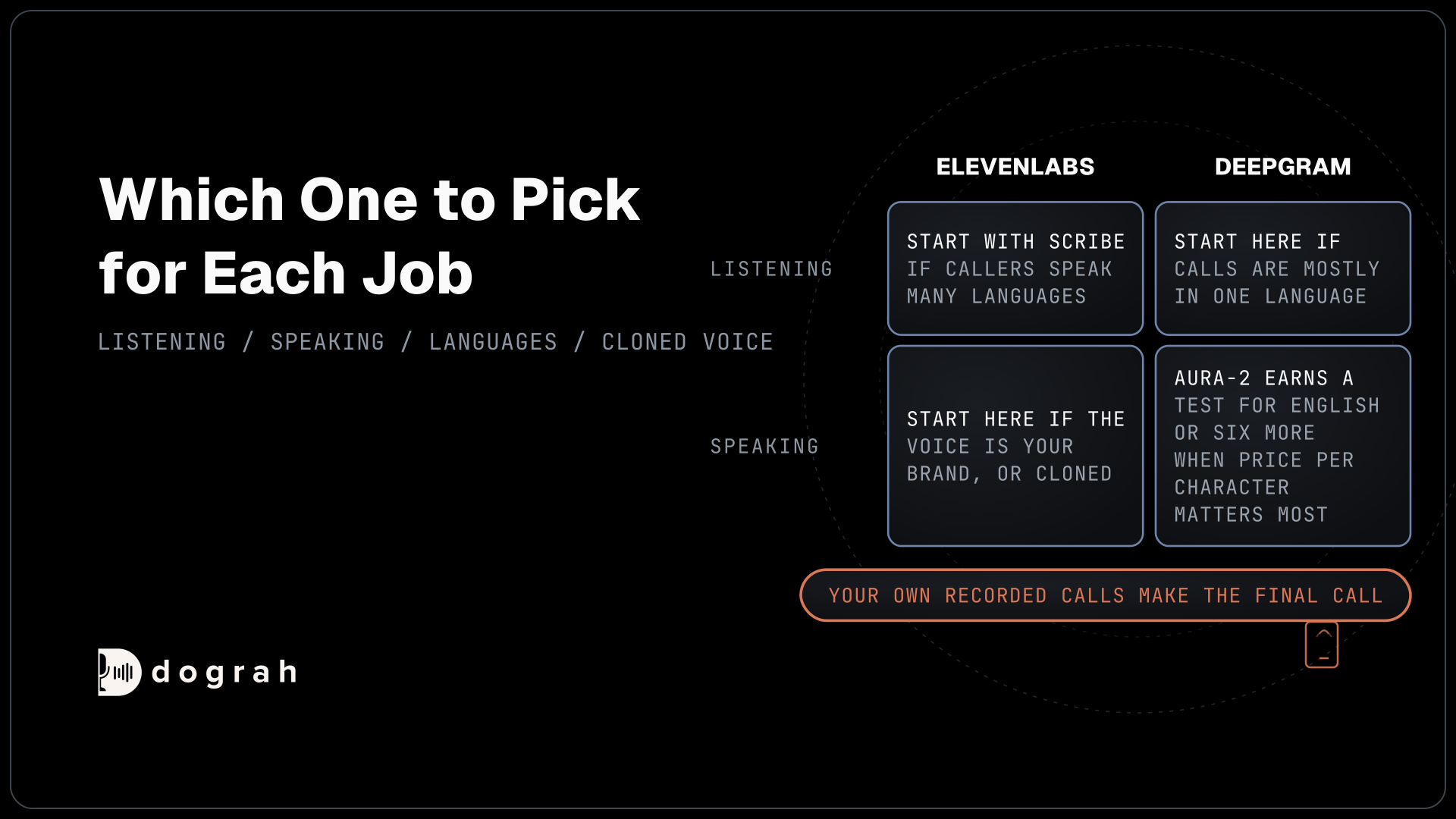
For listening, start with Deepgram if your calls are mostly in one language. It led the streaming test, bills per second, and Flux spots the end of a turn inside the model. Start with Scribe v2 Realtime if your callers speak many languages, since it lists more than 90. Whichever leads on paper, your own recorded calls make the final call.
For speaking, start with ElevenLabs if the voice is part of your brand or you need a cloned voice. Eleven v4 sounds best on the blind board, and Flash v2.5 is the faster step down at half its price per character. Aura-2 earns a test for English or its other six languages when price per character matters most, as long as it passes on your own script.
Both vendors also sell their own bundle. ElevenLabs Agents costs $0.08 a minute, with the language model on top, as our breakdown of ElevenLabs pricing shows. Deepgram's Voice Agent API costs $0.075 a minute on Standard, as covered in our post on Deepgram pricing. Each bundle runs its own vendor's speech models, so Deepgram ears with an ElevenLabs voice need a platform that takes both keys.
Glossary
- Semantic word error rate
- Word error rate that counts only transcription mistakes that change the meaning. The Pipecat STT benchmark scores streaming models this way, where Nova-3 scored 1.37% and Scribe v2 Realtime 3.13%.
- Time to final segment
- How long a streaming transcriber takes, after the speaker stops, to send its final text for that speech. Pipecat measured a median of 247 ms for Nova-3 and 281 ms for Scribe v2 Realtime.
- Keyterm prompting
- Sending a list of names and product words with the audio so the speech model favours them. Deepgram and ElevenLabs both sell it as an add-on, and Dograh sends the agent's Dictionary to Deepgram this way.
- Speech Arena
- Artificial Analysis's public text-to-speech leaderboard, ranked by listeners voting blind between pairs of clips. Ranks move as votes come in, so name the exact model when you quote one.