
Cartesia's Sonic and Deepgram's Aura-2 both start fast enough for phone calls, and a published test puts Sonic 3.5 37 ms ahead of Aura-2 at the median. Sonic 3.6 speaks 44 languages, Aura-2 seven at $0.030 per 1,000 characters. Dograh, the open-source AI voice agent platform we build, runs both on your own keys, self-hosted or on Dograh Cloud.
Key Takeaways
- Sonic 3.5's published median is 267 ms, Aura-2's 304 ms with wider spread.
- Sonic 3.6 covers 44 languages, Aura-2 seven, Flux TTS English plus 41 more.
- Aura-2 is $0.030 per 1,000 characters, Sonic about $0.037 to $0.050.
Two voices can tie in a browser demo and still sound different on a phone line. We compare Cartesia's Sonic and Deepgram's Aura-2 and Flux voices on speed, sound over phone audio, languages and price, then show how to test both on a real call in Dograh.
How fast each voice starts talking
Both text-to-speech (TTS) voices start speaking fast enough for a live call, and the published gap between them is small. The most quoted comparison is a Coval test published on Cartesia's own comparison page, with 478 Cartesia runs and 951 Deepgram runs. It measured time to first audio, the wait between sending text and hearing the first sound.
At the median, Sonic 3.5 started speaking in 267 ms against 304 ms for Aura-2. Deepgram's newer Flux TTS came in at 245 ms. The spread tells you more than the middle value. Sonic 3.5's middle half of runs sat inside a 63 ms band, while Aura-2's stretched from 213 to 424 ms and Flux TTS's from 201 to 500 ms.
Read those numbers with two cautions. Cartesia chose to publish them, and Sonic 3.6, its current model, was not in the test. Each vendor also times speed its own way on its own pages. On a call, what matters is the whole turn, and in our experience a turn needs to stay under about 800 ms end to end to feel natural. Speech-to-text usually takes a bigger share of that budget than the voice does.
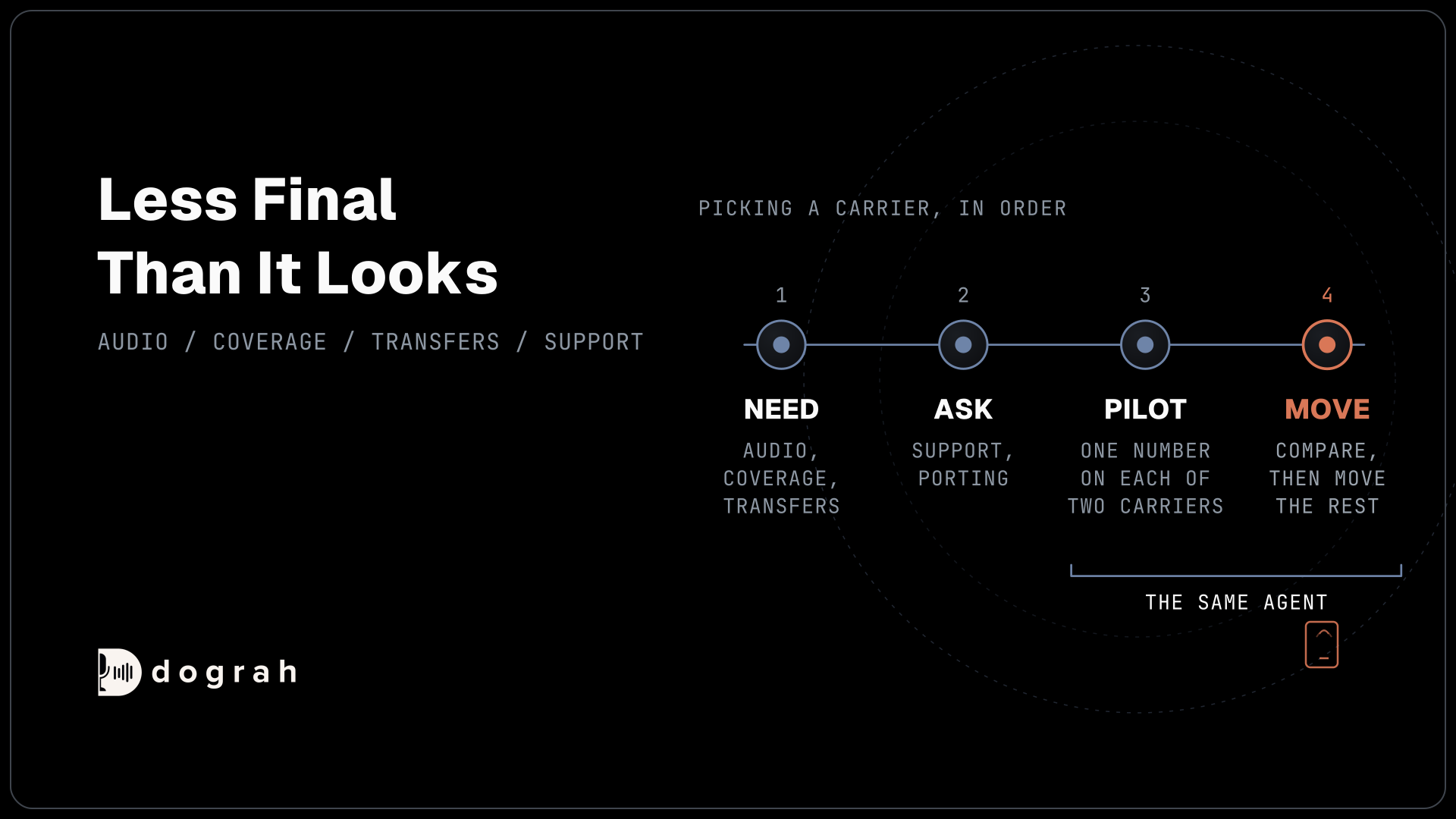
So measure the voice on your own path. In Dograh, each call's trace shows the speech-to-text, AI and voice time for every turn, as the tracing guide explains. Run the same script through both voices from the region you will deploy in, and compare the voice line turn by turn.
How each voice sounds on a phone line
On blind listening tests, Sonic 3.6 sits far above Deepgram's Flux TTS. On the Artificial Analysis Speech Arena, where listeners vote between two unlabelled clips of the same line, Sonic 3.6 has an Elo of 1,293 and ranks fifth of 104 models. Deepgram's Flux TTS scores 1,051 and ranks 70th. Aura-2 is not on the board.
Those votes are cast on clean web audio, and a phone call is a different listening room. Most phone calls still reach the caller as 8 kHz narrowband audio, while a browser demo plays at 16 kHz. The narrow line cuts the top of the voice, and in our experience voices sound flatter and less expressive on it, with less of the emotion that won the votes.
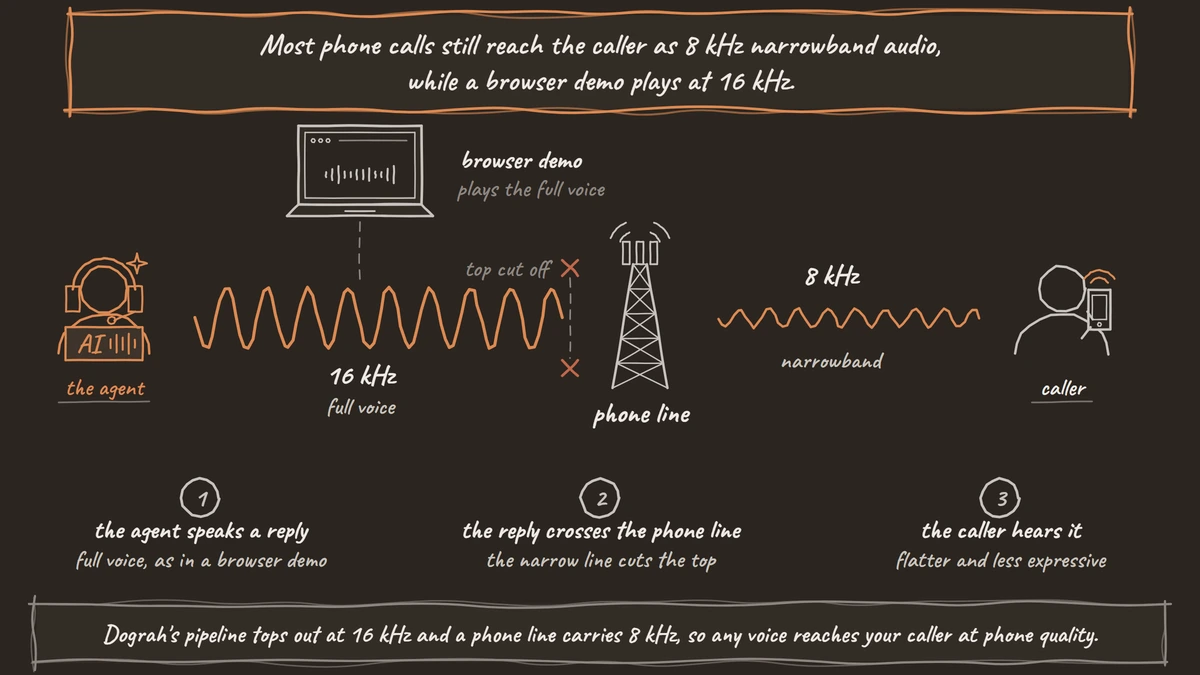
The test that settles it is your own. Dograh's pipeline tops out at 16 kHz and a phone line carries 8 kHz, so any voice reaches your caller at phone quality. Call the agent from a real phone with each voice, using a script full of the prices, dates and names your callers will hear. Our post on how to reduce robotic TTS in voice agents shows how to fix the words that trip a voice up.
Languages and accents each one covers
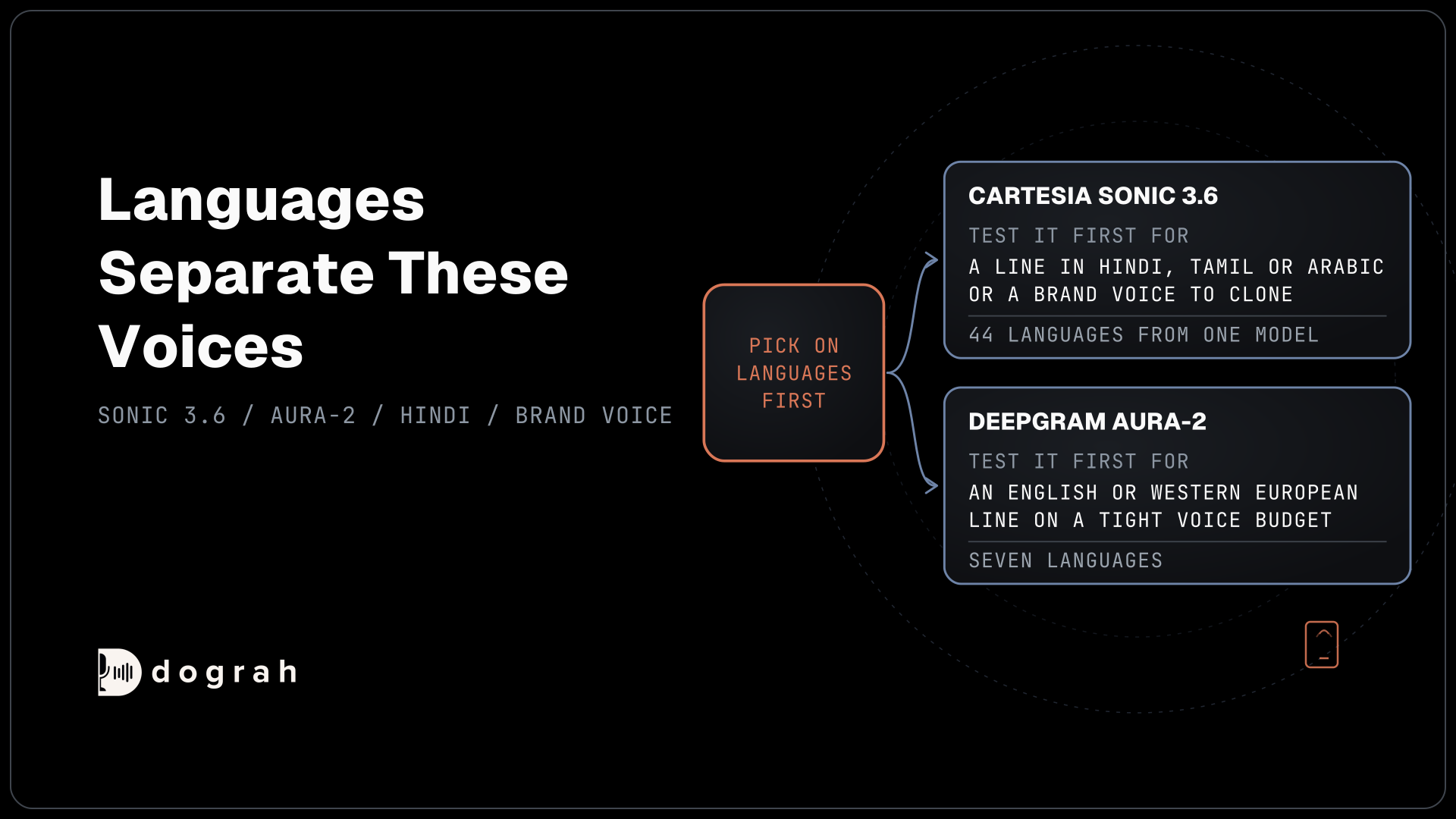
Languages separate these voices more than speed does. Sonic 3.6 speaks 44 languages from one model, and this version added Odia and Urdu. Deepgram's Aura-2 voices cover seven languages, which are English, Spanish, German, French, Dutch, Italian and Japanese.
Flux TTS goes wider than Aura-2. Deepgram's Flux voice list gives English in seven accents plus 41 other languages. Some of those are in Early Access without text normalisation, the step that turns "$45" or "11/06" into spoken words, so numbers and dates can come out wrong. Its non-English voices are also not served from Deepgram's Australia endpoint, which matters if you route your voice traffic there.
For an English line, all three voices cover you. For a line in Hindi, Tamil or Arabic, test Sonic 3.6 first, and check Flux TTS's list for your language before you count on it. If your callers switch between Hindi and English mid-sentence, Sonic 3.6 handles that within one sentence.

Open Source Alternative to Vapi / Retell
Self-hosted voice agent platform — no per-minute fees
dograh-hq/dograh
Star on GitHub
What each voice costs per call minute
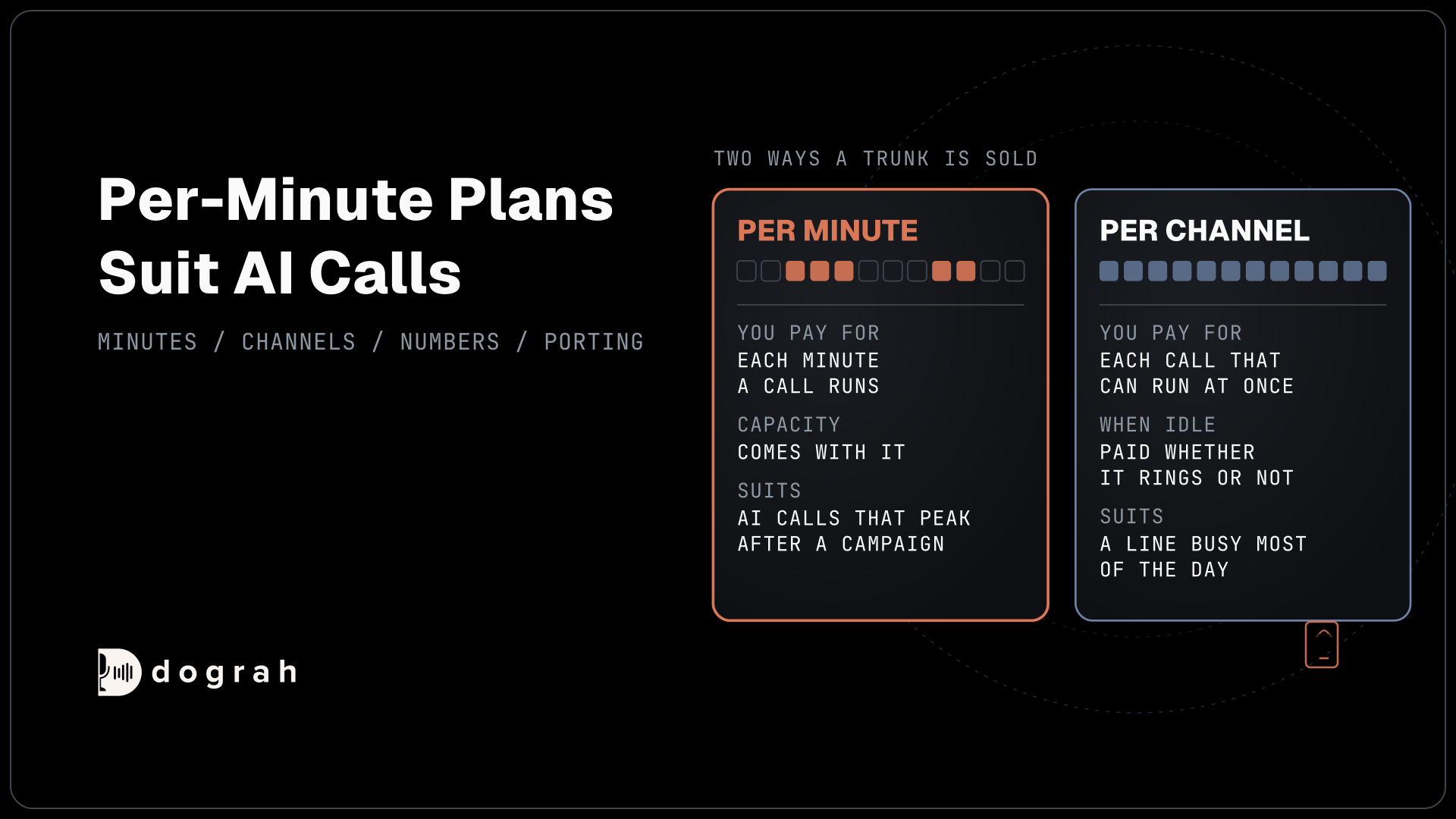
Deepgram prices its voices per 1,000 characters of text. Deepgram charges $0.030 per 1,000 characters for Aura-2 on pay as you go and $0.027 on the prepaid Growth plan, and $0.045 for Flux TTS on both. Growth starts at $4,000 a year in prepaid credits, and new accounts get a $200 credit. Our Deepgram pricing breakdown covers the rest of its meters.
Cartesia sells credits instead. Cartesia charges 1 credit per character for Sonic and puts a minute of audio at about 750 to 800 credits. Plans run from Pro at $5 for 100,000 credits to Startup at $49 for 1.25 million and Scale at $299 for 8 million. Our arithmetic puts 1,000 characters at about $0.039 on Startup and $0.037 on Scale, and $0.050 on the small Pro plan.
Both vendors bill on the text the agent speaks. Our pricing posts assume 400 characters of agent speech per call minute, roughly half of Cartesia's 750 to 800 characters per minute of audio, since the caller talks too. At that rate a call minute costs about 1.2 cents on Aura-2 and 1.6 cents on Sonic with Startup credits. Flux TTS comes to 1.8 cents. The caller's side of the conversation costs nothing on either meter.
Here is an example month of 1,000 calls, five minutes each. At 400 characters of agent speech per call minute, that is 2 million characters, priced line by line below.
| Line | Aura-2, pay as you go | Flux TTS | Sonic 3.6, Startup plan |
|---|---|---|---|
| Characters spoken | 2 million | 2 million | 2 million |
| Rate | $0.030 per 1,000 | $0.045 per 1,000 | $49 for 1.25 million credits, then $45 per million |
| Usage | 2,000 blocks of 1,000 x $0.030 | 2,000 blocks of 1,000 x $0.045 | $49.00 plan + 0.75 million overage credits at $45 per million, $33.75 |
| Month | $60.00 | $90.00 | $82.75 |
Two Cartesia details change that bill. Overage runs only if you switch it on, and without it requests fail once credits run out. Each plan also caps how many voice requests run at once, 5 on Startup and 15 on Scale, so check the cap against your busiest hour, as our post on STT and TTS concurrency limits explains. The full plan table is in our Cartesia pricing post.
Sonic, Aura-2 and Flux TTS compared
The table puts the figures above in one place, with what each voice gets when it runs in Dograh. Prices are list rates, and the speed row comes from one published test, so treat it as the starting point for your own.
| Cartesia Sonic 3.6 | Deepgram Aura-2 | Deepgram Flux TTS | Running it in Dograh | |
|---|---|---|---|---|
| Median time to first audio, Coval test on Cartesia's page | 267 ms (Sonic 3.5) | 304 ms | 245 ms | Voice time for every turn in the call trace |
| Speech Arena Elo | 1,293, rank 5 | Not on the board | 1,051, rank 70 | Test on a real phone call |
| Languages | 44 | 7 | English in 7 accents plus 41 | Language set per voice |
| Price | About $0.037 to $0.050 per 1,000 characters, from credits | $0.030 per 1,000 characters, $0.027 on Growth | $0.045 per 1,000 characters | Billed by the vendor on your own key |
| Voice settings | Sonic 3.6, 3.5 or 3, speed 0.6 to 1.5, volume, language | Speed 0.7 to 1.5 on English and Spanish voices | Speed 0.7 to 1.5, expressivity -2 to 2 | EU or Australia endpoint for Deepgram |
| Plan | Free to $299 a month, Enterprise custom | Pay as you go, or Growth from $4,000 a year | Pay as you go, or Growth from $4,000 a year | No platform fee self-hosted, 1¢-a-minute platform fee on Dograh Cloud |
Running both voices in Dograh
Dograh has Cartesia and Deepgram as built-in voice providers, each on your own key. Add the key under Providers, and the voice settings load the voices your account can use, clones included. You can also paste any voice ID by hand.
For Cartesia you pick Sonic 3.6, the default, Sonic 3.5 or Sonic 3, then set speed from 0.6 to 1.5, volume and language. For Deepgram you pick Aura-2, Aura-1 or Flux. Speed runs from 0.7 to 1.5 on Flux voices and on Aura-2's English and Spanish voices, and Flux adds expressivity, from -2 for calm to 2 for animated. The Deepgram endpoint can also point at its EU or Australia region, which decides where your text is processed.
The voice sits in a named model configuration under Models, so trying the other vendor means duplicating that configuration and changing one setting. Run the same call script on each, read the voice time per turn in the trace, and let the built-in QA review the test calls. That way the choice rests on your own traffic and your own script.
Cartesia also clones voices, with Instant cloning from the Pro plan and Professional clones on Startup and Scale. That makes it the natural fit for pre-recorded clips with a cloned fallback. A person records the lines the agent says most, and Sonic speaks everything else in a clone of that same voice, so the call sounds like one speaker throughout.
Self-hosted Dograh has no per-minute platform fee, but servers, model keys and phone minutes still cost money. Dograh Cloud charges a 1¢-a-minute platform fee. Either way, Cartesia or Deepgram bills you directly for the voice, at the rates above.
Join the Dograh Community
Dograh is an OSS alternative to Vapi. Join our Slack community for queries, releases, best practices & community interactions.
Which voice to pick for your calls
Pick on languages first, then on what your callers hear. For an English or Western European line on a tight voice budget, Aura-2's $0.030 per 1,000 characters is the smallest rate of the three, and its published median start time sits close to Sonic's. For callers in other languages, or a brand voice you want to clone, Sonic 3.6 is the stronger choice, and it leads Flux TTS on the blind listening board by a wide margin.
Flux TTS sits between them, with far more languages than Aura-2 at the highest rate of the three. Whichever you lean towards, put both voices on a real phone line with your own script before you decide. If ElevenLabs is also on your list, our Cartesia vs ElevenLabs comparison covers voices, speech-to-text and agent platforms for those two.
Glossary
- Time to first audio
- The wait between sending text to a voice API and receiving the first sound back. A Coval test published by Cartesia measured it at a 267 ms median for Sonic 3.5 and 304 ms for Aura-2.
- Narrowband audio
- Phone audio sampled at 8 kHz, which drops the higher frequencies of a voice. Most phone calls still carry it, while a browser demo plays at 16 kHz, so voices sound flatter on a call.
- Elo
- A rating built from head-to-head votes. On the Artificial Analysis Speech Arena, listeners pick the better of two unlabelled clips, and Sonic 3.6 scores 1,293 against 1,051 for Flux TTS.
- Credit
- Cartesia's unit for speech. Sonic uses 1 credit per character, about 750 to 800 credits per minute of audio, drawn from a monthly plan balance with optional overage.