
A DID number, short for direct inward dialing, is a number that rings a specific person or agent without a receptionist. The carrier tells your phone system which number was dialed, and it routes the call. Dograh, the open-source AI voice agent platform you can self-host or use on Dograh Cloud, lets you point a DID at an inbound agent.
Key Takeaways
- A DID rings one extension or agent directly, with no operator in between.
- The carrier passes the dialed digits so your system knows where to send the call.
- Twilio, Plivo and Telnyx rent one US local number for $0.50 to $1.15 monthly.
Most direct lines to a desk inside a company are DIDs, even if nobody calls them that. We explain what direct inward dialing means and how the dialed number reaches the right place, then we talk about what a DID costs and how to point one at an AI agent.
What direct inward dialing means
The standards body ATIS defines direct inward dialing as "A service feature that allows inward-directed calls to a PBX to reach a specific PBX extension without human intervention." In plain words, a caller dials a number and reaches the right desk on the first try, with nobody at a switchboard passing the call along. So the term belongs to company phone systems, not to every number that reaches a person.
The idea is older than the internet. Before it, a company had one main number and an operator who answered every call and transferred it by hand. In the United States, AT&T developed the feature in the 1960s, modeled on an earlier German service, and it later ran mostly over digital PRI lines. In Europe and Oceania the same service is usually called direct dial-in, or DDI.
Today the term DID mostly names the number itself. When a carrier sells you a DID, it rents you a phone number that it will deliver to your phone system, your contact center software or an app. A DID is an address, not a line. It says where a call should go, and the trunk or circuit it arrives on is a separate thing you pay for.
How a dialed number reaches the right place
Every call carries two numbers. One is the caller's number, which shows up as caller ID (ANI). The other is the number they dialed. Direct inward dialing works because the carrier passes that second number along with the call, so the receiving system knows which of your numbers was used.
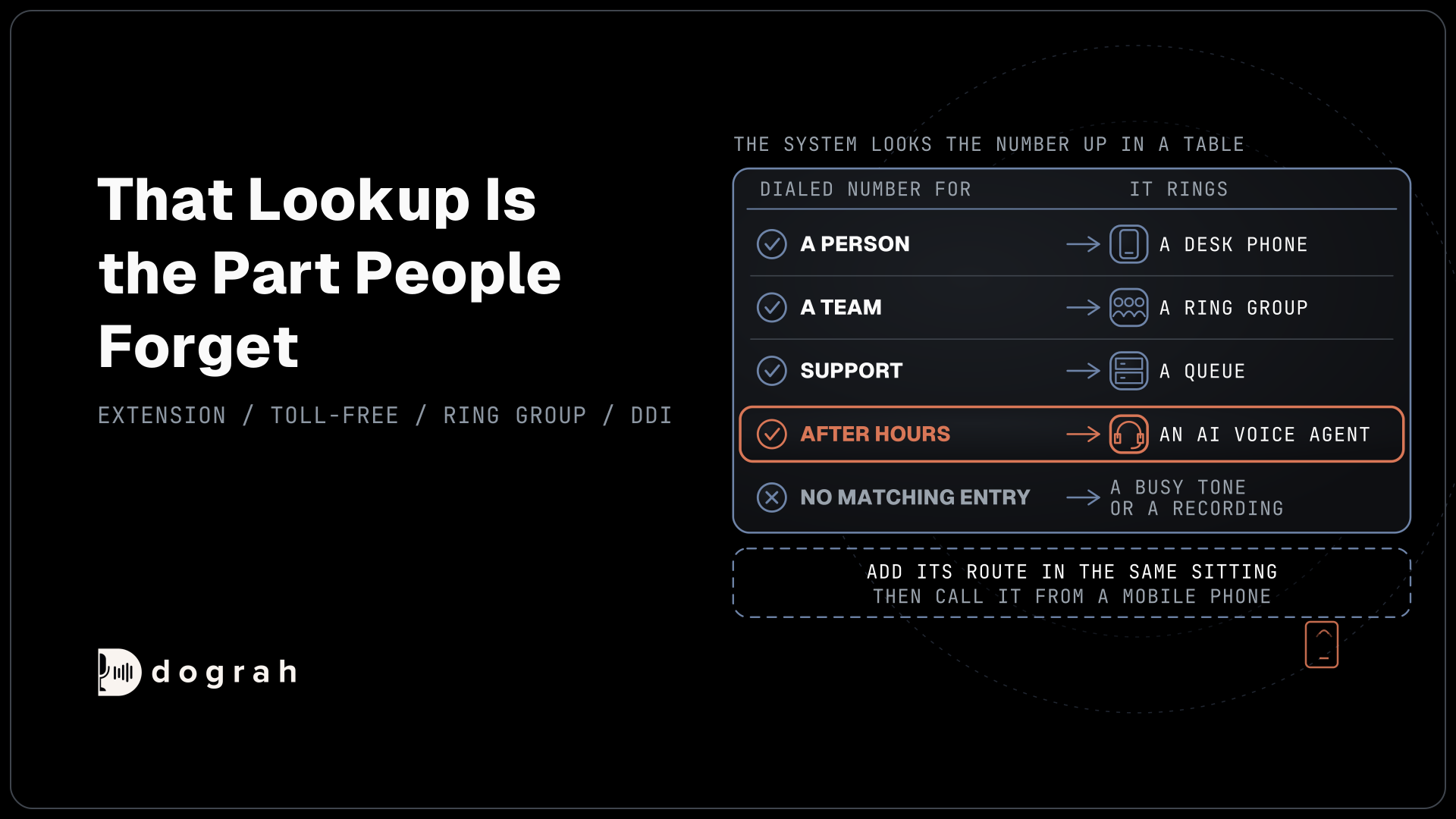
On older digital lines the carrier sends the dialed digits in a field called DNIS, sometimes trimmed to the last four digits so they match an extension. On a SIP trunk, the dialed number sits in the call request itself. Either way, the phone system looks the number up in a table and sends the call where that row says, such as a desk phone, a team's ring group, a queue or an app.
That lookup is the part people forget. Buying a number does nothing until something on your side knows what to do with it. If a number arrives at a system with no matching entry, the caller hears a fast busy tone or a recording, and the carrier still bills the rental. When you add a DID, add its route in the same sitting and then call it from a mobile phone to check.

Open Source Alternative to Vapi / Retell
Self-hosted voice agent platform — no per-minute fees
dograh-hq/dograh
Star on GitHub
DID vs extension, toll-free and DDI
People mix up these four because they all look like phone numbers. The table shows what each one is and who pays when someone calls.
| DID number | Extension | Toll-free number | DDI | |
|---|---|---|---|---|
| What it is | A full public number routed to one destination | A short internal number on a phone system | A public number in a toll-free range such as 800 or 888 | The European and Oceania name for a DID |
| Reachable from outside | Yes, dialed directly | Only through a main number or a DID mapped to it | Yes, dialed directly | Yes, dialed directly |
| Who pays for the call | The caller pays their normal rate, and the business pays its inbound minutes | No phone network charge inside the system | The call is free for the caller, and the business pays higher inbound minutes | Same as a DID |
| Typical use | A person, team, location or agent | Staff calling each other | Sales and support lines | Same as a DID |
A toll-free number can be routed exactly like a DID, so the two overlap. The real difference is on the caller's side. A toll-free call costs the caller nothing, while the business pays inbound minutes on both kinds of number, at a higher rate on toll-free. On Twilio, for example, an inbound toll-free minute costs $0.0220, against $0.0085 for a local one.
One trunk, many numbers
Numbers and capacity are separate. A company can hold 100 DIDs on a trunk with 10 channels, and that works as long as no more than 10 people call at the same moment. The numbers decide where each call goes, and the channels decide how many calls fit at once. Our explainer on what SIP trunking is covers channels and how a trunk is sized.
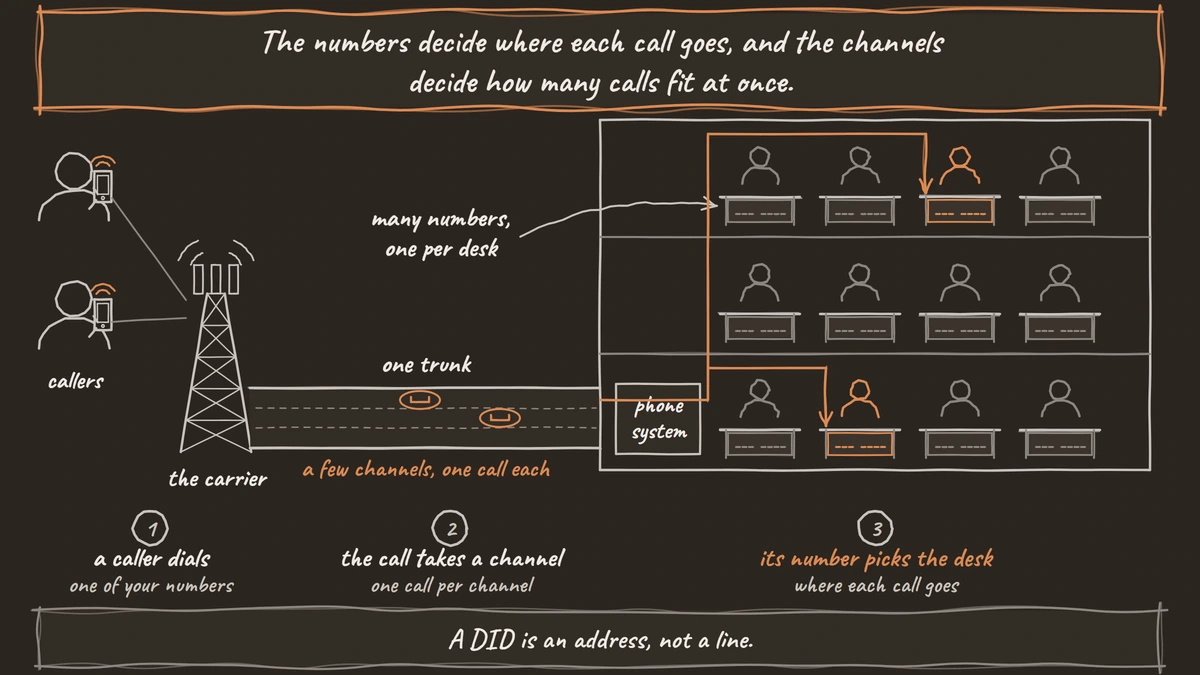
Phone system vendors often sell DIDs as a saving, since everyone gets a direct number without a physical line each. That part is true, because many numbers share a few lines. The numbers are not free, though. Each one is a monthly rental, toll-free inbound minutes cost more than local ones, and a company with hundreds of numbers pays for all of them whether they ring or not. Count the numbers you will really route before you buy a block of them.
Where to get a DID and what it costs
Carriers rent DIDs by the month, and inbound minutes are billed on top. Here are the US prices for one number from Twilio, Plivo and Telnyx, and our breakdown of Twilio phone number pricing covers Twilio's other number types.
| Carrier | US local number | US toll-free number | Notes |
|---|---|---|---|
| Twilio | $1.15 a month | $2.15 a month | Inbound $0.0085 a minute local, $0.0220 toll-free |
| Plivo | $0.50 a month | $1.00 a month | Inbound $0.0055 a minute local, $0.0180 toll-free |
| Telnyx | From $1 a month | From $1 a month | Pay as you go, lower rates in volume tiers down to $0.25 at 5,000+ numbers, SMS and MMS add $0.10 |
Plivo includes audio streaming at no extra charge, and Telnyx's per-number price drops with volume, to $0.79 for the next 200 numbers, $0.50 for the next 750 and $0.39 for the next 4,000.
Outside the US, many countries ask for an address or a business document before a carrier can rent you a number, and the rules change by number type. Our guide to getting a phone number for an AI voice agent covers that paperwork. If customers already know your number, you can keep it and port your business number to a new carrier instead of buying a fresh DID.
Join the Dograh Community
Dograh is an OSS alternative to Vapi. Join our Slack community for queries, releases, best practices & community interactions.
Routing a DID to a person or an AI agent
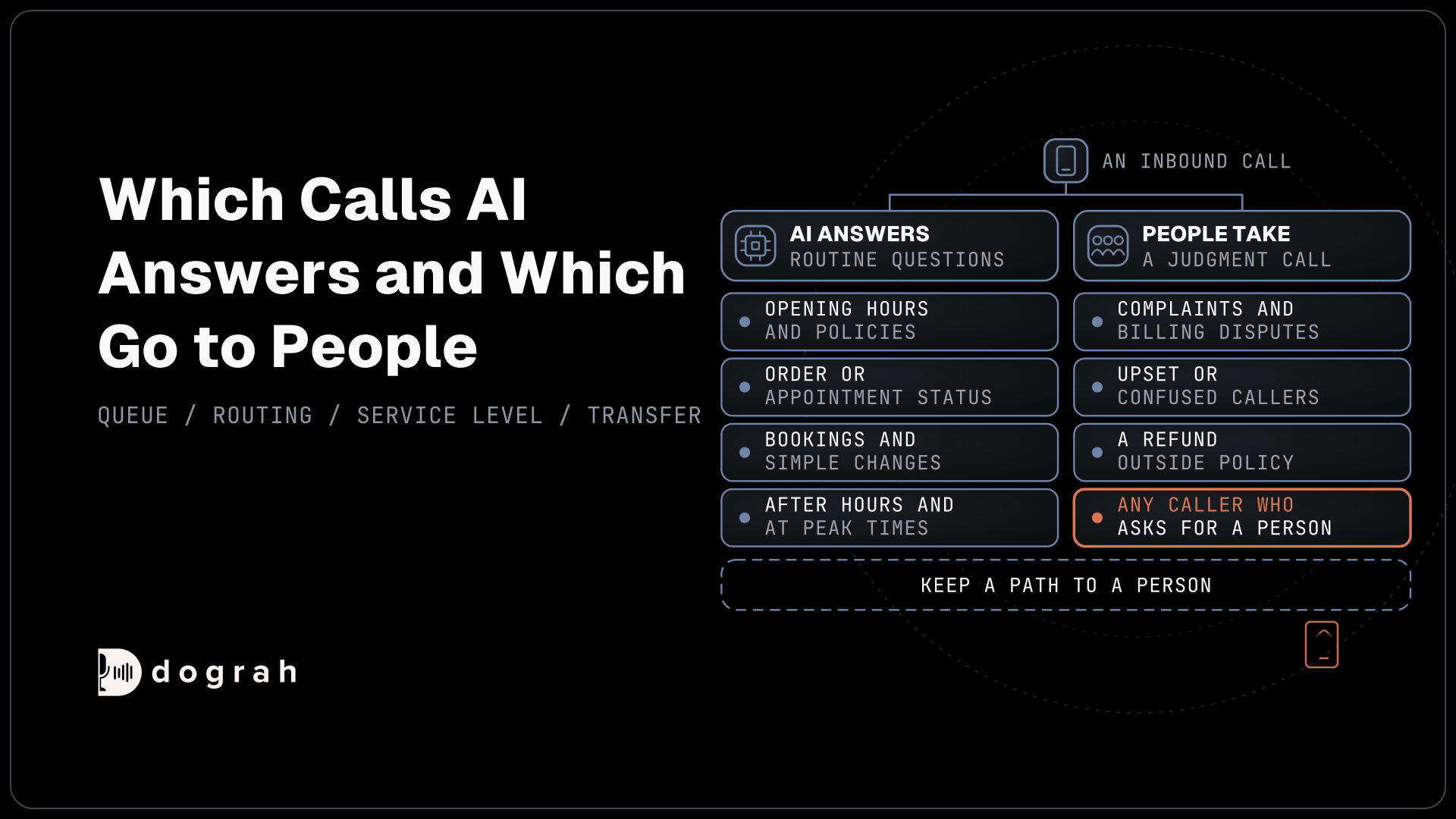
Once a DID lands on your system, you choose what it rings. A small office might send each number to one desk phone. A support team might send its number to a ring group that rings several people at once, or to a queue that holds callers in order. A number can also forward to a mobile phone or go to an app that answers by itself.
An AI voice agent is one more destination in that list. The number can point straight at the agent for every call, or your phone system can send it there only after hours or when every person in the group is busy. Many businesses keep one number for the agent and leave staff lines alone.
The dialed number is also a signal the agent can use. A business with several branches can give each one its own local number, and the agent greets callers by the branch they called. Our guide to local numbers for each location shows how that works for franchises.
Pointing a DID at a Dograh inbound agent
Dograh connects to the carrier that rents you the DID, so the number stays with that carrier and you point it at an agent. In the dashboard, open Telephony in the sidebar, choose Add configuration, give it a name, pick your carrier as the Provider and enter its credentials. Then use Add phone number, type the number in E.164 form such as +1415555XXXX, choose its Country and set the Inbound workflow to the agent that should answer. The telephony overview lists the carriers it connects to.
What happens next depends on the carrier. On Twilio, saving the Inbound workflow points the number at Dograh straight away. On Plivo, Dograh updates the application, and you link the number to that application in Plivo's console. On Telnyx, you assign the number to the Call Control app.
Numbers on a SIP trunk work too. You can bring them through your own Cloudonix account and bind each number to the voice application Dograh creates, as the Cloudonix setup page shows. A self-hosted install can also take them from an Asterisk PBX through Asterisk ARI. Running Dograh yourself means you still pay for servers, model keys and the carrier's minutes, and your team looks after the database and upgrades.
Several numbers can point at one agent, and the dialed number reaches Pre-Call Data Fetch as to_number. Your endpoint can look it up and return details such as the branch name before the agent speaks. Call each number from a mobile phone, then open Agent Runs to check the call landed on the right agent.
Glossary
- DNIS
- Dialed Number Identification Service. The carrier passes the digits the caller dialed, so a system with many numbers knows which one was used and where to send the call.
- Caller ID (ANI)
- The caller's own number, sent with the call. It tells you who is calling, while the dialed number tells you which of your numbers they used.
- Ring group
- A set of phones that ring together or in turn when one number is called, so the first free person on a team answers.
- E.164
- The international phone number format, a plus sign, country code and number with no spaces, such as +14155550100. Most carrier and voice agent settings expect it.