
Voxtral vs Whisper for voice agents comes down to streaming. Voxtral Mini 4B Realtime turns speech into text while the caller talks, with a delay you set, under Apache 2.0. Whisper transcribes finished clips and covers 99 languages under MIT. For teams that self-host, Dograh, the open-source AI voice agent platform, runs Whisper as a local model.
Key Takeaways
- Voxtral Mini 4B Realtime streams text with a delay from 80 ms to 2.4 s.
- Voxtral Mini 4B Realtime averages 8.72% WER on FLEURS at 480 ms.
- Whisper turbo needs about 6 GB and runs about 8x faster than large.
Voxtral and Whisper are the two open speech-to-text families teams most often weigh when they host a voice agent's hearing themselves. We compare them in one table, then on streaming, delay and accuracy, languages, license, hardware and phone audio, and then we talk about how each runs in open-source Dograh.
Voxtral vs Whisper in one table
The two families differ most on whether they can follow a caller in real time. Each row comes from Mistral's and OpenAI's own model cards and repositories, with the date each figure was published.
| Row | Voxtral (open weights) | Whisper |
|---|---|---|
| Open models today | Voxtral Mini 3B and Small 24B (July 2025), Voxtral Mini 4B Realtime (February 2026) | tiny to large-v3, turbo, English-only .en versions up to medium |
| License | Apache 2.0 | MIT |
| Live call mode | Mini 4B Realtime streams over a WebSocket, Mini 3B transcribes finished clips | Finished clips, streaming only as OpenAI's hosted gpt-realtime-whisper |
| Delay | Set from 80 ms to 2.4 s, 480 ms recommended | Waits for the end of the clip |
| Published accuracy | Mini 4B Realtime 8.72% FLEURS average at 480 ms (February 2026) | See WildASR and Open ASR results by link |
| Languages | Mini 4B Realtime 13, Mini 3B 8 | 99 |
| GPU memory | Mini 3B about 9.5 GB in bf16, Mini 4B Realtime 16 GB or more | turbo about 6 GB, large about 10 GB |
| Serving | vLLM | faster-whisper through Speaches and many others |
Which Voxtral and which Whisper
Both names cover several models, and only some are open. Mistral released Voxtral Mini 3B and Voxtral Small 24B in July 2025 under Apache 2.0, both built to transcribe finished audio of up to 30 minutes. In February 2026 it added Voxtral Mini 4B Realtime, also Apache 2.0, which is the one built for live speech.
Voxtral 3, released in October 2026, is a different case. Its transcription models run as Mistral's API, with no license listed and self-deployment arranged through Mistral's team, so it sits outside a comparison of open models. Our post on Voxtral 3 for voice agents covers its prices and what you can host.
Whisper is a size ladder. Whisper's repository lists models from tiny at 39M parameters to large at 1,550M, with English-only versions up to medium. Turbo, at 809M, is an optimized large-v3 that runs about 8x faster than large, though it is not trained for translation. Most voice agents run Whisper through faster-whisper, a rebuild that uses less memory for the same weights.
Streaming or finished clips
For a live call, the deciding difference is when the text appears. Whisper works on finished audio. A voice agent using it waits until a voice detector decides the caller has stopped, then sends that clip and gets the words back. The longer the caller speaks, the more audio Whisper has to process after they finish.
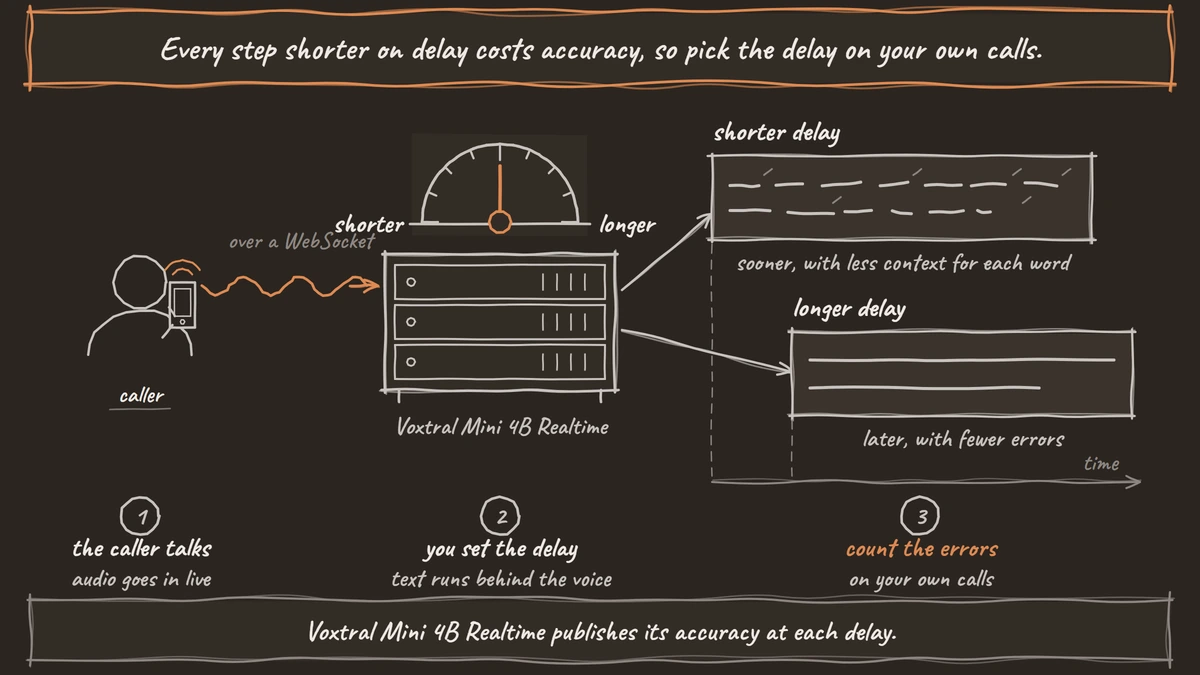
Voxtral Mini 4B Realtime streams instead. Audio goes in over a WebSocket to vLLM's realtime endpoint, and text comes back while the caller is still talking, running behind the voice by a transcription delay you choose. The card allows 80 ms steps up to 1.2 s, plus 2.4 s, and recommends 480 ms.
That matters because speech-to-text is one of the steps that adds wait in a voice agent's turn. With finished clips, transcription starts only after the caller stops. With streaming, most of the words are ready by then, so the language model can start sooner. The catch is that a streaming model has less context for each word, which shows up in its error rate.
If you want Whisper-family streaming without running a streaming server, OpenAI's hosted gpt-realtime-whisper does it for $0.017 a minute. That is an API, not open weights, so it gives up the reason most teams pick Whisper in the first place.
Delay and accuracy, with dates
Voxtral Mini 4B Realtime publishes its accuracy at each delay. On Mistral's card, published in February 2026, it averages 8.72% word error rate across 13 FLEURS languages at 480 ms, 10.80% at 240 ms and 6.73% at 2.4 s. The same audio transcribed offline averages 5.90%. Every step shorter on delay costs accuracy, so pick the delay on your own calls.
The older Voxtral Mini 3B lists a 7.05 average on the Open ASR Leaderboard in its July 2025 card, measured on finished clips in English. Mistral's July 2025 launch post went further and said "Voxtral comprehensively outperforms Whisper large-v3". In October 2026, Mistral's charts put Voxtral Small Transcribe 3 at 4.1% on FLEURS across 45 languages against 16.0% for Whisper large-v3, though that Voxtral model is an API.
The Register pointed out at launch that these benchmarks are Mistral's own, with the strongest claims limited to English short-form and Common Voice, and no published data on hallucinations. Whisper's phone-line result is reassuring. In Boson AI's WildASR test, Whisper large-v3 moved only from 4.2% on clean audio to 4.8% through G.711, a result our Whisper vs Parakeet vs Voxtral comparison covers.

Open Source Alternative to Vapi / Retell
Self-hosted voice agent platform — no per-minute fees
dograh-hq/dograh
Star on GitHub
Languages and license
Whisper covers far more languages. It handles 99, while Voxtral Mini 4B Realtime covers 13, from Arabic, Hindi and Chinese to Russian, Japanese and Korean, and Mini 3B covers 8. A caller base in Tamil, Polish or Swahili points straight to Whisper, while a line in English, Spanish or French can use either.
The licenses both allow commercial use. Whisper's code and weights are MIT, and Voxtral's open models are Apache 2.0, which adds an explicit patent grant. The one trap is Voxtral 3, whose models carry no open license, so check which Voxtral a vendor means when it says Voxtral.
GPU memory and serving
Whisper is easier to fit on a shared GPU. Turbo needs about 6 GB and large about 10 GB in the original code, and faster-whisper builds need less. That leaves room for a small language model on the same card, which keeps network hops out of each turn.
Voxtral needs more room. The Voxtral Mini 3B card puts it at about 9.5 GB in bf16, Mini 4B Realtime wants a single GPU with 16 GB or more, and Small 24B will not share a 24 GB card at all. Plan Mini 4B Realtime as its own card or a large one shared with a quantized model.
Serving differs too. Voxtral runs on vLLM, with a transcription route for Mini 3B and the realtime WebSocket for Mini 4B Realtime. Whisper runs almost anywhere, most often as faster-whisper behind Speaches, an OpenAI-compatible server. Our guide to running faster-whisper locally walks through that setup.
Testing both on phone audio
Phone audio is the test that matters most, and neither family publishes a phone-line result for its newest model. Most phone calls still reach the agent as 8 kHz audio, while a browser demo runs at 16 kHz, so a model that looks clean in a demo can miss more words on a real line. In our field experience the error rate on phone calls can be up to 3x the web-call figure, though the gap depends on the model and the phone path.
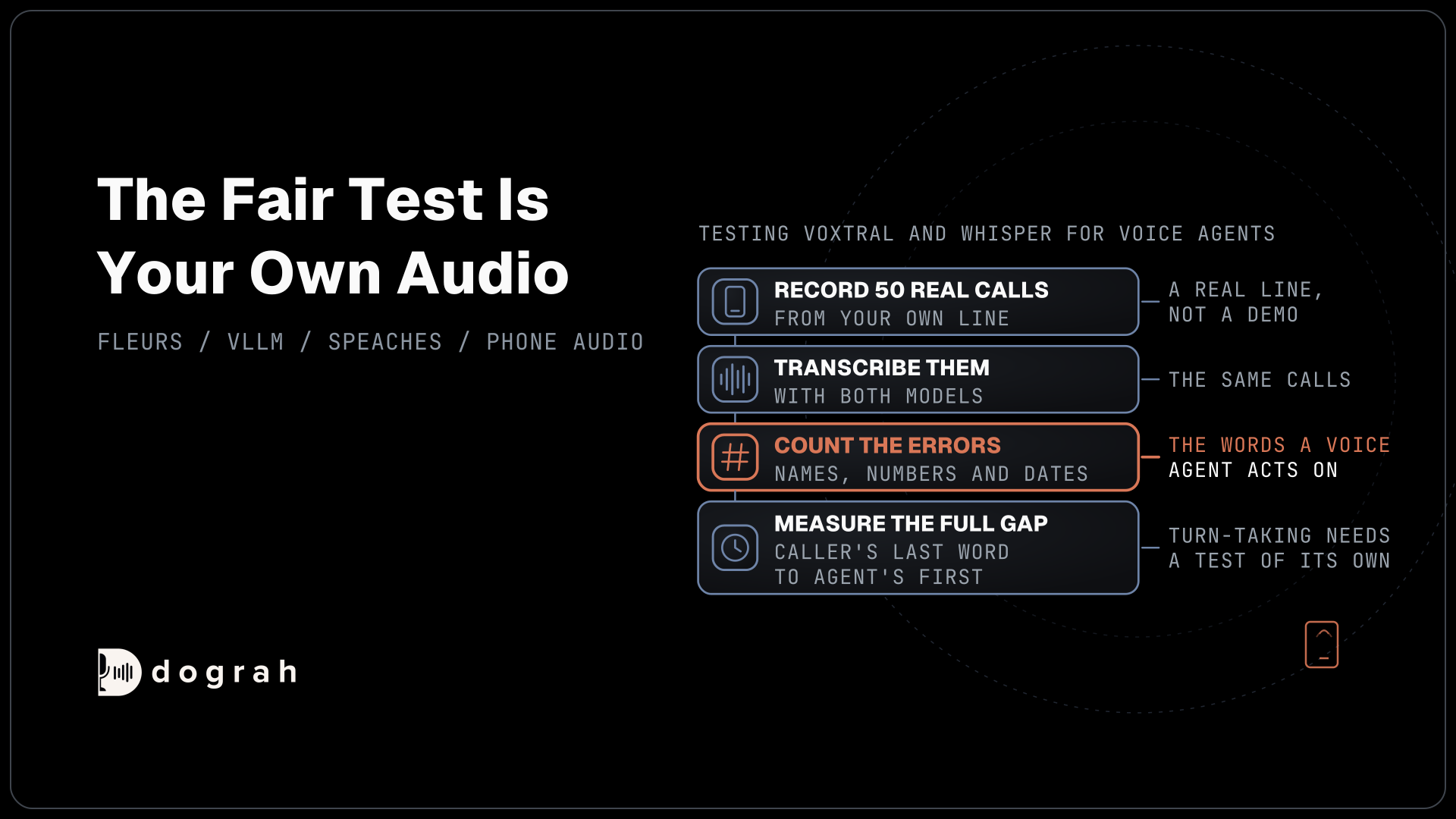
The fair test is your own audio. Record 50 real calls from your own line, transcribe them with both and count the errors on names, numbers and dates, since those are the words a voice agent acts on.
Turn-taking needs a test of its own. With Whisper, the voice detector's silence setting adds its wait before any transcription starts. With Voxtral Mini 4B Realtime, the words arrive early, but the agent still has to decide when the caller has finished, so measure the full gap from the caller's last word to the agent's first.
Which one fits a live call
Voxtral wins when delay is the problem. Mini 4B Realtime is the open model of the two that streams, the delay is yours to set, and Apache 2.0 covers commercial use with a patent grant. A team with a 16 GB GPU to spare and callers in its 13 languages can cut the wait after each sentence.
Whisper wins on reach and ease. It covers 99 languages, runs from a 39M model to turbo, plugs into most local speech servers and holds up on G.711 phone audio in WildASR's test. For a team starting out, it is the shorter path to a working agent.
If you are also weighing a hosted API, our post on Deepgram vs Whisper covers that trade, and our ranking of the best open-source STT models adds Parakeet, Qwen3-ASR and others.
Join the Dograh Community
Dograh is an OSS alternative to Vapi. Join our Slack community for queries, releases, best practices & community interactions.
Running Voxtral or Whisper in Dograh
Dograh runs open speech-to-text models through its Local Models (Speaches) provider, which calls any OpenAI-compatible speech server. Under Providers, add a Local Models (Speaches) connection. In Models, open a BYOK configuration, choose that connection on the STT tab and enter your speech server's base URL and the model name. The default in the transcriber settings is Systran/faster-distil-whisper-small.en, which handles English only, and Systran/faster-whisper-large-v3 covers other languages.
Each finished speech segment goes from Dograh to that server, which means any model that transcribes finished clips works today. Whisper runs through Speaches with no extra work. For Voxtral, serve Mini 3B with vLLM, point the base URL at it and place a test call before going live.
Running the model and the platform yourself keeps call audio on your own servers. A self-run Dograh has no per-minute platform fee, and the costs that remain are the GPU servers, any model keys and the phone minutes. Your team owns the database and the upgrade schedule. Support comes from the open-source community, while Enterprise customers get custom SLAs. Dograh Cloud is the hosted route, priced at a 1¢-a-minute platform fee.
Glossary
- Transcription delay
- How far a streaming speech model runs behind the caller's voice. Voxtral Mini 4B Realtime lets you set it from 80 ms to 2.4 s.
- Apache 2.0
- An open-source license that allows commercial use and adds an explicit patent grant. Voxtral's open models use it, while Whisper's code and weights are MIT.
- FLEURS
- A public speech benchmark with recordings in many languages. Mistral reports Voxtral's error rates on it, averaged across languages.
- faster-whisper
- A rebuild of Whisper on the CTranslate2 engine that runs the same weights faster and with less memory. Speaches serves it over an OpenAI-compatible API.