
The best open-source STT models for live phone calls are Whisper large-v3 and turbo, Parakeet TDT 0.6B v3, Qwen3-ASR 1.7B and Nemotron 3.5 ASR Streaming, then Voxtral, Canary-Qwen 2.5B and Granite Speech 3.3. Whisper leads on fit rather than accuracy. Dograh, the open-source AI voice agent platform, runs them on your own servers through Speaches.
Key Takeaways
- Whisper ranks first because it plugs straight into a finished-clip pipeline.
- Dograh runs Whisper locally through Speaches, and other providers on your own key.
- Nemotron 3.5 ASR Streaming is built for voice agents, with chunks from 80 ms.
Open-source speech-to-text models now rival paid APIs on published benchmarks, but a phone agent needs more than a low word error rate. We set the criteria first, rank seven models for live phone calls with each figure's source and date, then we look at which ones run in Dograh.
How we ranked them
We ranked for live phone calls, because that is where a speech model has the least room for error. A model scores higher when it runs on one modest GPU, serves behind a standard API, covers the caller's language and has a license a business can use. Published accuracy counts too, but it does not lead the ranking.
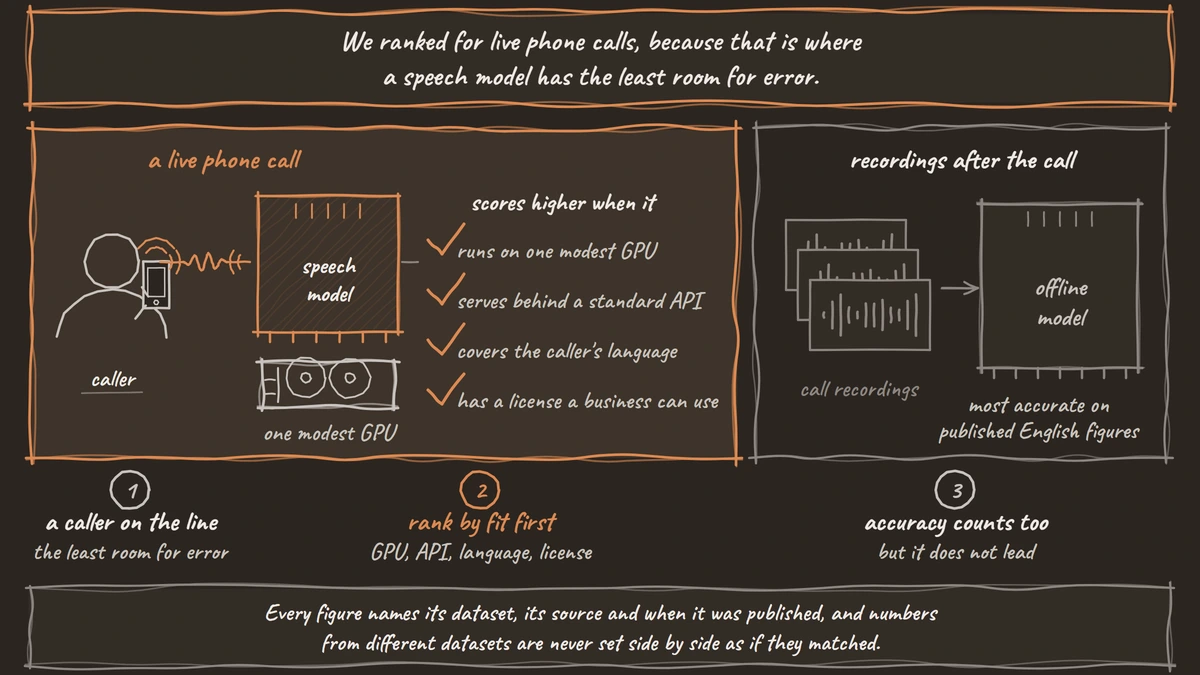
Each model gets the same columns, its license in plain words, whether it streams or transcribes finished clips, languages, size and one published accuracy figure. Every figure names its dataset, its source and when it was published, and numbers from different datasets are never set side by side as if they matched. Northflank's list ranks the same field by English error rate alone, which puts Canary-Qwen and Granite on top.
If you need the license and GPU detail for each model, our guide to open-source STT models covers it. This post adds the ranking, the newer models and the figures behind each place.
The seven models at a glance
The table lists each model in rank order. The accuracy column is the figure each source publishes, so compare it within a dataset only.
| Rank | Model | License | Streams or finished clips | Languages | Size | Published accuracy (dataset, source, date) |
|---|---|---|---|---|---|---|
| 1 | Whisper large-v3 and turbo | MIT | Finished clips | 99 | 1550M, turbo 809M about 6 GB | 4.08% Fleurs English (Qwen's report, Jan 2026) |
| 2 | Parakeet TDT 0.6B v3 | CC-BY-4.0 | Chunked streaming through NeMo | 25 European | 600M, about 2 GB | 6.34% average (card, released Aug 2025) |
| 3 | Qwen3-ASR 1.7B | Apache 2.0 | Both, streaming through vLLM | 52 languages and dialects | 1.7B | 3.35% Fleurs English offline, 4.02% streaming (Qwen card) |
| 4 | Nemotron 3.5 ASR Streaming 0.6B | OpenMDW-1.1 | Streams, 80 ms to 1.12 s chunks | 40 language-locales | 600M | 9.43% to 7.91% FLEURS English (card, Jun 2026) |
| 5 | Voxtral Mini 3B and Mini 4B Realtime | Apache 2.0 | 3B finished clips, 4B streams | 8 and 13 | About 9.5 GB, 16 GB GPU | 7.05 mean (3B card, Jul 2025), 8.72% FLEURS at 480 ms (4B card, Feb 2026) |
| 6 | Canary-Qwen 2.5B | CC-BY-4.0 | Finished clips | English | 2.5B | 5.63 mean (card, released Jul 2025) |
| 7 | Granite Speech 3.3 8B | Apache 2.0 | Finished clips | 5 | 8B | 5.74 mean (card, released Jun 2025) |
1. Whisper large-v3 and turbo (OpenAI)
Whisper ranks first on fit rather than accuracy. It covers 99 languages under the MIT license, it transcribes finished clips, which is how most voice agent pipelines send audio, and it has the widest set of servers and builds of any open model. Newer models beat it on published error rates, and the rest of this list shows where.
Whisper's repository lists sizes from tiny at 39M parameters to large at 1550M, which needs about 10 GB. Turbo, at 809M, needs about 6 GB and runs about 8x faster than large, though it is not trained for translation. English-only versions exist up to medium, and faster-whisper builds run the same weights faster with less memory.
On accuracy, Qwen's own report puts Whisper large-v3 at 4.08% on Fleurs English, behind Qwen3-ASR's 3.35% offline on the same set. Our guide to running faster-whisper locally covers the setup.
2. Parakeet TDT 0.6B v3 (NVIDIA)
Parakeet ranks second because it is small, fast and accurate. The Parakeet TDT 0.6B v3 card reports a 6.34% average error rate across the Open ASR Leaderboard's sets, at an RTFx of 3,332.74, for a model released in August 2025. It covers 25 European languages and detects the language itself.
At 600M parameters and about 2 GB, it fits on the same GPU as a language model. It streams in chunks through a NeMo script and needs an OpenAI-compatible server in front to sit in a voice agent pipeline. The license is CC-BY-4.0, so a business can use it if it credits NVIDIA. Northflank's figure of about 8.0% is for Parakeet TDT 1.1B, an older model. Our post on Parakeet for voice agents covers serving it.
3. Qwen3-ASR 1.7B (Qwen)
Qwen3-ASR ranks third for its language range and its one-model streaming. The Qwen3-ASR 1.7B card lists 52 languages and dialects, 30 languages plus 22 Chinese dialects, under Apache 2.0, with streaming and offline transcription in one model.
Qwen's report from January 2026 sets it against Whisper large-v3 on the same sets. It scores 3.35% offline and 4.02% streaming vs 4.08% for Whisper on Fleurs English, and 7.39% vs 9.90% on CommonVoice English, while Whisper stays ahead on LibriSpeech clean at 1.51% vs 1.63%. These are Qwen's own figures, so test on your calls before relying on them.
Streaming runs only through vLLM, and that mode has no batch or timestamps. For a live call that is fine, since the agent needs words in order more than timing marks.

Open Source Alternative to Vapi / Retell
Self-hosted voice agent platform — no per-minute fees
dograh-hq/dograh
Star on GitHub
4. Nemotron 3.5 ASR Streaming 0.6B (NVIDIA)
Nemotron 3.5 ASR Streaming ranks fourth because it is built for voice agents and streams by design. The Nemotron 3.5 ASR Streaming card, published in June 2026, lists chunk sizes from 80 ms to 1.12 s and 40 language-locales.
On FLEURS English, it scores 9.43% at 80 ms chunks and 7.91% at 1.12 s, so you trade delay for accuracy. The license is OpenMDW-1.1, which NVIDIA marks ready for commercial use. At 600M parameters it is small, but it needs a streaming server rather than a finished-clip API, so it ranks below the three that drop into most pipelines more easily.
5. Voxtral Mini 3B and Mini 4B Realtime (Mistral)
Voxtral ranks fifth with two models that fit different jobs. Voxtral Mini 3B transcribes finished clips in 8 languages, needs about 9.5 GB in bf16 and serves through vLLM, with a 7.05 mean on its card from July 2025. Voxtral Mini 4B Realtime streams in 13 languages on a 16 GB GPU, and its card from February 2026 reports 8.72% on FLEURS at a 480 ms delay vs 5.90% for the offline model.
Both use Apache 2.0. They rank below Nemotron because they need more GPU memory for a similar job. Our comparison of Voxtral vs Whisper covers the two side by side on a live call.
6. Canary-Qwen 2.5B (NVIDIA)
Canary-Qwen ranks sixth despite strong accuracy, because it is English only and transcribes finished clips. Its card reports a 5.63 mean error rate on the Open ASR Leaderboard at an RTFx of 418, for a model released in July 2025.
At 2.5B parameters under CC-BY-4.0, it suits English recordings where accuracy matters more than speed. For a live call it is slower than Parakeet and covers fewer languages.
7. Granite Speech 3.3 8B (IBM)
Granite Speech ranks seventh because its size and batch examples make it the hardest to fit on a live call. IBM's card reports a 5.74 mean error rate, released in June 2025, across English, French, German, Spanish and Portuguese, under Apache 2.0.
At 8B parameters, it needs far more GPU memory than Parakeet or Nemotron. It is a strong pick for transcribing recorded calls in those five languages.
Join the Dograh Community
Dograh is an OSS alternative to Vapi. Join our Slack community for queries, releases, best practices & community interactions.
For recordings after the call
Nemotron 3.5 Transcribe 30B-A4B is the most accurate model here on published English figures, but NVIDIA calls it "an offline model". Its card, released in October 2026, reports a 4.71 mean on the Open ASR Leaderboard's English set, so it belongs on recordings after the call, for QA and analytics. Our post on Nemotron Transcribe for voice agents covers that use.
Two older names are left out. Mozilla DeepSpeech and Coqui STT are discontinued, so new projects should start on a model from this list.
Self-hosting or a hosted API
AssemblyAI, which sells a hosted speech API, argues that self-hosting costs more than it looks. GPUs, on-call cover, diarization and model upgrades add up, and in its view a hosted API often wins at real volume.
That holds for many teams. Self-hosting pays off when call audio has to stay on your own servers, when volume is steady enough to keep a GPU busy, or when you need a language or accent a hosted API handles poorly. In each case, test on your own phone audio, since most phone lines carry 8 kHz audio while published benchmarks use clearer recordings.
Running these in Dograh
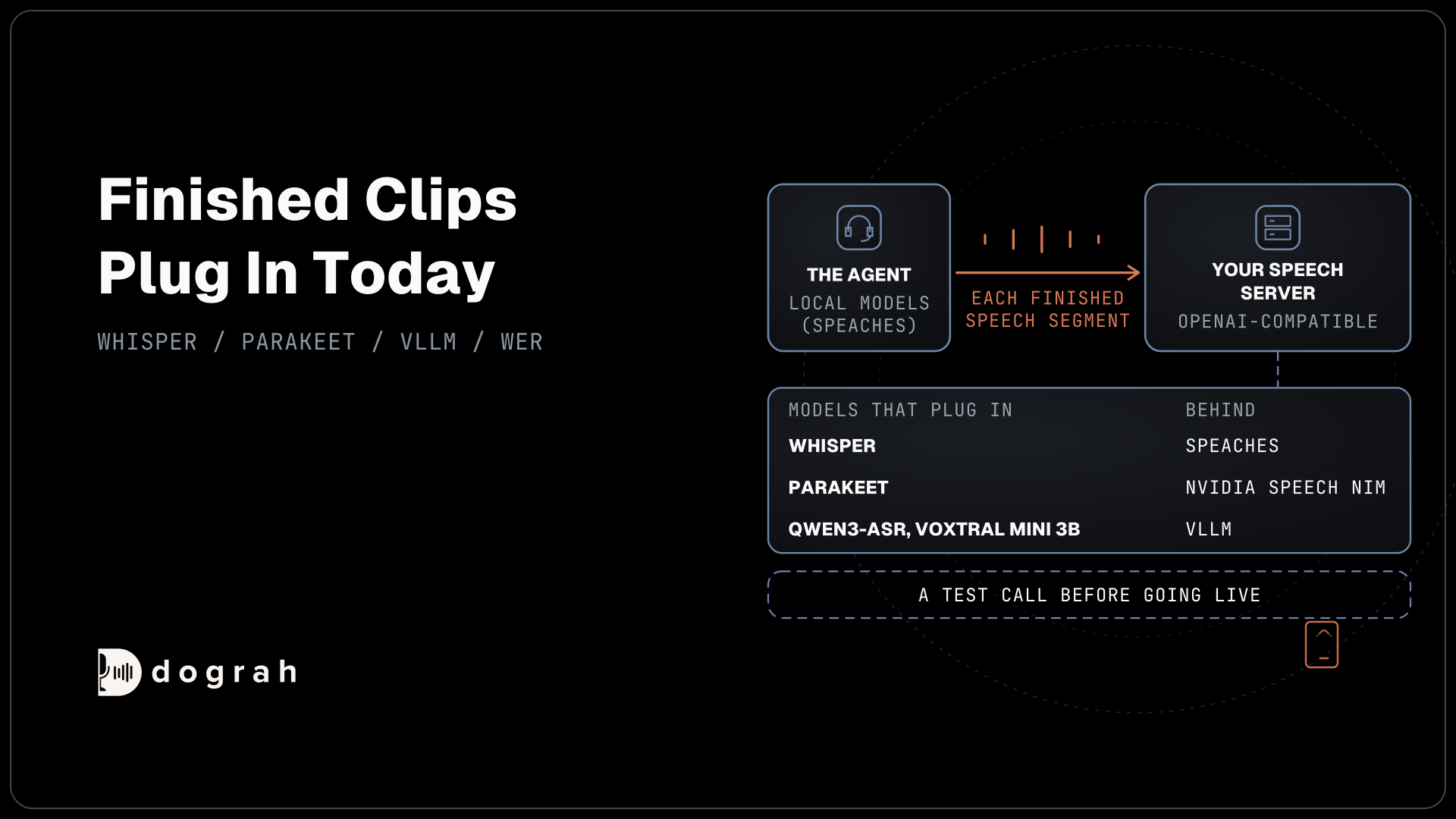
Dograh runs open speech-to-text models through its Local Models (Speaches) provider, which calls any OpenAI-compatible speech server. Add a Local Models (Speaches) connection under Providers, then pick it on the STT tab of a BYOK configuration in Models, with the base URL of your speech server and the model name. The transcriber settings list Systran/faster-distil-whisper-small.en as the default, which is English only, and Systran/faster-whisper-large-v3 for other languages.
Dograh sends each finished speech segment to that server, so models that transcribe finished clips plug in today. Whisper runs through Speaches with no extra work. Parakeet runs behind an NVIDIA speech NIM, and Qwen3-ASR and Voxtral Mini 3B behind vLLM, each after a test call before going live.
Speaches also serves local language models and Kokoro text-to-speech, so a fully local cascade is possible. Dograh is the orchestration layer that runs the call flow, tools and telephony, and the speech and language models are a separate layer you choose. On a self-hosted install, you can switch off telemetry with ENABLE_TELEMETRY=false.
Running the model and the platform yourself keeps call audio on your own servers, and Dograh adds no per-minute platform fee when you host it. The GPU and platform servers, any hosted model keys and your phone minutes are the costs that remain, and your team owns the database and each upgrade. The open-source community handles support, and Enterprise brings custom SLAs. Teams that want the platform managed can use Dograh Cloud, which charges a 1¢-a-minute platform fee.
Glossary
- Word error rate (WER)
- The share of words a speech model gets wrong, counting substitutions, deletions and insertions. Lower is better, and it only compares fairly on the same audio set.
- RTFx
- How many seconds of audio a model transcribes per second of compute. Parakeet TDT 0.6B v3's card reports 3,332.74, so higher means faster.
- Open ASR Leaderboard
- A public Hugging Face leaderboard that runs open speech models on the same English sets. Many model cards report their result from it.
- Chunked streaming
- Transcribing audio in short fixed pieces as it arrives. Smaller chunks return words sooner but usually make more errors.