
Voxtral 3 is Mistral's October 2026 family of four speech models, three for transcription and one for voice, on Mistral's API from $0.0035 a minute. It has no open weights, and self-deployment goes through Mistral's team. The open Voxtral Mini models connect to Dograh, the open-source AI voice agent platform that runs on your own servers or Dograh Cloud.
Key Takeaways
- Voxtral 3 runs on Mistral's API, and self-deployment goes through Mistral's team.
- The open Voxtral Mini 3B and Mini 4B Realtime are Apache 2.0.
- The open Voxtral voice model is non-commercial, so use Kokoro or Chatterbox.
This post is part of our guide to running voice AI on local, self-hosted models, where only models you can download share your own GPU. Below, we price Voxtral 3 for a phone call and then turn to the open Voxtral models a Dograh stack can run today.
What Mistral released in Voxtral 3
Voxtral 3 covers four speech models, three for transcription and one for the voice. Mistral's changelog dates the release to 20 October 2026, and Mistral's Voxtral 3 announcement gives each its own API name and price.
| Model | API name | Job | Price |
|---|---|---|---|
| Voxtral Mini Transcribe 3 | voxtral-mini-transcribe-3-0 | Batch transcription | $0.0035 a minute |
| Voxtral Small Transcribe 3 | voxtral-small-transcribe-3-0 | Batch transcription | $0.0040 a minute |
| Voxtral Mini Transcribe Realtime 3 | voxtral-mini-transcribe-realtime-3-0 | Live transcription | $0.008 a minute |
| Voxtral Mini TTS 3 | voxtral-mini-tts-3-0 | Voice | $13 per 1 million characters |
Mistral says the Mini variant has 4 billion parameters and that transcription covers 50 languages, including the 24 official EU languages. It puts the realtime model under 500 ms in over 35 languages. The voice model covers 35+ languages with zero-shot cloning, and a Pro Voice option adapts a voice from 30 minutes of audio. These are Mistral's own figures, so test them on your own calls.
Mistral also sells a voice agent API that runs live transcription, a reasoning model and the voice as one stream, at $0.04 a minute with Mistral Small 4 or $0.08 with a larger model.
Hosted API, or self-deployment through Mistral
Voxtral 3 has no weights to download. Mistral's models overview marks all four as Premier models with no license shown, and the only open Voxtral listed there is the older Voxtral Small, under Apache 2.0. Mistral offers the family through its EU-hosted API, with European, US and global endpoints, or for self-deployment on your own infrastructure, which you arrange by talking to its team.
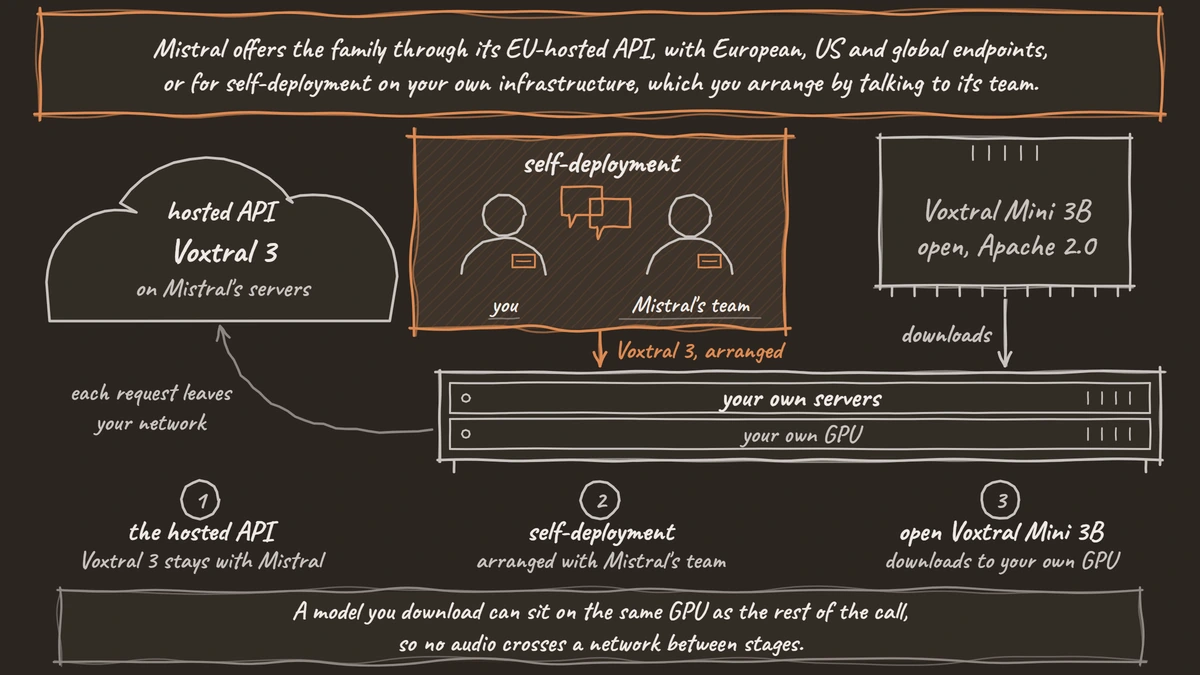
That second route starts with a conversation with Mistral's team. For most buyers, Voxtral 3 is a hosted API, and that decides how it fits a voice stack. A model you download can sit on the same GPU as the rest of the call, so no audio crosses a network between stages. A hosted model stays on Mistral's servers, so the closest you get is the Mistral endpoint nearest your own. Our post on reducing voice-agent latency with server colocation covers that choice. It also decides where call audio goes. Every request to a hosted API leaves your network, which matters when your data has to stay in-house.
What a 5-minute call costs on Voxtral 3
A worked example turns the rates into a call. It uses the call from our guide to LLM API pricing for voice agents, 5 minutes with 12 agent replies of about 37 words each, and assumes about 6 characters a word, spaces included.
| Example line | Sum | Result |
|---|---|---|
| Live transcription | 5 minutes x $0.008 | $0.04 |
| Agent's voice | 12 x 37 words x 6 characters = 2,664 characters, x $13 / 1,000,000 | about $0.035 |
| Speech for the call | $0.04 + $0.035 | about $0.075 |
So 1,000 such calls cost about $75 for speech. That is before the language model, the platform and the phone line. The voice line moves most with your script, since a longer reply means more characters.

Open Source Alternative to Vapi / Retell
Self-hosted voice agent platform — no per-minute fees
dograh-hq/dograh
Star on GitHub
The open Voxtral models you can run today
The Voxtral line still has open models, and two of them suit speech-to-text on your own GPU. Voxtral Mini 3B is Apache 2.0, needs about 9.5 GB of GPU memory in bf16, covers 8 languages and is served by vLLM on the standard transcription route. Our comparison of Whisper vs Parakeet vs Voxtral covers how it is served and why it does not share a 24 GB card with a 4-bit 27B language model.
Voxtral Mini 4B Realtime is the streaming one. The Voxtral Mini 4B Realtime model card lists it as Apache 2.0, about 4B parameters, 13 languages and a delay you can set from 240 ms to 2.4 seconds, with 480 ms recommended. It needs a single GPU with at least 16 GB, and vLLM serves it on a realtime endpoint over WebSockets, so it suits streaming transcription rather than one request per sentence.
Voxtral Small, the 24B open model, is too big to share a 24 GB card at all. On one machine, Mini 3B or Mini 4B Realtime is the realistic pick.
The open Voxtral voice is non-commercial
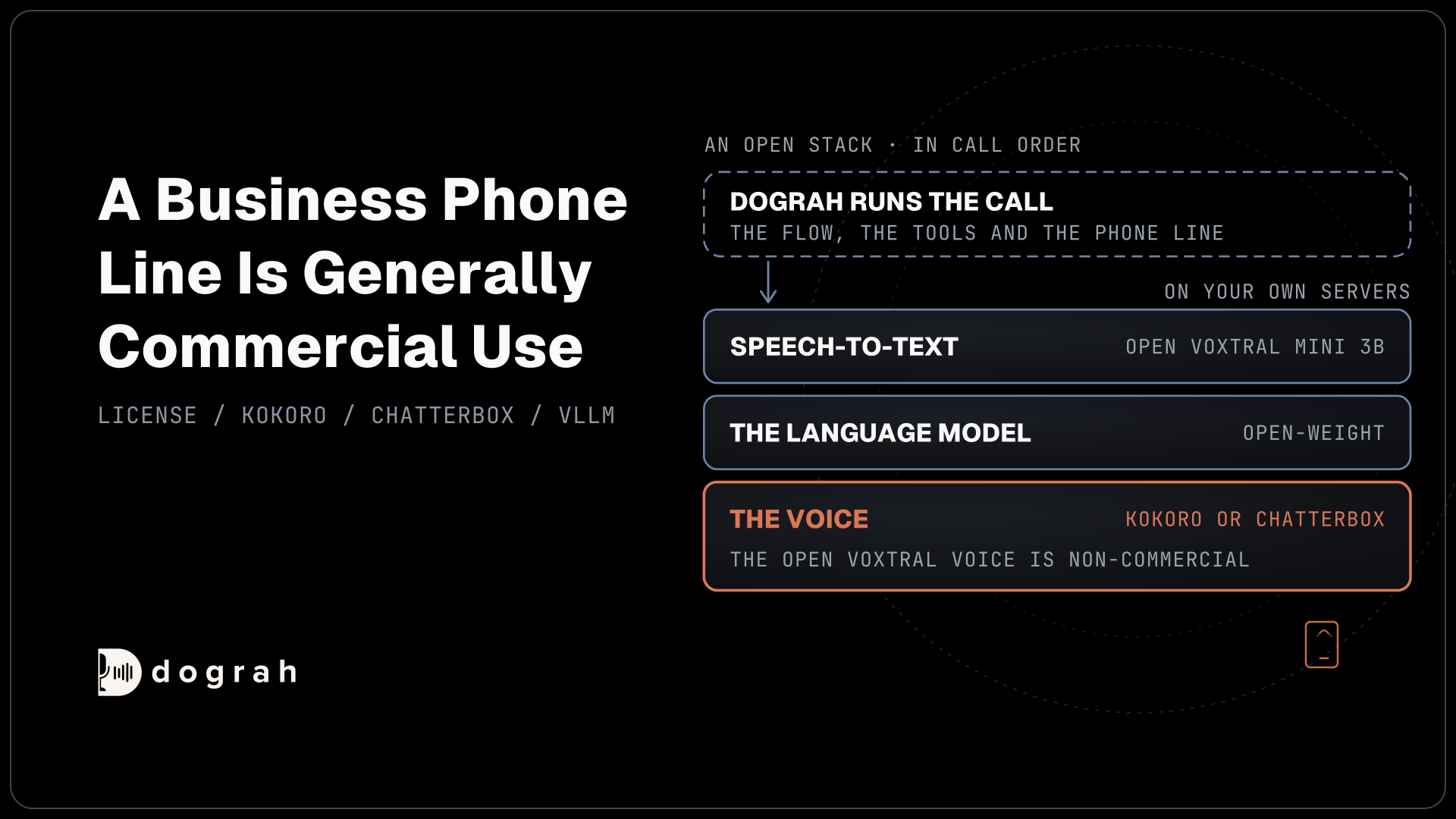
The Voxtral line also has an open voice model, and its license rules it out for a business line. The Voxtral 4B TTS model card lists it under CC BY-NC 4.0, with 9 languages and 20 preset voices, served by vLLM-Omni. A business phone line is generally commercial use, so this model is for experiments only.
For the voice on a real line, run Kokoro, which is Apache 2.0 with fixed voices, or Chatterbox, which is MIT and can clone a voice. Our comparison of Kokoro vs Chatterbox vs Coqui XTTS covers the licenses and cloning in each.
Join the Dograh Community
Dograh is an OSS alternative to Vapi. Join our Slack community for queries, releases, best practices & community interactions.
Fitting open Voxtral into a Dograh stack
Dograh runs the call itself, meaning the flow, the tools and the phone line, while speech-to-text, the language model and the voice form a separate layer you fill. On your own servers, add a Local Models (Speaches) provider with your model server’s address and model name, as the speech-to-text settings show.
Dograh sends each finished stretch of the caller’s speech to that server as one HTTP request to /v1/audio/transcriptions. Voxtral Mini 3B, served by vLLM, answers that route. Place a test call before real callers arrive. Mini 4B Realtime streams over a WebSocket connection instead, so Mini 3B is the Voxtral model for this route.
Self-hosted Dograh has no per-minute platform fee, but servers, model keys and phone minutes still cost money. Dograh Cloud charges a 1¢-a-minute platform fee. Voxtral on your own GPU adds no per-minute speech-to-text bill, only the GPU. For the whole open-model setup, see self-hosted voice AI on open-weight models.
Because the model is a setting, you can try Voxtral Mini against Parakeet or Whisper on the same agent. Each call’s trace shows the speech-to-text time for every turn, so compare them on your own calls.
Pre-recorded clips cover the lines your agent says most, so a voice model on your own GPU speaks fewer of them at busy hours.
Glossary
- Open weights
- Model files published for anyone to download and run on their own hardware, under a stated license. Voxtral Mini 3B and Mini 4B Realtime have them. Voxtral 3 does not, so it runs on Mistral's API or through a deployment arranged with Mistral.
- Premier model
- Mistral's label for models offered through its API and commercial agreements, without public weights or a license on its models overview. All four Voxtral 3 models carry it.
- Streaming transcription
- Speech-to-text that returns text while the caller is still talking, over a held-open connection. Voxtral Mini 4B Realtime works this way over WebSockets, unlike a model that takes one request per finished sentence.
- CC BY-NC 4.0
- A Creative Commons license that allows sharing and changing a model but forbids commercial use. The open Voxtral 4B TTS model carries it, so it cannot voice a business phone line.