
Voiceflow suits teams that want one builder for voice and chat, billed as a plan fee plus seats and credits. PolyAI suits phone-first support lines, self-serve from $49 a month or built for you on Enterprise. Dograh suits teams that want to own the platform, as an open-source AI voice agent platform you can self-host or run on Dograh Cloud.
Key Takeaways
- Voiceflow bills a plan fee, editor seats and credits, with phone minutes at $0.05.
- PolyAI's self-serve plans include minutes, starting at 250 on Essentials for $49 a month.
- A BAA, single sign-on and regional data storage sit on PolyAI's Enterprise tier.
Voiceflow and PolyAI both put an AI agent on your support line, but they differ on who runs it and how the bill grows. We compare who operates each one, channels and models, billing, a priced month and compliance, then show where open-source Dograh fits.
Voiceflow and PolyAI in one table
Both are closed, hosted platforms, so the differences sit in who builds, what the bill counts and what each plan adds.
| Voiceflow | PolyAI | |
|---|---|---|
| Who builds the agent | Your team in the builder, with self-serve or fully managed implementation for businesses | You, with Wren, on self-serve plans. PolyAI, Wren or a partner on Enterprise |
| Channels | Voice and chat from one agent | Phone-first |
| Models | Major model providers, or bring your own model | Raven 3.5 recommended, OpenAI and Amazon Bedrock options, or your own LLM endpoint |
| How it bills | Monthly plan fee, add-ons such as editor seats and phone numbers, and credits | Monthly plans with minutes included, then a per-minute overage. Platform pay as you go from 9.5¢ a minute |
| Phone minutes | $0.05 a minute in credits on self-serve plans | Inside the plan's minutes, then 30¢, 25¢ or 20¢ |
| Calls at once | A per-plan limit, raised with an add-on | 5 on Essentials, 10 on Plus, 10 per location on Scale |
| Enterprise adds | Single sign-on, private cloud hosting, custom credit allotments | BAA, single sign-on, PCI card capture, data storage in your region, uptime SLA |
Who operates the agent on each
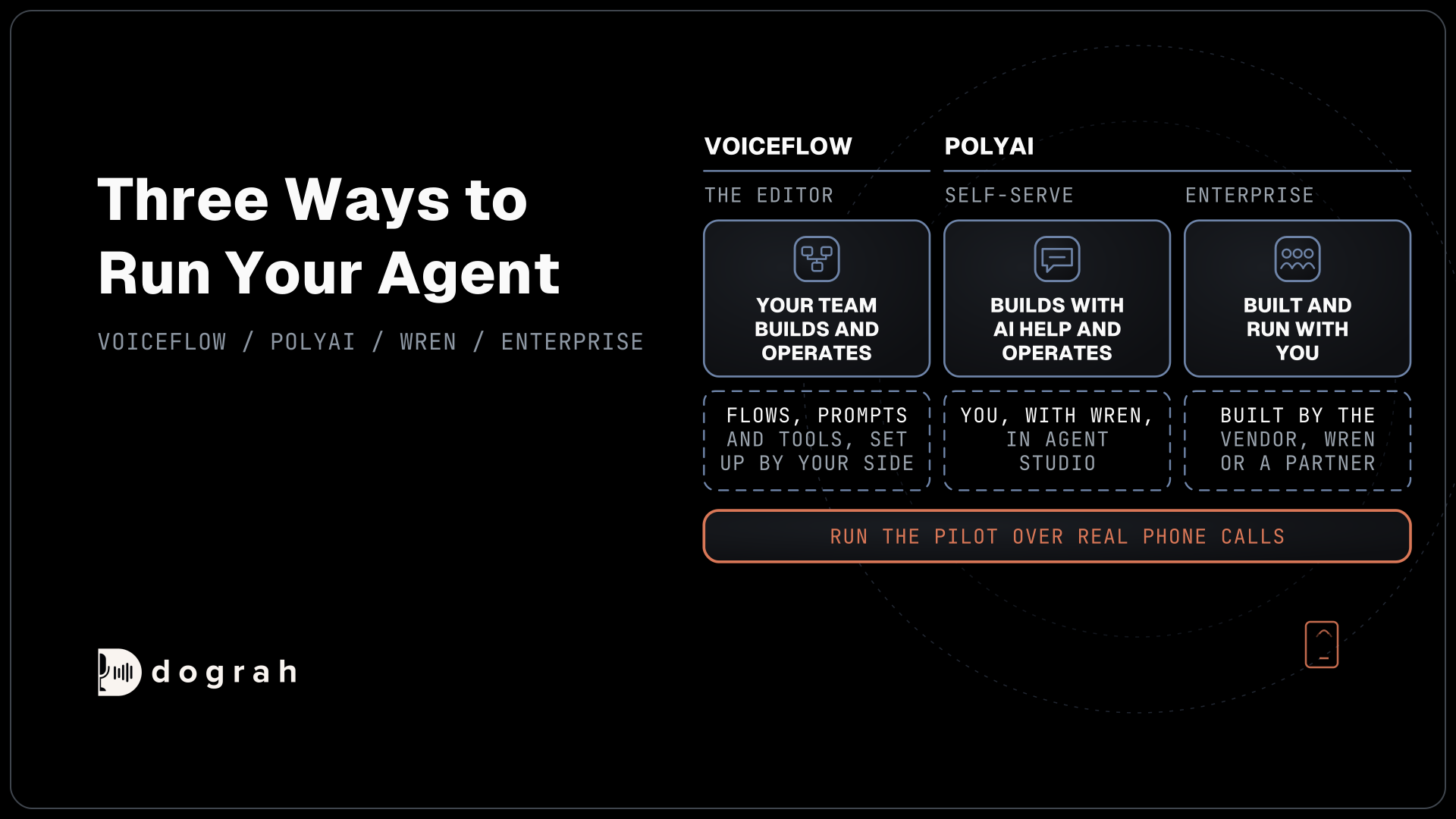
Voiceflow is a builder your team runs. Every flow, prompt and tool is set up in the Voiceflow editor by people on your side, and editors need seats. Voiceflow now offers businesses implementation support that is "self-serve or fully managed", so a team can ask for help with the first build, but the agent still lives in a workspace your staff maintain.
PolyAI sells two ways of working. On its self-serve plans, Essentials, Plus and Scale, the builder is "You, with Wren", meaning Wren, the PolyAI builder you talk to in plain language inside Agent Studio. On Enterprise, the agent is built by PolyAI, Wren or a partner, with a named account manager and support around the clock. That second route is the managed service PolyAI is known for, and it suits contact centers that would rather buy an outcome than staff a builder.
So there are really three ways to run it. A Voiceflow team builds and operates. A PolyAI self-serve team builds with AI help and operates. A PolyAI Enterprise customer has it built and run with them. Our Voiceflow review and PolyAI review cover each one's day-to-day work in more depth.
Voice and chat, or voice first
Voiceflow's main strength is reach across channels. One agent design can answer on the website chat and on the phone, and Voiceflow lets you pick from the major model providers or bring your own model. For a team that wants the same answers in chat and voice, that saves building two agents. On the phone side, each workspace includes one Voiceflow number, more numbers are an add-on, and calls draw $0.05 a minute in credits.
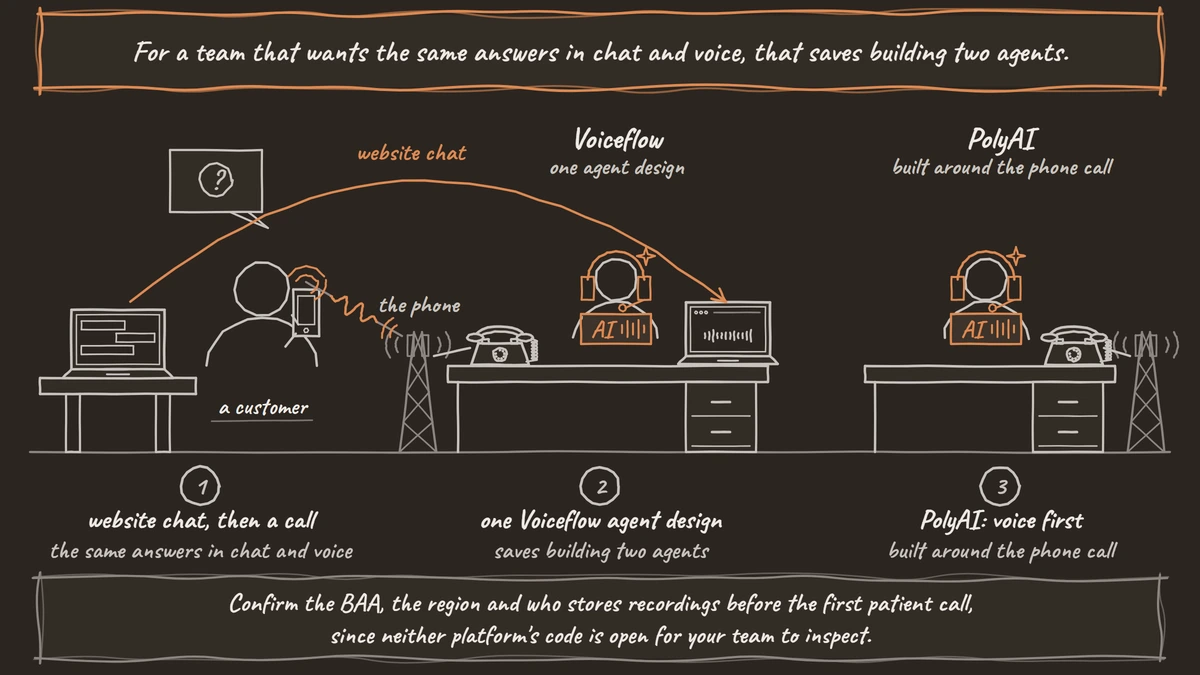
PolyAI is built around the phone call. PolyAI's model guide names Raven 3.5, its own model, as the recommended choice for all deployments, and lists OpenAI and Amazon Bedrock models alongside it, plus a way to connect your own LLM endpoint. Integrations widen by plan. Essentials covers calendars and Zapier, Plus adds HubSpot, Zoho CRM and Dynamics 365, and Scale adds Salesforce, Zendesk, Freshdesk and Amazon Connect, while Enterprise reaches contact-center suites such as NiCE CXone, Five9 and Genesys Cloud.
Seats and credits or a pool of minutes
The two bills grow in different ways. Voiceflow's billing overview describes a monthly plan fee, optional add-ons like editor seats and phone numbers, and credit-based usage. Every action draws from one credit balance, so phone minutes, chat messages and model calls all come out of the same pool. Voiceflow shows plan and seat prices in its dashboard rather than publicly, and our breakdown of Voiceflow pricing walks through the credit table.
PolyAI prints its plans. Essentials costs $49 a month with 250 minutes, then 30¢ a minute, Plus $199 with 1,000 minutes, then 25¢, and Scale $299 per location with 1,500 pooled minutes per location, then 20¢. The Platform plan is pay as you go from 9.5¢ a minute, built from a 5¢ platform charge, 3¢ for its Dialog-RSN-1 model and 1.5¢ for a standard voice, with $20 of credit to start.
In practice, a Voiceflow bill follows how much the agent does, and a PolyAI bill follows how many minutes it talks. A wordy agent on Voiceflow burns more model credits. A busy month on PolyAI runs into the overage rate.

Open Source Alternative to Vapi / Retell
Self-hosted voice agent platform — no per-minute fees
dograh-hq/dograh
Star on GitHub
What 2,000 support minutes cost
A priced month makes the shapes concrete. Take an example of one support line at one site, with 2,000 call minutes a month.
| Option | 2,000 minutes | Still to add |
|---|---|---|
| PolyAI Essentials | $49 + 1,750 x $0.30 = $574 | Nothing for models or the standard voice |
| PolyAI Plus | $199 + 1,000 x $0.25 = $449 | Nothing for models or the standard voice |
| PolyAI Scale, one location | $299 + 500 x $0.20 = $399 | Nothing for models or the standard voice |
| PolyAI Platform | 2,000 x $0.095 = $190 | Your carrier's minutes |
| Voiceflow | 2,000 x $0.05 = $100 in phone credits | Plan fee, seats, and model and speech credits shown in the dashboard |
The rows are not like for like. PolyAI's plan rows already include the model and a standard voice. Voiceflow's $100 is only the floor for phone time, and the rest depends on the plan, the seats and how much the agent says, so we leave its total open. At this volume the PolyAI Scale plan for a single location comes out below Plus, which is worth checking before you pick a tier.
Join the Dograh Community
Dograh is an OSS alternative to Vapi. Join our Slack community for queries, releases, best practices & community interactions.
Compliance and where call data lives
PolyAI publishes more of its compliance detail. It lists ISO/IEC 27001, SOC 2 Type II, PCI-DSS, Cyber Essentials Plus and GDPR, and says its systems are designed to meet HIPAA where relevant. A BAA, single sign-on, PCI card capture and data storage in your region sit on the Enterprise tier, not on the self-serve plans. Its Conversations API runs from US, UK and EU regional hosts.
Voiceflow's Enterprise plan adds single sign-on and private cloud hosting. Below Enterprise, agents run in Voiceflow's shared cloud. For a healthcare line, the practical rule is the same on both. Confirm the BAA, the region and who stores recordings before the first patient call, since neither platform's code is open for your team to inspect.
Which one fits your team
Voiceflow fits a team that wants one agent across chat and phone, has people who will own the flows, and is comfortable with a credit balance that rises and falls with usage. Its seats and dashboard pricing suit teams that already run digital support.
PolyAI fits a phone-first support operation. Small teams can start self-serve on Essentials or Plus and build with Wren, multi-site businesses can pool minutes on Scale, and large contact centers can hand the build to PolyAI on Enterprise, with the connectors and the BAA that come with it.
Whichever you choose, run the pilot over real phone calls. Most calls still reach the agent as 8 kHz audio, while a browser test runs at 16 kHz, so names and account numbers that work in a demo can break on a real line.
Where Dograh fits for open-source and on-prem teams
Some teams want to operate the agent themselves and also control where it runs. Dograh, the open-source AI voice agent platform under the BSD 2-Clause license, is built for teams like that. New agents start in the Agent Builder, the Knowledge Base takes PDF, DOCX, DOC, TXT and JSON files up to 5 MB each, and helpdesks or CRMs connect through HTTP API tools during the call and a Webhook node after it.
You pick the speech-to-text, language model and voice provider for each agent, from Dograh's own models to your keys with a provider you already pay or open models on your own servers. For callers who need a person, Transfer Call runs on Twilio, Telnyx, Plivo, Cloudonix and Asterisk ARI. Dograh calls the destination first and connects the caller only when someone answers, and a busy line, a failed call or no answer comes back to the agent, which carries on with the caller.
Hosting decides both where call data sits and what you pay. You can run it on your own servers with Docker on at least 8 GB of RAM and 4 vCPUs, on the managed cloud, or on-prem on the Enterprise plan. Self-hosted, it takes 10 calls at once by default, a limit you can raise, and Cloud's pay as you go plan includes 10, with more on request. Self-hosted Dograh has no per-minute platform fee, but servers, model keys and phone minutes still cost money. Dograh Cloud charges a 1¢-a-minute platform fee, $20 for the 2,000-minute month above. Running it yourself means your team owns the server, the database and the upgrades, with community support on the open-source edition and custom SLAs on Enterprise.
Quality checks are built in. The QA node scores every step of test and live calls on a sample rate you set, and View Trace shows the speech-to-text, AI and voice time on each turn, so a support lead can see why a call went wrong without asking a vendor.
Glossary
- Editor seat
- A paid login that can build or change agents. Voiceflow includes some on every paid plan and sells more as an add-on, while viewers are free.
- Credits
- A prepaid balance that every action draws from. On Voiceflow's self-serve plans a phone minute costs $0.05 in credits, and chat messages and model calls draw from the same balance.
- Pooled minutes
- Minutes included in a plan that several lines or sites share. PolyAI's Scale plan pools 1,500 minutes per location across up to 9 locations.
- Overage rate
- The per-minute price once a plan's included minutes run out. PolyAI's is 30 cents on Essentials, 25 on Plus and 20 on Scale.