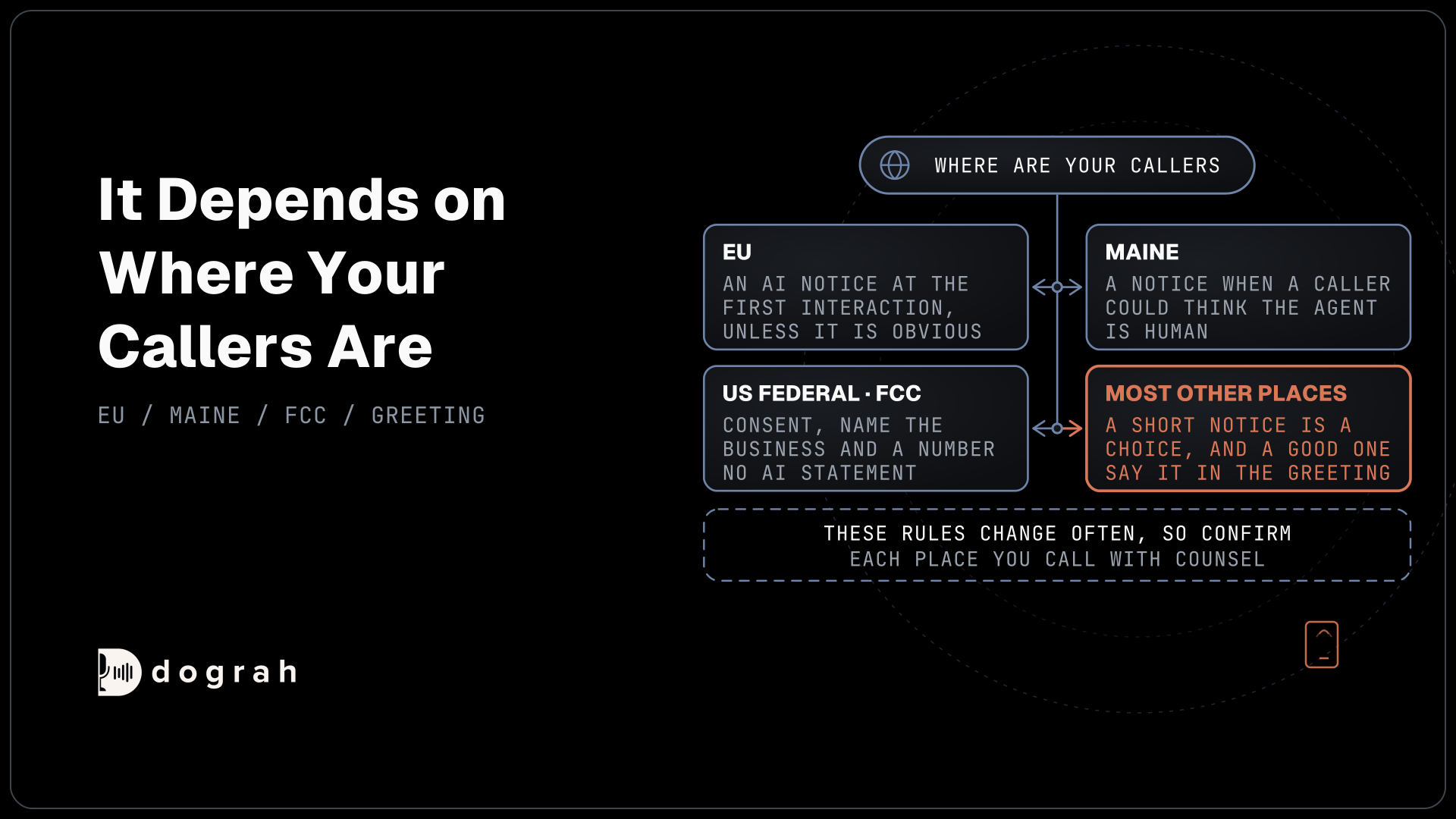

Sometimes. You must tell callers they are talking to an AI in the EU, since 2 August 2026, and in Maine when a caller could think the agent is human. US federal rules require consent and naming the business for AI-voiced calls, with no AI statement. In most other places a short notice is a choice, and a good one.
Key Takeaways
- The EU and Maine require an AI notice in the situations they name.
- The FCC treats AI voices as artificial voices, which brings consent, not an AI statement.
- Where no law asks, a one-sentence notice in the greeting still builds trust.
The honest answer depends on where your callers are and what the call is for, so a single yes or no misleads. We go through the places where a notice is required, then we talk about where it is only good practice and how to word and place it.
Where the law requires an AI notice
The clearest rule is in Europe. The EU Artificial Intelligence Act has required AI systems that talk with people to tell them so since 2 August 2026, at the latest at the first interaction, unless it is obvious from the context. On a phone call it rarely is, so in practice a voice agent serving EU callers says it at the start. Our post on what a voice agent must tell callers under Article 50 covers how the notice should sound.
In the US, Maine has the clearest rule for voice. Maine's law on AI chatbots, 10 MRSA §1500-DD, covers chatbots that talk as well as type. A business may not use one with a consumer in a way that may mislead or deceive a reasonable consumer into believing they are dealing with a human, unless the consumer is told in a clear and conspicuous manner. A breach counts as a violation of Maine's Unfair Trade Practices Act.
Maine's rule turns on whether a caller could be misled, and with a natural voice on a phone line that is the normal case. So a voice agent calling or answering Maine consumers should say it is an AI early and plainly. A few other states have narrower rules, such as answering truthfully when a consumer asks, and our post on why a voice agent should always say it is an AI lists them. These rules change often, so confirm your position for each place you call with counsel.
What the FCC ruling requires, and what it does not
The federal position comes from one ruling. The FCC's ruling on AI-generated voices, released 8 February 2024, confirms that the Telephone Consumer Protection Act's limits on calls using an "artificial or prerecorded voice" cover AI voices that sound human. An AI-voiced call therefore needs the called person's prior express consent, unless it has an emergency purpose or an exemption.
The same rules require every artificial-voice call to name the business at the start and give a phone number. That identifies who is calling. It does not require the agent to say "I am an AI", and no federal rule does. Our post on whether AI phone calls are legal covers the consent side in full, including the stricter rule for sales calls.

Open Source Alternative to Vapi / Retell
Self-hosted voice agent platform — no per-minute fees
dograh-hq/dograh
Star on GitHub
Where a notice is good practice
In most US states, no law requires a voice agent to say it is an AI, and the same is true in many countries outside the EU. That is a real gap, and some teams read it as permission to stay quiet. We think that is a mistake, for a practical reason more than a legal one.
Callers who find out halfway through a call that they were talking to software tend to feel tricked, and that lands on the business. A one-sentence notice costs a few seconds and removes the surprise. It also prepares the caller for the moments an agent handles worse than a person, such as an unusual request.
Two habits are worth keeping wherever you call. Name the business in every greeting, which US rules already require for artificial-voice calls. And when a caller asks "Am I talking to a real person?", the agent should answer plainly. The notice itself belongs in the greeting, next to the business name.
Join the Dograh Community
Dograh is an OSS alternative to Vapi. Join our Slack community for queries, releases, best practices & community interactions.
How to word and place the notice
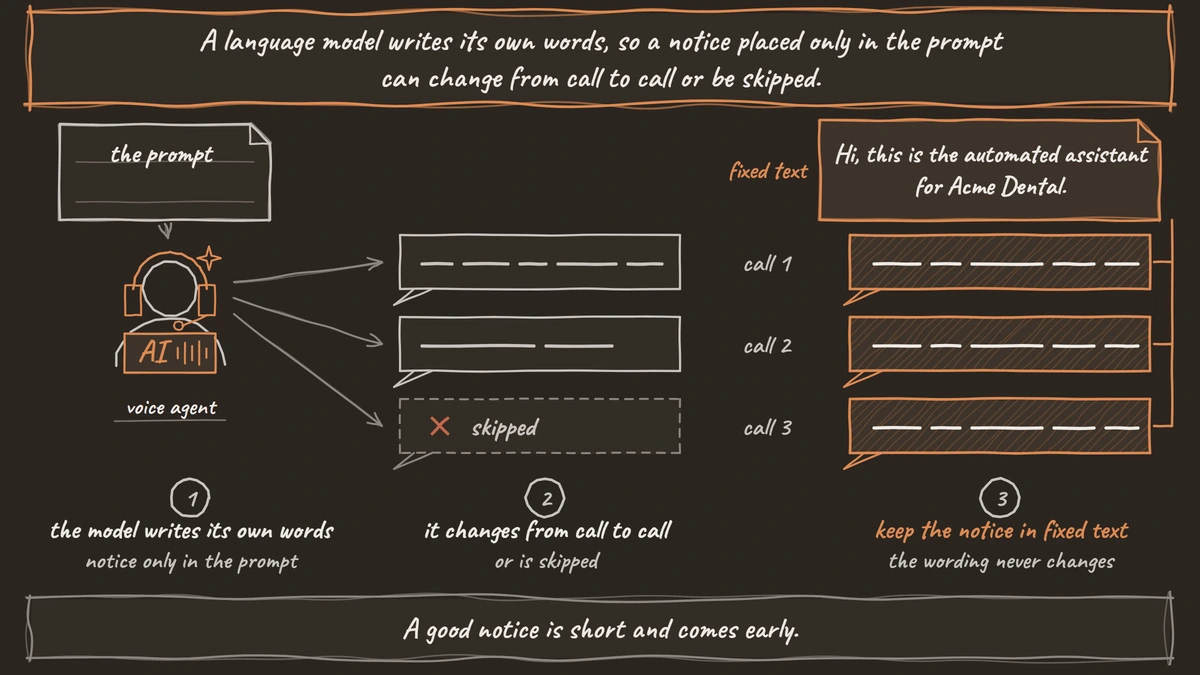
A good notice is short and comes early. Put it in the first sentence or two, next to the business name, and before the agent asks anything. These lines are examples we wrote to adapt. "Hi, this is the automated assistant for Acme Dental. I can book or move your appointment." Or, on an outbound call, "Hello, this is Acme Insurance's AI assistant, calling about your renewal."
Keep the notice in fixed text. A language model writes its own words, so a notice placed only in the prompt can change from call to call or be skipped. Recording is a separate notice under separate laws, and if you record calls, add that sentence after the AI line, as our post on call-recording consent laws explains.
In Dograh, the open-source AI voice agent platform, the notice goes in the Greeting Text of the Start Call node, which plays word for word, or in a recorded greeting. Switch off Allow Greeting Interruption, and the caller's speech is held until the greeting ends, so the notice always plays in full.
Glossary
- Artificial voice
- A voice not spoken live by a person. Since the FCC's 2024 ruling, AI-generated voices count as artificial voices under the TCPA.
- Clear and conspicuous notice
- A notice a caller cannot reasonably miss, given early and in plain words. Maine's AI chatbot law uses this standard.
- First interaction
- The EU AI Act's deadline for telling people they are dealing with an AI. On a phone call, that means the opening of the call.
- Greeting interruption
- A caller talking over the opening greeting. With it switched off, the caller's speech is held until the greeting, and any notice in it, finishes.