
AI phone calls are legal in the US, UK and EU, and the rules follow what the call does. Calls you place with an AI voice need the consent artificial or automated calls need, stricter for sales. People in the EU must hear they are talking to an AI. An AI answering your calls generally needs no calling consent.
Key Takeaways
- US law has treated AI voices as artificial voices since February 2024.
- UK and EU automated marketing calls need the person's consent before the call.
- Recording consent rules still apply when an AI answers your inbound calls.
Whether an AI may phone someone depends less on the AI than on the call. This page answers for the US, the UK and the EU in one place. It then separates calls you place from calls you answer, because that split changes which rules apply.
What decides whether an AI call is legal
None of the three regions bans AI phone calls, so the useful question is which rules a given call triggers. Two facts about the call settle most of it. The first is who started it, since calling laws are mostly written about calls a business makes, not calls it receives. The second is whether the call sells anything, because marketing calls carry the strictest consent rules everywhere.
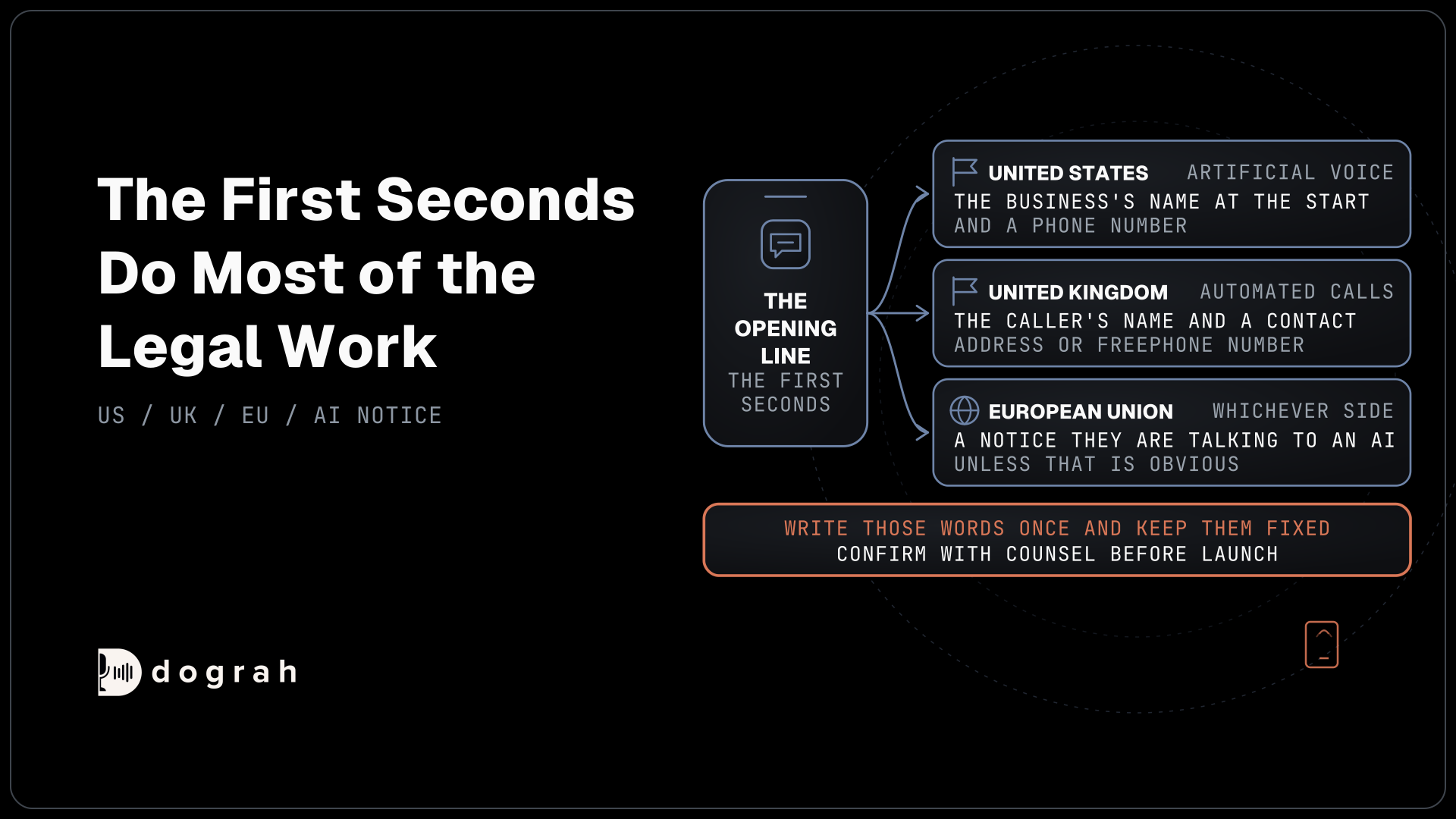
The opening line sits on top of both. US and UK rules want an artificial or automated call to name the business at the start, and the EU wants people told they are talking to an AI unless that is obvious. The table puts the main rules side by side before each region gets its own section.
| Region | AI marketing calls you place | Other calls you place | Calls you answer | What the opening must carry |
|---|---|---|---|---|
| United States | Prior express written consent for artificial-voice calls to mobile and home lines | Prior express consent, unless an emergency or an exemption applies | Generally no calling consent, recording consent still applies | The business's name at the start and a phone number |
| United Kingdom | Consent to automated calls under the Privacy and Electronic Communications Regulations (PECR), on the safe reading that an AI call is automated | Service calls sit outside PECR's marketing rules, and the UK General Data Protection Regulation (UK GDPR) applies | Generally no calling consent, UK GDPR applies | The caller's name and a contact address or freephone number |
| European Union | Prior consent under the ePrivacy Directive, through each member state's law | National rules vary, and the GDPR applies | Generally no calling consent, the GDPR applies | A notice that the person is talking to an AI, from the first interaction |
United States: AI voices count as artificial voices
The Federal Communications Commission (FCC) settled the main US question in February 2024. Its declaratory ruling on AI-generated voices confirms that the Telephone Consumer Protection Act (TCPA) limits on calls using an "artificial or prerecorded voice" cover current AI technologies that generate human voices. A call placed with an AI voice therefore needs the called person's prior express consent, unless it has an emergency purpose or falls under an exemption.
Sales calls need more. Under the FCC's calling rules, an artificial-voice telemarketing call to a mobile or home line needs prior express written consent. Every artificial-voice call must also name the business at the start and give a phone number during or after the message.
Mistakes cost real money because the law lets people sue. The TCPA lets each person called recover $500 per unlawful call, or up to $1,500 when the violation was willful or knowing, and a campaign of a few thousand calls multiplies that fast. Do-not-call lists and calling hours apply to AI sales calls just as they apply to calls a person makes, and our AI cold calling guide follows that consent chain from the first dial.
States add their own limits on top of the federal rules. Some end the calling day earlier, and some cap how often the same person can be called on the same subject in a day. Our post on outbound calling rules for voice agents covers those state windows and caps.

Open Source Alternative to Vapi / Retell
Self-hosted voice agent platform — no per-minute fees
dograh-hq/dograh
Star on GitHub
United Kingdom: PECR and automated marketing calls
PECR treats live and automated marketing calls differently. PECR's rule on automated calls allows an automated marketing call only to a person who has told the caller they consent to such calls from it. Consent to marketing in general, or to live calls, does not stretch that far.
The Information Commissioner's Office (ICO) wrote its guidance around recorded messages, and an AI agent is not a live person. So the safe reading treats an AI marketing call as automated, which means that specific consent comes before the first call. Automated calls must also carry the caller's name and a contact address or freephone number, and live marketing calls must be screened against the Telephone Preference Service.
Calls that sell nothing sit apart. A call about an existing account or policy is generally a service call outside PECR's marketing rules, but UK GDPR still covers the recording and the transcript. Once a service call adds an offer, it becomes marketing. Our post on AI voice agents for UK insurance works through that split for renewals and quote chases.
European Union: consent and an AI notice
Two EU laws apply before anything specific to AI. The ePrivacy Directive allows direct marketing through automated calling systems without human intervention only to people who have given prior consent. An AI agent placing a marketing call with no person on the line generally fits that description. Each member state writes the rule into its own law, sometimes with extra limits, so the country you call matters. The General Data Protection Regulation (GDPR) then covers everything the call produces, including the recording and the transcript.
The AI Act adds the rule that is about AI itself. Since 2 August 2026, an AI system that talks with people must be designed so they are told they are dealing with an AI, unless that is obvious. The Commission's questions and answers on Article 50 say the notice should come from the start of the first interaction, in a clear and distinguishable way.
That notice covers calls the AI answers as much as calls it makes, and breaches can be fined up to 15 million euros or 3% of worldwide turnover. Our post on what a voice agent must tell callers under Article 50 covers the narrow exception for obvious cases and gives sample opening lines.
Dates that change AI calls in late 2026
Both the EU and the US rules moved this year. Regulation (EU) 2026/1744, the Digital Omnibus on AI, was adopted and came into force on 27 July 2026. It pushed the AI Act's high-risk duties to 2 December 2027 for listed uses such as credit scoring and hiring, and to 2 August 2028 for AI built into regulated products. It left the 2 August 2026 date for the AI notice where it was.
One more EU date falls on 2 December 2026. That is when the grace period ends for machine-readable marking of AI-generated audio from systems already on the market, a duty that sits with whoever provides the voice generator. A business running a customer service agent mostly feels it through its voice vendor.
In the US, an FCC rule on revoking consent takes effect on 25 November 2026. A caller may then name one way for people to opt out, as long as the call says so clearly, and may treat a stop said after an informational call as covering only that kind of call. Stop requests still have to be honored within 10 business days.
Join the Dograh Community
Dograh is an OSS alternative to Vapi. Join our Slack community for queries, releases, best practices & community interactions.
Calls you answer versus calls you place
Most calling law is written about calls a business makes. The TCPA's artificial-voice rules restrict making or initiating calls, and the consent rules in PECR and the ePrivacy Directive cover marketing calls a business sends out. A business that answers calls people place to it, with an AI receptionist or a support agent, is not initiating those calls, so it generally needs no calling consent for them.
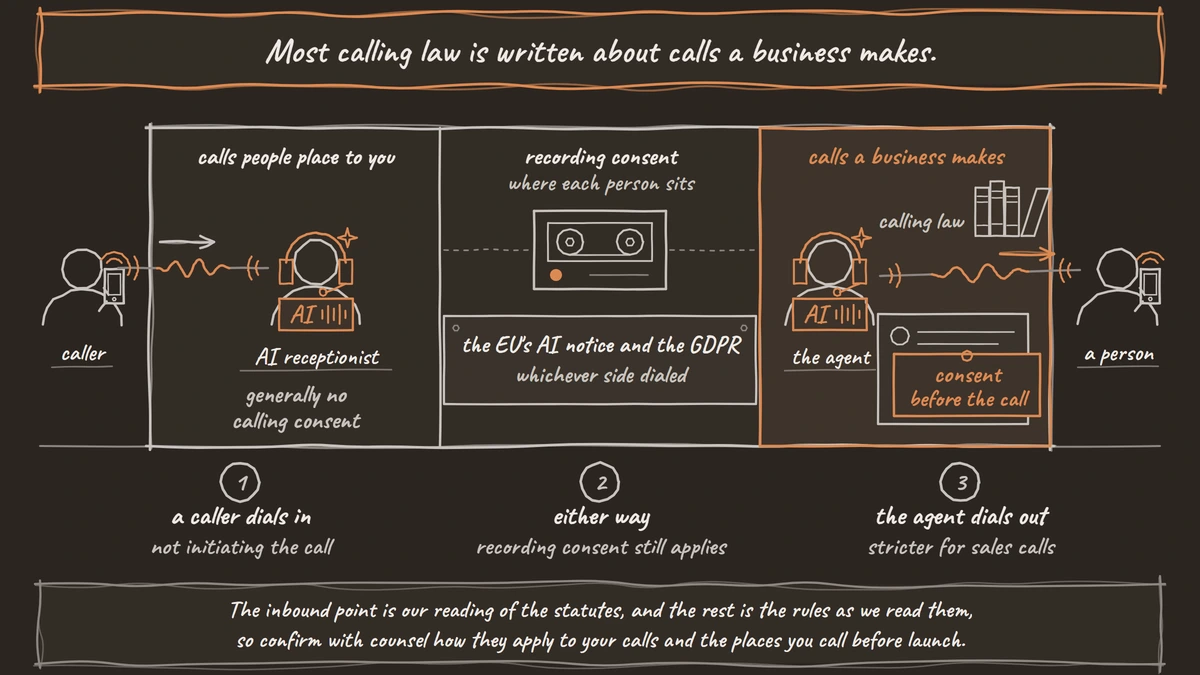
Other rules still reach inbound calls. Recording needs consent under the law where each person sits, which is one party under the federal wiretap law and every party in states such as California. Our post on call-recording consent laws covers the notice wording. The EU's AI notice and the GDPR apply whichever side dialed. The inbound point is our reading of the statutes, and the rest is the rules as we read them, so confirm with counsel how they apply to your calls and the places you call before launch.
The opening line that carries the rules
The first seconds of a call do most of the legal work. In the US and UK, an artificial or automated call names the business at the start, with a phone number in the US and a contact address or freephone number in the UK. In the EU, the same opening tells the person they are talking to an AI.
Write those words once and keep them fixed, because a language model asked to say a required line can paraphrase it away. In Dograh, the open-source AI voice agent platform we build, the fixed opening is the Greeting Text on the Start Call node, which plays word for word the moment the call connects. If you want to tell callers they're speaking with an automated assistant, or your location requires it by law, write it in the Greeting Text along with the business's name.
Glossary
- Artificial or prerecorded voice
- The TCPA's term for a voice that is not a live person speaking. The FCC confirmed in February 2024 that AI-generated voices fall inside it, so AI calls follow the same consent rules.
- Prior express written consent
- A signed agreement, which can be electronic, to receive sales calls using an artificial voice at a given number. US artificial-voice telemarketing to mobile and home lines needs it.
- Automated calling system
- Equipment that places calls and plays messages without a person on the line. EU and UK rules require prior consent before such systems make marketing calls.
- AI notice
- The AI Act's requirement that people talking with an AI system are told so, unless that is obvious. On a phone call it belongs in the opening line.