
RingCentral AI Receptionist suits teams already on RingCentral phones who want AI answering on the same bill. It starts at $49 a month with 100 minutes, then $0.50 a minute. Dograh, the open-source AI voice agent platform we build, is the option for owning the agent instead. You can self-host it or run it on Dograh Cloud.
Key Takeaways
- Every minute past 100 costs $0.50, billed in 30-second steps.
- Transfers to your staff carry a call summary and caller details.
- Dograh takes RingCentral calls through forwarding, not a direct integration.
This post is part of our guide to AI receptionists, where software is judged on the hard calls first and price second. Below, we review RingCentral's add-on, its plans, its pros and cons and who it suits. The last section covers Dograh, for teams that want to own the agent.
What RingCentral AI Receptionist does
RingCentral AI Receptionist, or AIR for short, answers business calls with an AI agent at any hour. RingCentral AIR answers questions, books appointments, captures leads and sends texts. It routes callers by name, location, department, keyword or the context of the call.
It speaks English, Spanish, French, Italian, German and Portuguese. It connects to Salesforce, HubSpot and Zoho and to Google and Outlook calendars, with WhatsApp, Calendly and Shopify marked as coming soon. RingCentral says customer data is not used to train its AI.
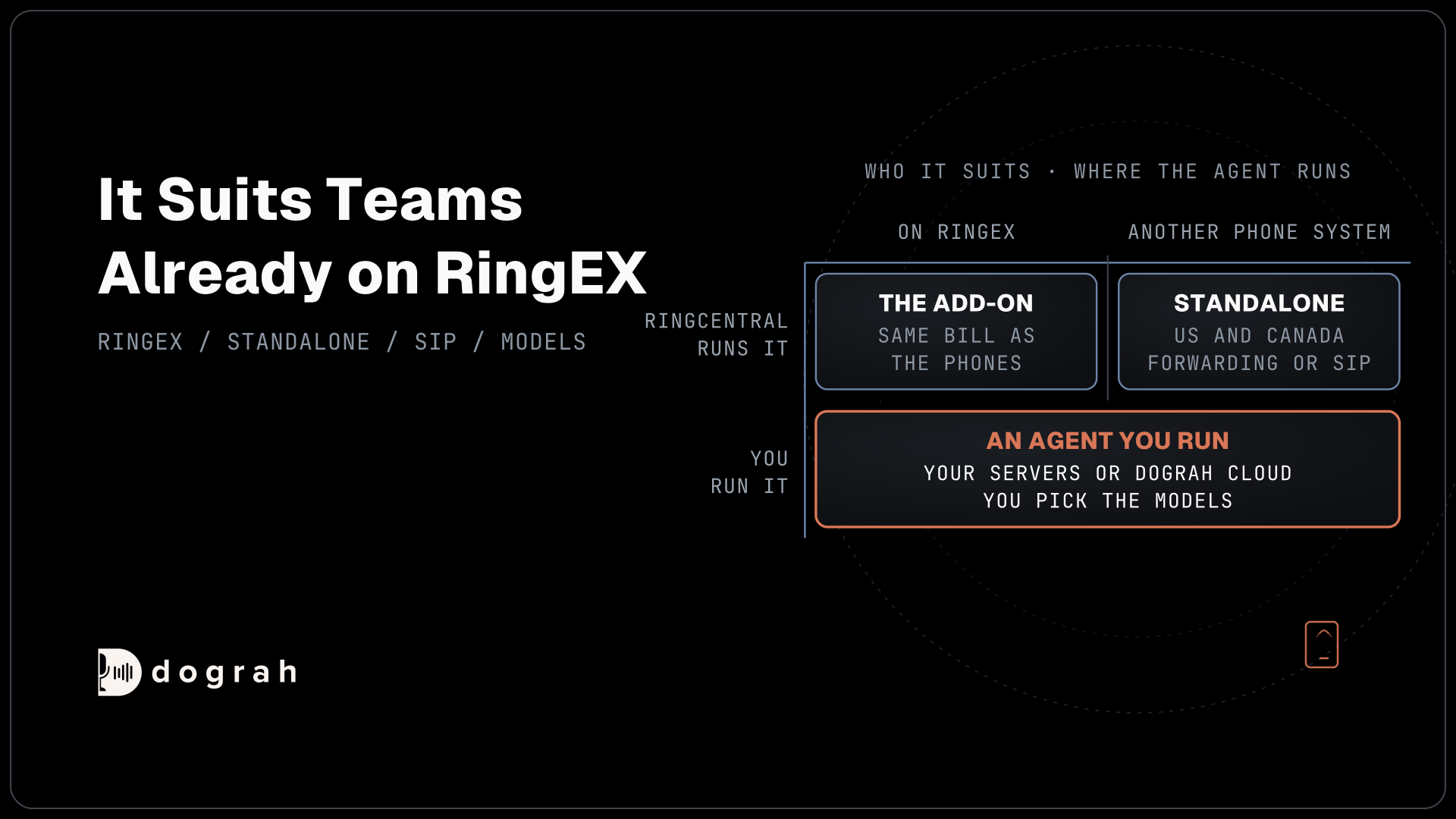
You can buy it on its own or as an add-on to RingEX, RingCentral's phone system, in the US and Canada, and as an add-on in the UK, Australia and the EU. It can also sit in front of another company's phone system through call forwarding or SIP.
Plans and what a month costs
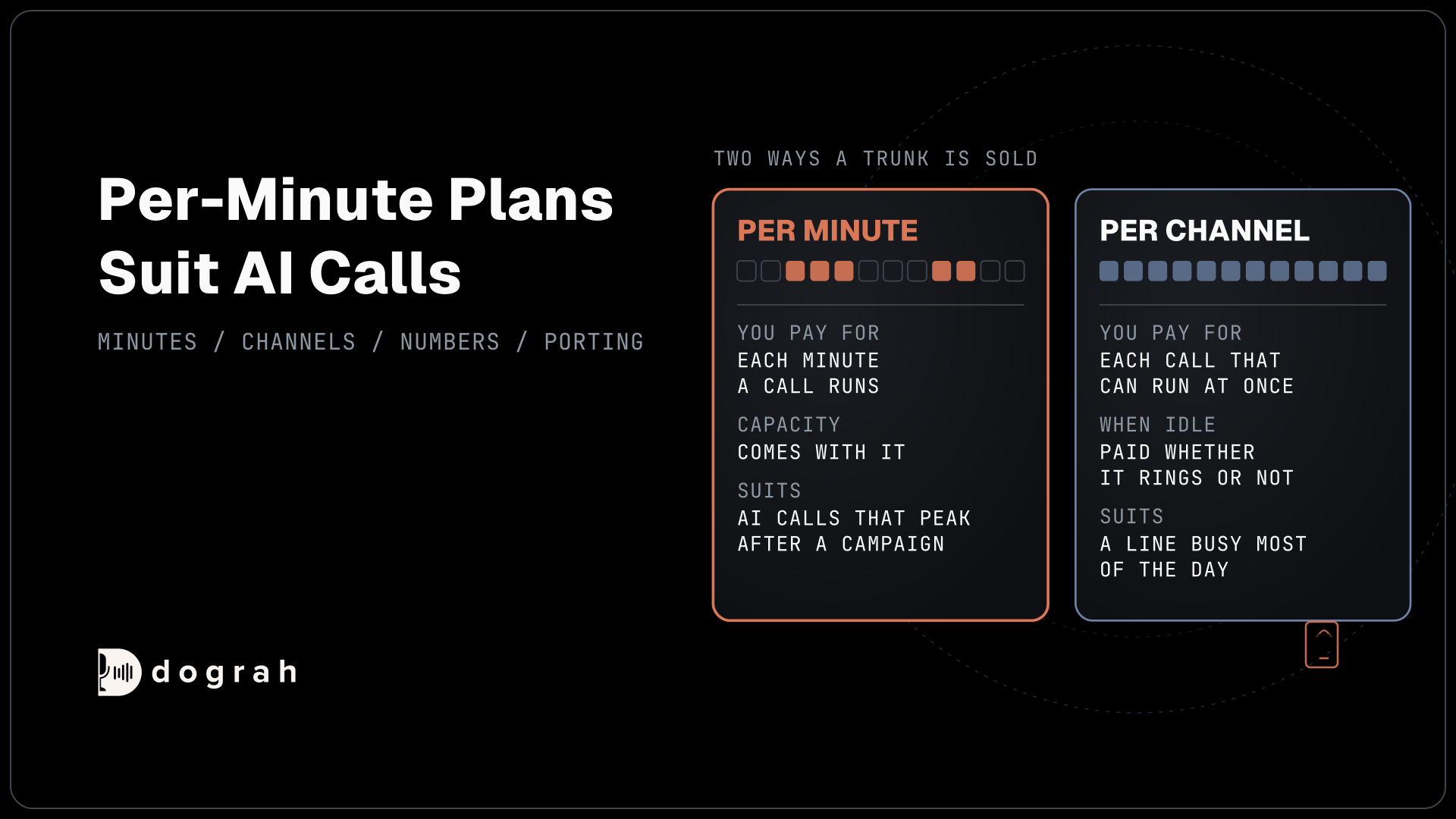
There are two ways to buy AIR, and both include 100 minutes. The standalone RingCentral AIR plan starts at $49 a month. As an add-on it is $39 a month on top of RingEX Core at $30 a month, $69 in all. Every minute past the included 100 costs $0.50, rounded up and billed in 30-second steps, and bundles of extra minutes are available.
| Option | Monthly price | Included | After that | Where the agent runs |
|---|---|---|---|---|
| AIR standalone | From $49 | 100 minutes | $0.50 a minute, in 30-second steps | RingCentral's service |
| AIR with RingEX | $39 plus $30 for RingEX Core | 100 minutes | $0.50 a minute, in 30-second steps | RingCentral's service |
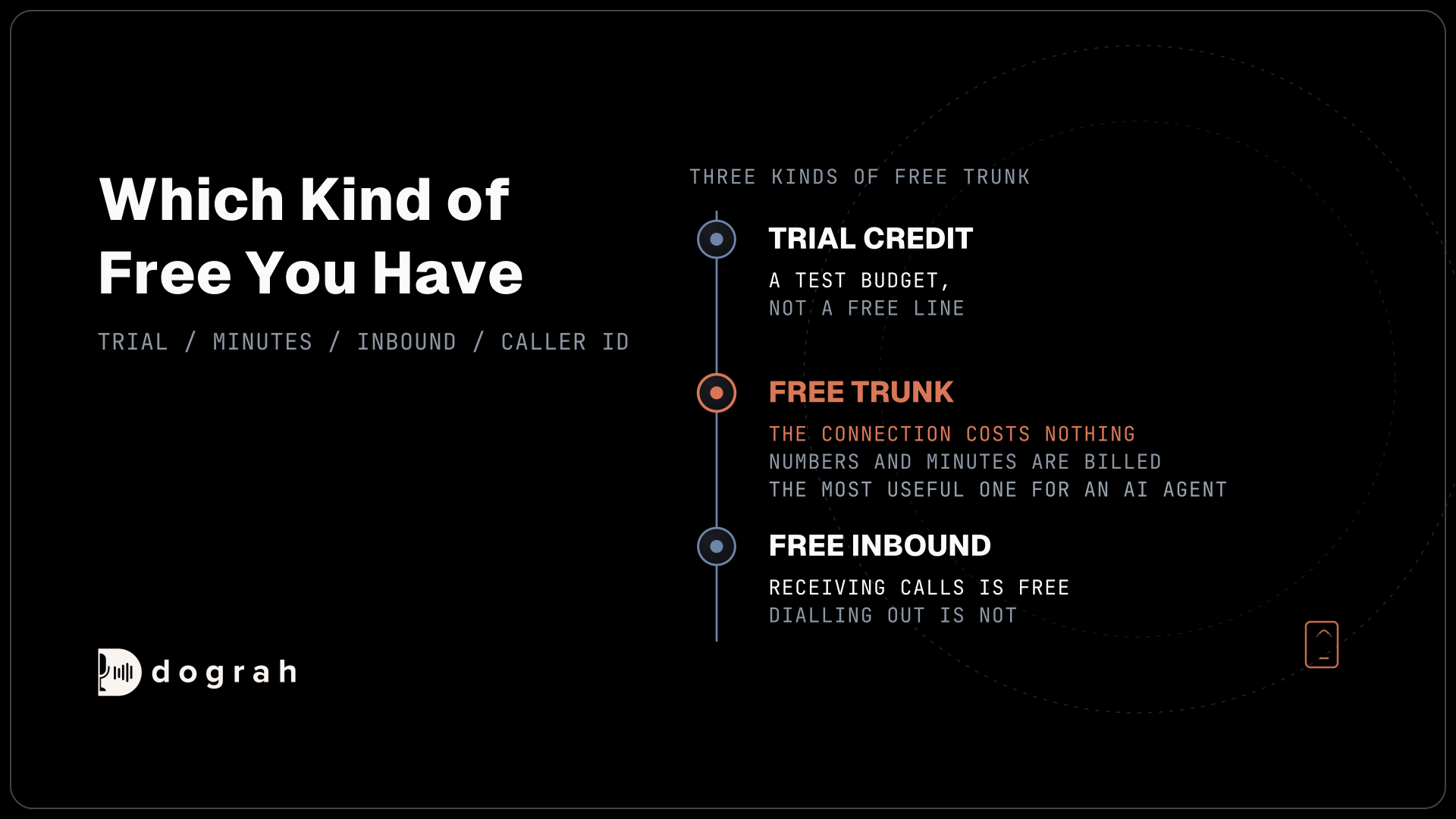
| Dograh Cloud | Prepaid credits from $5 | Pay as you go | 1¢/min platform fee, plus your phone line and models | Dograh's managed cloud |
| Dograh self-hosted | No platform fee | Not metered | Your servers, phone line and models | Your own servers |
Here is one example month, built from those list prices. A small office takes 200 calls that each bill at exactly 2 minutes, 400 minutes in all. On the standalone plan, the first 100 minutes are included and the other 300 cost 300 x $0.50 = $150, so the month is $49 + $150 = $199. As a RingEX add-on, the same month is $69 + $150 = $219.
The 30-second steps push real bills above that for short calls. A call of 61 seconds bills as 1.5 minutes, so an office that takes many quick calls pays for more minutes than its callers spend talking. AI texts may also cost extra, so add them if your agent sends many.
Pros: where it works well
Its biggest strength is that it is native to RingCentral. A team already on RingEX turns it on without forwarding numbers or adding a carrier, and it sits on the same bill as the phones.
The handover is well thought out. RingCentral says transfers include a call summary and caller details, so the staff member who picks up does not start from zero. Routing by department or keyword suits offices with several teams, and six languages plus CRM connectors cover a lot of small-business needs without building anything.

Open Source Alternative to Vapi / Retell
Self-hosted voice agent platform — no per-minute fees
dograh-hq/dograh
Star on GitHub
Cons: what to check before you buy
Minutes are the main cost risk. At $0.50 a minute past the first 100, billed in 30-second steps, a busy month grows quickly, so price your real call log before you sign.
Several integrations are still marked coming soon, including WhatsApp, Shopify and Calendly, so check that the ones you need are live. If you take patient calls, ask RingCentral in writing whether a business associate agreement (BAA) under the Health Insurance Portability and Accountability Act (HIPAA) covers AIR. RingCentral lists HIPAA and SOC 2 compliance for AIR, but a compliance claim is not the same as a signed BAA.
The agent also runs on RingCentral's service and is set up with RingCentral's tools. Moving it to another provider later means building it again there.
Who RingCentral AI Receptionist suits
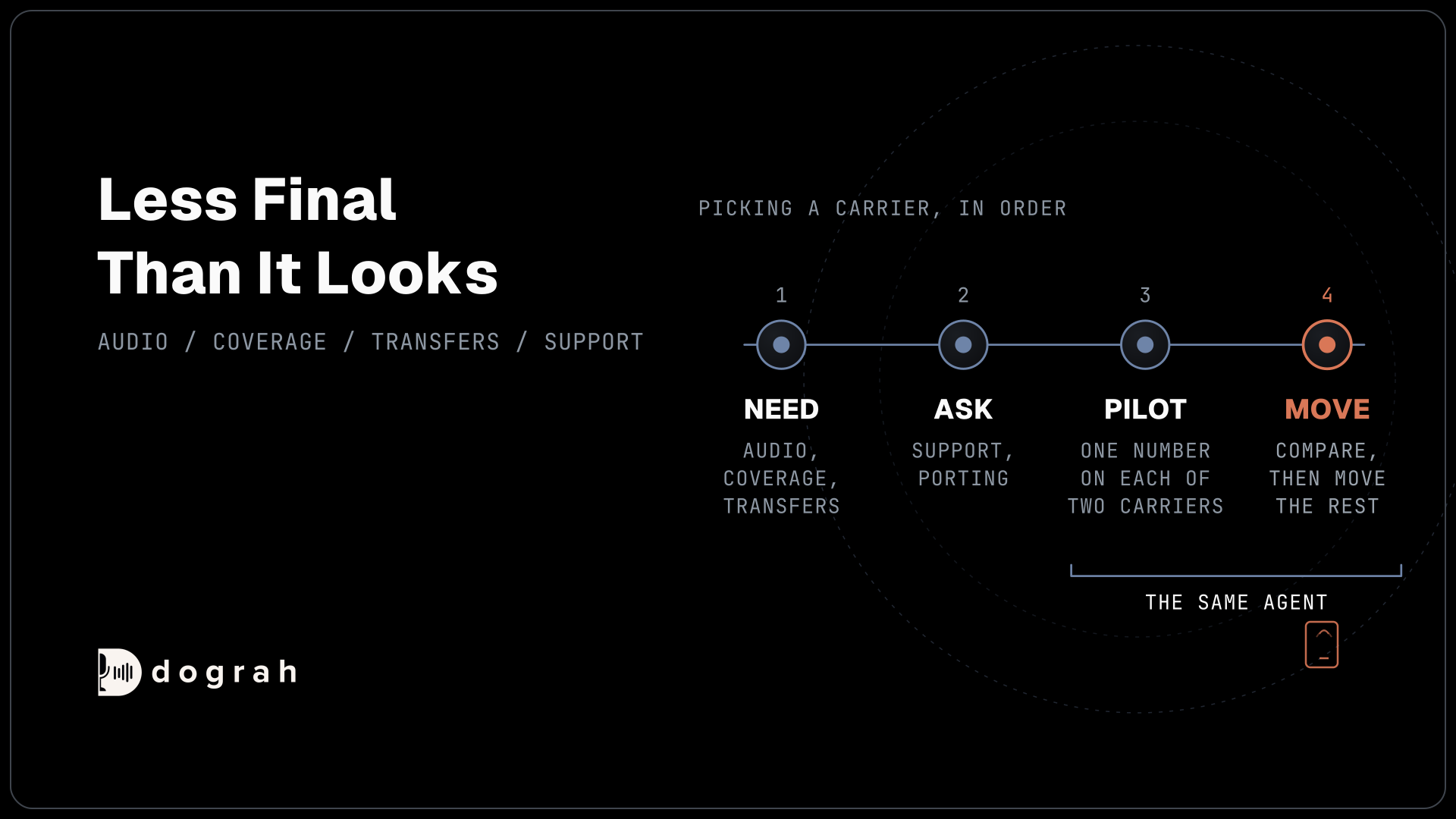
It suits teams already on RingEX who want AI answering on the same bill and a handover with a summary attached, at volumes where 100 included minutes go a long way. It suits fewer teams that need the agent on their own servers or a choice of speech and language models. For other phone systems, our roundup of the best AI receptionist software compares ready-made products and platforms you build on.
Join the Dograh Community
Dograh is an OSS alternative to Vapi. Join our Slack community for queries, releases, best practices & community interactions.
Sending RingCentral calls to Dograh
The route from RingCentral to Dograh is call forwarding rather than a direct integration, and it keeps your RingCentral numbers. In RingCentral, turn on Forward all calls and choose "Forward the call", which sends calls to any extension or phone number.
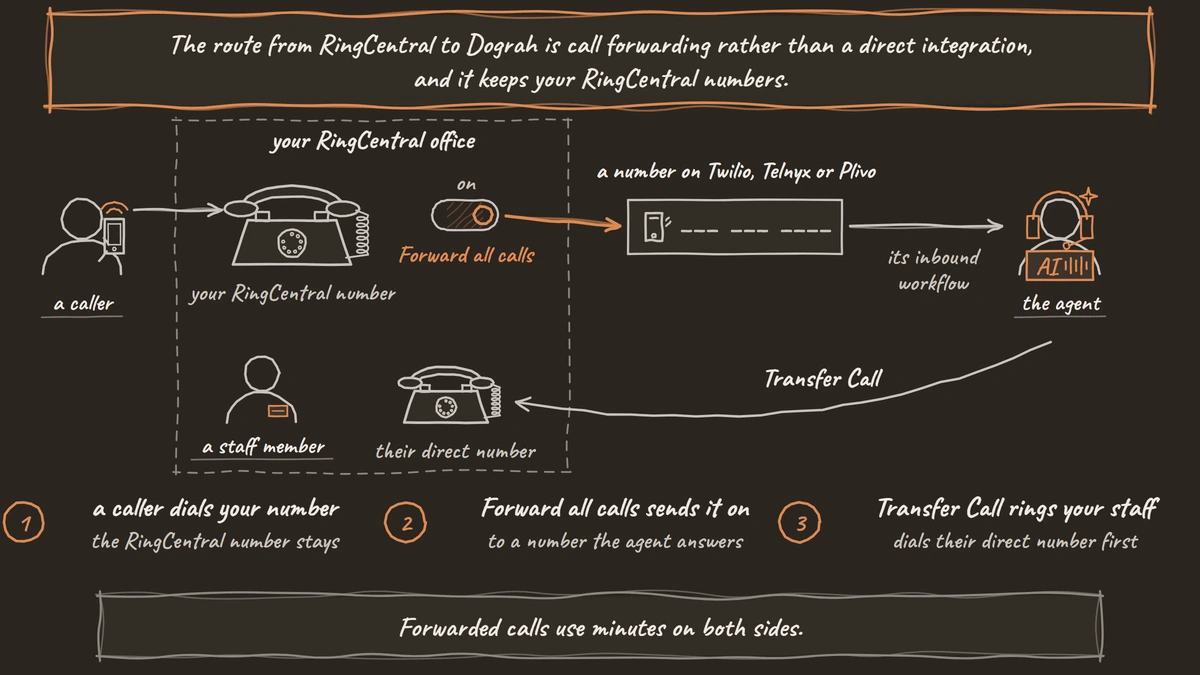
Point it at a number on a provider Dograh connects to, such as Twilio, Telnyx or Plivo, and assign your agent to that number as its inbound workflow. Forwarded calls use minutes on both sides. The Dograh-side number bills its own inbound minutes, for example $0.0085 a minute on a Twilio US local number, and RingCentral bills whatever it charges for the forwarded leg.
Handing calls back to your staff works through Transfer Call. It dials a RingCentral user's direct number first while the caller hears hold music, and connects them only when that person answers. It works on Twilio, Telnyx, Plivo, Cloudonix and Asterisk ARI, and if nobody answers within 30 seconds, the default, the caller stays with the agent.
Where AIR passes a summary, Dograh has the agent write the caller's details to your system through an HTTP API tool before the transfer. On Twilio you can also add a short spoken introduction that both people hear before they are connected. It is off by default.
What you get in return is ownership. Self-hosted Dograh has no per-minute platform fee, but servers, model keys and phone minutes still cost money. Dograh Cloud charges a 1¢-a-minute platform fee. You pick the speech and language models, by your own key or as open-weight models on your servers, and every call has a full trace and can be scored by built-in QA.
To see the full setup, our tutorial on how to build an AI receptionist goes step by step, and our page on running an AI receptionist on your own phone lines covers keeping the numbers you already have.
Glossary
- RingEX
- RingCentral's business phone system. AIR can be added to it for $39 a month on top of RingEX Core, or bought on its own in the US and Canada.
- 30-second steps
- The billing increment AIR uses, the block of time a call is rounded up to on the bill. AIR rounds usage past the included minutes up to the next 30 seconds, so a 61-second call bills as 1.5 minutes.
- Call forwarding
- A phone-system setting that sends incoming calls to another number. It is how RingCentral calls reach an agent you run on Dograh, and the forwarded call uses minutes on both sides.
- Transfer Call
- The step in a Dograh agent that hands the caller to a member of staff. It dials the person first, connects the caller only when they answer and returns the caller to the agent if nobody picks up within the timeout.