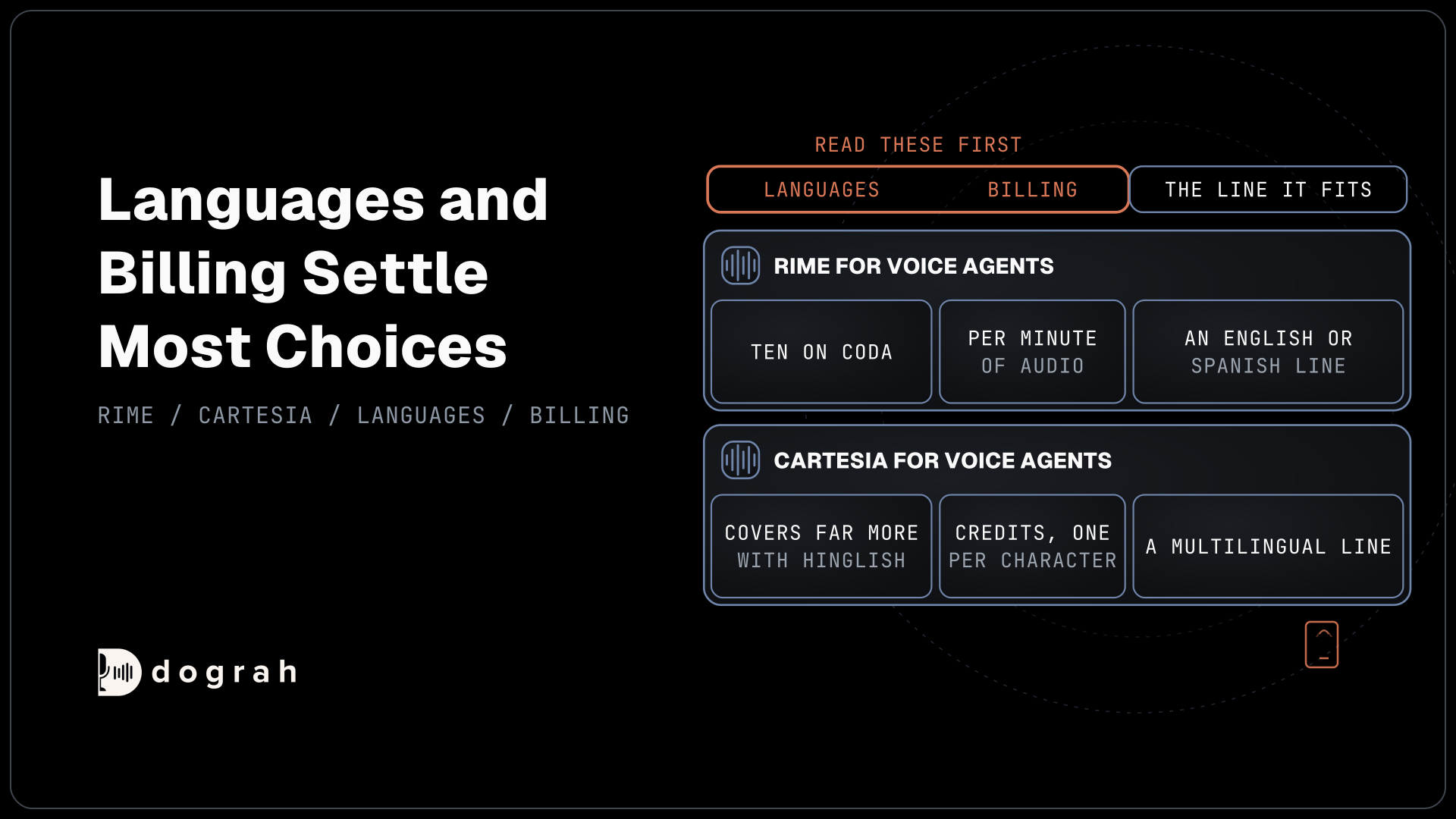

Rime vs Cartesia comes down to languages, listener votes and billing. Cartesia's Sonic 3.6 speaks 44 languages and sits near the top of Artificial Analysis's blind-vote board. Rime charges a flat rate per audio minute, $0.030 for Mist v3, and its Coda model covers ten languages. Both return 8 kHz phone audio natively.
Key Takeaways
- Cartesia's Sonic 3.6 speaks 44 languages, and Rime's Coda covers ten.
- Rime bills per audio minute, while Cartesia bills credits per character.
- Both return 8 kHz phone audio natively, so compare them on a real call.
Rime and Cartesia both sell voices built for real-time agents, and the right pick depends on your callers' languages and how you want to be billed. This post sets the two side by side, looks at how each sounds on a phone line and prices a 10,000-minute month. The last section shows how Dograh runs either one.
Rime vs Cartesia in one table
Both are closed, hosted text-to-speech services that stream audio back while the agent is still talking, and both sell an enterprise deal that moves the model into your own cloud or data center. The table sets them side by side on the points a phone agent depends on.
| Rime | Cartesia | |
|---|---|---|
| Main models | Coda, and Mist v3 for the fastest start | Sonic 3.6, with Sonic 3.5 and Sonic 3 still offered |
| Languages | 10 on Coda, 4 on Mist v3 | 44 on Sonic 3.6 |
| Phone audio | G.711 μ-law at 8 kHz, native | μ-law and A-law at 8 kHz |
| Speed, in the vendor's words | About 37 ms P50 for Mist v3 in Rime's benchmark | First audio in under 90 ms |
| Blind listener votes | Coda v2 in the top half, Mist v3 not listed | Sonic 3.6 near the top |
| How you pay | Per minute of audio | Credits, 1 per character |
| List price | Mist v3 $0.030 and Coda v2 $0.050 a minute on Flex | Plans from $5 to $299 a month, then overage |
| Voice cloning | Enterprise only | Instant from Pro, professional from Startup |
| Your own cloud or on-prem | Enterprise, cloud, VPC or on-prem | Enterprise, on-prem or VPC |
Read the languages and billing rows first, because they settle most choices before quality enters the picture.
Models and languages
Rime runs two current model families. Rime's model guide calls Coda the default for most new apps, its flagship, with ten cloud languages, English, Arabic, Dutch, French, German, Hindi, Italian, Japanese, Portuguese and Spanish, across 313 voices. Mist v3 trades range for speed and speaks English, French, German and Spanish. Mist v1 and v2 retire on 3 December 2026, and a request that names no model is served by Mist v3, so always set the model you mean.
Cartesia's current model is Sonic 3.6, released as the snapshot sonic-3.6-2026-08-27, with native support for 44 languages, including Hinglish for calls that mix Hindi and English. Sonic 3.5 and Sonic 3 stay available for teams that pinned them. Cartesia also sells Ink speech-to-text and a hosted agent product, and our guide to Cartesia's features covers those.
For an English-only agent the language gap does not matter. For a multilingual line, Cartesia covers far more ground, and Rime's list is worth checking against your callers before anything else.
Phone audio at 8 kHz
Most phone calls still reach a voice agent as 8 kHz audio, so a voice has to sound right at that rate, which a browser demo cannot show. Both vendors handle this natively. Rime synthesizes G.711 μ-law at 8 kHz without a conversion step, and Cartesia's output formats include μ-law and A-law at 8,000 Hz, with μ-law used in North America and Japan and A-law in Europe and India.
Native phone audio saves a resampling step and the small quality loss that comes with it. It does not tell you how a voice sounds once a carrier compresses it, and bright, wide-band voices can lose more on a phone line than calmer ones. Play the same script through both on a real call to the kind of phones your callers use, because a browser test at 16 kHz hides most of that difference.
Speed claims and how to check them
Each vendor publishes its own speed figure, and they are not measured the same way. Rime says Mist v3 reaches about 37 ms P50 in its own benchmark, and that Coda runs under 100 ms of model latency on its GPU engine when self-hosted, with 25 to 50 ms of network time added from most of the continental US in its cloud. Cartesia says Sonic 3.6 delivers first audio in under 90 ms.
These are claims from each vendor, timed on their own setups, and setting them side by side as if one stopwatch measured both would mislead. Some comparison pages line up a text-to-speech figure against a speech-to-speech one, which measures a different stretch of the call. Neither vendor's number includes your language model or the network between you and the caller.
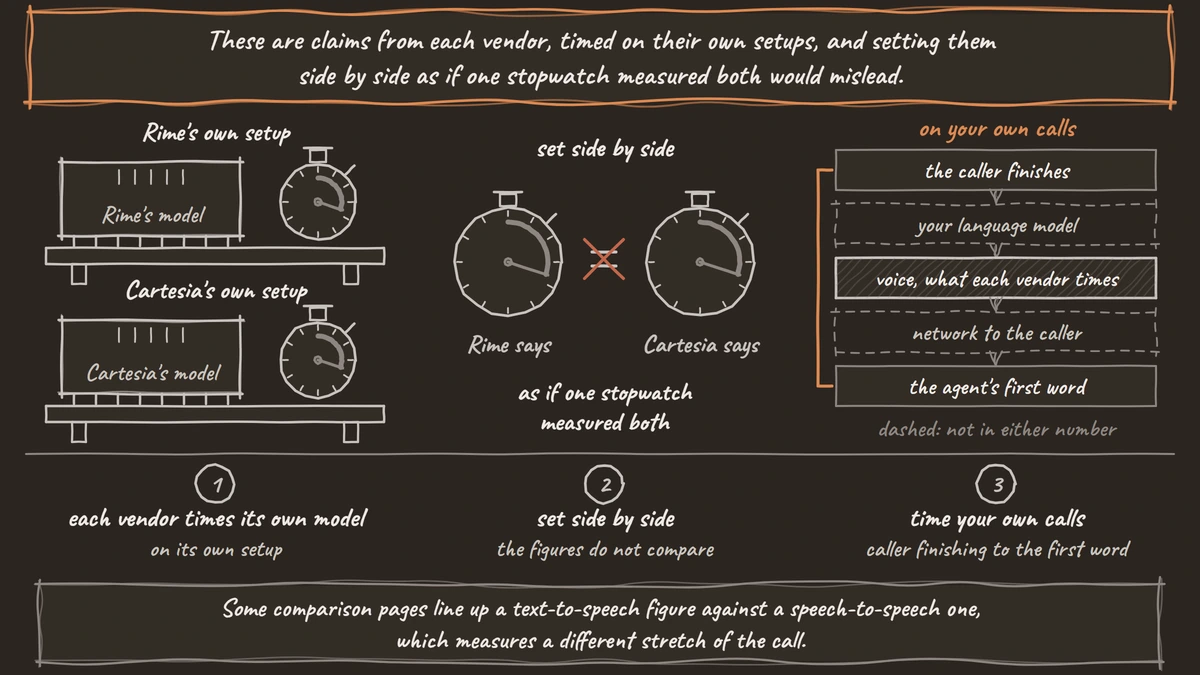
What matters is the time from the caller finishing to the agent's first word on your own calls. Run both voices on the same agent, place a few dozen real calls, and read how long the voice step took on each turn in your call traces.

Open Source Alternative to Vapi / Retell
Self-hosted voice agent platform — no per-minute fees
dograh-hq/dograh
Star on GitHub
What listeners vote for
The best independent view of quality is Artificial Analysis's blind-vote board, where listeners pick the better of two unlabeled clips and the votes become a ranking. Sonic 3.6 sits near the top of that board. Coda v2 sits in the top half, well below it, and older Rime models rank lower. Mist v3, Rime's fastest model, is not listed.
The board has two limits worth keeping in mind. Its clips are full-quality audio, not 8 kHz phone audio, and it is a live board that moves as new models arrive. Treat it as a strong signal on naturalness and confirm on your own line, since a voice that wins in a headphone test can lose some of its edge on a phone.
What 10,000 minutes a month costs
The two vendors count the bill in different units. Rime's pricing charges per minute of audio, with a Free plan that includes $50 of usage a month, Flex with no monthly fee, and Scale at $100 a month with 20% off every rate and a $100 monthly credit that rolls over up to $200. Cartesia's plans sell credits at one per character, which Cartesia puts at about 750 to 800 credits per minute of speech.
Here is an example month of 10,000 minutes of agent speech, at list prices.
| Plan | Rate | 10,000 minutes |
|---|---|---|
| Rime Flex, Mist v3 | $0.030 a minute | $300 |
| Rime Flex, Coda v2 | $0.050 a minute | $500 |
| Rime Scale, Mist v3 | $100 a month, $0.024 a minute | $240, the fee counts as credit |
| Rime Scale, Coda v2 | $100 a month, $0.040 a minute | $400 |
| Cartesia Startup | $49 with 1.25M credits, $45 per extra 1M | About $330 to $353 |
| Cartesia Scale | $299 with 8M credits | $299, using about the whole month's credits |
Each vendor's conversion drives these sums. Rime counts about 1,000 characters a minute for its own rates, and Cartesia's bill follows the text, so wordy replies or fast speech raise a Cartesia bill and leave a Rime bill alone. Cartesia also caps concurrent requests by plan, at 5 on Startup and 15 on Scale, which matters for a busy phone line. Our breakdown of Cartesia pricing covers every plan in detail.
Cloning, deployment and data
Cartesia makes cloning self-serve. Instant cloning starts on the $5 Pro plan, and professional clones come with Startup, which has two slots, and Scale, which has four. Rime keeps custom voice cloning for Enterprise customers, so a team that needs its own brand voice from day one gets there faster on Cartesia.
Both move the model closer to your data only through an enterprise contract. Rime's Enterprise plan runs in its cloud, your VPC or on-prem, with a HIPAA BAA and SOC 2 Type II. Cartesia's Enterprise tier offers on-prem or VPC through sales, with SOC 2 Type II, DPAs and BAAs. On every other plan, the text your agent speaks goes to the vendor's cloud to be turned into audio.
Join the Dograh Community
Dograh is an OSS alternative to Vapi. Join our Slack community for queries, releases, best practices & community interactions.
Which voice fits which call
Cartesia fits a multilingual line and a team that wants its own cloned voice without a sales call. It also suits any agent where naturalness on listener votes carries the most weight. Its credit plans suit a steady monthly volume that fits inside one plan's credits.
Rime fits an English or Spanish line where a flat per-minute price matters more than the widest language list, and teams that want Mist v3's speed claim for short, quick replies. Its billing is easier to forecast when reply length varies. Our guide to Rime for voice agents covers its models, pronunciation controls and setup in depth.
When the facts leave a tie, let a real phone call decide. Put each voice on the same agent for a day of test calls and compare the recordings and traces before you sign a plan.
Where Dograh fits
Dograh, the open-source AI voice agent platform, has both voices built in on your own key, so you can run that test without new code. Cartesia is a Dograh partner, and the comparison above stays on published facts. You choose the voice for each agent in the voice settings, so one agent can run on Cartesia while another runs on Rime.
For Cartesia, the model starts at sonic-3.6, the voice ID comes from your Cartesia account so your clones work, and the language code passes through as typed. For Rime, set the Model field to coda or mistv3, and note that English, German, French, Spanish and Hindi pass through to Rime. Each call's trace shows how long the voice took on each turn, which is the speed test that counts. Run the same script on each voice for a day of real calls and the traces settle the question.
It runs on your own servers or on a hosted cloud, and the voice bill stays with your Rime or Cartesia account either way. Running Dograh yourself means no per-minute platform fee. You still pay for servers, model keys and phone minutes, and your team looks after the database and upgrades. Support comes from the open-source community, and Enterprise adds custom SLAs. If you would rather not host it, Dograh Cloud runs it for a 1 cent a minute platform fee. Fixed lines such as a greeting can play as pre-recorded audio, which skips the voice model and its bill on those lines. Our head-to-head with Cartesia covers how the platform and the voice vendor split the work.
Glossary
- G.711 μ-law
- The standard way North American and Japanese phone networks encode 8 kHz voice audio. A voice that outputs it natively needs no conversion before the call.
- First audio
- The moment a voice model sends back its first sound, counted from when it receives the text. Vendors time it on their own setups, so figures differ in what they include.
- Credits
- Cartesia's billing unit. Sonic uses one credit per character of text, which Cartesia puts at about 750 to 800 credits per minute of speech.
- Blind-vote board
- A ranking built from listeners choosing the better of two unlabeled voice clips. It measures naturalness, not speed or phone-line quality.