
Dograh vs Cartesia compares a platform with the models inside it. Cartesia makes Sonic voices, Ink speech-to-text and hosted Managed Agents. Dograh, an open-source AI voice agent platform and a Cartesia partner, runs the whole call for teams that want to own it, with Cartesia models on their own key.
Key Takeaways
- Sonic 3.6 speaks 44 languages and sits near the top of a blind-vote board.
- Ink 2 has turn detection built in and covers five languages.
- Cartesia Managed Agents cost $0.03 a minute, with the language model billed separately.
Cartesia makes speech models, while Dograh is an open-source platform that runs the whole call, and the two work together because Dograh can use Cartesia's voices and transcription. This post sets a model API beside a full platform and shows what each one handles. The last section covers when Dograh fits.
Dograh vs Cartesia at a glance
Cartesia and Dograh sit on different layers of a voice agent, and most rows show how they fit together more than how they compete. Each row compares the two on the same question.
| Row | Cartesia | Dograh |
|---|---|---|
| What it is | A voice AI lab selling speech models and Managed Agents | An open-source platform that runs the whole call |
| Code and weights | Closed models, served by API | Open source under BSD 2-Clause |
| Speech models | Sonic text-to-speech and Ink speech-to-text | Dograh's own models, Cartesia and other providers on your keys, or open voices you host |
| Building an agent | Managed Agents in the Playground or by API | Agent Builder chat or the canvas, with tools, QA and transfers |
| Where it runs | Cartesia's cloud, with on-prem or VPC model deployment through sales | Your servers, Dograh Cloud, or on-prem on Enterprise |
| Phone lines | A Cartesia number or your own carrier | Twilio, Telnyx, Plivo, Vonage, Exotel, Vobiz, Cloudonix and Asterisk ARI |
| Pricing unit | Credits for models, dollars per minute for agents | Self-hosted, no per-minute platform fee. Dograh Cloud, 1¢/min platform fee |
| How they connect | Cartesia is a built-in voice and speech-to-text provider in Dograh | Sonic 3.6 is the default Cartesia voice model in Dograh |
A model API next to a full platform
Cartesia makes the voice and the hearing, and a platform like Dograh runs the conversation around them. Sonic 3.6 turns text into speech and Ink turns the caller's speech into text, each called by API. A phone agent needs more than that, from the phone line and turn-taking to tools, transfers and a record of every call.
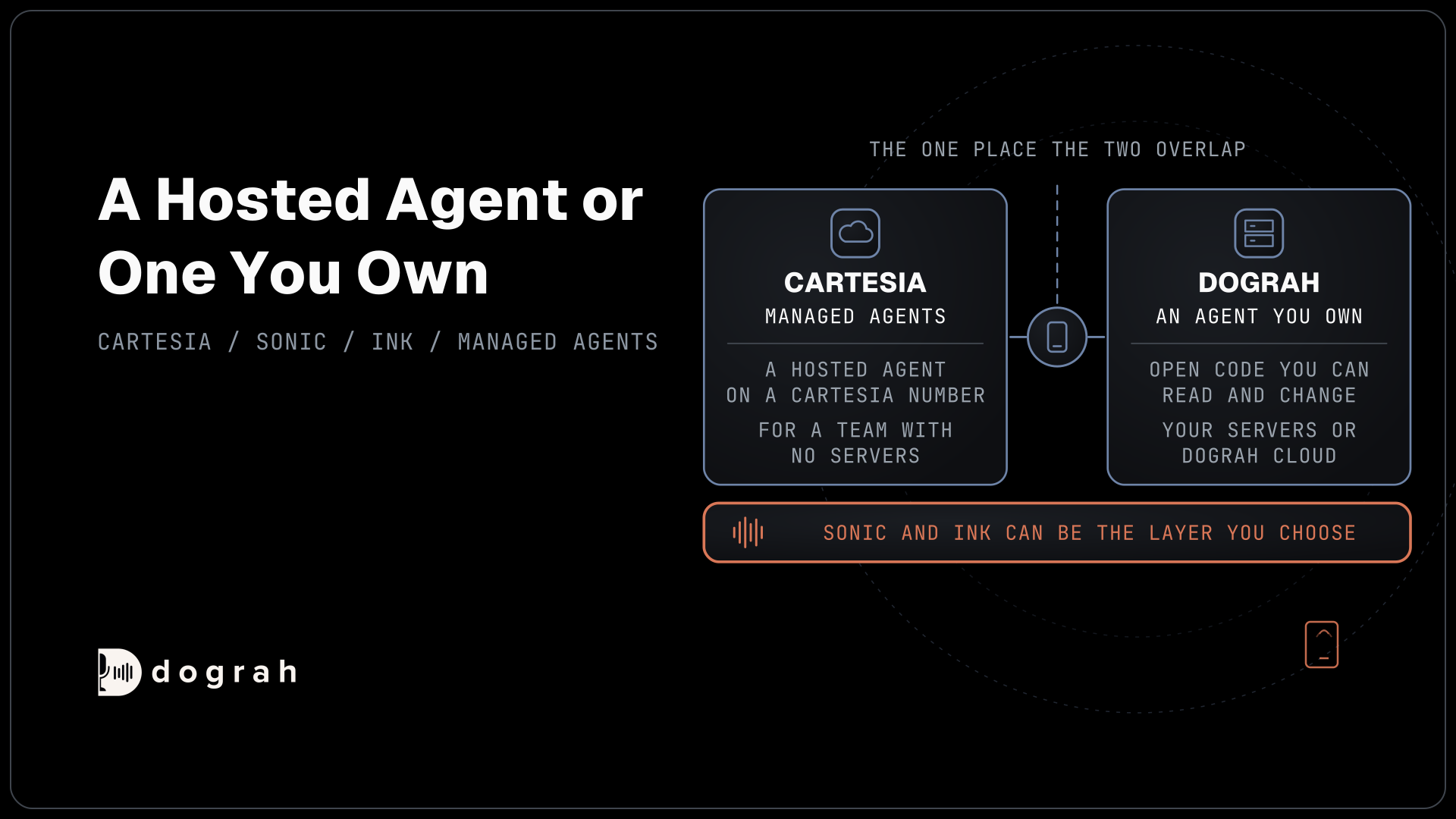
Dograh is the orchestration layer that runs the call flow, tools and telephony, and the speech and language models are a separate layer you choose. That is why the two are partners rather than rivals. Sonic and Ink can be the layer you choose, and Dograh handles everything between the caller and those models.
The usual worry about a full platform is that it trades flexibility for ready workflows. With open code that trade mostly goes away, since your team can read the platform, change it and run it where it likes, and still swap Cartesia for another provider per agent. Cartesia's own Managed Agents are the one place the two overlap, and the choice there is between a hosted agent and one you own.
Where Cartesia wins
Cartesia wins on the voice itself. On Artificial Analysis's blind-vote board, where listeners pick between voices without knowing the model, Sonic 3.6 sits near the top. Cartesia states first audio in under 90 ms for Sonic, and one model speaks 44 languages, with Odia and Urdu the latest additions.
Its speech-to-text is built for conversation. Ink 2 emits turn events as the caller starts, pauses, may be ending, resumes and finishes, so an agent knows when to reply without a separate detector. It covers English, French, Hindi, Japanese and Spanish, and Cartesia's instant cloning needs about 10 seconds of audio.
Cartesia also reaches places a model API usually does not. It can deploy its models on-premise or in a private cloud through its sales team, and Enterprise adds DPAs and BAAs. Managed Agents give a team with no servers a hosted agent on a Cartesia number. Our post on Cartesia features covers each model in depth, and Cartesia vs ElevenLabs sets Sonic against its closest rival.

Open Source Alternative to Vapi / Retell
Self-hosted voice agent platform — no per-minute fees
dograh-hq/dograh
Star on GitHub
Cartesia models inside Dograh
Cartesia is a built-in voice provider in Dograh, and its models run on your own Cartesia key. Sonic 3.6 is the default text-to-speech model, with Sonic 3.5 and Sonic 3 also offered. You pick a Cartesia voice from a dropdown or paste its voice ID, and set speed from 0.6 to 1.5 and volume from 0.5 to 2.0.
Speech-to-text works the same way. Dograh offers ink-whisper as the default Cartesia model and Ink 2 as the other choice. Ink 2 is English only in Dograh, and with it the agent waits on Cartesia's own turn events to decide when the caller has finished. For other languages, ink-whisper covers a long list.
Models are chosen per agent, in the editor's Model tab, from a configuration you set up under Providers and Models in the sidebar. Our page on how to use Cartesia voices in Dograh walks through that setup.
Languages and phone audio in practice
Language coverage is where a real deployment needs the most care. Sonic 3.6 speaks 44 languages, while Ink 2 hears five and runs English only in Dograh, so an agent for Spanish or Hindi callers pairs a Sonic voice with ink-whisper or another speech-to-text provider. Each agent takes its own voice, speech-to-text and language model, so a Cartesia voice with another provider's speech-to-text is a normal setup.
Phone audio is the second test. Most phone calls still reach the agent as 8 kHz audio, while a browser demo runs at 16 kHz, so a voice that sounds rich on a laptop can sound thinner on a handset. Judge Sonic voices on a real phone line before you pick one.
Speed works the same way. Cartesia's first-audio figure is the model's part of a turn, and on a call the turn also includes speech-to-text, the language model and the network between them. View Trace on each call shows the speech-to-text, AI and voice time for every turn, so you can see which part to tune.
Pre-recorded clips with a Cartesia clone
The most human-sounding pattern in Dograh pairs real recordings with a Cartesia clone of the same voice. Fixed lines such as the greeting and common answers play as recordings of a real person, and the agent falls back to speech generated in a cloned copy of that voice when it needs to say something new.
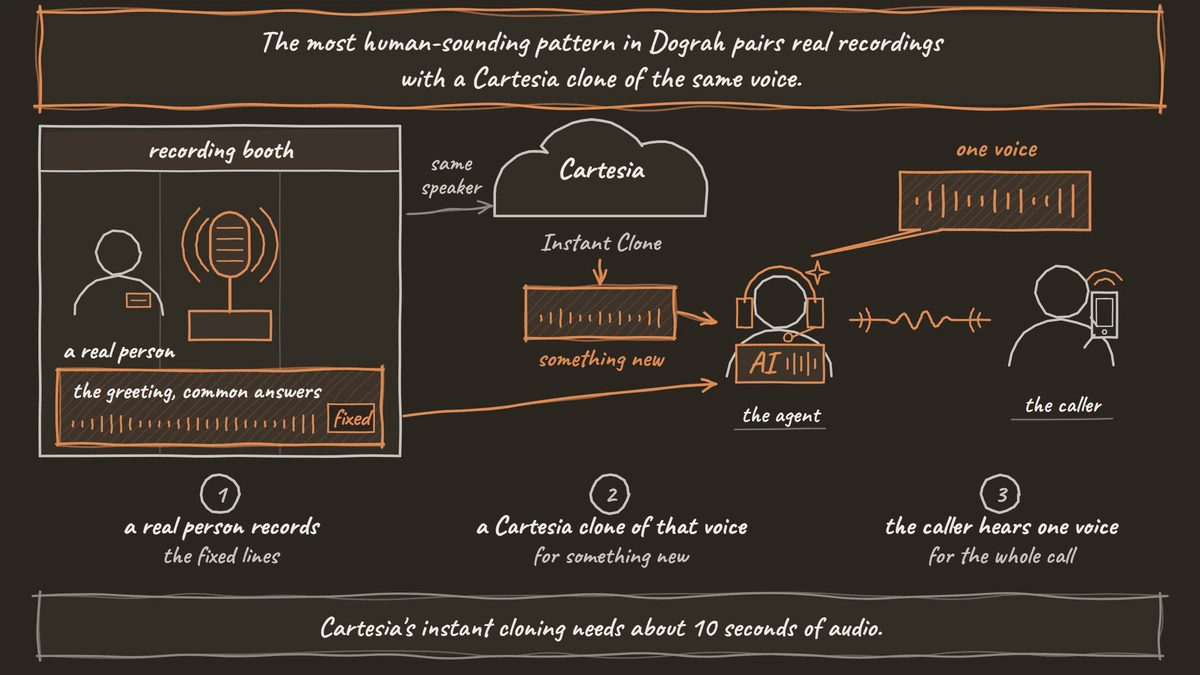
Pre-recorded audio in Dograh is built around this. You create an Instant Clone in Cartesia from the same speaker, upload the recordings on the Recordings page, and the caller hears one voice for the whole call. Each clip that plays is also text Cartesia never voices, so it uses no Sonic credits and starts faster than generated speech.
Join the Dograh Community
Dograh is an OSS alternative to Vapi. Join our Slack community for queries, releases, best practices & community interactions.
Hosting, data and cost on each side
Cartesia bills models in credits and agents in dollars. Cartesia's rates put Sonic at about 1 credit per character and Ink 2 at 3 credits a second of audio, with plans from free to Scale at $299 a month for 8 million credits. Managed Agents cost $0.03 a minute, plus $0.014 on a Cartesia number, with the language model billed separately. Our breakdown of Cartesia pricing covers the plans in full.
With Cartesia inside Dograh, the Cartesia bill stays on your own Cartesia account. Your own key moves the model contract to you while text and audio still reach Cartesia, and a team that needs the voice inside its own walls can ask Cartesia about on-prem models or run open voices on its servers through an OpenAI-compatible speech server.
The platform is the other line. Running Dograh yourself means no per-minute platform fee. You still pay for servers, model keys and phone minutes, and your team looks after the database and upgrades. A self-hosted install runs 10 calls at once by default, a limit you can raise. Support comes from the open-source community, and Enterprise adds custom SLAs. If you would rather not host it, Dograh Cloud runs it for a 1 cent a minute platform fee, and Pay as you go includes 10 concurrent calls.
When Dograh fits
Dograh fits when you want to own the layer around the voice. That means open code you can read and change, running it on your own servers or on-prem, and keeping recordings and transcripts in your own storage, with Sonic and Ink still doing the speaking and listening.
It also fits a team that wants to choose its own carrier and hand callers to people. Transfer Call works on Twilio, Telnyx, Plivo, Cloudonix and Asterisk ARI, and Dograh calls the destination first and connects the caller only when someone answers. A QA node scores the agent's calls.
To test the fit, connect your Cartesia key, build one agent with Sonic 3.6 and place a real call with the editor's Phone Call button. Then open View Trace on the run and compare the voice time per turn with your current setup.
Glossary
- Model API
- A service that sells access to an AI model by request, such as Cartesia's Sonic for speech. The platform calling it runs the rest of the conversation.
- Turn events
- Signals a speech-to-text model sends as the caller starts, pauses and finishes speaking. Cartesia's Ink 2 emits them, and Dograh uses them to decide when to reply.
- Credits
- Cartesia's unit for model use. Sonic uses about 1 credit per character and Ink 2 uses 3 credits a second of audio, from a monthly allotment.
- Instant Clone
- A Cartesia voice copy made from about 10 seconds of audio. Paired with recordings of the same speaker, it keeps one voice across a hybrid call.