
Before a voice agent dials, check that every caller ID is a number you own leaving through the carrier that issued it, that it takes do-not-call requests, and that CNAM, registry and reassigned-number checks are done. Dograh, the open-source AI voice agent platform, picks the number and trunk, and you can self-host it or run it on Dograh Cloud.
Key Takeaways
- Any active number on the configuration can show, so check every one.
- The number shown must take do-not-call requests during business hours.
- Twilio and Telnyx branded calling reaches T-Mobile and Verizon mobiles only.
A spam label is often earned before the first call, through a number or a list set up carelessly. This checklist gives each caller ID job a pass condition, from what the law asks you to send to CNAM, registration, branded calling and reassigned numbers, with Dograh's small part marked.
Why caller ID needs checks before the first dial
Most of what decides the label on a contact's screen is fixed before the agent says a word. Our post on STIR/SHAKEN and caller ID explains how carriers sign calls, what the A, B and C levels mean and how labeling firms weigh them. This post skips that theory and lists what to check, in the order you can check it.
The carrier does most of the work here. It signs each call with an attestation level and carries the caller name. Dograh's part is narrower and still matters, because it decides which of your numbers each call shows and which trunk the call leaves on. Each check below says who owns it and what a pass looks like.
Run the list once per telephony configuration and again whenever you add a number or a carrier. Our outbound voice campaigns guide covers the rest of a launch, from the contact list to the circuit breaker.
1. Every number is yours and on its own trunk
The first check is ownership, because a number you cannot prove is yours starts every call at a disadvantage. In Dograh, the numbers on a telephony configuration are the caller IDs. A campaign rotates across every active number on that configuration, so any of them can appear on a contact's screen, and an API Trigger call can name one with from_phone_number_id. Treat each active number as live.
Then match each number to its carrier. When a configuration has more than one trunk, each number's Outbound trunk setting decides where its calls leave, and the form tells you to pick the trunk whose carrier authorized the number. Carriers reject a caller ID they do not own, and a number sent out through another carrier can only earn partial trust. Ask each carrier which attestation level your calls get today, since some sign platform traffic at the lowest level until they have checked your business.
Showing a number is also a legal matter. The Federal Communications Commission's Truth in Caller ID rule bars anyone from causing misleading or inaccurate caller ID with intent to defraud, cause harm or wrongly obtain anything of value. A number you own or are authorized to use keeps you clear of that question.
Check: every active number is one you own or may use, each is set to leave on the trunk of the carrier that issued it, and each carrier has told you the attestation level your calls get.
2. The number takes do-not-call requests
The number a person sees has to work in the other direction too. The FCC's caller ID rule for telemarketers requires them to send a calling number and, where their carrier allows, their name, and they may not block caller ID. The number shown has to let anyone make a do-not-call request during regular business hours. A seller's name and customer service number can stand in for the telemarketer's, and the Federal Trade Commission's Telemarketing Sales Rule asks for the same number on caller ID.
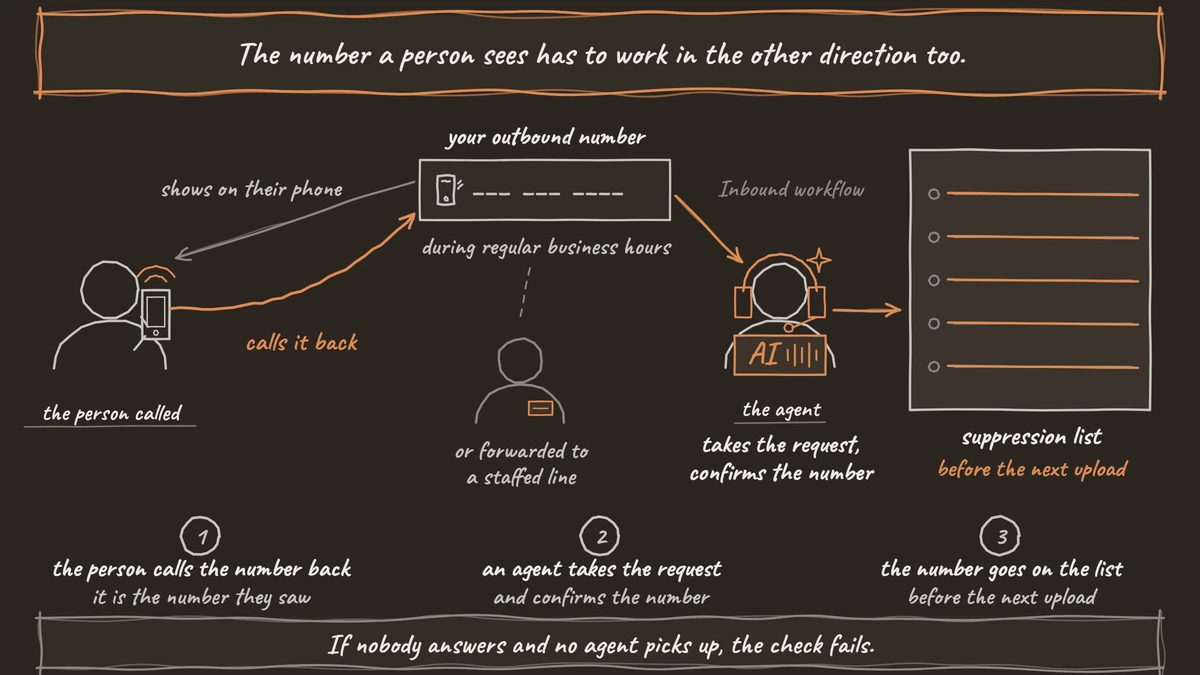
In practice, call each outbound number from your own phone and see what happens. If nobody answers and no agent picks up, the check fails. One way to pass is to point each number's Inbound workflow at an agent whose prompt takes the request, confirms the number and writes it to your suppression list through an HTTP API tool. Another is to forward the number to a staffed line during business hours. These rules apply to telemarketing calls, and tax-exempt nonprofits are exempt, so confirm with counsel which of them covers your calls.
Check: a call back to every outbound number reaches someone, or an agent, who can take a do-not-call request during business hours, and that request reaches the list before the next upload.

Open Source Alternative to Vapi / Retell
Self-hosted voice agent platform — no per-minute fees
dograh-hq/dograh
Star on GitHub
3. CNAM and the registry are filled in
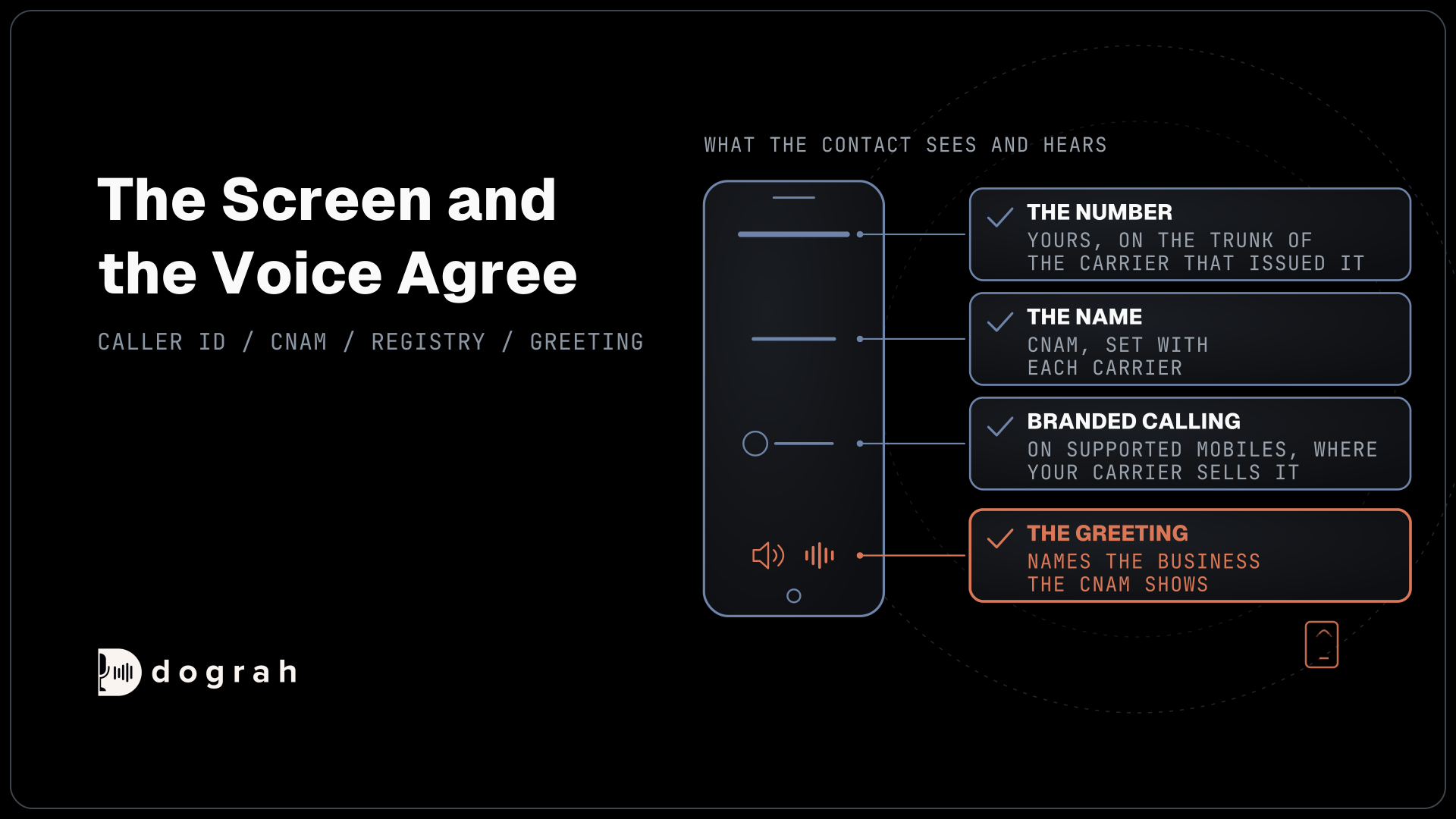
Two separate entries tell phones and labeling firms who you are, and one does not fill in the other. CNAM is the caller name that shows beside the number, and you set it with the carrier that owns each number. Landlines in particular rely on it. Keep the name short and recognizable, since carriers cap its length and a cut-off name reads like a scam.
The Free Caller Registry is the second entry. You can enter up to 20 numbers by hand or upload a file of 10-digit US numbers, one per line, as .xlsx or .txt under 100 KB. The registry is explicit that the providers using it do not use the data to deliver the caller name, so CNAM stays a separate step with your carrier. Our STIR/SHAKEN post covers what registration can and cannot do for a label.
Check: every active number has a CNAM set with its carrier, and every active number, including the ones a campaign only uses in rotation, is in the registry.
4. Branded calling, where your carrier sells it
Branded calling adds a name, a logo and a reason for the call on the person's phone, and it is bought from the carrier, not set in Dograh. Twilio's Branded Calling comes in a Basic tier with the business name, in public beta in the US, and an Enhanced tier with name, logo and call reason, generally available in the US. It shows on mobile phones only, listed for T-Mobile and Verizon in the US, and Twilio points landline calls back to CNAM.
Telnyx's Branded Calling shows name, logo and reason on US-to-US calls to T-Mobile and Verizon mobile numbers, and it says display isn't guaranteed. It costs $50 once plus $50 a month per brand, with display from $0.075 per call, and the calls must leave through Telnyx's outbound SIP trunking. Branded Calling ID, the CTIA service, charges only when delivery is confirmed.
Branding therefore reaches only part of a list, on certain phones, and you pay for each call it shows on. A calling pattern people dislike still draws complaints, and those count against the number whatever logo it carries.
Check: you know which carriers and handsets will show your brand, the numbers in use are the ones you registered for it, and landline contacts still see a CNAM name.
5. The greeting names the business
What the agent says first is part of caller identity too. The FCC's rules under the Telephone Consumer Protection Act (TCPA) require an artificial or prerecorded voice message to name the business responsible at the start and to give a phone number during or after the message. The FCC treats an AI voice as an artificial voice under that law.
In Dograh, the opening line lives in the Start Call node's Greeting Text, which is spoken word for word. Put the business name there, the same name as your CNAM and brand, so the screen and the voice agree. If you want to tell callers they are speaking with an automated assistant, or your location requires it by law, write that in the Greeting Text with the business name.
Check: the Greeting Text names the business the CNAM shows, and the call or its message gives a number the person can call back.
Join the Dograh Community
Dograh is an OSS alternative to Vapi. Join our Slack community for queries, releases, best practices & community interactions.
6. Old lists are checked for reassigned numbers
A number that changes hands turns a consented contact into a stranger, and retries to an old list find those numbers. The FCC's Reassigned Numbers Database tells you whether a number has been permanently disconnected since a date you give, usually the date the person agreed to calls. The safe harbor applies only when the database answers "no", and the caller has to prove it checked.
Run the check before a campaign on any list you have not dialed recently, and again before a redial. Our post on calling hours and retries for AI campaigns shows how retries and redials are scheduled, so you know when an old number may be dialed again.
Check: every list older than your chosen cutoff has a fresh database result on file, and numbers that came back "yes" are removed before upload.
Pace each number and watch the results
Rotation spreads volume across numbers. It does not hide a pattern, because complaints and short calls follow the behavior to the next number. Size the pool to the pace you plan, so no single number makes far more calls a day than a person would. The campaign's Max Concurrent Calls and Calls Started per Second set that pace.
Watch each number after launch. Read answer rates and call lengths per caller ID in the first days, and take a number out of rotation by switching it off when its answers fall. Our STIR/SHAKEN post covers recovering a flagged number.
Running it next to your own trunks
Self-hosting lets you put Dograh next to the SIP trunks you already have with each carrier, and none of the checks above change with where the platform runs. Self-hosted Dograh has no per-minute platform fee, although servers, model keys and phone minutes still cost money. Dograh Cloud adds a 1¢-a-minute platform fee. If you self-host, the server, the database and the upgrades are yours to run and keep current, with help from the community on Slack and GitHub on the open-source version and custom SLAs on Enterprise.
Glossary
- CNAM
- Caller name delivery, the short business name shown beside a number. You set it with the carrier that owns the number, and registering the number elsewhere does not set it.
- Attestation level
- The trust level a carrier signs into a call under STIR/SHAKEN. A carrier gives full trust only when it knows the customer and that the number is theirs, so each number should leave through the carrier that issued it.
- Branded calling
- A paid carrier service that shows a business name, logo and call reason on supported mobile phones. Twilio and Telnyx sell it for calls to T-Mobile and Verizon mobiles in the US.
- Reassigned Numbers Database
- The FCC's database that says whether a number has been permanently disconnected since a given date. A "no" answer gives a caller a safe harbor if the number turns out to belong to someone new.