
Hume AI now suits teams that want to measure emotion in voice, since it has stopped selling EVI and Octave. Its Expression Measurement API scores 415 expressions and bills by the second, and its Audio Decision API is waitlisted. For teams that want an agent they own, Dograh is the open-source AI voice agent platform, self-hosted or on Dograh Cloud.
Key Takeaways
- Hume has stopped selling EVI and Octave and now sells emotion measurement APIs.
- Expression Measurement bills every second of audio, silence included, with a 10-second minimum.
- EU law bans emotion recognition on staff and treats it as high-risk on customers.
Hume built its name on an empathic voice, and buyers searching for it now find a different company. We cover what Hume sells today, how its emotion scores behave on a phone call, where EU rules draw lines, who it fits and how Dograh runs an agent beside those scores.
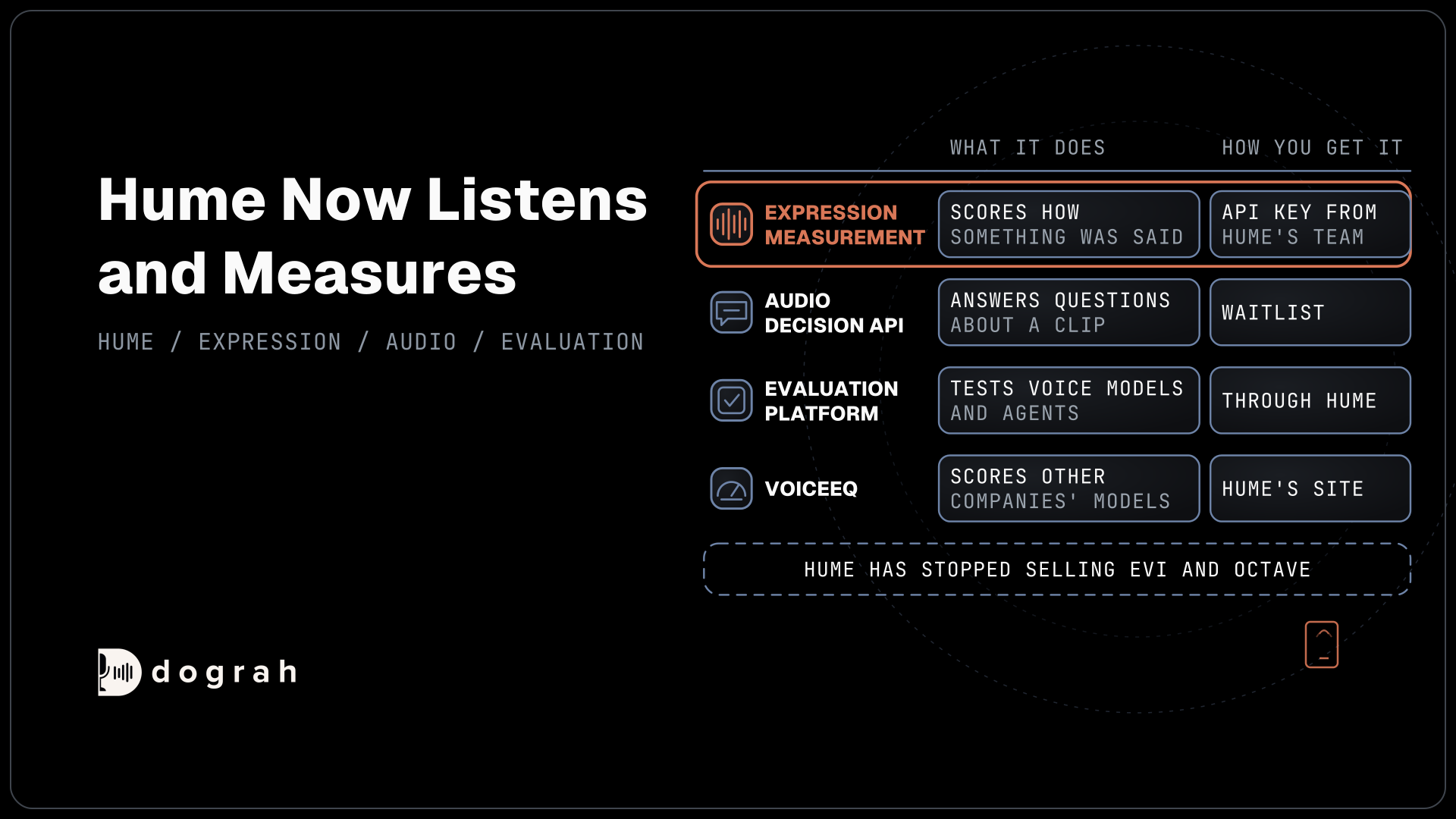
Hume AI in one table
Hume today is a set of measurement APIs, so the table judges each product on what a voice team would use it for. Hume now offers an Audio Decision API, Expression APIs, a Human Feedback API, a User Testing API and Speech Data, with access through a "Talk to Hume" form.
| Product | What it does | How you get it | How it bills |
|---|---|---|---|
| Expression Measurement API | Scores expressions and voice attributes in speech, and expressions in faces | API key, through Hume's team | Seconds of media sent, 10-second minimum per run |
| Audio Decision API | Answers questions you write about a clip, as probabilities | Waitlist | Input tokens |
| VoiceEQ | Hume's benchmark that ranks other companies' voice models | Hume's site | Not a product you call |
| Evaluation platform | Tests voice models and agents with automated and human review | Through Hume | Through Hume |
| EVI and Octave | Hume's former voice agent and text-to-speech | No longer sold | No longer sold |
The pattern is clear from the rows. Hume now listens to voices and measures them, and it no longer speaks.
What Hume sells after EVI and Octave
Hume has stopped selling EVI, its empathic voice interface, and Octave, its text-to-speech, and neither is listed on Hume's site or in its docs. If you ran either one, our guide to the Hume EVI alternative covers what carries over and where to move. This review looks at what is left.
What is left is measurement. The Expression APIs score how something was said. The Audio Decision API launched on 2 November 2026 and answers plain questions about a clip. Hume also sells an evaluation platform for testing voice models and agents, including simulated customer calls, and it publishes VoiceEQ, a benchmark that scores other companies' voice models on emotion alignment, naturalness and reliability. Pricing for each product is set with Hume's team.
Expression Measurement on a live phone call
Expression Measurement is the product a voice team would wire into calls, and it was built with live calls in mind. Hume describes it as an API that "measures emotional expression in speech and in faces", returning scores for each stretch of speech out of 415 expressions and 190 voice attributes. Its realtime endpoints stream over a WebSocket, which Hume suggests using "to route or monitor a live call".
The audio format is where phone calls get harder. The realtime endpoint takes 16 kHz mono audio, while most phone calls still reach the agent as 8 kHz audio. You can resample the call to 16 kHz, but resampling cannot put back what the phone line removed, so test the scores on real calls before you trust them. Scores also arrive every 3 seconds of speech by default, each covering the last 10 seconds, so they describe the recent past of the call.
Billing follows the media you send. Hume bills by seconds of audio, including silence and stretches with no speech, and charge at least 10 seconds for every upload and every billed realtime session. On a phone call that means you pay for the whole stream you send, so send only the side of the call you need scored.
The Audio Decision API
The Audio Decision API asks a question of a clip and returns an answer you can act on. You write the question and its possible answers, yes or no, a choice, a rating or a time span, and Hume's launch post says it returns "probabilities over the answers you defined". The same post says it is fast enough to ask "dozens of questions every few seconds on a live call", and lists flagging frustrated callers in contact centers among its uses.
It is early. Access is by waitlist, each request takes one MP3 or WAV file between 1 second and 5 minutes long, and billing is by input tokens. A team that wants it on calls today is testing a new product, so plan a trial before any rollout.
Where emotion scores help on a call
Emotion scores are most useful when they raise a flag for a person to look at. A rising frustration score can mark a call for a supervisor to join, or move it up a review queue after it ends. Scores across many recorded calls can show which step of a script tends to annoy callers, and Hume's own pitch for the Audio Decision API includes checking whether generated speech sounds natural.
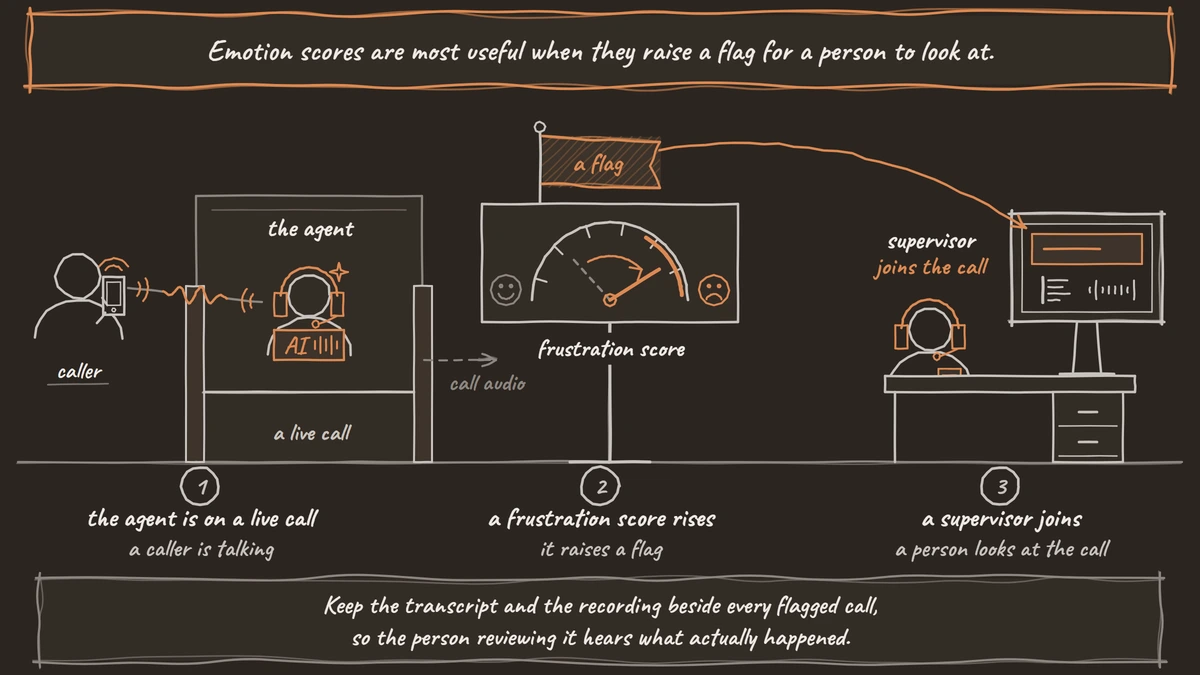
The risk starts when a score decides something on its own. A score is a model's estimate of how a voice sounded, measured on compressed phone audio, and accents, background noise and a bad line all move it. Use it to raise a flag for a person, and never to refuse service, set a price or judge an employee. Keep the transcript and the recording beside every flagged call, so the person reviewing it hears what actually happened.

Open Source Alternative to Vapi / Retell
Self-hosted voice agent platform — no per-minute fees
dograh-hq/dograh
Star on GitHub
Emotion scores and the EU AI Act
The EU Artificial Intelligence Act (AI Act) treats emotion read from a voice as emotion recognition, because voice counts as biometric data. Since 2 February 2025 the AI Act bans emotion recognition in the workplace and in education. The Commission's guidelines on prohibited practices give a call center as the example, where tracking the emotions of its own staff is banned while tracking its customers' emotions is not caught by that ban.
Customers are still covered by other rules. Emotion recognition on customers is a high-risk use, and under the Digital Omnibus on AI, Regulation (EU) 2026/1744, adopted and in force since 27 July 2026, those high-risk duties start on 2 December 2027. Article 50 of the AI Act, which applies from 2 August 2026, also says anyone running an emotion recognition system must tell the people it runs on and handle their data under the General Data Protection Regulation (GDPR). The guidelines treat emotion inferred from written text as outside the ban, since text is not biometric. These rules turn on the exact use, so confirm your position with counsel before scores reach a live call.
Our posts on prohibited AI practices in voice agents and high-risk voice agents cover both sets of duties in full.
Closed models and where the audio goes
Hume's APIs are closed models on Hume's cloud, and the caller's voice is the data you send them. Each request goes to Hume's servers with your API key, and you reach the models only through Hume's API. So every scored call puts a biometric recording with a vendor, and your contract with Hume, plus your notice to callers, has to cover that.
The model also decides what an emotion is. The 415 expressions are Hume's own categories, and you cannot inspect how a score was reached or retrain the model on your callers. For research and analytics that may be fine. For a decision that affects a customer, it is one more reason to keep a person in the loop.
Who Hume fits
Hume fits teams that study how people sound and can wait for access. A research group scoring recorded conversations, a contact center building analytics on recorded calls, or a voice model team using VoiceEQ and Hume's evaluation platform to compare models will all get real use from it. The 415-expression range is wider than most sentiment tools give.
It fits less well a team that needs a voice or an agent, since Hume no longer sells either. It also fits less well a team that wants to sign up and start today, a team that cannot send caller audio to a third party, or one in the EU that wants scores on its own staff, which the ban rules out.
Join the Dograh Community
Dograh is an OSS alternative to Vapi. Join our Slack community for queries, releases, best practices & community interactions.
Where Dograh fits
Dograh fits teams that want the agent itself on open code, with any emotion scoring kept as a separate step they control. Dograh handles orchestration, meaning the call flow, tools and telephony, and leaves the speech and language models to a separate layer you choose. It runs the voice providers it ships, such as ElevenLabs, Cartesia, Deepgram and Inworld, on your own key, plus open models you host through Local Models (Speaches). Speech-to-speech models in Realtime mode, such as GPT-Live and Gemini Live, hear the caller's tone directly, and our guide to speech-to-speech voice AI compares them.
Hume's scores can still sit beside a Dograh agent, after the call. A Webhook node can send the recording link to your own service when the call ends, and that service sends the audio to Hume's upload endpoint and stores the scores with the call. During the call, a caller who sounds upset can be handed to a person with Transfer Call on Twilio, Telnyx, Plivo, Cloudonix or Asterisk ARI. Dograh rings the destination first, connects the caller only once someone picks up, and lets the agent carry on with the caller if nobody does.
Dograh's built-in QA step reads the transcript after the call and gives each step its own tags, a score from 1 to 10, a sentiment and a summary. It works from written text, so its text sentiment is the kind the guidelines place outside the ban, and it runs on test calls and live ones.
Where calls and recordings live decides most of the cost and the data question. Self-hosted, the recordings stay on your servers and only what your own service sends ever reaches Hume. Self-hosted Dograh has no per-minute platform fee, but servers, model keys and phone minutes still cost money. Dograh Cloud charges a 1¢-a-minute platform fee. Running it yourself means the server, the database and every upgrade are your team's, with community support on Slack and GitHub for the open-source version and custom SLAs on Enterprise.
Glossary
- Expression Measurement
- Hume's API that scores how something was said, out of 415 expressions and 190 voice attributes for speech. It bills by seconds of audio sent.
- Emotion recognition system
- Under the EU AI Act, AI that infers emotions from biometric data such as a voice. It is banned on staff and students, and high-risk on customers.
- Resampling
- Converting audio from one sample rate to another, such as 8 kHz phone audio to the 16 kHz a model expects. It cannot restore sound the phone line removed.
- Text sentiment
- A positive, neutral or negative reading taken from a written transcript, not from the voice. Dograh's QA step works this way.