
Hume's notice said its Octave and EVI APIs would end on 13 November 2026, so alternatives divide into a voice swap and a full agent. Octave users can move to ElevenLabs, whose v4 Turbo voice takes audio tags. EVI users can rebuild on Dograh, an open-source platform that ships ready to use and runs ElevenLabs voices or speech-to-speech models.
Key Takeaways
- Hume voice IDs and clones stay behind. Keep your original recordings.
- ElevenLabs v4 Turbo is the closest real-time swap for an Octave voice.
- Replacing EVI means rebuilding listening, turn-taking, reasoning and voice, which Dograh can run.
Hume's exit from voice leaves two groups of developers looking for a new home. We cover what the shutdown includes and what carries over, compare every route in one table, then turn to ElevenLabs for an Octave voice and Dograh for rebuilding an EVI agent.
What the Hume shutdown covers
The shutdown covers the two products most voice developers used Hume for. Hume's notice, as quoted on other voice vendors' migration pages, said access to its Octave text-to-speech API and its Empathic Voice Interface (EVI) would end on 13 November 2026 at 12:01 a.m. Eastern time, and that account data would be permanently deleted afterwards. Hume's own pages for both products, prices included, already send visitors to its homepage.
The company itself carries on in a different direction. Hume's site now lists an Audio Decision API, its Expression APIs for measuring emotion in voice and text, a Human Feedback API, a User Testing API and the VoiceEQ benchmark. If you came to Hume to measure expression, that work continues there. If you came for a voice that speaks, or an agent that talks back, you need a new provider.
What carries over from a Hume account
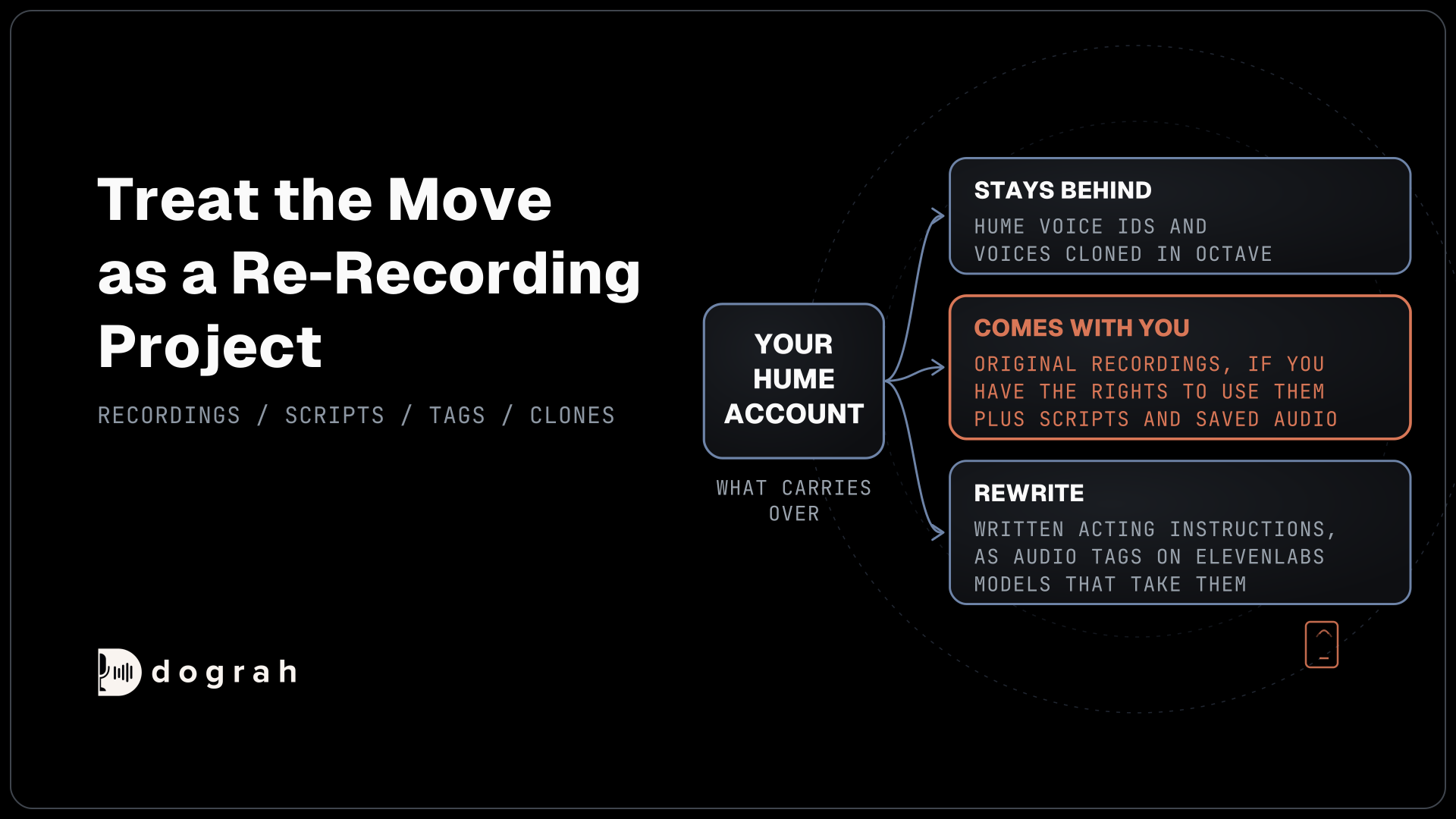
Very little moves on its own, so the files on your own disk matter most. A Hume voice ID means nothing to another provider, and a voice you cloned in Octave does not travel as a voice. What you can take is the material behind it: the original recordings you cloned from, if you have the rights to use them, and the scripts and generated audio you saved. Since the notice said account data would be deleted, download everything you want to keep.
Octave also let you steer delivery with written acting instructions, and those notes need rewriting for the next model's controls. On ElevenLabs that means audio tags in square brackets inside the text, such as [whispers], on the models that support them.
So treat the move as a re-recording project. Clone each voice again from its source recordings, then listen to every one on your real scripts before it reaches a caller. A voice that sounded right in Hume can land differently on a new model, and the people who know your brand voice should hear it first.
Two kinds of Hume user, two moves
The right replacement depends on which Hume product you ran. An Octave user sent text and got audio back, so the job is a voice swap: pick a provider, then rebuild and re-test each voice. Everything else in the app stays as it is.
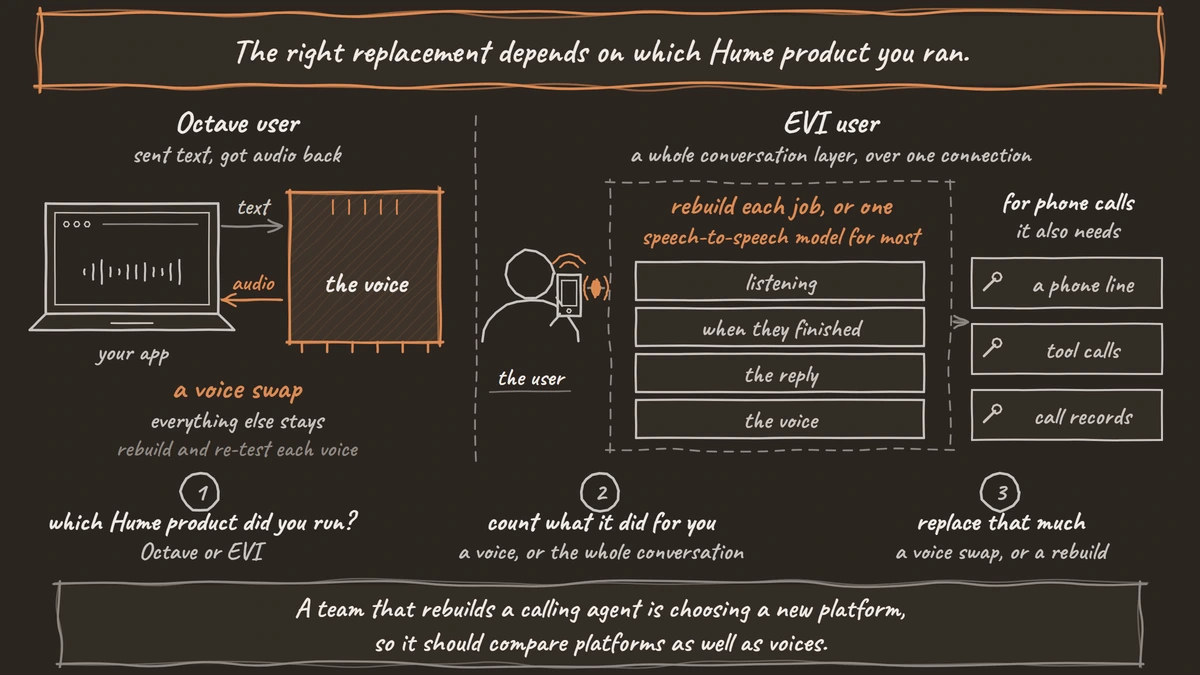
An EVI user had a whole conversation layer from Hume. EVI listened to the user, decided when they had finished speaking, generated a reply and spoke it in an expressive voice, all over one connection. Replacing it means rebuilding each of those jobs, or picking one speech-to-speech model that does most of them. If the agent answers phone calls, it also needs a phone line and tool calls into your systems, with a record kept of every call.
That second move is much bigger, and it is where most of the planning time goes. A team that only swaps a voice can finish quickly. A team that rebuilds a calling agent is choosing a new platform, so it should compare platforms as well as voices, as the route table just below does.
Every route off Hume side by side
Each route replaces a different part of what Hume did. The table sets them side by side, with Hume as the baseline, and the sections after it take the routes in turn.
| Route | Replaces | Voice and delivery | List price | Where it runs |
|---|---|---|---|---|
| Hume Octave and EVI (baseline) | Nothing after 13 November 2026 | Expressive voices and acting instructions | Access set to end 13 November 2026 | Gone after 13 November 2026 |
| Dograh with ElevenLabs | Octave and EVI | ElevenLabs models up to v4 Turbo on your key | Self-hosted no platform fee, Cloud 1¢-a-minute platform fee, plus models | Your servers or Dograh Cloud |
| Dograh with a speech-to-speech model | EVI | The model's own voices | Self-hosted no platform fee, Cloud 1¢-a-minute platform fee, plus the model | Your servers or Dograh Cloud |
| Dograh with local open models | Octave and EVI, data in your network | Depends on the open model | No platform fee, plus your servers | Your servers |
| ElevenLabs API, v4 Turbo | Octave text-to-speech | Audio tags, voice library, cloning on paid plans | $0.04 per 1,000 characters | ElevenLabs' cloud |
| ElevenLabs Agents | EVI, as a hosted agent | ElevenLabs voices, language model of your choice | $0.08 a minute past plan minutes, model on top | ElevenLabs' cloud |
| A speech-to-speech model | EVI's conversation loop | The model's own voices | The provider's usage rates | The provider's cloud |
The three Dograh rows cover both Hume products, because the platform runs the whole call and treats the voice and the model as parts you can swap later. The hosted rows each replace one piece. Calling a speech-to-speech model straight from its provider gives you the conversation loop at the provider's usage rates, while your own code supplies the phone line, the tools and the call records.
Hume vs ElevenLabs for an Octave voice
For a text-to-speech swap, ElevenLabs is the closest match on expressive delivery. ElevenLabs calls Eleven v4 Turbo its "most emotive, real-time speech synthesis model", lists audio tags for fine-grained control, and recommends it for agents that need expressive delivery. Eleven v3 Conversational, the earlier generation, also takes audio tags in real time, and Flash v2.5 is the fast option when speed matters more than feeling.
Price is per character. On the API, ElevenLabs charges $0.04 per 1,000 characters for v4 Turbo, v3 Conversational and Flash, and $0.08 for v4, v3 and Multilingual v2. So the real-time expressive model costs the same per character as the fast one, and the slower studio models cost double.
The two companies were never quite the same kind of vendor. Hume built its voice around measuring and producing emotion, and it is keeping the measuring half. ElevenLabs sells voices and voice agents as its main products, with a large voice library and cloning on its paid plans. For an Octave user, that means a broader catalog to choose from, and a delivery style you steer with tags instead of written descriptions.
Test the shortlist on a real phone line before you decide. Phone audio usually reaches the agent at 8 kHz, while a browser demo runs at 16 kHz. Expressive detail is the first thing a narrow phone channel flattens, so a voice that sounds rich in a demo can sound plain on a call.
Dograh: the open-source EVI alternative you can run
Dograh is an open-source voice agent platform under the BSD 2-Clause license, and it takes over the whole conversation EVI used to run, with the phone call around it. It ships a visual flow builder, telephony, call transfer, call history, and QA that scores each step of each call. An EVI prompt becomes a greeting, a few agent steps and the rules for moving between them.
The rebuild comes in two shapes. A cascade runs speech-to-text, a language model and a voice in sequence, and suits an agent that books or updates records. A speech-to-speech model hears audio and answers in audio from one model, which suits open conversation but can fail on complex tool calling. Our post on cascade vs speech-to-speech goes through the tradeoffs.
For a cascade, ElevenLabs can cover both ends, with Scribe v2 Realtime for transcription and a v4 Turbo voice. In the voice settings you pick an ElevenLabs model, from Flash v2.5 up to v4 Turbo, and a clone rebuilt from Hume recordings goes in by pasting its voice ID.
For speech-to-speech, the inference provider settings cover OpenAI's realtime models, Gemini Live, Azure's realtime service, Grok, Ultravox and Amazon Nova 2 Sonic. Listen for warmth on your own scripts, because EVI's selling point was emotion and none of these models was built to copy it.
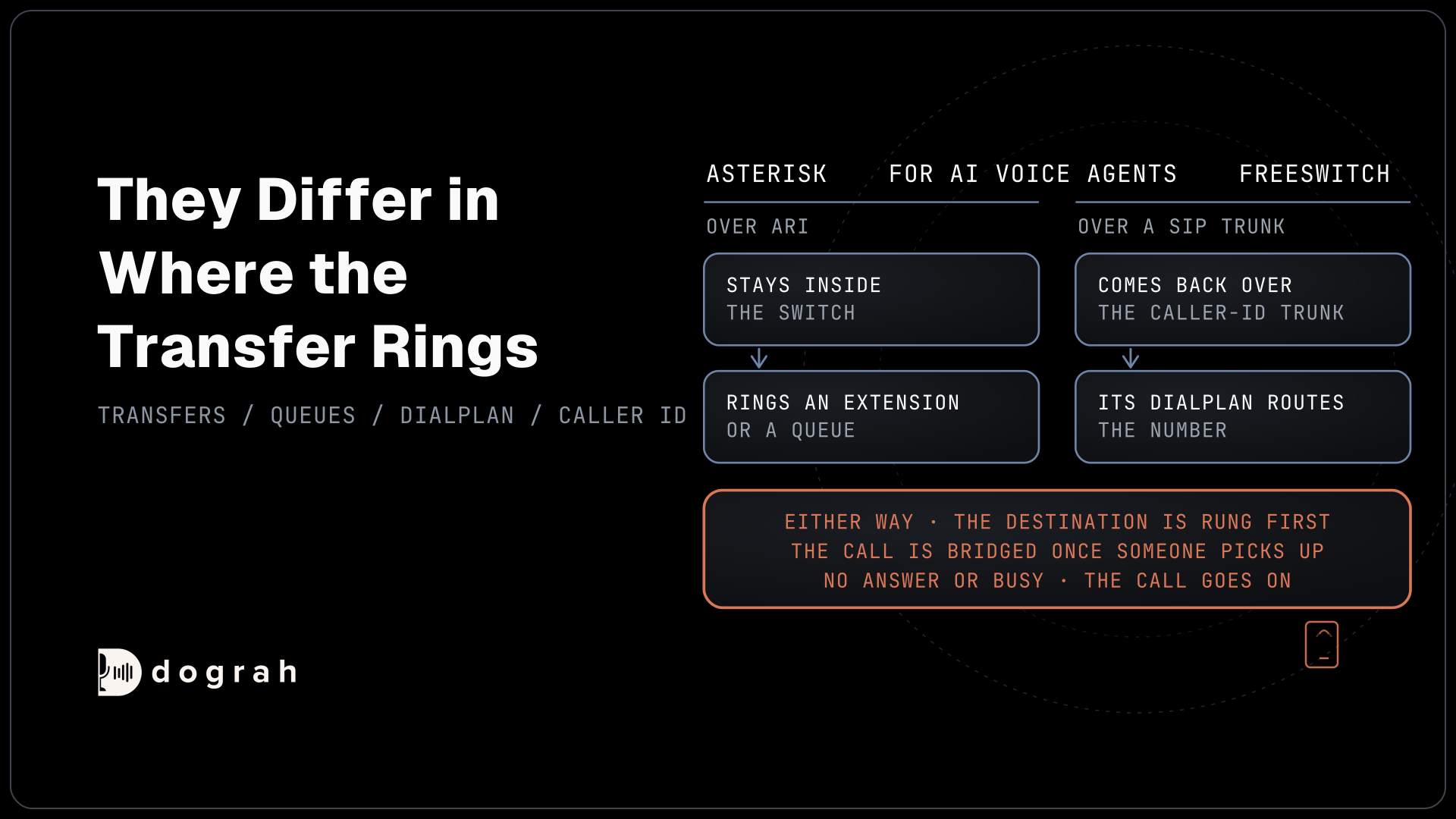
Dograh is the orchestration layer, not a model, so the speech and language slots take Dograh's own models, any supported provider on your key, or open-weight models you host, and only the last keeps call audio on your servers. Transfer Call to a person works on Twilio, Telnyx, Plivo, Cloudonix and Asterisk ARI.
Self-hosted Dograh has no per-minute platform fee, but servers, model keys and phone minutes still cost money. Dograh Cloud charges a 1¢-a-minute platform fee. Self-hosting needs Docker Compose on a machine with at least 8 GB of RAM and 4 vCPUs, and it handles 10 concurrent calls by default, with 10 included on Cloud's pay as you go. Every call keeps a full trace.
To move an EVI agent, build its flow in the visual editor, or ask an AI assistant such as Claude Code or Cursor to create it through Dograh's MCP server, then review it before any phone number points at it and test transfers on a real phone call. Running it yourself means your team owns the server, the database and every upgrade. Our guide to testing voice agents before you go live puts the checks in order.
Other routes off Hume
ElevenLabs Agents is the hosted route for EVI. It runs ElevenLabs' own transcription, voices and turn-taking for $0.08 a minute past plan minutes, with the language model billed on top, and its business associate agreement for HIPAA sits on Enterprise. It suits a team that wants one vendor and is happy to run in ElevenLabs' cloud. For the wider field, see our guide to ElevenLabs alternatives.
Developers who would rather write the agent in code can start from an open-source framework. Pipecat (BSD 2-Clause) and LiveKit Agents (Apache 2.0) give you the real-time building blocks, and your team adds the phone wiring, call history and QA on live calls. Dograh itself is built on a fork of Pipecat. Our comparison of open-source voice AI frameworks covers both.
The voice can be open too. Open-weight speech models run on your own servers, which keeps the audio in your network, though how expressive they sound depends on the model. Our post on Orpheus TTS for voice agents looks at one open model that takes emotion tags.
Join the Dograh Community
Dograh is an OSS alternative to Vapi. Join our Slack community for queries, releases, best practices & community interactions.
Picking your route
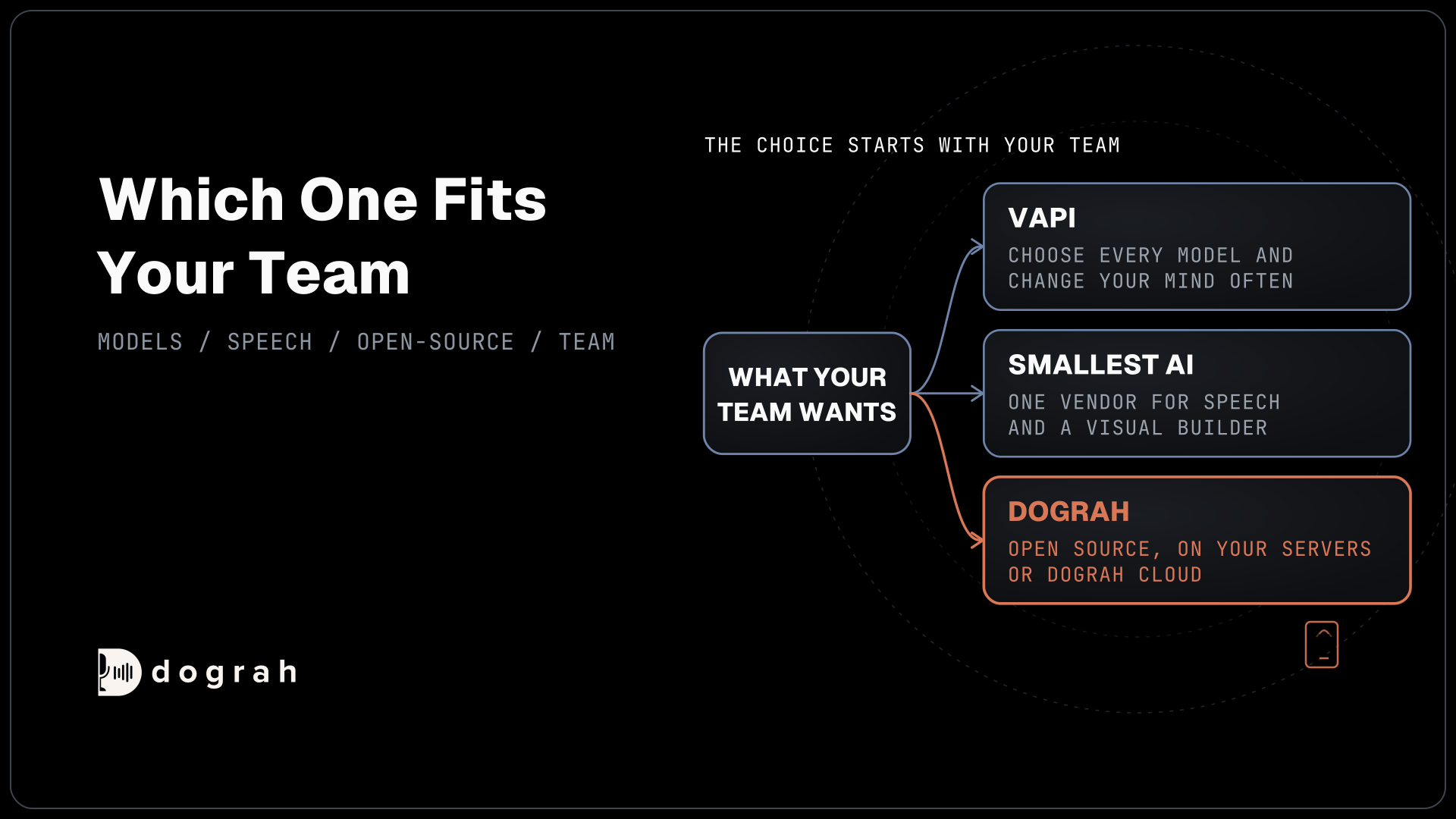
Start from the Hume product you ran. If EVI ran conversations for you, and especially phone calls, Dograh fits teams that want an open-source platform around the new agent: ElevenLabs voices or a speech-to-speech model, the carrier you already use, QA on every step, and the choice of your own servers or Dograh Cloud. If you only used Octave, the ElevenLabs API with v4 Turbo is the short move, with each voice cloned again from your recordings. Teams that want one hosted vendor for the whole agent can take ElevenLabs Agents, and developers who prefer to write every part in code can start from Pipecat or LiveKit Agents. Whichever you choose, rebuild one agent or voice and listen to it on a real phone line before you move the rest.
Glossary
- Empathic Voice Interface (EVI)
- Hume's speech-to-speech API, which listened to a user, decided when they had finished, replied and spoke in an expressive voice over one connection. Hume said access would end on 13 November 2026.
- Audio tags
- Words in square brackets, such as [whispers], placed inside the text sent to a voice model to steer its delivery. ElevenLabs lists them for Eleven v4 Turbo and v3 Conversational.
- Cascade
- A voice agent built from separate speech-to-text, language model and voice steps run in sequence. It suits agents that call tools or need a cloned voice, at the cost of more hops per turn.
- Speech-to-speech model
- One model that hears audio and answers in audio, with no separate transcription or voice step. Examples include OpenAI's realtime models and Gemini Live.