
German AI voice agents need speech-to-text and voices that handle compound words and regional German. Advertising calls to consumers need prior consent under Germany's unfair competition law (UWG), and call data falls under the DSGVO (GDPR). For teams keeping that data on their own servers, Dograh, the open-source AI voice agent platform, runs self-hosted or on Dograh Cloud.
Key Takeaways
- German speech-to-text must handle compound words and numbers said units first.
- Advertising calls to consumers need prior express consent, documented and kept five years.
- Self-host Dograh in Germany and run the models there to keep calls local.
German callers expect formal speech and a clear answer on what happens to their data. We cover what German does to each layer and which models list it, then we talk about the rules in one place and how a German agent runs in Dograh.
What German does to each layer
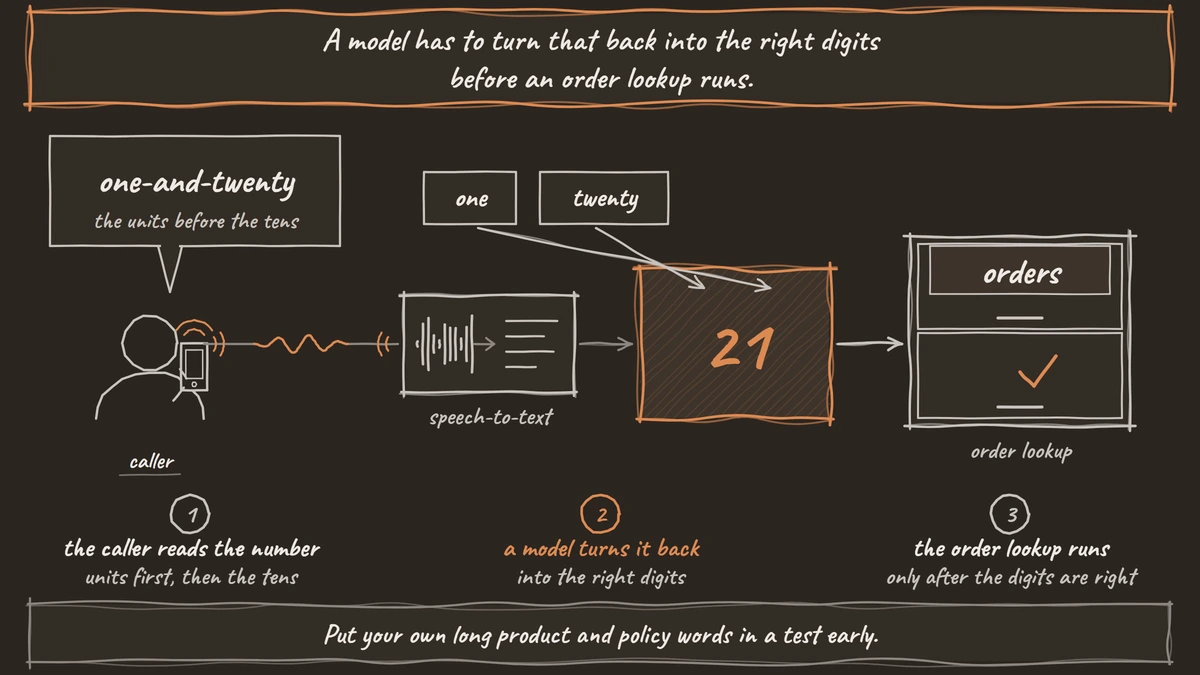
German looks easy for speech-to-text until the first long noun. Words such as Kundennummer, Rechnungsadresse or Haftpflichtversicherung are one word in German, and a model that splits them, or hears half, writes a transcript your tools cannot match. Put your own long product and policy words in a test early.
Numbers are the second trap. German says the units before the tens, so 21 is einundzwanzig, literally one-and-twenty, and callers often read phone numbers in pairs. A model has to turn that back into the right digits before an order lookup runs. Dates can come out as "am dritten Elften" or as "dritter November", so test both forms.
The language model and the voice need the register right. A business line in Germany uses Sie, and the prompt should say so for every node where the agent speaks. Austrian callers sit close to Standard German, while Swiss callers often speak dialect even when they write Standard German. Our post on Swiss German, Flemish and Belgian French covers the regional codes, so here we stay on German as a whole.
Speech-to-text that lists German
German is well covered for speech-to-text, including open-weight models you can run yourself. The table lists each option from the provider's own page or the settings Dograh passes it.
| Option | German codes listed | Regional German | In Dograh |
|---|---|---|---|
| Deepgram Nova-3 (also Dograh's own STT) | de, de-DE, de-AT, de-CH | Swiss German as its own code | "German" and "German (Switzerland)" |
| Deepgram Flux multilingual | de | One German code | Through Multilingual (Auto-detect) |
| Google Speech-to-Text | de-DE, de-AT, de-CH | Austria and Switzerland | Yes, on your key |
| Azure Speech | de-DE and other German locales | Typed in as a custom code | Yes, on your key |
| Speechmatics | One German pack | Germany, Austria and Switzerland in one pack | Yes, on your key |
| AssemblyAI, Soniox, ElevenLabs Scribe, Cartesia ink-whisper | de | Not split by region | Yes, on your key |
| Parakeet TDT 0.6B v3 (open weights) | One of 25 European languages | Not split by region | Through an OpenAI-compatible server you run |
| Voxtral Mini 3B (open weights) | One of 8 languages | Not split by region | Through an OpenAI-compatible server you run |
Speechmatics' language list takes one route, a single German pack for Germany, Austria and Switzerland. Deepgram takes the other, with Swiss German as its own code. Neither is better on paper, which is why the test has to use callers from each region you serve.
For teams that want German speech-to-text on their own hardware, Parakeet TDT 0.6B v3 covers German among 25 European languages under a CC BY 4.0 license, and Voxtral Mini 3B lists German under Apache 2.0. Both are open weights, so the audio never has to reach an outside company.
Voices that speak German
German voices are plentiful. Azure Speech lists 23 de-DE voices, including HD and multilingual voices, plus two each for Austria and Switzerland. ElevenLabs, Cartesia Sonic 3.6, Deepgram Aura-2 and Google all list German, so most teams have a shortlist before they start.
The open side is thinner. Chatterbox's multilingual model, under the MIT license, lists German and can clone a voice, which suits a team that wants one consistent voice from a recording. Kokoro-82M, a common default on self-hosted speech servers, ships no German voice, so a German agent on that setup needs a different voice model.
Whichever voice you shortlist, have it read your agent's real replies, with order numbers, dates and your long product words, over a real phone line. Most phone calls reach the agent as 8 kHz audio, and a voice that sounds rich in a browser can sound flatter on a handset.

Open Source Alternative to Vapi / Retell
Self-hosted voice agent platform — no per-minute fees
dograh-hq/dograh
Star on GitHub
Testing a German agent before launch
A short test on real calls catches most German problems before customers do. Here is a plan we wrote for it. Write a script of 30 to 40 lines that covers your long product and policy words, order and customer numbers read in pairs, prices, dates said both ways and a few street names. Have callers from each region you serve read it over the same carrier and number the agent will use.
Run the recordings through each speech-to-text option on your shortlist and compare the transcripts line by line. Score the details that drive actions first, such as numbers, dates and names, because a near-miss there sends the wrong data to your systems. Then check the agent's own side on a few full test calls, from the Sie form in every reply to the notices in the greeting playing in full.
After launch, keep a German speaker reading a sample of calls each week, starting with the ones QA flags. The transcript is where a German reviewer spots a word the agent keeps mishearing, and that word goes into the Dictionary.
German rules for AI calls in one place
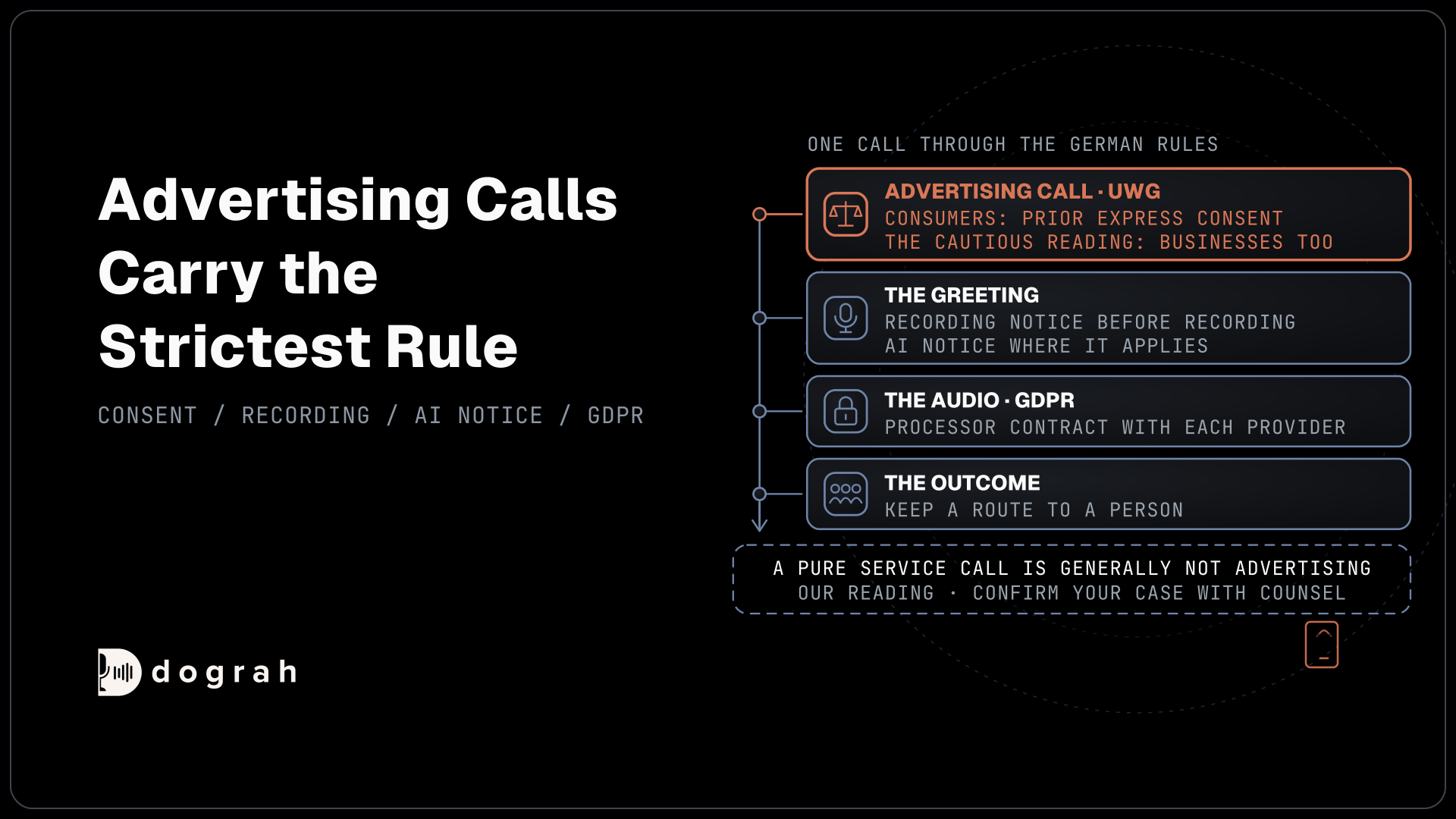
Advertising calls carry the strictest rule. Under Germany's Act Against Unfair Competition (Gesetz gegen den unlauteren Wettbewerb, UWG), a phone advertising call to a consumer needs prior express consent, and a call to a business needs at least presumed consent. Advertising with an automatic calling machine needs prior express consent from anyone, and the cautious reading treats an AI agent as one.
Consent has to be provable. A consumer's consent to phone advertising must be documented when given and kept for five years, and fines run up to €300,000 per call without consent and €50,000 for missing records. Enforcement is active, and the Bundesnetzagentur received 39,842 written complaints about unlawful phone advertising in 2025. A pure service call with no offer is generally not advertising, while adding an offer generally makes it one. Our post on outbound AI calling laws in the UK, Germany and France covers these rules in depth.
Every call also falls under the DSGVO, the GDPR in German. That means a lawful basis for each purpose, a short notice in the greeting with the full one on your website, a processor contract (AVV) with each provider that hears the audio, a legal route for any transfer outside the EU, and a DPIA when the risk is high. Our DPIA for a voice agent walks through one. Article 22 covers decisions made only by automated processing that have legal effect or a similar weight, so it usually does not touch an agent that answers questions or books appointments. Some lawyers read a fully automated outcome as such a decision, so keep a route to a person.
Recording needs its own consent. The German Criminal Code makes recording someone's non-public spoken words without consent an offense, so the recording notice goes in the greeting, before anything is recorded. The EU AI Act adds a duty to tell callers they are talking to an AI, and our post on what a voice agent must tell callers under Article 50 covers the wording. This is our reading of the rules for a typical agent, so confirm your own case with counsel before the first campaign.
Join the Dograh Community
Dograh is an OSS alternative to Vapi. Join our Slack community for queries, releases, best practices & community interactions.
Running a German agent in Dograh
In Dograh, models are chosen per agent, in the editor's Model tab, through a model configuration with LLM, STT and TTS tabs. Dograh's own speech-to-text offers "German" and "German (Switzerland)" in the Language dropdown. For a line that takes German and English, set Language to "Multilingual (Auto-detect)" and tick both under Language hints, and write the greeting in both, for example "Guten Tag, hello".
Long German words that Dograh's own speech-to-text, Deepgram, AssemblyAI, Soniox or Speechmatics misses go in Dictionary in the agent's Settings, as one comma-separated list. The greeting is also where the notices go, since Greeting Text plays word for word. Put the business name there, the recording notice if you record, and the AI notice where it applies. For outbound campaigns, set the campaign's time zone to Europe/Berlin, since calling hours run in one time zone per campaign.
Where data sits is a hosting choice. The provider settings include Deepgram's EU base URL, an ElevenLabs data-residency endpoint, a Google Vertex location and Azure regions such as Germany West Central, which change where the audio goes. To keep calls in Germany end to end, self-host Dograh in a German data center and run open-weight models there too. Transfer Call works on Twilio, Telnyx, Plivo, Cloudonix and Asterisk ARI, and Dograh calls the destination first and connects the caller only when someone answers.
Dograh is the orchestration layer that runs the call flow, tools and telephony, and the speech and language models are a separate layer you choose. Hosted in your own German data center, the orchestration layer carries no per-minute platform fee. Servers, model keys and phone minutes are still paid for, and your team takes care of the database and each upgrade. Help comes from the open-source community, while Enterprise adds custom SLAs. Dograh Cloud runs the hosting instead for a 1¢-a-minute platform fee.
Glossary
- Automatic calling machine
- Equipment that places advertising calls without a person speaking. Under the UWG it needs prior express consent from anyone, and the cautious reading includes AI agents.
- AVV (Auftragsverarbeitungsvertrag)
- The German name for the DSGVO processor contract. A voice agent needs one with each provider that hears or stores the call audio.
- Compound word
- A German noun built from several words, such as Rechnungsadresse. Speech-to-text has to keep it whole, or tools that match the word fail.
- Presumed consent
- The lighter consent the UWG accepts for advertising calls to a business, based on its likely interest. Advertising calls to consumers need prior express consent instead.