
A DPIA for a voice agent records what the agent hears and keeps, where call data goes, the risks and the measures that reduce them. GDPR Article 35 sets the minimum, and the EDPB's draft template supplies the headings. For teams that self-host Dograh, call records stay on their servers, and the processor list starts with the model providers.
Key Takeaways
- A support line rarely meets Article 35(3), yet a DPIA is still worth writing.
- Speech, language and voice providers each need a DPA and a transfer check.
- Self-hosted Dograh keeps call records on your servers. Check the DPA question if any agent uses Dograh's managed models.
A data protection impact assessment is easier to write once you have seen one filled in. We start with when a voice agent needs one, then fill in the EDPB's draft template for an inbound support line. Then we talk about how a self-hosted Dograh install changes the processor list.
When a voice agent needs a DPIA
A DPIA is required before processing that is likely to result in a high risk to people's rights and freedoms, especially when it uses new technology. That test sits in Article 35 of the General Data Protection Regulation (GDPR), which also names three cases that always need one. They are automated evaluation with legal or similarly significant effects, large-scale processing of special category data and large-scale monitoring of public areas.
A support line that answers order and delivery questions rarely fits any of those. The wider test still catches many voice agents. The DPIA guidelines from the European Data Protection Board (EDPB) set nine criteria, and processing that meets two of them usually needs an assessment. An AI agent counts as innovative technology, and a busy line can add large-scale processing on its own. Vulnerable callers or health details push it further.
So our advice is to write the DPIA for any voice agent that records or transcribes calls, even when you could argue your way out of it. It takes a few days and gives your data protection officer something concrete to review. It is also the document a customer's procurement team will ask for. Each supervisory authority also publishes its own list of processing that needs a DPIA, and what follows is our reading of the GDPR, so confirm with counsel which list applies to you and whether your agent needs one.
The draft template and the support line we filled in
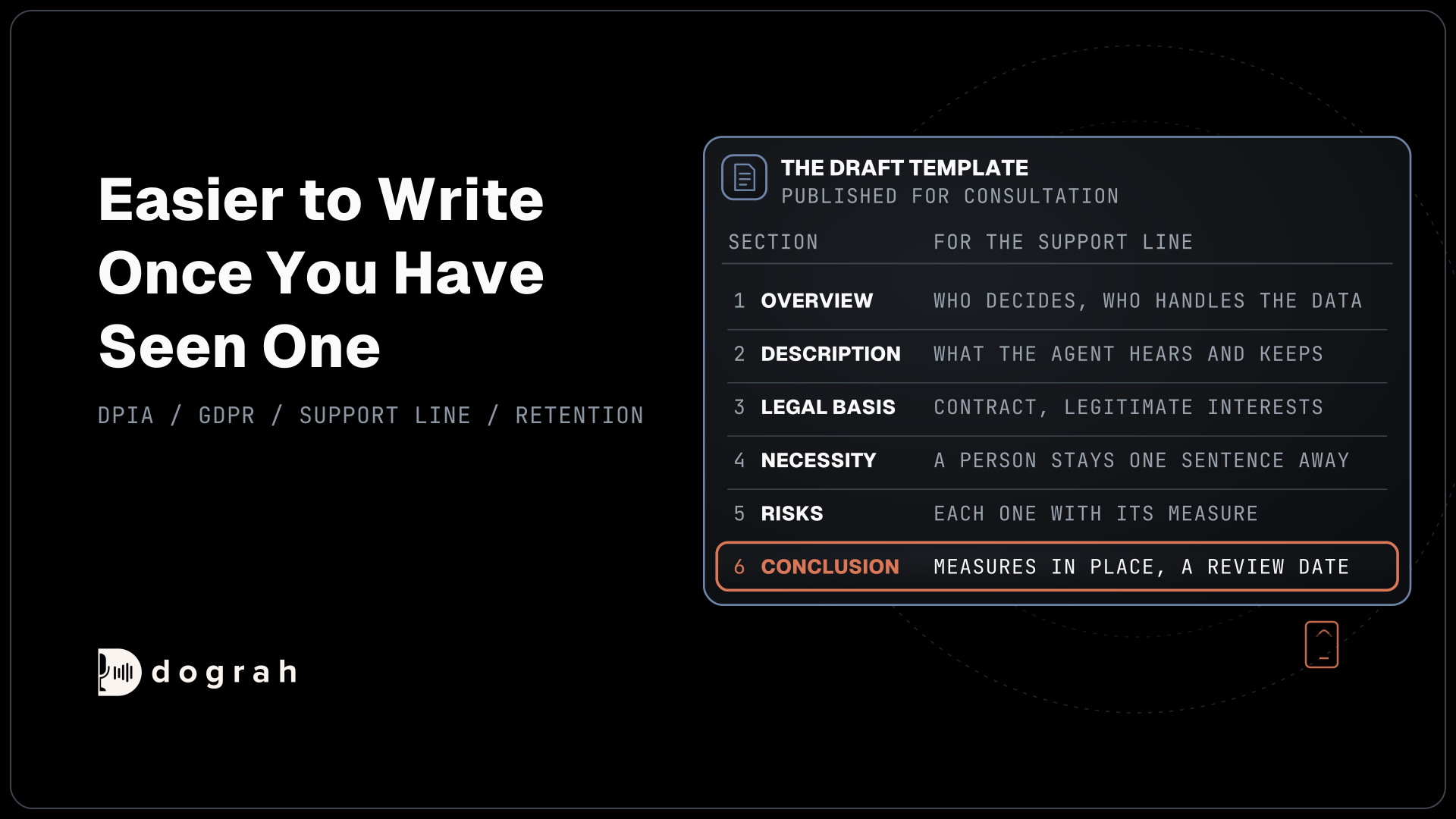
The EDPB published a draft DPIA template in April 2026 for public consultation, which closed on 9 June 2026. It is still a draft template published for consultation, which the EDPB encourages organizations to try in the meantime. It does not change what Article 35 asks for. We follow its headings anyway, because they put the right questions in the right order and give every reviewer the same layout.
Our example is an inbound support line for an online shop selling to customers in the EU. The agent answers order status and return questions and checks the caller with the order number and postcode before it reads out any details. It hands the call to a person on request and records calls for quality review. Treat what follows as a worked template to adapt, since your purposes, providers and retention periods will differ.
Overview: controller and processors
The overview names who decides and who handles the data on their behalf. The shop is the controller. Every outside party that processes the audio or the text for it is a processor and needs a contract under Article 28, known as a data processing agreement (DPA). Our post on GDPR and voice AI explains the roles and international transfers, so here we only fill in the rows.
| Party | Role in the example | What it handles | Contract |
|---|---|---|---|
| The shop | Controller | Everything below | Its own record of processing |
| Cloud host running your servers | Processor | Servers, database and stored recordings | DPA with the host. None in your own data center |
| Speech-to-text provider | Processor | Live call audio | DPA with the provider |
| Language model provider | Processor | Transcript text and prompts | DPA with the provider |
| Voice provider | Processor | Reply text it turns into audio | DPA with the provider |
| Phone carrier | Carries the call | Audio in transit and call records | Its terms, after checking what it stores |
| Self-hosted Dograh | Software you run | No call data reaches the company | No DPA with Dograh |
| Dograh Cloud or Dograh's managed models | Run by Dograh | Call data for those agents | Ask Dograh about Cloud terms |
The software row turns on where the platform runs. A self-hosted install sits on your servers, so the company behind it never receives your calls. That holds while every agent uses your own provider keys or open-weight models, because agents left on the company's managed models send audio to its model service. For those agents, or for Dograh Cloud, ask Dograh about Cloud terms before you fill in that row.

Open Source Alternative to Vapi / Retell
Self-hosted voice agent platform — no per-minute fees
dograh-hq/dograh
Star on GitHub
Systematic description: what the agent hears and keeps
This part lists the personal data, the purposes and how the system is built. For a voice agent it runs longer than most teams expect, because one call leaves several copies behind.
| Data | Example from the support line | Where it is kept |
|---|---|---|
| Caller's phone number | The number that rang the shop's line | Call record in your database |
| Call audio | The caller's voice, while the call is live | Streamed to the speech-to-text provider |
| Recording | The full call | Your object storage, unless recording upload is off |
| Transcript | Every turn, tagged with the step it ran in | Your object storage |
| Extracted fields | Order number and return reason | Call record |
| Call logs and model settings | Turn events, tool calls and the models that ran | Call record |
| Usage and cost | Minutes and model usage | Call record |
The purposes are answering order and return questions and reviewing call quality. Reuse for anything else, such as model training or marketing, belongs under secondary uses, and our example lists none. The nature and scope rows give the expected call volume, the countries callers ring from and the fact that callers can be of any age.
The architecture row traces one call. The caller reaches the shop's number at the carrier, which streams the audio to the platform on your servers. The platform sends the audio to the speech-to-text provider, the transcript to the language model and the reply to the voice provider, then writes records to your PostgreSQL database and object storage. Voice counts as biometric data only when it is processed to identify someone, as the EDPB's guidelines on virtual voice assistants discuss. A support agent that transcribes speech without voice identification stays outside that category in most cases.
Legal basis, minimization and retention
The analysis section asks why the processing is lawful and how little of it you can keep. Our example rests order questions on the contract with the customer and quality recordings on legitimate interests, with the balancing test written out. The bases you pick also shape the notice callers hear.
Minimization starts in the prompt. The agent asks for the order number and postcode and never for a card number or a date of birth it does not need, and it writes only the order number and return reason into the record. Self-hosted, recordings and call records stay in your own database and storage until you remove them, so retention is a job you schedule yourself. Our example keeps recordings for 30 days and call records for 12 months, removed by a scheduled script against the database and storage. Our post on where voice agent call data goes lists every copy that script has to reach.
Rights and security follow from the same setup. Access and erasure requests are answered from your own database and storage, by searching for the caller's number. Recording upload can be switched off for the whole server with ENABLE_CALL_RECORDING_UPLOAD in the environment variables, though transcripts are still saved. Encryption and backups are your own measures on a self-hosted install, and usage telemetry can be switched off when self-hosting.
Necessity and proportionality
This section asks whether a voice agent is needed at all and whether it goes further than it must. Our example's answer is that callers wait less outside office hours and a person stays one sentence away. When a caller asks for someone, Dograh calls the destination first and connects the caller only when someone answers, which works on Twilio, Telnyx, Plivo, Cloudonix and Asterisk ARI. Recording for quality review alone, and for 30 days, keeps the intrusion in line with that purpose.
The opening line carries the notices. Since 2 August 2026 the EU AI Act asks for people to be told they are talking to an AI unless that is obvious, and the same line can say the call is recorded and why. The Greeting Text on the Start Call node plays word for word, so the wording in the DPIA matches what callers actually hear.
Risk assessment: inherent risk and measures
The template scores each risk twice, first as it stands and again after the extra measures. Likelihood times severity gives the level, and the residual level decides what happens next. These are the risks we found for the support line.
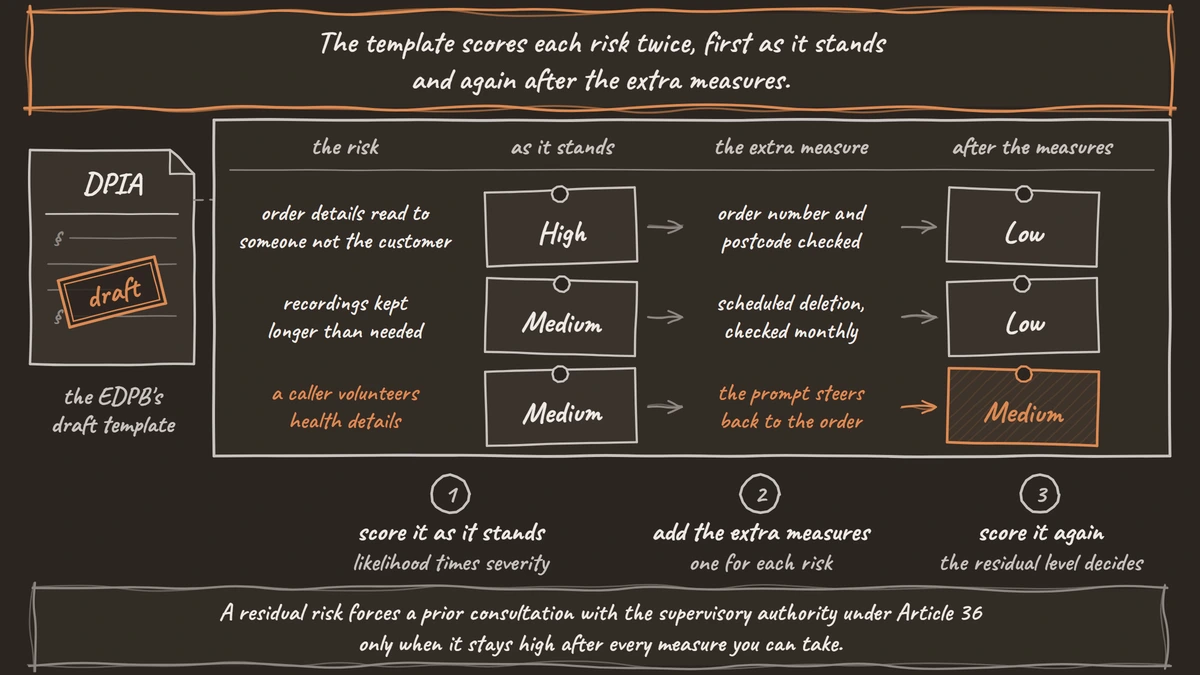
| Risk to callers | Inherent level | Measure | Residual level |
|---|---|---|---|
| The agent reads order details to someone who is not the customer | High | Order number and postcode checked before any details | Low |
| A misheard order number lands on the wrong record | Medium | The agent reads the number back before saving it | Low |
| Call audio is processed outside the EU | Medium | EU endpoints where offered, transfer safeguards in each DPA | Low |
| Recordings are kept longer than needed | Medium | Scheduled deletion at 30 days, checked monthly | Low |
| Staff open recordings without a reason | Medium | Access limited to the support lead, access logs on your servers | Low |
| A caller volunteers health details | Medium | The prompt steers back to the order, the team deletes flagged calls | Medium |
The EU endpoint row depends on each provider. Our list of EU-hosted LLM, STT and TTS providers gives the route for each one, such as Deepgram's api.eu.deepgram.com set as the base URL on the Deepgram connection. The last row stays at medium, and that is fine to record. A residual risk forces a prior consultation with the supervisory authority under Article 36 only when it stays high after every measure you can take.
Join the Dograh Community
Dograh is an OSS alternative to Vapi. Join our Slack community for queries, releases, best practices & community interactions.
DPO advice, callers' views and the conclusion
The last sections record who reviewed the assessment and what was decided. Where you have a data protection officer, Article 35 asks you to seek their advice, and the template has a box for it and for whether you followed it. It also asks for the views of the people affected where that is appropriate. For a support line, that can be a short session where a few customers listen to the greeting and the recording notice.
The conclusion in our example says the processing can start with the six measures in place and a review date set. Revisit the DPIA whenever you change a model provider, add a field to collect or extend a retention period, because each change moves the processor list or the risk table. Our post on EU AI Act record-keeping for voice agents covers the call logs you may also need to keep.
Dograh rows: your servers and your choice of models
Dograh, the open-source AI voice agent platform we build, is the orchestration layer that runs the call flow, tools and telephony, and the speech and language models are a separate layer you choose. That split is what shapes the processor table. You pick models per agent in a model configuration, from the platform's own models, your own provider keys or open-weight models on your own servers.
Bringing your own keys moves the contract to you, and the audio still reaches each provider, so each one stays a processor with its own DPA. Only open-weight models running in your own data center take the model rows off the table. What is left then is the phone carrier and, if you rent servers, your cloud host.
A self-hosted install runs with Docker Compose on servers you pick, and call records, recordings and transcripts sit in your own database and object storage. Running Dograh yourself means no per-minute platform fee. You still pay for servers, model keys and phone minutes, and your team looks after the database and upgrades. Support comes from the open-source community, and Enterprise adds custom SLAs. If you would rather not host it, Dograh Cloud runs it for a 1 cent a minute platform fee.
Glossary
- Data protection impact assessment (DPIA)
- The GDPR Article 35 assessment of processing likely to be high risk. It describes the processing, tests necessity and proportionality, and lists risks and the measures that reduce them.
- Data processing agreement (DPA)
- The Article 28 contract between a controller and a processor. Each speech, language or voice provider that receives call audio or text needs one.
- Residual risk
- The risk left after the extra measures are in place. The EDPB draft template scores it separately from the inherent risk.
- Prior consultation
- The Article 36 step of asking the supervisory authority before processing starts, needed only when a DPIA leaves a high risk that measures cannot reduce.