
To choose a text-to-speech model for a voice agent, rule out voices that miss your callers' language, measure first audio in your own call traces, hear the voice on an 8 kHz phone line, and turn its price into a per-call figure. Dograh, the open-source AI voice agent platform, sets the voice per agent so you can compare.
Key Takeaways
- Measure first audio in your own call traces, not from vendor speed claims.
- Judge every voice over a real phone line, never only in a browser.
- Dograh sets one voice per agent, from providers including ElevenLabs, Cartesia and Deepgram.
A voice that wins a blind listening test can still sound slow or thin on a phone call. We set out the order that decides the choice, from language to price per call, then talk about how Dograh lets you swap and compare voices on real calls.
Rule out voices by language and accent
Language rules out more voices than any benchmark. Check that each candidate speaks every language your callers use, with an accent they will trust, and that it reads the numbers, dates and addresses of that language correctly. A voice built for American English can stumble on Indian addresses or Spanish surnames even when the provider lists the language.
Accent is a brand choice too. A clinic in Texas and a bank in London want different voices for the same script, and a caller who hears a distant accent often assumes a distant call center. Some providers cover many languages with one model, such as Cartesia's Sonic 3.6 with 44, while others offer a few voices per language.
Our list of text-to-speech APIs for voice agents shows the languages, voices and prices per provider, so this guide sticks to the order of the decision.
Measure first audio in your own traces
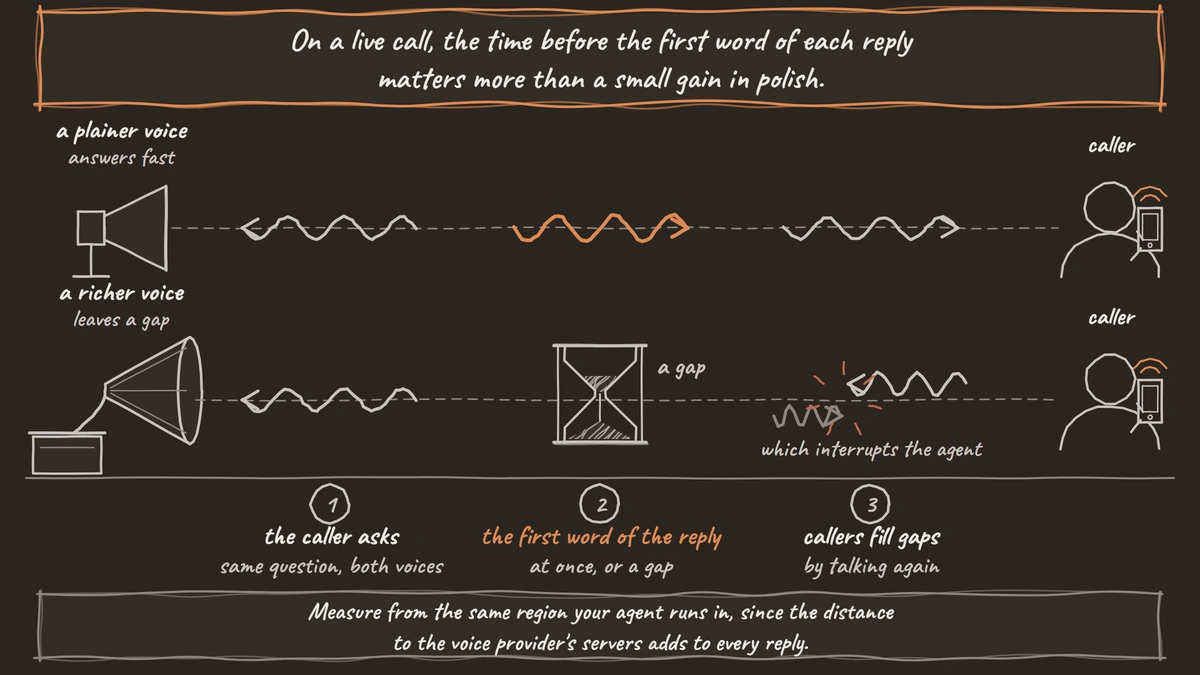
On a live call, the time before the first word of each reply matters more than a small gain in polish. A slightly plainer voice that answers fast feels more human than a richer one that leaves a gap, and callers fill gaps by talking again, which interrupts the agent.
Vendors publish their own speed figures, and they are measured on the vendor's servers, without your network, your language model or your phone line. ElevenLabs calls v4 Turbo its best model for real-time and agents, and every voice vendor makes a similar claim. Treat those figures as a reason to test.
Streaming matters as much as raw speed. A voice that starts speaking from the first sentence of the reply, while the language model is still writing the rest, cuts the wait more than a faster model that waits for the whole reply. Check that the provider accepts text in pieces over a live connection and returns audio in chunks, and test long replies, where the difference shows most.
Measure first audio in your own call traces instead. Run the same agent on two or three voices, make a dozen calls on each, and compare the voice time for each turn. Measure from the same region your agent runs in, since the distance to the voice provider's servers adds to every reply.
Use the blind-vote board as a tiebreaker
Once speed and language narrow the field, quality decides between the survivors. On the Artificial Analysis Speech Arena, listeners vote between two unnamed voices, and the board turns those votes into an Elo score. Eleven v4 Turbo leads at 1340 and Eleven v4 follows at 1338, with Cartesia's Sonic 3.6 near the top.
Two limits keep the board a tiebreaker. Listeners hear studio-quality audio, not a phone call, and the board shows no speed. A voice a few points lower that answers sooner can be the better pick for a phone agent, so use the board to pick which voices to test, and let your own calls decide.
Check the voice on an 8 kHz phone line
A phone line usually carries 8 kHz audio, half the 16 kHz of a browser demo. A voice that sounds rich in a browser loses its high frequencies on a phone line, so breathy or very soft voices can turn thin, and fast talkers can blur.
Output format is the technical half of the same check. Some providers stream audio already in the phone format, and Deepgram's streaming TTS outputs linear16, mu-law or A-law, with mu-law and A-law at 8,000 Hz by default. Others send wideband audio that the platform converts for the line. Either works, but conversion done badly adds noise, so check the result by ear.
The fix is simple and often skipped. Call the agent from a real mobile phone and a landline, in a quiet room and on speakerphone, and listen to the same script on each candidate voice. Our guide to making TTS sound less robotic covers the text and speed changes that help once you have picked a voice.
Turn the price into a per-call figure
Voice providers use different billing units, per character, per credit or per minute of audio, so turn each one into a cost per call before you compare. Count how many characters your agent speaks in a typical call from your transcripts. As an example, take 1,500 characters a call, about a minute and a half of speech.
ElevenLabs v4 Turbo at $0.04 per 1,000 characters comes to $0.06 a call, and its v4 model at $0.08 to $0.12. Deepgram's Aura-2 at $0.030 per 1,000 characters comes to $0.045. Rime's Mist v3 at $0.030 a minute, billed at about 1,000 characters a minute, also comes to $0.045, and Inworld's TTS-2 at $25 per million characters comes to $0.0375.
Plan minimums, included credits and volume tiers change those figures, so run the sum at your real monthly calls. Lines that never change, such as the greeting and closing, can play as recordings and take no characters at all, as our guide to pre-recorded audio with TTS shows.

Open Source Alternative to Vapi / Retell
Self-hosted voice agent platform — no per-minute fees
dograh-hq/dograh
Star on GitHub
Concurrency, cloning and open voices
Every call speaking at once needs its own voice request, so a plan's concurrency limit caps your busiest minute. Cartesia's plans allow 2 concurrent requests on Free, 3 on Pro, 5 on Startup and 15 on Scale, and other providers set similar limits per plan or per key. Check the limit against the number of calls you expect at your peak, not your monthly total.
Cloning adds its own rules. Some vendors keep professional clones for higher plans or for your own voice only, and several ask you to confirm consent before they build a clone. If a cloned brand voice is part of the plan, check those gates before you commit to a provider, and our list of the best voice cloning tools for voice agents compares them.
Open text-to-speech models run on your own GPU, so the text your agent speaks never goes to a voice vendor, and there is no per-character bill. Kokoro is the common starting point for a fast, light English voice, and other open models add cloning or more languages with licence limits to check.
The trade is the same as with any self-hosted model, which is work. You run the GPU, keep the model updated and test it on phone calls yourself. Our guide to open-source TTS models covers the shortlist, the licences and how each reads numbers.
A one-week listening test
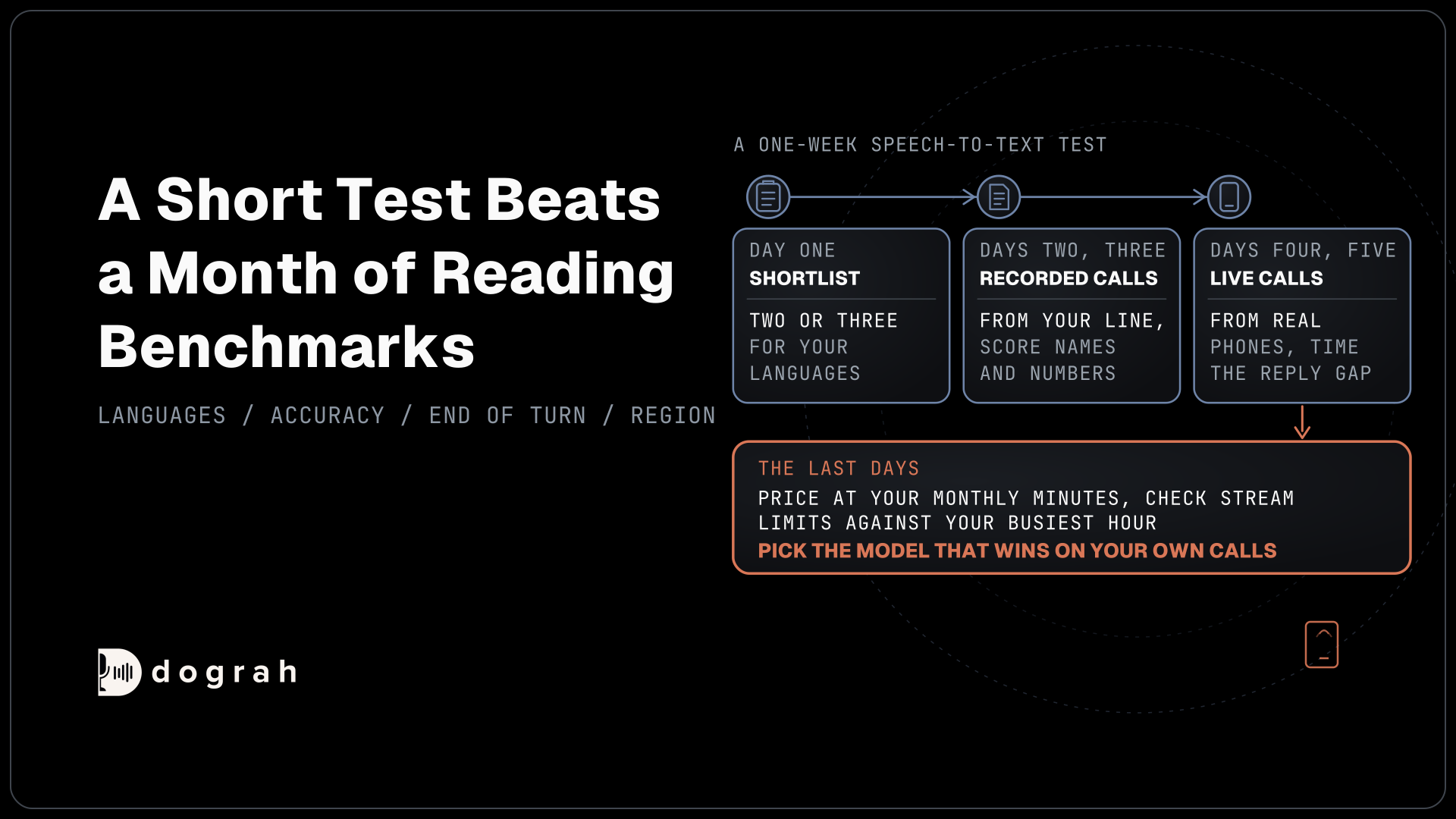
A short test beats a month of comparing demo pages. On day one, shortlist three voices that cover your languages and fit your price per call. On days two and three, put each on a test agent and make a dozen calls from real phones, timing the voice part of each turn in your traces.
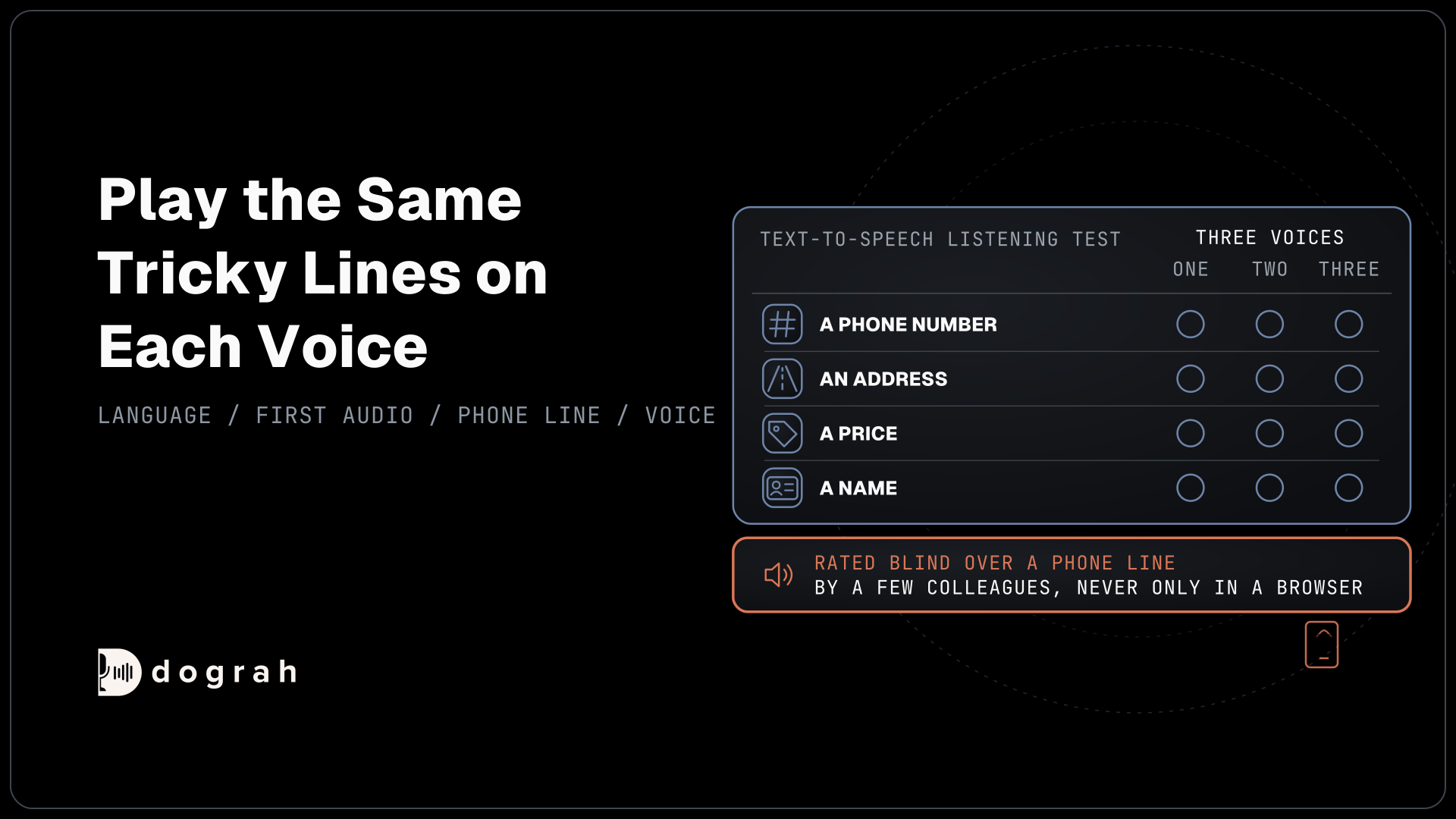
On days four and five, play the same five tricky lines on each voice, such as a phone number, an address, a price and a name, and ask a few colleagues to rate them blind over a phone line. On the last days, check concurrency against your peak hour and pick the voice that wins on your calls. Write down the winner's voice ID, model and speed, so the same voice can be set on every agent that callers might reach.
Choosing a voice in Dograh, a worked example
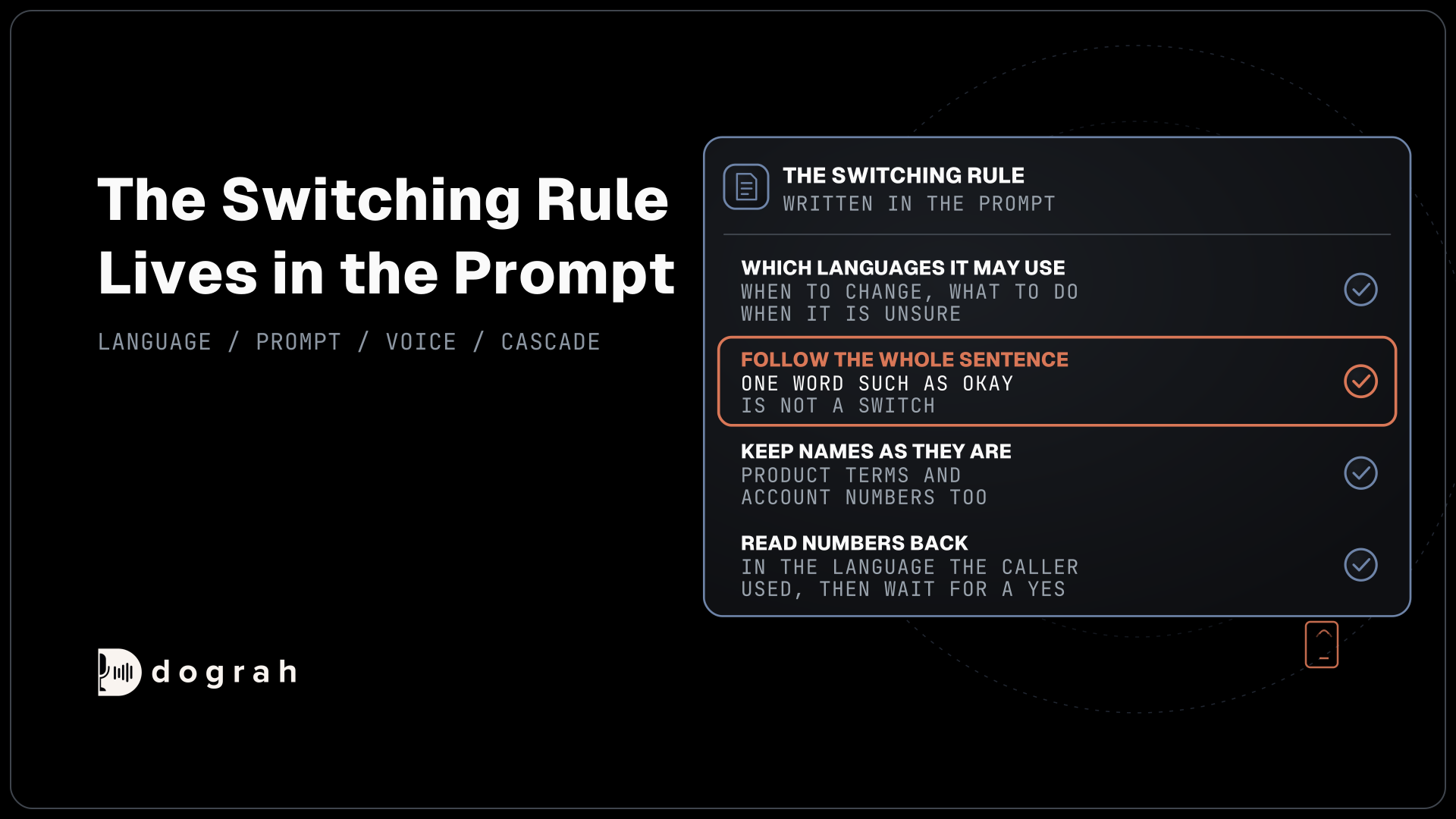
In Dograh, each agent speaks with one voice, set on the Models page by adding a configuration and opening its TTS tab, or by picking Custom on the agent's Model tab. Choose the provider, then the model and the Voice field, where Enter Custom Value takes any voice ID, and adjust Speed if the provider offers it. The voice settings cover providers including ElevenLabs, Cartesia, Deepgram, Inworld, Rime, Azure Speech, Google, MiniMax and Sarvam, and for Rime pick mistv3 in the Model field.
On a phone line, Dograh runs the call at the line's own 8 kHz rate, so the choice is the voice itself and the audio format follows the line. Test it with the Phone Call button and compare the voice time per turn in View Trace. Fixed lines such as the greeting can play as recordings of a real speaker, using pre-recorded audio.
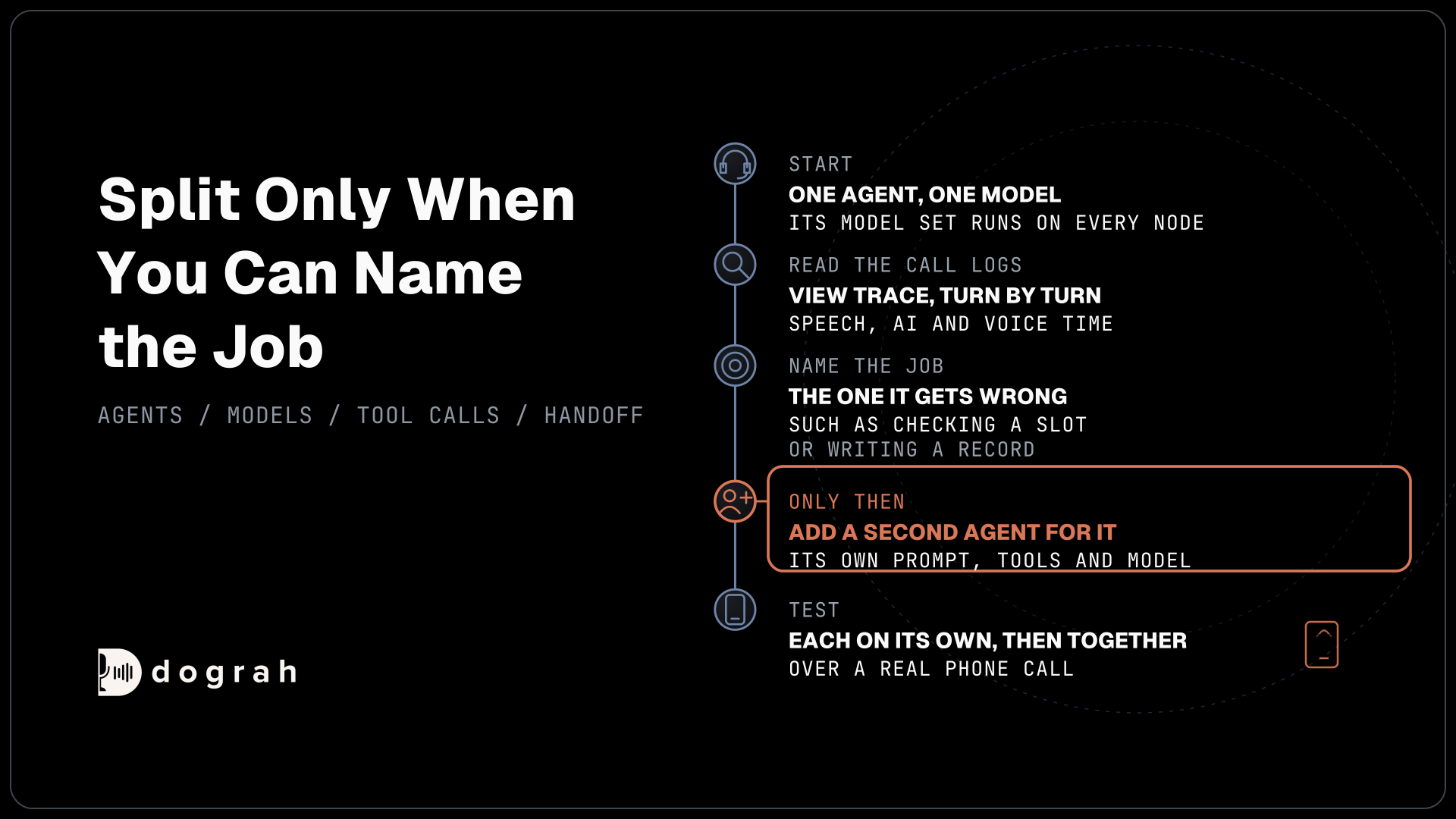
The voice can also change around a call. A Pre-Call Data Fetch response can set the voice for one call, for example by language or account. With Transfer To Agent, each agent speaks with its own voice, so set the same voice on every agent in a handoff when the caller should hear one person. For busy days, Add API Key spreads calls across several keys for one provider.
Running Dograh yourself means no per-minute platform fee. It also lets an open voice such as Kokoro run through Local Models (Speaches). You still pay for servers, model keys and phone minutes, and your team looks after the database and upgrades. Support comes from the open-source community, and Enterprise adds custom SLAs. If you would rather not host it, Dograh Cloud runs it for a 1 cent a minute platform fee.
Join the Dograh Community
Dograh is an OSS alternative to Vapi. Join our Slack community for queries, releases, best practices & community interactions.
Glossary
- First audio
- The first sound of a reply that the caller hears, timed from the moment the reply text is ready. Measure it in your own call traces, since vendor figures leave out your network.
- Mu-law
- The 8 kHz audio encoding used on most North American and Japanese phone lines. A-law plays the same role in most other countries.
- Elo score
- The Speech Arena's score from blind listener votes between two voices on Artificial Analysis. It ranks studio-quality sound and shows no speed.
- Billing unit
- What a voice provider counts to charge you, such as characters, credits or minutes of audio. Rime counts about 1,000 characters to a minute of speech.