
The EU AI Act's record-keeping rules apply to high-risk AI systems. Providers build in automatic logs, and deployers keep the logs they control for at least six months, from 2 December 2027 for listed uses. Most support and booking agents are not high-risk. Teams that self-host Dograh keep call logs, transcripts and agent versions on their own servers.
Key Takeaways
- Automatic logs and six-month retention apply only to high-risk systems, from December 2027.
- The Article 50 notice covers every voice agent and carries no log duty.
- Dograh stores each call with the agent version that ran it.
Record-keeping is the part of the EU AI Act that voice agent teams most often over-read. We start with what the logging articles ask you to keep and what does not apply to most agents. Then we talk about how Dograh stores call logs, transcripts and agent versions.
What the Act asks you to keep
The record-keeping duty starts with the system's design. Article 12 says a high-risk AI system must technically allow the automatic recording of events, its logs, over the whole lifetime of the system. Automatic means the system writes them as it runs, and lifetime means from first deployment until it is switched off.
The logs help spot situations where the system may present a risk or has been substantially modified. They also support the provider's monitoring after launch and let the business using it watch how it runs. Article 12 prescribes a minimum list of fields only for remote biometric identification systems, so for anything else the content of the logs is left to the provider.
Keeping the logs is split by role. Article 19 asks providers to keep the logs under their control for a period suited to the system's purpose, at least six months. Article 26 puts the same duty on deployers, the businesses that use a high-risk system, for the logs they control. Both carry the same exception where other EU or national law, in particular data protection law, says otherwise.
What does not apply to most voice agents
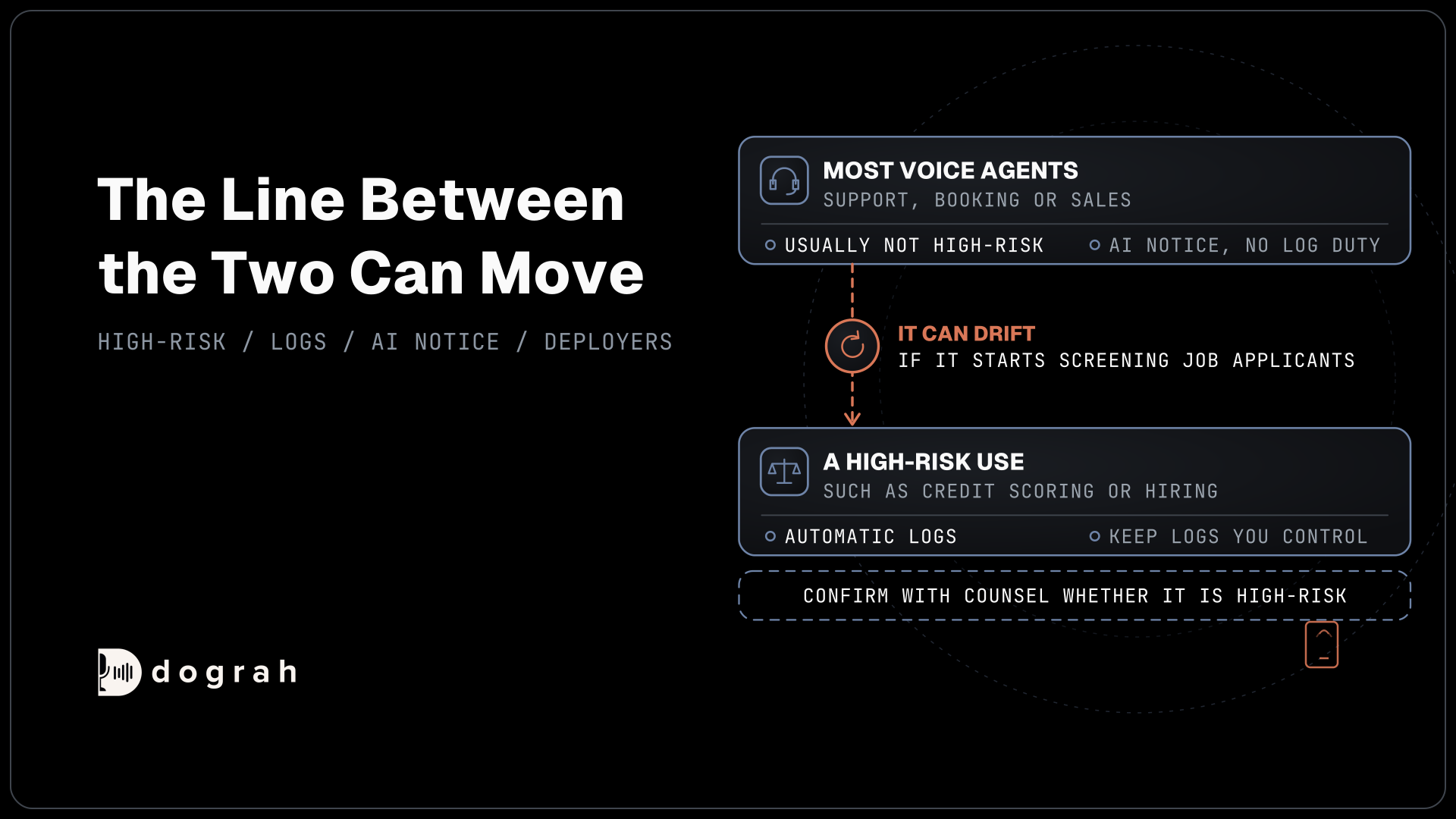
Every duty above applies only to high-risk systems. Those are the uses the Act lists, such as credit scoring or hiring, plus AI inside regulated products. A support, booking or sales agent is usually not one of them. Our post on high-risk rules for voice agents walks through that test and the narrow way out.
The rule that reaches every voice agent is the notice. Since 2 August 2026, Article 50 has required that callers learn they are speaking with an AI unless it is obvious, and it carries no duty to keep logs. Keeping proof that the notice played is still good practice, because it is the first thing anyone asks for after a complaint. Our post on what a voice agent must tell callers covers the wording.
The line between the two can move. An agent that only books appointments today can drift into a listed use if it starts screening job applicants or judging eligibility for a benefit. These rules are our reading of the Act, so confirm with counsel whether your agent is high-risk before you decide what to keep.
When the logging duties start
The logging and retention duties sit in the part of the Act whose start date was moved. Article 113, as amended by the Digital Omnibus on AI, applies them from 2 December 2027 for the listed high-risk uses and from 2 August 2028 for AI built into regulated products. The notice in Article 50 kept its date of 2 August 2026.
So a high-risk voice agent has time to build its logging, and every agent already needs its opening line. Our EU AI Act timeline sets out every other date in the Act.

Open Source Alternative to Vapi / Retell
Self-hosted voice agent platform — no per-minute fees
dograh-hq/dograh
Star on GitHub
If your agent is high-risk: logs under your control
A high-risk deployer keeps the logs under its own control, so the first job is knowing which logs those are. A voice agent's events are spread across the phone carrier, the speech, language and voice providers and the platform that runs the call. Many model APIs keep nothing after a request, or keep it on their side under their own terms, so the platform's call record is usually the one log that covers a call from start to end.
Article 26 also asks deployers to monitor the system as the provider's instructions describe and to report the risks they find. For a voice agent, that monitoring mostly means reading calls. Sample live calls for review and keep the results next to the call log. Note every change to the prompt or the models too, since a substantial change is one of the events the logs exist to catch.
Roles can stack, too. A business that builds its own agent and puts it into service under its own name may carry provider duties as well, including the design duty in Article 12. In that case the logging has to be built in from the start, which is easier on a platform that already writes a full record of every call.
Six months is a floor, and the GDPR sets the ceiling
The six months in Article 26 is a minimum, and data protection law decides the maximum. Call logs and transcripts hold personal data, and the General Data Protection Regulation (GDPR) says personal data should be kept in a form that identifies people for no longer than its purpose needs. A high-risk deployer therefore picks a period of at least six months that it can justify, and a team outside the high-risk rules picks one from its purpose alone.
Write that period down before launch, along with what gets deleted and who runs the deletion. Article 26 also points deployers of high-risk systems at their GDPR impact assessment, using the information the provider supplies. Our worked DPIA for a voice agent shows where the retention periods go in that document.
What to keep in practice for any voice agent
Whether or not your agent is high-risk, a short keep list answers most questions after a complaint or a bad call. The periods below are an example for a support line outside the high-risk rules, and a high-risk deployer would set at least six months for the logs.
| Record | Why you keep it | Example period |
|---|---|---|
| Call log with turn events and tool calls | Shows what the agent did, step by step | 12 months |
| Transcript | Shows what was said on both sides | 12 months |
| Recording | Settles disputes the transcript cannot | 30 to 90 days |
| Agent version that ran the call | Shows which prompt and flow were live | As long as the call log |
| Model settings for the call | Shows which speech, language and voice models ran | As long as the call log |
| Greeting wording | Proves the AI notice played | As long as the version |
| QA results | Shows the calls you checked and what you found | 12 months |
| Access logs | Shows who opened a recording or transcript | Your security policy |
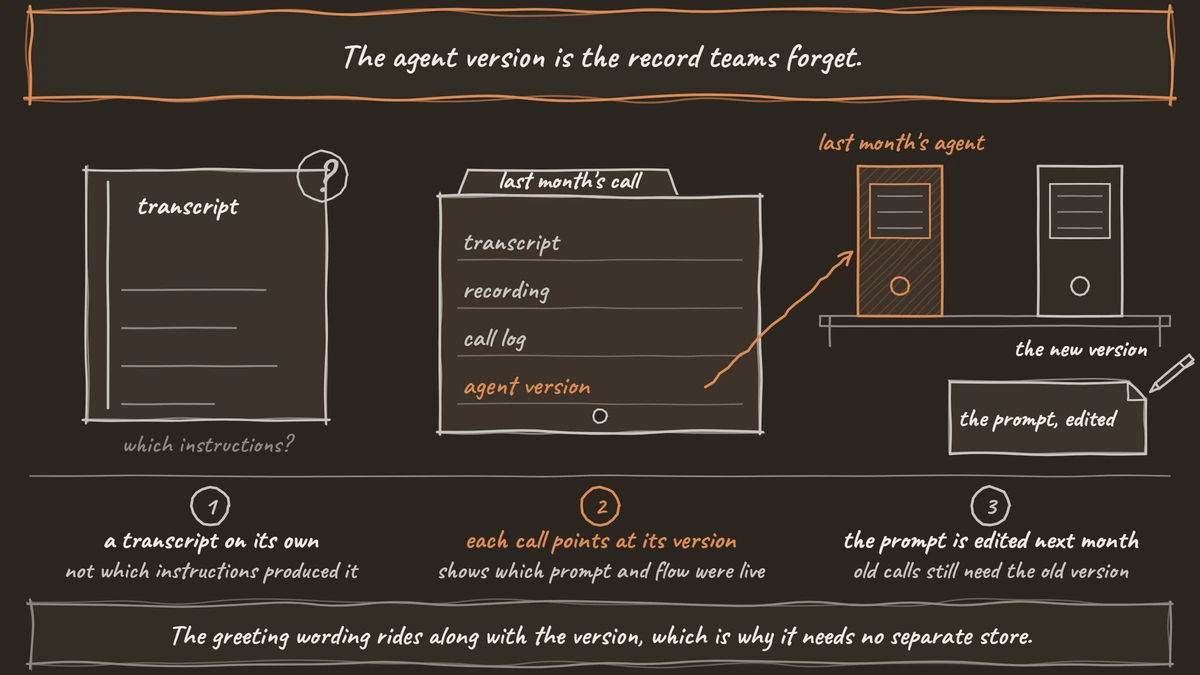
The agent version is the record teams forget. A transcript on its own shows what was said, but not which instructions produced it. When someone edits the prompt next month, last month's calls still need to point at last month's agent, or the log stops proving anything. The greeting wording rides along with the version, which is why it needs no separate store.
Join the Dograh Community
Dograh is an OSS alternative to Vapi. Join our Slack community for queries, releases, best practices & community interactions.
Where Dograh keeps call logs, transcripts and versions
In Dograh, the open-source AI voice agent platform we build, every call becomes one call record. It holds the recording and transcript links, a log of turn events and tool calls, the values the agent extracted and a snapshot of the model settings that ran. Each record also points at the exact agent version that took the call. On a self-hosted install the record sits in your PostgreSQL database and the files in your own object storage.
Versions are made when you publish. Saving updates a single draft, and Publish version turns that draft into the published version, with optional notes for the Version History panel, while the previous published version is archived. Live calls run the published version, so each publish adds a version to the history and every call records the version it ran. For a turn-by-turn view, tracing sends each call to a Langfuse project you choose. Our post on building an auditable voice AI stack maps each record to the question a reviewer asks.
Retention is a job you run. A scheduled script you own clears old records from the database and storage at the end of your period. Recording upload can be switched off for the whole server when self-hosting, though transcripts are still saved. Access logs come from your own database, storage and proxy, and the Enterprise plan lists audit logs.
A self-hosted install runs with Docker Compose on servers you choose, which is what keeps these records under your control. Running Dograh yourself means no per-minute platform fee. You still pay for servers, model keys and phone minutes, and your team looks after the database and upgrades. Support comes from the open-source community, and Enterprise adds custom SLAs. If you would rather not host it, Dograh Cloud runs it for a 1 cent a minute platform fee.
Glossary
- Automatic logs
- Records of events a high-risk AI system writes by itself while it runs, over its whole lifetime, as Article 12 of the EU AI Act requires.
- Deployer
- The business that uses an AI system under its own authority. Deployers of high-risk systems keep the logs they control for at least six months.
- High-risk AI system
- An AI system in a use the Act lists, such as credit scoring or hiring, or built into a regulated product. Most support agents are not one.
- Published version
- The agent version live calls run in Dograh. Each publish adds a version to the history, and every call record points at its version.