
AI calling laws in the UK, Germany and France all start from consent. The UK needs consent to automated calls, Germany express consent with five years of records, and France, since 11 August 2026, opt-in consent plus fixed weekday hours. On Dograh, the open-source AI voice agent platform, self-hosted or on Dograh Cloud, each country gets its own schedule.
Key Takeaways
- France moved consumer sales calls to opt-in consent on 11 August 2026.
- German consent to phone advertising must be documented and kept for five years.
- Only France sets calling hours in law, weekdays with a lunch break.
The UK, Germany and France ask for consent before an AI sales call, each of a different kind. We put the rules in one table, cover each country with France in full, and say where consumer and business rules part. Then we talk about how Dograh runs each country's schedule.
Consent and calling hours in one table
The table compares sales calls, since service calls with no offer fall outside most of these rules in all three countries. AI calls get their own row, because each country treats automated calls more strictly than calls a person makes, and the cautious reading puts an AI agent in that group everywhere.
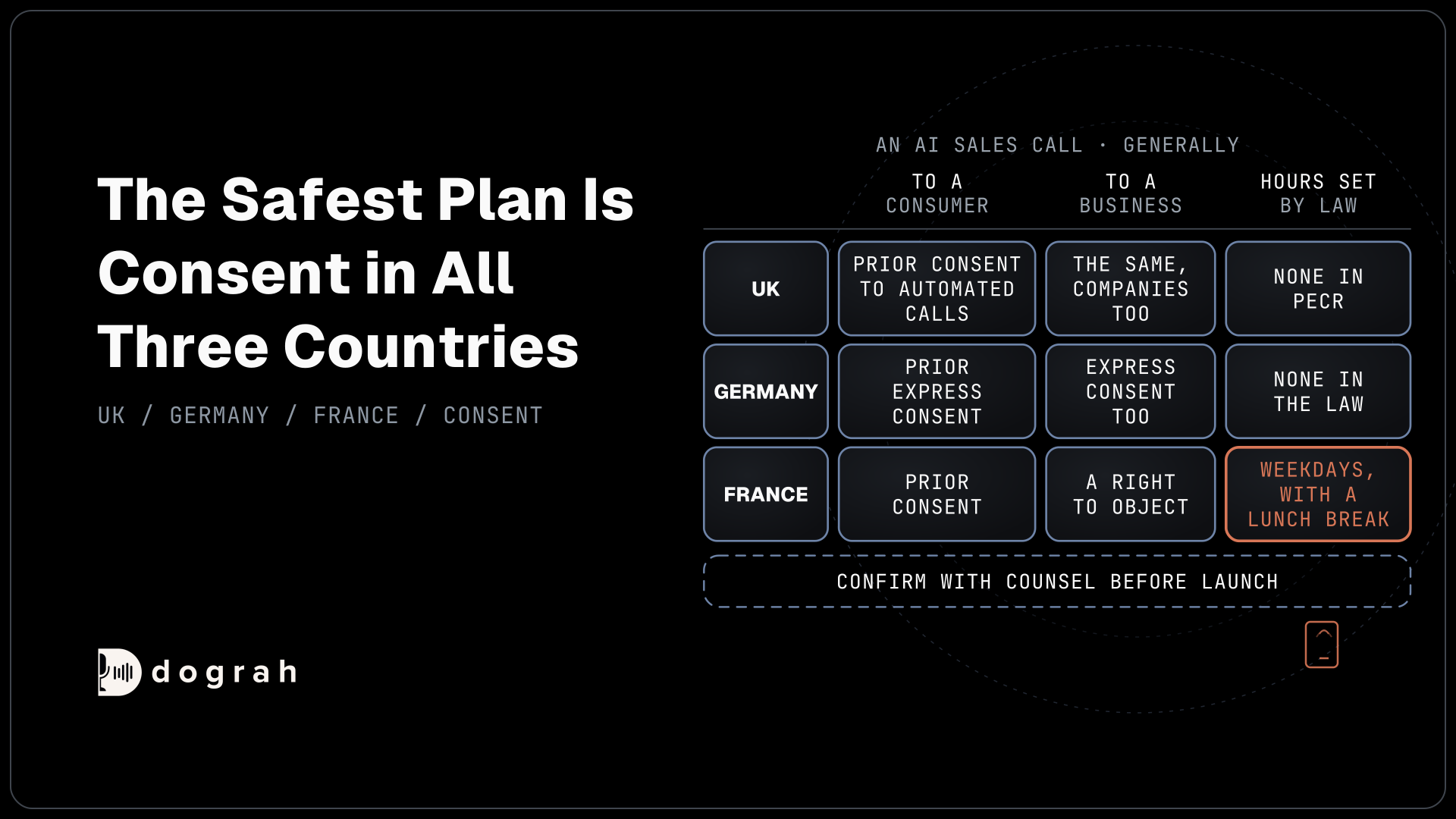
| Rule | United Kingdom | Germany | France |
|---|---|---|---|
| Sales call to a consumer by a person | Allowed unless the number is on the TPS or the person objected | Prior express consent | Prior consent since 11 August 2026 |
| Sales call to a business by a person | Allowed unless the number is on the Corporate TPS or the business objected | At least presumed consent | Allowed when it relates to the person's job, with a right to object |
| AI or automated sales call | Prior consent to automated calls, consumers and businesses alike | Prior express consent from anyone | Prior consent from individuals, a right to object for professionals |
| Calling hours set by law | None in PECR | None in the law | Monday to Friday, 10:00 to 13:00 and 14:00 to 20:00 |
| Consent records | Keep proof of who agreed and how | Documented, kept five years | Consent lasts one year, proof kept at least three years |
United Kingdom: consent to automated calls
The UK rule turns on whether the call is automated. Under the Privacy and Electronic Communications Regulations (PECR), an automated marketing call needs the person's prior consent to automated calls from you, and that covers companies as well as people. Live marketing calls instead must avoid numbers on the Telephone Preference Service (TPS) and the Corporate TPS.
PECR does not name AI, and the safe reading treats an AI agent as automated. PECR sets no calling hours, though Ofcom expects the first words within two seconds of pickup. Since 5 February 2026 the regulator can fine up to £17.5 million or 4% of worldwide turnover. Our post on AI phone calls in the UK covers each rule, the 2026 fines and a checklist. For the US and EU picture, see our post on whether AI phone calls are legal.
Germany: express consent and five years of records
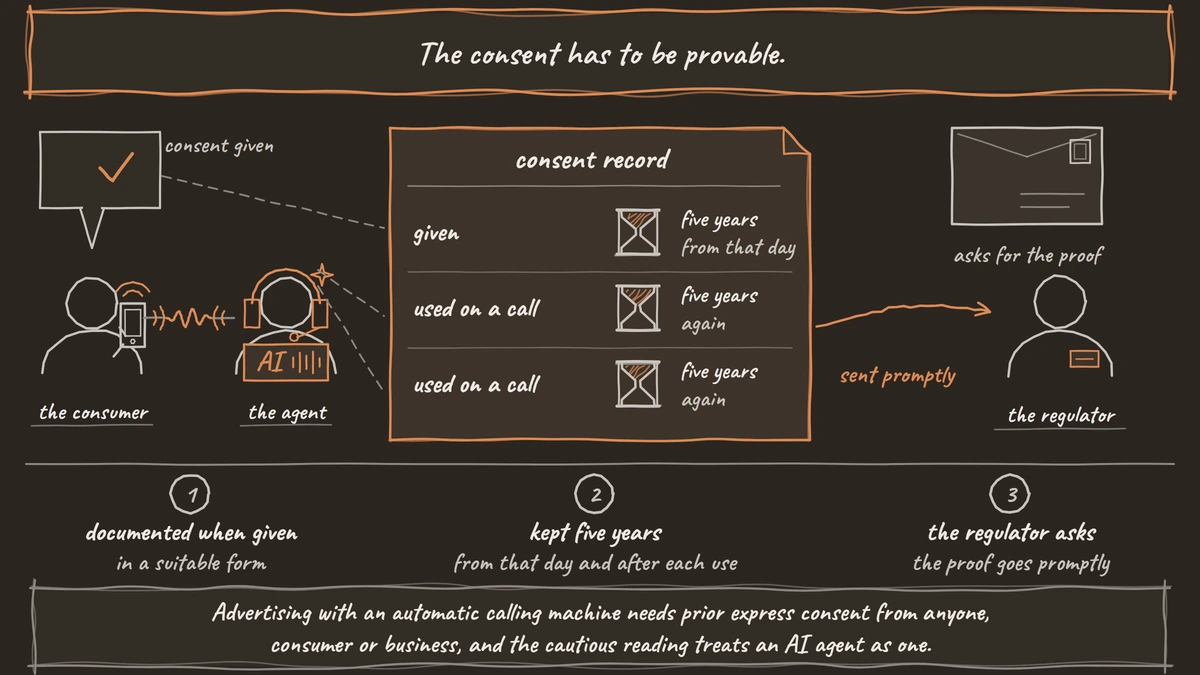
Germany's rule depends on who you call. Under the Act against Unfair Competition (Gesetz gegen den unlauteren Wettbewerb, UWG), a phone advertising call to a consumer needs that person's prior express consent. A call to a business needs at least presumed consent, meaning a concrete reason to think the business wants it. Advertising with an automatic calling machine needs prior express consent from anyone, consumer or business, and the cautious reading treats an AI agent as one.
The consent has to be provable. Consent to phone advertising from a consumer must be documented in a suitable form when it is given, then kept for five years from that day and again after each use. The proof has to go to the regulator promptly when asked, so keep it next to the contact list where you can find it quickly.
Enforcement is steady. The Bundesnetzagentur, Germany's network regulator, received 39,842 written complaints about unlawful phone advertising in 2025 and imposed fines of over €1.099 million. Each advertising call to a consumer without consent can bring a fine of up to €300,000, and missing consent records up to €50,000.
Germany sets no calling hours for advertising calls in these laws. It does require calls to carry a full German number the caller has the right to use, and German numbers on calls arriving from abroad are suppressed. Our post on outbound calling in Germany and Spain covers that caller ID rule and what carriers ask for.

Open Source Alternative to Vapi / Retell
Self-hosted voice agent platform — no per-minute fees
dograh-hq/dograh
Star on GitHub
France: opt-in since 11 August 2026
France changed the most in 2026. Since 11 August 2026, the CNIL's rules on phone prospecting require a consumer's prior consent before a sales call. The Commission nationale de l'informatique et des libertés (CNIL) is France's data protection regulator, and Bloctel, the old opt-out register, ended when the new rule began.
The consent must be free, specific, informed and unambiguous. The request has to name who will call and the kind of goods or services, and it lasts at most one year. People can withdraw it at any time and can ask to see the proof, which you keep for at least three years from the day you collected it. Because the request names the kind of goods or services, consent given for insurance quotes does not cover a call about broadband, so each campaign needs consent that matches its offer.
A few calls need no prior consent. Selling newspaper or magazine subscriptions is one. A call about a contract the person already has is another, as long as it stays on that contract's subject. Charity calls and other non-commercial prospecting are also outside the rule, as long as the person can object simply and for free.
The hours are fixed too. Calls may go out Monday to Friday, from 10:00 to 13:00 and from 14:00 to 20:00, and not on weekends or on public holidays unless the person agreed to other times. Phone selling is banned outright for energy renovation, home adaptation for loss of autonomy and the personal training account (CPF).
Automated calls follow a separate rule. The CNIL's page on automated calling machines requires prior consent from individuals, while professionals have a right to object. An AI agent placing sales calls fits the cautious reading of such a machine, so plan on consent for every individual.
Where consumer and business rules differ
Business numbers get more room in every country, but less than many teams assume once the call is automated. In France, a professional can be called about their job on legitimate interest with a right to object, and the same goes for automated calls. In Germany, presumed consent covers a person calling a business, yet an automatic calling machine needs express consent from businesses too. In the UK, the automated-call rule covers companies just as it covers people.
So the safest plan for an AI agent is consent in all three countries, for consumers and businesses alike, with France's hours on top. The business routes are narrower than they look, since each one depends on how a regulator or court reads "automated" for an AI voice. That is our reading of the rules, so confirm with counsel how they apply to your calls, lists and countries before launch.
Join the Dograh Community
Dograh is an OSS alternative to Vapi. Join our Slack community for queries, releases, best practices & community interactions.
Setting up calls for each country in Dograh
The opening line names the caller in every country, so make it fixed text. In Dograh, the business name and the reason for the call go in the Greeting Text of the Start Call node, written in the caller's language, and the agent says it word for word when the call connects. In Germany and France, the EU AI Act also expects people to be told they are talking to an AI, and our post on what a voice agent must tell callers under Article 50 gives sample lines.
Each country gets its own campaign, because a campaign's Call Schedule runs in one Timezone. For France, set Europe/Paris with two Time Slots on each weekday, 10:00 to 13:00 and 14:00 to 20:00, and none on Saturday or Sunday. The schedule takes up to 50 slots, so the lunch break fits. Pause the campaign on French public holidays, since the schedule has no holiday calendar. Germany and the UK run on Europe/Berlin and Europe/London, with hours you choose.
Proof of consent stays with your list, because Dograh calls the numbers you upload. Keep the date, the wording and the source of each consent beside the contact, for five years in Germany and at least three in France. When someone objects during the call, the call disposition do_not_call marks it, and a Webhook node sends it to your list before the next upload.
Recordings are stored wherever the agent runs. To keep call data in the EU or the UK, self-host in a data center there and run the speech and language models in the same place. Running Dograh yourself means no per-minute platform fee. You still pay for servers, model keys and phone minutes, and your team looks after the database and upgrades. Support comes from the open-source community, and Enterprise adds custom SLAs. If you would rather not host it, Dograh Cloud runs it for a 1 cent a minute platform fee.
Glossary
- Presumed consent
- German UWG term for a business's likely wish to get a call, based on concrete signs of interest. It covers calls by a person, never an automatic calling machine.
- Automatic calling machine
- Equipment that places advertising calls without a person speaking. Germany and France require prior consent for these, and the cautious reading includes AI agents.
- Bloctel
- France's former opt-out register for phone selling. It ended on 11 August 2026, when consumer phone prospecting moved to prior consent.
- Proof of consent
- The record of when, how and in what words a person agreed to calls. Germany keeps it five years, France at least three.